Of course, straight after 7/10, mainstream journalists were quick to promote the deployment of planes and personnel to support “our ally” in the region.
While the Sun splashed photos of British jets and frigates heading to the eastern Mediterranean with the headline “United We Stand”, the BBC basically reproduced a Ministry of Defence press release in its story, “UK to deploy Royal Navy ships to Middle East to ‘bolster security’.”
On 2 December, the Ministry of Defence released a short statement on UK military activity in the region, ostensibly to secure the release of (only) Israeli hostages.
The BBC, along with other news outlets, immediately ran a story repeating the MoD’s words verbatim (with a sprinkling of additional text from the Pentagon) as if these were to be innocent “surveillance flights” despite the fact that over 15,000 Palestinians had already been killed in brutal air strikes since 7/10.
This was followed by a flurry of highly bullish coverage of two further military interventions directly related to bolstering UK support for Israel – evidence of the “extensive defence and security cooperation” between the two countries that was embedded in the ‘Roadmap’ agreement signed in 2023 (and ignored by the media).
…
Censorship by omission
This lack of interest in the British government’s military links to Israel shouldn’t suggest, however, that there is nothing to investigate.
Indeed, Declassified UK has published multiple stories on the more opaque actions of the UK government that have been largely ignored by mainstream news including the deployment of a British spy team in Israel since 7/10, the dozens of flights by UK military aircraft to Israel in this period, the surveillance activities in support of Israel and the training of Israeli military personnel in the UK. Almost none of these have been followed up in broadcast bulletins and articles.
There is one area, however, in which the media do appear to have engaged with this topic: British arms sales to Israel that, according to the Campaign against Arms Trade, amount to £576 million since 2008.
That there were 2,648 stories mentioning “arms sales to Israel” and “UK” between 7 October and 19 June 2024 might suggest this is a major area of concern for journalists.
Not so fast. 85% of all stories appeared after 1 April when three UK citizens were among seven aid workers killed when Israeli jets attacked the food convoy they were managing.
For the 177 days between 7/10 and 1 April, the media (with the exception of the Scottish National, Guardian and BBC Parliament) showed little inclination to open up discussion on the issue.
Despite serious concerns that, through its exports of weapons to the Israeli military, the UK is complicit in ongoing war crimes, major news outlets only started to show an interest in the topic once British people, not Palestinians, were the story.
…
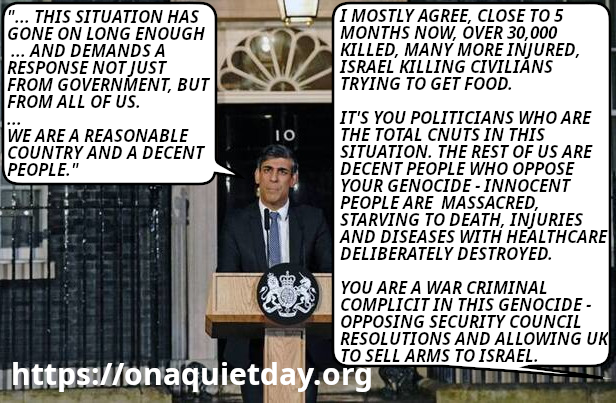
Response to Rishi Sunak’s extremism speech at Downing Street 1 March 2024. Second version of this image with text slightly altered.Zionist Keir Starmes is quoted “I support Zionism without qualification.” He’s asked whether that means that he supports Zionism under all circumstances, whatever Zionists do.
Climate activists Just Stop Oil launched a protest at Stonehenge, the 5,000-year-old stone monument in southern England, a day before thousands of people planned to gather there to celebrate the summer solstice.
Two members of the group sprayed three of the standing stones with an orange powder made from cornflour to draw attention to their campaign and its demands: that the UK government commit to ending the extraction and burning of oil, gas and coal by 2030.
Much like other protests by Just Stop Oil, which have included throwing paint – and sometimes tomato soup – at protected paintings in galleries, the Stonehenge action has been lambasted for threatening that which people hold dear: cultural heritage and national identity.
Politicians, archaeologists and heritage enthusiasts have condemned Just Stop Oil for supposedly endangering the stones. Some have even called for prison sentences – which could happen, as the Unesco World Heritage Site is protected by the Ancient Monuments and Archaeological Areas Act (1979). Lichen species growing on the stones are also protected under the Sites of Special Scientific Interest (SSSI).
The backlash demonstrates how heritage sites such as Stonehenge hold a sacred place for many and generate an almost desperate desire for rigid preservation. But Stonehenge and its landscape are dynamic features that forever shift and change. They have been beset by wars, roadworks and countless solstice gatherings. The stones were touched by thousands of hands before a barrier was installed and still bear the footfall of millions of visitors. They have withstood several interventions by archaeologists, who have hoisted the stones upright and replaced the lintels. In fact, all of the stones painted by Just Stop Oil – 21, 22 and 23 – have been re-erected or consolidated during the 20th century.
This is also not the first time the stones have been vandalised. As well as graffiti carved into some of them, the stones have often been the stage for political protests. The slogan “ban the bomb”, referring to the call for nuclear disarmament, was sprayed across nine stones in 1961. The Stonehenge landscape will survive this protest by Just Stop Oil.
The real threat to Stonehenge
What Stonehenge may not withstand is climate change. The UK is set to experience warmer, wetter winters and hotter, drier summers, as well as an increase in the occurrence and severity of extreme weather which will include high winds and flooding. This will have an impact on the stones and their landscape, exacerbating erosion of the faces of the stones caused by freezing and thawing while much wetter or much drier soil undermines their stability.
There are 70 species of lichen growing on the stones, some of which are rare for the surrounding Salisbury plain. But drier summers brought about by climate change may deteriorate the environment required for these species to thrive.
While Just Stop Oil’s protest at Stonehenge has generated outrage, there is silence over the cumulative and ongoing effects of climate change upon this and other heritage sites. There is little to no public uproar about climate change posing one of the biggest challenges to cultural landscapes, buried archaeology and the built environment. Without immediate and drastic reductions in greenhouse gas emissions, we will witness the loss and change of beloved heritage sites which will in turn affect our economy, way of life and sense of place.
Heritage and climate change have a complex relationship. Climate change affects, and will continue to affect, heritage – but the reverse is also true. Heritage can encourage climate action. My research has demonstrated that greater awareness of heritage loss can raise consciousness of the climate crisis and prompt action.
This is in part due to the emotional attachment people have to local and national heritage sites, and even those in other countries. When climate change and heritage meet during these protests, it is incredibly emotive. The visceral response to the protest at Stonehenge reveals our fear of loss and change, but this can act as a catalyst for climate action too. Just Stop Oil’s protest appears to have highlighted a collective fear of losing revered heritage, yet the conversation about it has overlooked the main instigator.
The orange cornflour has been washed away by the charity English Heritage, which reports no visible damage. But climate change will continue to threaten Stonehenge, its wider landscape and the rare lichen living on the stones. We must channel our concern over potential damage to Stonehenge towards the real threats facing heritage sites.
However, in a ruling on Monday, Mr Justice Holgate largely dismissed their claim, finding most parts of their case were “unarguable”.
SSWHS previously said the approved scheme would “destroy” around seven hectares of the world heritage site, and mark “the first step” towards being de-listed by Unesco.
…
Then-transport secretary Grant Shapps first gave the green light to the project in November 2020, despite advice from Planning Inspectorate officials that it would cause “permanent, irreversible harm” to the area.
Israel Prime Minister Benjamin Netanyahu hugs U.S. President Joe Biden. (Photo: Brendan Smialowski/AFP via Getty Images)
The president’s level of indifference to the human suffering of Palestinians can only be described as soulless.
With the world’s sensibility already reeling from Israel’s deliberate incineration of dozens of civilians huddled in tents in a purported safe zone in Rafah, the genocidaires doubled down two weeks later by slaughtering nearly 300 Palestinians and wounding 700 more during their U.S.-aided rescue of four Israeli hostages.
Upon receiving word of the blood-drenched June 8 operation, American President Joe Biden celebrated the “safe rescue” of the hostages while wholly ignoring the so-called collateral damage—innocent civilians, most of whom were women and children. That level of indifference can only be described as soulless.
So goes the ongoing reveal of the American president’s true nature.
Nothing he’s ever done measures up to his unconscionable decision to sponsor Israel’s genocide in Palestine, while simultaneously running interference to prevent anyone else from stopping it.
Biden has sculpted his political career by leaning into his persona as an indefatigably decent and compassionate man. Until now (save for the MAGA crowd), you’d have been hard-pressed to find someone on either end of the political spectrum who disagreed with that characterization. Which is why his increasingly heartless response to Israel’s genocide in Palestine can be so difficult to process. Yet, a number of the choices he’s made in recent years offered a preview of what lies beneath his public facade.
Biden telegraphed his approach to foreign policy by choosing Israel apologist Antony Blinken to serve as secretary of state and Avril Haines (architect of Barrack Obama’s assassination-themed drone program, and whitewasher of a Senate committee report on the CIA’s torture of detainees) as his director of national intelligence.
In addition to genuflecting to Israeli Prime Minister Benjamin Netanyahu, Biden’s tenure as president includes his embrace of strongmen Abdel Fattah al-Sissi (Egypt), Narendra Modi (India), and Saudi Crown Prince Mohammed bin Salman (a.k.a. MBS). For good measure, he granted the latter legal immunity, sparing bin Salman the indignity of facing any consequences for orchestrating the murder of Saudi journalist, and critic of the crown prince, Jamal Khashoggi.
Closer to home, the man who’s consistently portrayed himself as someone who cares deeply about the well-being of his fellow citizens has solidified his allegiance to the insurance industry by doing everything in his power to prevent Universal Healthcare from becoming a reality in America. Along the way, Biden invited Michael McCabe—the man who advised pollution giant DuPont chemical company on how to circumvent government regulations—to join his Environmental Protection Agency transition team.
But nothing he’s ever done measures up to his unconscionable decision to sponsor Israel’s genocide in Palestine, while simultaneously running interference to prevent anyone else from stopping it. He’s even taken a page out of his political arch-enemy’s playbook by lying through his teeth every chance he gets about what the rest of us can see with our own eyes—repeatedly claiming that Israel isn’t deliberately starving the Palestinian people and that the tens of thousands of civilian casualties, as well as the trauma inflicted upon millions more, are merely a regrettable side effect of Israel’s precision-like effort to nullify Hamas militants.
Donald Trump (whose defining characteristic is his amorality, which is entirely different) can get away with spewing lie after lie without fear of losing the support of his truth-averse loyalists because he’s telling them precisely what they want to hear. Biden, on the other hand, seems to believe his base isn’t bright enough to notice his deceit, or that they just don’t care about his complicity in the ongoing massacre. He’s deluding himself on both counts.
But this condemnation isn’t about numbers. It’s about the most powerful man on the face of the Earth figuratively giving the world the finger while actively participating in a crime that has no equal.
He might as well be piloting Israeli bombers over Palestine, raining fire from the sky.
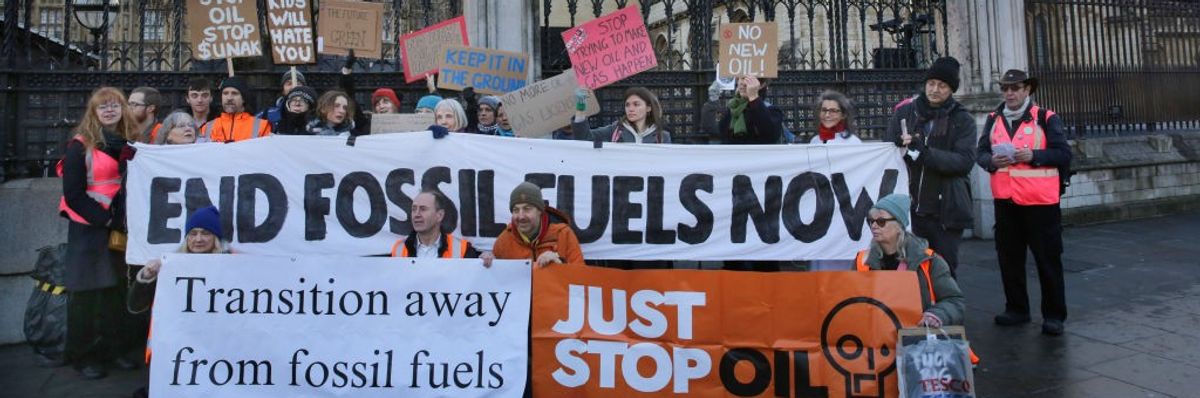
Campaigners gathered outside the Houses of Parliament in London, United Kingdom, in January 2024 to protest the issuance of North Sea oil and gas licenses. (Photo: Martin Pope/SOPA Images/LightRocket via Getty Images)
“There can be no doubt that citizens across the world are saying to their leaders, you have to act and, above all, have to act faster,” a U.N. official said. “This is an issue that almost everyone, everywhere, can agree on.”
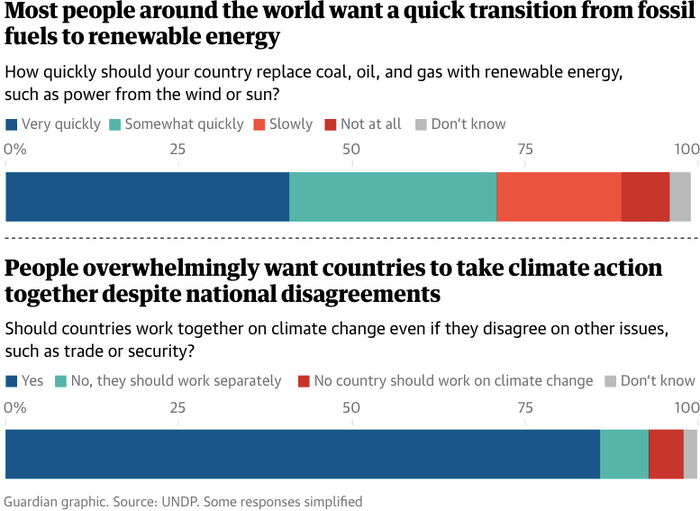
A large majority of the global population, including people who live in oil, gas, and coal producing countries, supports a fast transition to clean energy and a phaseout of fossil fuels, a poll released Thursday showed.
Across 77 countries, 72% of those surveyed supported a quick fossil fuel phaseout, while an even higher percentage, 80%, supported stronger climate action in general, according to the poll, called Peoples’ Climate Vote and conducted for the United Nations Development Program (UNDP) with the University of Oxford and GeoPoll.
“There can be no doubt that citizens across the world are saying to their leaders, you have to act and, above all, have to act faster,” UNDP Administrator Achim Steiner told The Guardian. “This is an issue that almost everyone, everywhere, can agree on.”
People in most major fossil fuel producing nations support a quick energy transition in their own countries, the poll showed. In the United States, the world’s largest oil and gas producer, 53% supported either a “very” or “somewhat” quick phaseout; in Saudi Arabia, the second largest, 75% did so; and in China and India, the leading coal producers, the figures were 80% and 76%, respectively.
The poll also showed overwhelming support for transnational cooperation, even if it requires setting aside other differences: 86% of those surveyed said want countries to tackle climate change together. Steiner called this a “stunning” level of consensus.
Steiner noted that fossil fuel subsidies distort the market and subvert the public will for change.
“There are very narrow, self-interested agendas that maintain artificially inflated [profits] for fossil fuel-based industries that ultimately are coming at the cost of everyone,” he said.
The poll—the largest standalone public opinion survey on climate change to date, building on a first edition that was run in 2021—clarifies the will of the global public and strengthens the moral case for climate action, commentators said.
“Brilliant to see clear, credible evidence that the overwhelming majority of people across the world—oil rentier economy or not—want to see transition from fossil fuels to renewable energy ‘quickly,’” X user Dave Drabble wrote. “Let’s not let oil and gas interests determine our fate.”
Similarly rejecting the influence of fossil fuel interests, Steiner said, “It is so important we let the people speak for themselves.”
Original article by Nicholas Mwangi republished from peoples dispatch under a Creative Commons Attribution-ShareAlike 4.0 (CC BY-SA) license.
Police heavily repressed the protests against the Finance Bill 2024 on Tuesday June 18. Photo: Mathare Justice Center
Hundreds were arrested and brutalized in Nairobi by police forces during protests against the government’s finance bill
On Tuesday June 18, the streets of Kenya’s capital were the site of a major showdown, as peaceful protesters advocating for the rejection of the Finance Bill 2024 were met with brutal repression by state forces. According to human rights groups in Kenya, between 300-400 protesters were arrested as they rallied against the punitive tax measures proposed by the government. The protest organized by a wide variety of civil society organizations and left groups was violently disrupted by police forces attempting to prevent the demonstrators from reaching the parliament building, where organizers had planned to launch a sit-in at 2 pm.
Despite the heavy-handed police attacks with water cannons, and tear gas, the protesters persisted throughout the day, ensuring their voices were heard by those in power and not allowing their right enshrined in article 37 of the constitution – “Assembly, demonstration, picketing and petition” to be compromised. This article outlines that every person has the right, peaceably and unarmed, to assemble, to demonstrate, to picket, and to present petitions to public authorities.”
The tension and public dissent exerted considerable pressure on the government. This was evident as President William Ruto convened an early meeting with members of parliament. The outcome of this meeting saw some “compromises” in the government’s stance on the contentious finance bill. The parliamentary finance committee announced the government’s U-turn at a press briefing on Tuesday, attended by the president and ruling party lawmakers. They announced the decision to withdraw certain proposed taxes, including those on cooking oil, mobile money services, and motor vehicles. The concession was clearly a direct response to the mounting public outcry nationwide.
However, the selective removal of these taxes has done little to appease the masses. Many view it as a strategic move by the government to placate the population while still pushing through other unpopular measures. The finance bill of 2024, in its entirety, remains widely rejected by the masses. The protesters’ message is clear: they demand a complete overhaul of the proposed financial policies, not just a piecemeal reduction of specific taxes.
Ruto’s neoliberal Finance Bill
The Finance Bill 2024, much like its predecessor in 2023, has stirred controversy and discontent across Kenya due to its stringent and, many argue, draconian proposals. This widespread dissatisfaction is deeply rooted within the broader context of an already high cost of living, which will be increased by the proposed new taxes. Beginning last week, Kenyans have voiced their disapproval with the finance bill by taking to social media, where they posted the contacts of Members of Parliament (MPs) and encouraged each other to reach out to their leaders, urging them to reject the bill.
The Finance Bill 2024, officially published by the National Assembly on May 9, 2024, outlines the Government of Kenya’s proposed tax measures for the financial year 2024-2025. Among the numerous changes proposed are significant amendments to Income Tax, Value Added Tax (VAT), and Excise Duty, as well as modifications to the administration of taxes in Kenya. One of the most contentious proposals in the bill is the imposition of a 16% Value Added Tax on financial transactions, and among basic commodities.
Many protested as they believe this will worsen their financial hardships rather than alleviate them. The protests are set to continue, with the third round of Parliament scheduled for June 20th.
The government’s justification for raising taxes, claiming it is necessary for Kenya to live within its means, is hypocritical given its extensive and often unnecessary expenditures. For instance, the government has increased its borrowing target for the fiscal year starting in July to Sh 597 billion, a substantial sum that raises questions about fiscal responsibility. A closer look at government spending reveals significant outlays that contrast sharply with its message.
According to Business Daily, the latest budget control data show a significant rise in travel perks for foreign and local trips, with an increase of Sh 1.62 billion from the Sh 12.4 billion spent in a similar period the previous year. The Parliamentary Service Commission’s spending has also surged by 18.5% to Sh 1.86 billion, and the bill for Members of Parliament (MPs) has grown by 4% to Sh 4 billion. Such figures highlight a pattern of lavish expenditure that stands in stark contradiction to the government’s narrative of financial prudence.
Further, the bill has received backing from the International Monetary Fund (IMF), despite widespread public outcry against it. This support from the IMF is not surprising as they did the same last year, and many Kenyans feel that the country has been effectively mortgaged to the institution. Historically, the IMF’s involvement has brought about economic policies and austerity measures that are seen as an attack on the working class and the marginalized peasants alike, often leading to increased economic strain for the average citizen.
Organized resistance poses more serious challenge to government
What distinguishes the current wave of protests from previous ones is the nature of their organization. Unlike past protests that were primarily mobilized by opposition party leader Raila Odinga against the government, these demonstrations have been driven by different organizations and particularly on online platforms, which have successfully translated their digital activism into tangible, on-the-ground action. This movement has seen an unexpectedly high level of participation from “Gen Z” and the middle class, groups that have traditionally been less involved in these demonstrations.
As the protests continue, the Kenyan government will continue to face mounting pressure to address the economic concerns of the masses. In the last two months there have been three major protests organized by grassroots movements among them against state demolitions on the informal settlements of the downtrodden coming to terms with the recent flood crisis that killed many and destroyed properties of unknown value. The fight for total liberation continues.
Nicholas Mwangi is a member of the Ukombozi Library in Kenya.
Original article by Nicholas Mwangi republished from peoples dispatch under a Creative Commons Attribution-ShareAlike 4.0 (CC BY-SA) license.