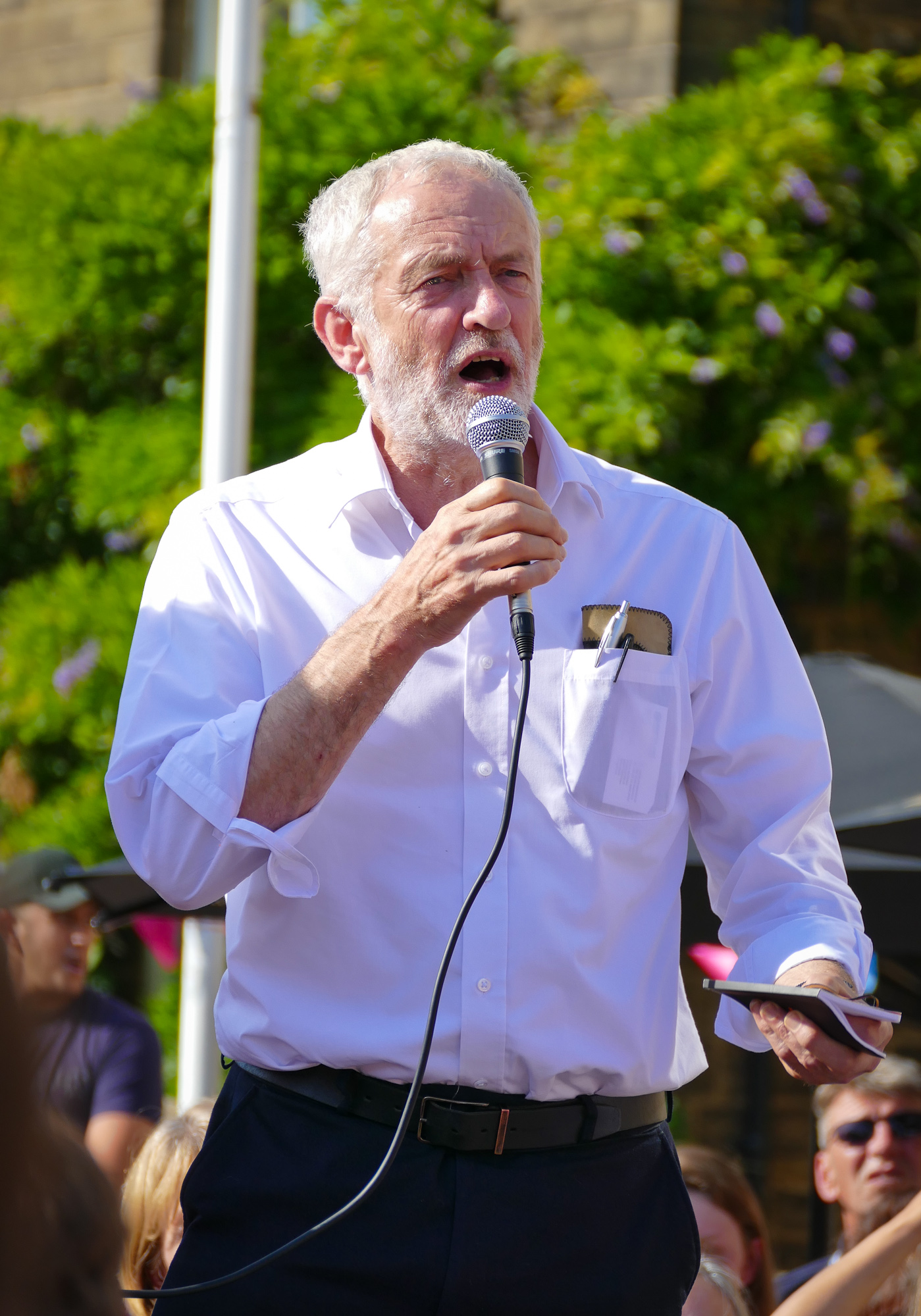
Corbyn plans to host monthly “people’s forums”, which he describes as “a shared, democratic space” for local campaigns, and trade, tenants’ and debtors’ unions.
He believes these forums will form the basis of a new grassroots organising model that can be replicated across the country.
Most MPs hold regular surgeries for constituents to air their grievances or lobby the MP on a particular subject.
The Islington North MP called for people to “stand up for themselves and against those who have ignored their demands for peace and humanity”.
One of the defining features of contemporary electoral politics in Britain is the age divide. Young people are far more likely to support Labour, and older people to support the Conservatives. This divide is still apparent following the 2024 election – but it hides the complexity of how young people in particular choose to vote.
To the extent that there is a “youth vote” in Britain, it is characterised not by support for a single party, but by a particularly fierce rejection of the Conservatives – alongside greater enthusiasm than their elders for left-wing, socially liberal alternatives to Labour.
YouGov surveyed 2,182 adults of all ages between July 5 and 8 for my research team at the University of Exeter. The sample was selected to be representative of the British adult population.
The data from this survey – published here for the first time – gives a snapshot of how people of different ages say they cast their votes. Five per cent of our respondents under 30 didn’t tell us how they voted so we don’t know how their votes might have changed the overall picture. More research in the coming months may give a fuller account.
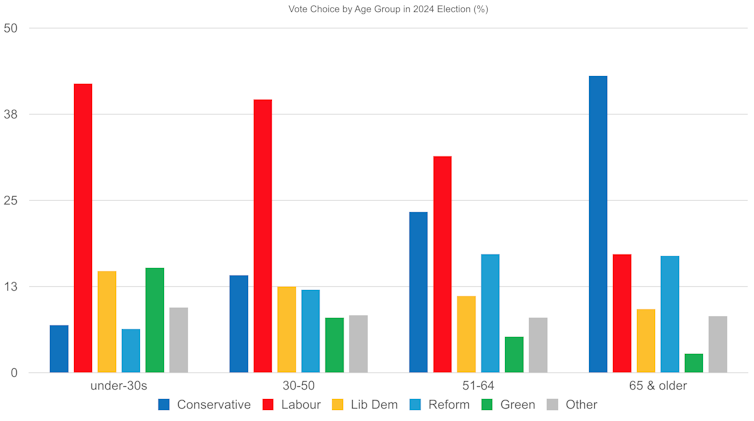
As the graph below shows, it’s only among the over-65s that the Conservatives won more support than Labour (by around 26 percentage points). They trailed Labour by around 8 points among the 51-64 age group, 26 points among 30- to 50-year-olds, and 35 points among the under-30s. Almost incredibly for Britain’s oldest and most successful political party, the Conservatives won barely 7% of the vote of under-30s in the survey.
Parties voted for by age group:
Bar chart showing vote choice by age group. Source: YouGov for University of Exeter, 5-7 July 2024., CC BY-NC-ND
Another key characteristic of the 2024 election is the record-low combined vote share for Labour and the Conservatives, and concurrent record-high vote share for smaller parties. This was not a blip. Voters have been steadily shifting away from the two major parties for years. But in 2024, the extent to which they did so was unprecedented: overall, the combined Labour/Tory vote share was just 57%.
The rejection of the major parties is most profound among young voters. Their support has become fragmented to such an extent that it is not really accurate to speak of a singular “youth vote”. Less than half (49%) of under-30s surveyed voted for Labour or the Conservatives. This compares to 54% of 30- to 50-year-olds, 55% of 51- to 64-year-olds, and 60% of over-65s.
The combined vote share for smaller parties among the under-30s was greater – at 46% – than the 42% who voted for the Labour party. The most successful challengers to the major parties for the youth vote were the Greens and Liberal Democrats, each of whom were backed by 15% of under-30s in the survey.
“Others” – including the Scottish National Party, Plaid Cymru and independents – won a combined 10% of votes from young respondents aged under 30. But the young people surveyed were not simply casting around for any alternative to the major parties. Just 6% of under-30s in the survey said they backed Reform UK (compared with 17% among the over-50s).
Want more politics coverage from academic experts? Every week, we bring you informed analysis of developments in government and fact check the claims being made.
Sign up for our weekly politics newsletter, delivered every Friday throughout the campaign and beyond.
No Reform youthquake
In the closing days of the campaign, there was some suspicion that Reform might achieve a “mini youthquake” in this election or the next. A JLPartners poll found that Reform appealed strongly to soon-to-be-enfranchised 16- and 17-year-old voters, and mock school elections apparently saw Reform winning a great deal of support among schoolchildren across the country.
Our data suggests this did not materialise in 2024. Reform has had some success in appealing to young voters: among under-30s from poorer households, for example, 13% said they supported Reform, compared with 4% for those from wealthier households.
However, similar proportions of under-30s from poorer households also said they voted for the Liberal Democrats (11%) and the Greens (14%). While voters in older age groups who were fed up of Labour and the Conservatives were more likely to switch to Reform and may do so again in future, among the under-30s such voters appeared more likely to switch to the Liberal Democrats, Greens and nationalist parties in Scotland and Wales.
Turnout
Turnout is a crucial issue when considering how young people vote. They have always been less likely to vote than their elders in any particular election. This owes primarily to lower levels of political interest, as well as circumstances associated with early adulthood such as being financially precarious and being less settled in one location. This was true in 2024 as well.
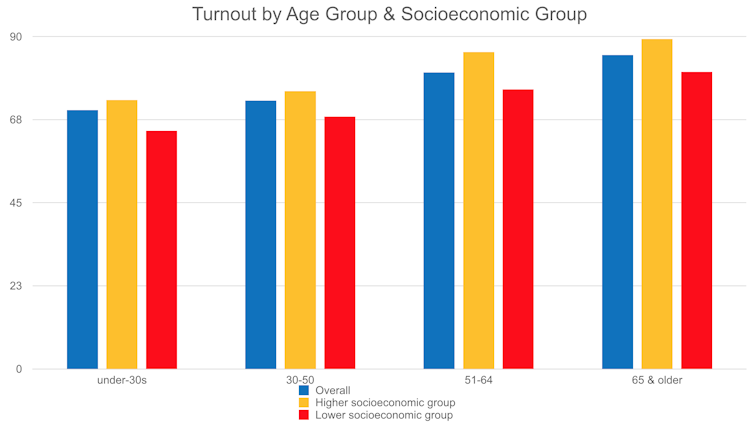
The graph below shows self-reported turnout by age group. The figures are substantially higher than the true turnout numbers, reflecting the long-established tendency of people to exaggerate their voting behaviour in surveys, but they clearly illustrate the age divide: under-30s were the group most likely to say they hadn’t voted.
Turnout by age group:
YouGov for University of Exeter, 5-7 July 2024., CC BY-NC-ND
The graph shows not only was the turnout of under-30s lower than that of older age groups, but that of under-30s from poorer households was particularly low. Young people from poorer backgrounds are less likely to vote than their predecessors were 30 years ago, and so are under-represented in elections to an even greater extent today.
People who vote during early adulthood establish habits that make them likely to vote for the rest of their lives. Those who don’t form such habits by their late 20s are likely to remain serial abstainers.
Younger generations are becoming increasingly unlikely to vote in their first election, leading a greater proportion of them to develop lasting habits of non-voting.
It is this tendency that lies behind one of the major democratic challenges facing the UK: rising levels of disengagement with politics and with voting, as younger people age but continue their youthful pattern of avoiding the ballot box.
People walk past a Heritage Foundation welcome sign for the Republican National Convention (RNC) at the Milwaukee Mitchell International Airport on July 12, 2024 in Milwaukee, Wisconsin. (Photo: Michael M. Santiago/Getty Images)
The Heritage Foundation is “stoking irresponsible inflammatory fear of election fraud,” said one journalist.
One election law expert warned this week that the right-wing Heritage Foundation is already baselessly claiming that President Joe Biden is likely to respond to the voting results as his predecessor, presumptive GOP nominee Donald Trump, did in 2020: by refusing to accept the will of American voters.
“This is gaslighting and it is dangerous in fanning flames that could lead to potential violence,” Rick Hasen, a professor at the University of California, Los Angeles, told HuffPost Friday.
The Heritage Foundation, the think tank that has spearheaded the drafting of Project 2025—a policy agenda threatening mass deportation and immigrant detention, the dismantling of federal agencies, and the consolidation of power with the president should Trump win a second term—said in a report released Thursday that Biden may try to continue his presidency “by force” even if he loses in November.
The claim has no basis in statements made by Biden, who has said he will accept the election results.
In May, White House Press Secretary Karine Jean-Pierre reiterated that Biden “will accept the will of the American people.” Trump has not made the same commitment.
Nevertheless, the Heritage Foundation report went on to say that “the lawlessness of the Biden administration—at the border, in staffing considerations, and in routine defiance of court rulings—makes clear that the current president and his administration not only possesses the means, but perhaps also the intent, to circumvent constitutional limits and disregard the will of the voters should they demand a new president.”
Mike Howell, executive director of the group’s Oversight Project, said at a press conference that “as things stand right now, there is a 0% chance of a free and fair election in the United States of America… I’m formally accusing the Biden administration of creating the conditions that most reasonable policymakers and officials cannot in good conscience certify an election.”
“This is gaslighting and it is dangerous in fanning flames that could lead to potential violence.”
Such comments show, said New York Daily News columnist Mike Lupica, that “these people are the insurrectionists. Or election terrorists.”
Howell’s comments echoed Trump’s baseless warnings ahead of the 2020 election that voting would be “rigged” by widespread use of mail-in ballots amid the coronavirus pandemic. Trump relentlessly attacked voting by mail despite admitting that he had used mail-in ballots to vote in numerous elections.
The Heritage Foundation has conducted “role-playing exercises” that it says show “left-wing efforts to interfere with the election” are possible in 2024, HuffPost reported.
The report said voters should “reflexively disbelieve and challenge the intelligence community’s allegations regarding Trump, foreign interference, and Republican efforts to legally win the White House.”
Hasen told HuffPost that the group appeared to be trying to create doubt among the electorate about institutions that “give voters truthful information they need to evaluate evidence before them.”
Journalist Jane Mayer said the group was “stoking irresponsible inflammatory fear of election fraud.”
Political scientist Don Moynihan of Georgetown University added that the Heritage Foundation’s baseless accusations against Biden likely preview how the Trump campaign could respond to the election results if he loses, four years after the former president urged his supporters to violently attempt to stop the certification of Biden’s victory.
“The end game is to allow men in suits finish what the January 6th rioters started,” he said.
dizzy: A little explanation. The Heritage Foundation has produced a blueprint for Donald Trump should he be re-elected as President. Should that happen, it is expected that the Heritage Foundation would provide a huge amount of staff to Trump’s administration and Project 2025 would be pursued relentlessly. Following attacks by the Biden camp on the Heritage Foundation and Project 2025 Trump has recently disowned them falsely claiming to know nothing about them.
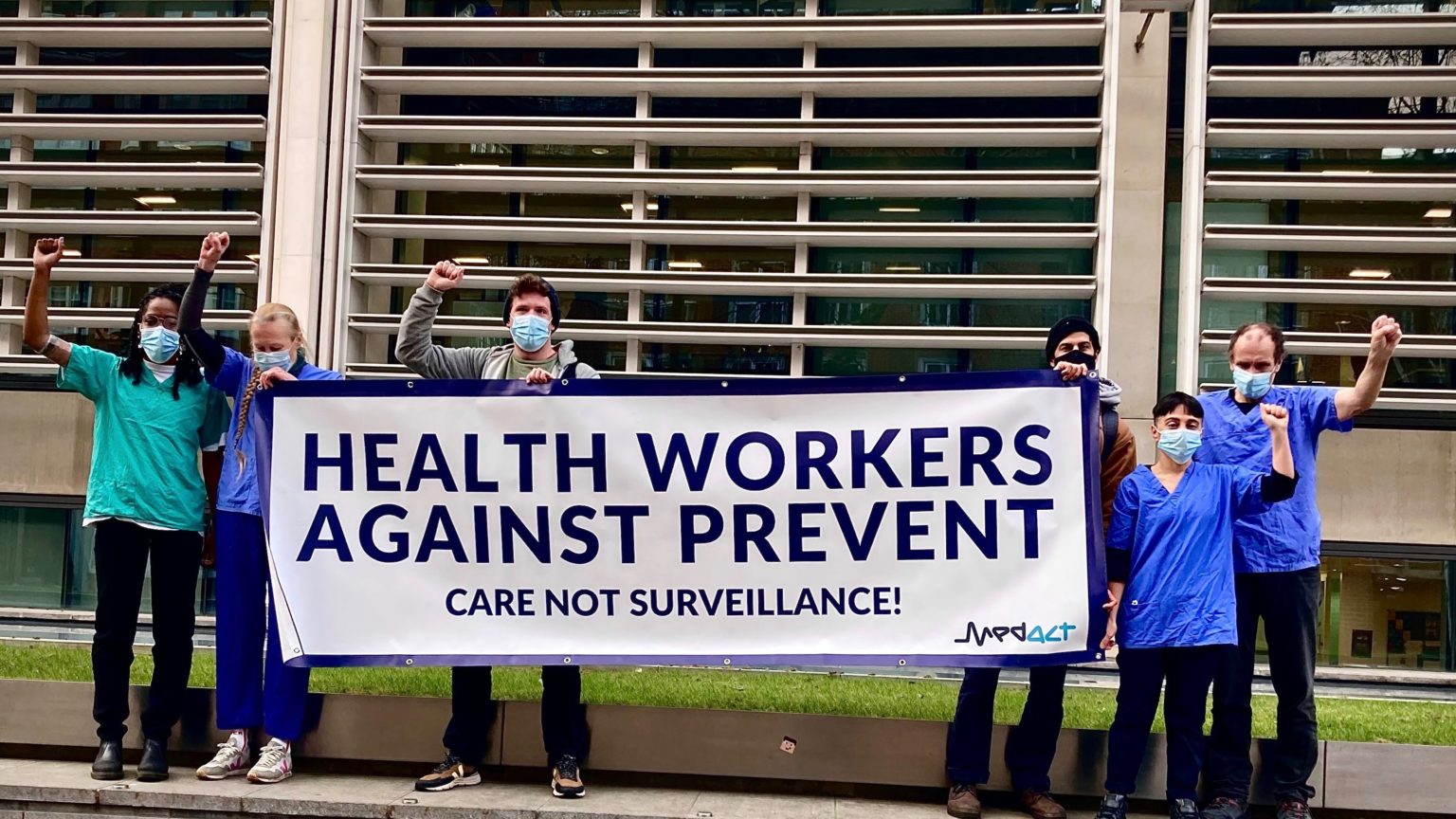
(Action against Prevent by members of Medact’s Securitization of Health group outside the UK Home Office on February 15, 2023. (Photo: Medact/Twitter)
NHS staff pulled into counter-terrorism programs, raising alarms over patient care and professional ethics
Mental health workers in the United Kingdom are being drawn into joint ventures with police and intelligence institutions as part of the national counter-terrorism agenda.
A new report by Medact, an association of health workers advocating for peace and social justice, highlights how the Counter Terrorism Clinical Consultancy Service (CT CCS) integrates National Health Service (NHS) staff with counter-terrorism agents. This service effectively turns health workers into interpreters for the police, who use the information provided to decide on tactics for individuals identified as potential terrorist threats.
In 2024, approximately £17 million was awarded to NHS Trusts to collaborate with security services involved in counter-terrorism. At the report’s launch in London, author Charlotte Heath-Kelly explained that these funds support interdisciplinary teams tasked with analyzing information about selected subjects.
The teams comprise mental health professionals, including nurses, psychiatrists, psychologists, and police officers. Health workers receive basic information on individuals identified as threats, which they then process and explain to their police counterparts. If the decision is made to continue monitoring a person, health workers interpret new information collected and may reach out to the person’s GP practice to encourage them to report on their patients in case they, for example, discontinue therapy or experience a stressful situation.
“This creates an indirect surveillance relationship between health workers and patients and may compromise a patient’s right to discontinue medical treatment since police-led interventions may follow non-compliance,” Heath-Kelly writes.
Unseen patients
CT CCS health professionals contextualize and explain how potential mental health issues could affect an individual’s behavior. This process, referred to as “formulating,” is commonly used in mental health care to better understand a person’s mental health status in the context of their everyday life and offering them support. However, unlike in healthcare settings where formulating is done collaboratively with the patient, CT CCS professionals have no direct contact with the people they are assessing, nor do they have their consent for the process to take place. This puts the teams at odds with professional ethics.
The involvement of health workers means that counter-terrorism teams do not only profile individuals but are guided in using available medical information contextually. Despite these “improvements,” it is likely that those most affected by this new line of intelligence will be racialized. Previous analyses by Medact have shown that Muslims were about 23 times more likely to be referred to a mental health hub for ‘Islamism’ than white British people were for ‘Far Right extremism.’
CT CCS work: legal but controversial
Alarmingly, there is no public accountability or oversight over the implementation of this program. If allowed to continue unchecked, it will persist as a “bubble of trust” between select health professionals and police officers, as described by a high-ranking officer interviewed by Heath-Kelly. This could easily erode the relationship between health workers and their patients and undermine the overall role of the NHS.
The work of CT CCS teams, while controversial, is entirely legal. They operate within regulations such as the GDPR, relying on provisions that allow information sharing when a person is flagged as a risk to themselves or others. However, they apply these rules even at very low levels of perceived risk, including many cases involving young people and children. This potential for misuse in the field of health information and data, which is particularly sensitive, suggests that similar practices could occur in other areas.
There must be a better way to utilize the millions of pounds allocated to the intersection of health and policing services, Heath-Kelly appealed at the launch. Considering the soaring needs in mental health services and the shortage of health workers in the field, the new government might want to divert the budget to address these critical areas instead.
The focus on growth to ease the UK’s economic ills will not be nearly enough, but there is a way to raise the sums needed
Never let your opponents define the terms of a debate. All too often, Labour has allowed the Conservatives and the billionaire press to demonise the notion of “tax and spend”. It went to great lengths before the election to assure voters it had no such intention. Now it drives home the message: instead, our needs will be met by “growth, growth, growth”. But tax and spend is the foundation of a civilised society.
Few of the changes this country requires can be achieved while adhering to the “tough spending rules” the new government has imposed on itself. We urgently need massive public investment in the NHS, social care, schools, environmental protection, social housing, local authorities, water, railways, the justice system and virtually all functions of government. We need a genuine levelling up, across regions and across classes. The austerity inflicted on us by the Conservatives was unnecessary and self-defeating and Labour has no good reason to sustain it.
The new government insists it is ending austerity. It isn’t. As the Institute for Fiscal Studies (IFS) pointed out in June, Labour’s plans mean that public services are “likely to be seriously squeezed, facing real-terms cuts”. Similarly, the Resolution Foundation has warned that, with current spending projections, the government will need to make £19bn of annual cuts by 2028-29. However you dress it up, this is austerity.
We are constantly told: “There’s no money.” But there is plenty of money. It’s just not in the hands of the government. The wealth of billionaires in the UK has risen by 1,000% since 1990. The richest 1% possess more wealth than the poorest 70%. Why do they have so much? Because the state does not; they have not been sufficiently taxed.