‘Shocking’: UNRWA Chief Decries Israel’s Destruction of Agency Headquarters

Spread the love

Original article by JAKE JOHNSON republished from Common Dreams under Creative Commons (CC BY-NC-ND 3.0). 

A United Nations worker surveys destruction caused by an Israeli airstrike on the Nuseirat camp in the central Gaza Strip on July 15, 2024. (Photo: Majdi Fathi/NurPhoto via Getty Images)

“Another episode in the blatant disregard of international humanitarian law,” said the commissioner-general of the United Nations agency for Palestinian refugees.

The head of the United Nations agency for Palestinian refugees expressed horror Monday over Israeli forces’ destruction of the key aid organization’s headquarters in Gaza City, which Israel’s military recently attacked and left in ruins.

“Shocking,” Philippe Lazzarini, commissioner-general of the U.N. Relief and Works Agency for Palestine Refugees in the Near East (UNRWA), wrote in a social media post, which included photos of the bombed-out headquarters complex.

“UNRWA headquarters in Gaza, turned into a battlefield and now flattened,” Lazzarini continued. “Another episode in the blatant disregard of international humanitarian law. United Nations facilities must be protected at all times. They must never be used for military or fighting purposes. Every war has rules. Gaza is no exception.”

Photos of UNRWA’s destroyed headquarters emerged following a deadly weekend of Israeli bombings across the Gaza Strip that were overshadowed in the media by the attempted assassination of former U.S. President Donald Trump on Saturday.

More than 140 people were killed and hundreds more were wounded on Saturday and Sunday, including in Israeli airstrikes on a so-called “safe zone” in southern Gaza.

Tamara Alrifai, UNRWA’s head of external relations, told Al Jazeera on Monday that “the last week has been one of the deadliest weeks in Gaza since the war started.”

“The images coming out of the UNRWA headquarters are really shocking,” said Alrifai. “What I saw today in the footage is unrecognizable.”

UNRWA and its infrastructure in Gaza, including schools, have been major targets of Israel’s far-right government since its latest assault on the Palestinian enclave began in October following a deadly Hamas-led attack. Israeli officials have repeatedly claimed—without providing evidence—that a significant number of UNRWA employees are members of terrorist organizations.

Nearly 200 UNRWA facilities in Gaza, most of which have been serving as shelters for displaced people, have been damaged during Israel’s war on the besieged territory, Alrifai noted Monday. Around 500 people have been killed in Israeli attacks on UNRWA facilities, according to Alrifai.

“It speaks volumes to the blatant disregard for international humanitarian law,” she said.

Israel’s aerial and ground attacks on Gaza continued Monday as much of the territory’s population is facing catastrophic levels of hunger. Since the start of the assault, Israel has dramatically restricted the flow of humanitarian assistance to the Gaza Strip, depriving Palestinians of food, medicine, clean water, and other basic necessities.

Reuters reported that Israel “struck the southern and central Gaza Strip” on Monday and “blew up several homes.”

“Medical officials said they recovered 10 bodies of Palestinians killed by Israeli fire in eastern areas of the city, some of which had already begun to decompose,” the news agency added. “The military also stepped up aerial and tank shelling in central Gaza in the al-Bureij and al-Maghazi historic refugee camps. Health officials said five Palestinians were killed in an Israeli air strike on a house in Maghazi camp.”

Original article by JAKE JOHNSON republished from Common Dreams under Creative Commons (CC BY-NC-ND 3.0). 

Zionist Keir Starmer is quoted "I support Zionism without qualification." He's asked whether that means that he supports Zionism under all circumstances, whatever Zionists do.
Zionist Keir Starmer is quoted “I support Zionism without qualification.” He’s asked whether that means that he supports Zionism under all circumstances, whatever Zionists do.

Continue Reading‘Shocking’: UNRWA Chief Decries Israel’s Destruction of Agency Headquarters

Campaigners Demand Global Ban on Deep-Sea Mining

Spread the love

Original article by JESSICA CORBETT republished from Common Dreams under Creative Commons (CC BY-NC-ND 3.0). 

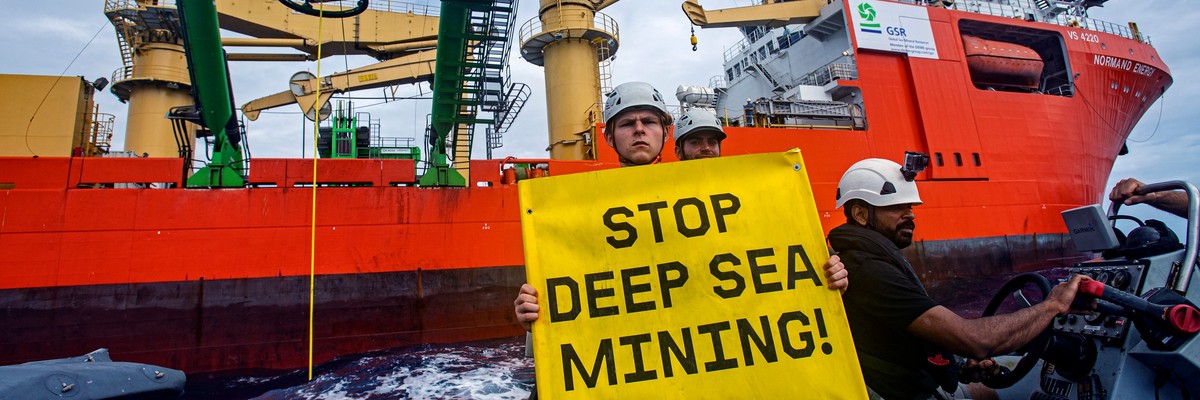
Greenpeace International activists attach a flag reading “Stop Deep Sea Mining” to the cable holding the prototype robot, Patania II, to disturb a deep-sea mining impact test by the company Global Sea Mineral Resources. (Photo: © Marten van Dijl / Greenpeace)

As talks resume, supporters of a moratorium are also calling for the ouster of the International Seabed Authority’s leader, who faces an election on July 29.

As talks to establish global policies on deep-sea mining resumed in Jamaica on Monday, Greenpeace International renewed its demand for a moratorium on the practice, the path also backed other civil society and Indigenous groups, at least hundreds of science and policy experts, and 27 countries.

“The science is clear—there can’t be deep-sea mining without environmental cost and the only solution is a moratorium. The more we know about deep-sea mining, the harder it is to justify it,” said Greenpeace campaigner Louisa Casson, who is attending the United Nations-affiliated International Seabed Authority’s (ISA) 29th session in Kingston.

“Governments at the ISA must not dance to the tune of the industry and approve rushed regulations for the benefit of a few over the interests of Pacific communities and the opinion of scientists,” Casson argued, as companies and countries see chances to cash in on the clean energy transition by extracting metals including cobalt, copper, and nickel.

“The deep ocean sustains crucial processes that make the entire planet habitable, from driving ocean currents that regulate our weather to storing carbon and buffering our planet against the impacts of climate change.”

The Associated Press reported Monday that although the ISA has not allowed any extraction during debates, it “has granted 31 mining exploration contracts,” and “much of the ongoing exploration is centered in the Clarion-Clipperton Fracture Zone, which covers 1.7 million square miles (4.5 million square kilometers) between Hawaii and Mexico.”

The Mexican government last year endorsed a moratorium and Democratic Hawaii Gov. Josh Green last week signed a bill banning seabed mining in state waters, citing “environmental risks and constitutional rights to have a clean and healthy environment.”

Ahead of the meeting in Jamaica, Deep Sea Conservation Coalition campaign lead Sofia Tsenikli highlighted that “gouging minerals from the seafloor poses an existential threat that goes far beyond the immediate destruction of deep-sea wildlife and habitats.”

“The deep ocean sustains crucial processes that make the entire planet habitable, from driving ocean currents that regulate our weather to storing carbon and buffering our planet against the impacts of climate change,” Tsenikli said. “States must now protect the ocean and not allow any more damage.”

The ISA was established under the 1982 U.N. Convention on the Law of the Sea and a related 1994 agreement, and is responsible for waters not under the control of specific nations. As Common Dreams reported earlier this month, some diplomats have accused British lawyer Michael Lodge, its current secretary-general, of trying to speed up the start of mining.

“The rush to complete the mining code was triggered by the Pacific island state of Nauru, which is expected to submit a mining license application on behalf of Canada’s the Metals Company (TMC) later this year, regardless of whether or not regulations are complete,” Reuters noted Monday.

After ISA’s 36-member Council negotiates the “Mining Code” over the next two weeks, its full Assembly is scheduled to meet on July 29 to vote on the next secretary-general, with Lodge facing a challenge from Brazil’s Leticia Carvalho for the top post.

“It is time for change at the ISA,” Casson of Greenpeace declared Monday. “A third term for Michael Lodge would not only put the oceans under threat but also risk further damaging public trust in the regulator. Mining companies are impatient to get started and mounting evidence indicates that Lodge is overstepping his supposedly-neutral role to align with commercial interests.”

“The ISA must listen to millions of people and the growing number of governments calling for a halt to deep-sea mining,” she added. “It is time to put conservation at the heart of the ISA’s work.”

In preparation for the talks in Kingston, Environment Oregon Research & Policy Center, U.S. Public Interest Research Group (PIRG) Education Fund, and Frontier Group last month released a report showing that not only would deep-sea mining destroy “a vibrant, biodiverse place, teeming with complex ecosystems and thousands, possibly millions of species,” but also it isn’t necessary.

“Disposable electronic devices are creating a toxic e-waste mess. Now, some mining companies are trying to convince policymakers that we need to wreak havoc on the ocean to source the materials to make more,” said Charlie Fisher of the Oregon State PIRG Foundation. “This report shows that we don’t need to ruin the deep sea to make the products we need. There is a more sustainable path: Make long-lasting, fixable electronics and recycle them when they no longer work.”

Original article by JESSICA CORBETT republished from Common Dreams under Creative Commons (CC BY-NC-ND 3.0). 

Continue ReadingCampaigners Demand Global Ban on Deep-Sea Mining