Netanyahu Isn’t Interested in Peace, So Why Does Biden Keep Pretending Otherwise?

Spread the love

Original article by JAMES ZOGBY republished from Common Dreams under Creative Commons (CC BY-NC-ND 3.0). 
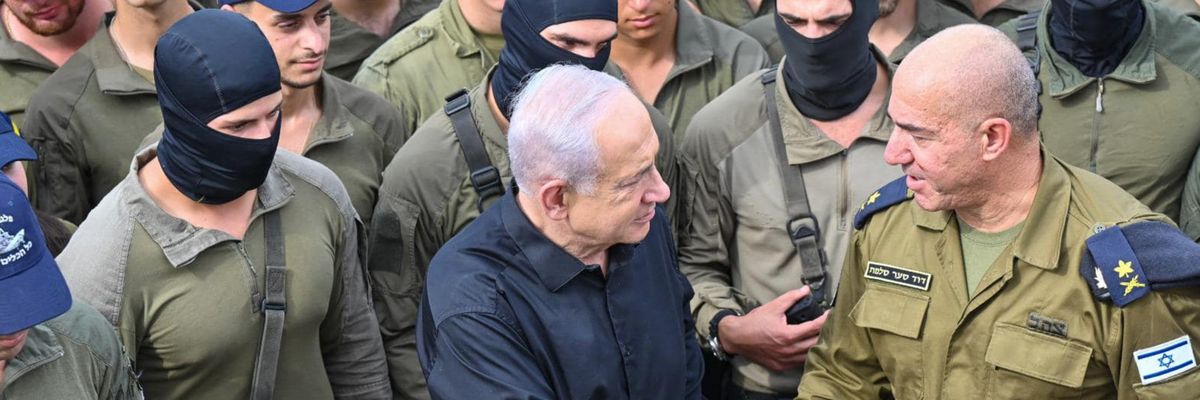
Israeli Prime Minister Benjamin Netanyahu shakes hands with Rear Adm. David Saar Salama at the Ashdod Naval Base on October 29, 2023. (Photo: Office of Benjamin Netanyahu)

Instead of turning a blind eye to Israel’s behaviors that are deliberately designed to provoke more war, the U.S. needs to stop playing games and get serious about holding Israel accountable.

Why—in the midst of critical negotiations to implement U.S. President Joe Biden’s plan to bring about a cease-fire in Gaza, release Israelis held captive by Hamas and a significant number of Palestinians held by Israel, and move toward a negotiated permanent end to the conflict—would Israeli leader Benjamin Netanyahu decide to assassinate the chief Hamas negotiator while he was visiting Iran? And why—while the U.S. says it was working to deescalate tensions with Lebanon’s Hezbollah—would Israel choose to up the ante by assassinating Hezbollah’s number two?

We know the answers to both questions: Benjamin Netanyahu isn’t interested in peace. He doesn’t want a negotiated deal to release hostages and end the war on Gaza. He doesn’t want to deescalate the conflict there or in the north with Hezbollah. And he most certainly doesn’t want a “two-state solution” that would grant the Palestinian people independence in a sovereign state of their own.

There are two things Netanyahu does want, and, at this point, both are perversely connected. Above all, he desperately wants to remain in office, because should he lose his post as prime minister, the prosecution of the corruption charges against him will continue in full force. As the charges are so serious and the evidence so clear, he will likely be convicted and humiliated. This is not speculation—it’s widely discussed in Israel and was even hinted at by President Biden in a May 28 interview with Time Magazine. When he was asked “Is Netanyahu prolonging the war for political reasons?” Biden responded, “There is every reason for people to draw that conclusion.”

Why hasn’t the administration condemned the assassinations in Beirut and Iran when they know that they will surely sabotage the efforts of negotiators?

The second reason is that Netanyahu wants the war to continue and even be accelerated. He made this clear in his remarks before U.S. Congress and in an address to the Israeli public a few days ago. He seeks “total victory,” which he defines as more than the military defeat of Israel’s enemies. Without acknowledging any Israeli culpability, he charged that the Palestinians had created a hate-filled culture which in the post-war period would require massive deradicalization—the outcome of which would have Palestinians accepting Jewish hegemony in Eretz Israel and understanding their place as a conquered and subordinate people.

This is the messianic Zionist vision that has long driven Netanyahu and which he now sees as possible, but only if all of Israel’s enemies—meaning Iran and its surrogates—are brought to heel. And this can only be realized if Israel can involve the U.S. in their regional conquest.

Netanyahu’s worldview raises several additional questions that must be considered. If we know that Netanyahu has never accepted the terms of the Biden plan, why has the president continued to maintain that it was “Israel’s plan” and placed the burden on Hamas to accept it? And if we know that Netanyahu is unwilling to make any peace agreement for fear of losing his other extremist coalition partners (who have threatened to abandon his government should he accept any terms leading to peace), why do we continue to dance around that fact? Why hasn’t the administration condemned the assassinations in Beirut and Iran when they know that they will surely sabotage the efforts of negotiators? Why, when we know that Netanyahu has no intention of completing a deal to release those held captive, do we continue to allow him to exploit the pain of their families, pretending that negotiations are close to completion, when we know they aren’t? And why, when we know that the demands and actions of Netanyahu’s extremist coalition partners are wreaking havoc in the West Bank and Jerusalem—terrorizing the Palestinian population, annexing more land, building more settlements, and erasing the possibility of Palestinian self-determination—have we been so passive and tolerant in response?

Let’s be clear: Hamas and Hezbollah are not good actors. The former was born of the brutal and sustained Israeli occupation of Palestinian land. It was nurtured by Israel to create division in the Palestinian ranks and fueled by Israel’s ruthless decades-long strangulation of the population of Gaza. The latter was born of Israel’s invasion of Lebanon and by that country’s corrupt sectarian system that denied the Shia community adequate representation and resources. It was fueled by Israel’s decades-long occupation of Lebanon’s south and massive devastation of the country’s infrastructure in 2006. To be sure, both have engaged in condemnable actions. But to criticize only them, while absolving Israel of its far greater crimes, is hypocritical at best.

If the U.S. were serious about ending conflict in the region, instead of turning a blind eye to Israel’s behaviors that are deliberately designed to provoke more war, we need to stop playing games and get serious about holding Israel accountable. This leads to one final question: Why, when we continue to massively supply Israel with weapons and block all efforts to sanction their deplorable behaviors, do we expect that anything will change?

Original article by JAMES ZOGBY republished from Common Dreams under Creative Commons (CC BY-NC-ND 3.0). 

Continue ReadingNetanyahu Isn’t Interested in Peace, So Why Does Biden Keep Pretending Otherwise?

‘Beyond Horror’: Israel Kills Mostly Children in Fresh Attacks on Gaza Schools

Spread the love

Original article by JAKE JOHNSON republished from Common Dreams under Creative Commons (CC BY-NC-ND 3.0).

Rescue teams recover the bodies of those killed in an Israeli attack on schools in Gaza City, Gaza on August 4, 2024. (Photo: Mahmoud Issa/Anadolu via Getty Images)

“Remember that each one of those numbers is one person, a child who has been forever changed by what’s happened.”

Israeli forces killed dozens of displaced Palestinians—mostly children—on Sunday with attacks on a pair of United Nations-run schools in the Gaza Strip as diplomats in the region worked to prevent all-out war from breaking out in the aftermath of Israel’s latest assassination spree.

Al Jazeera reported that 80% of the roughly 30 people killed in the Israeli attacks on two schools in Gaza City were children. The strikes came shortly after Israel’s military bombed a hospital complex in central Gaza, killing at least five people.

“This is beyond horror now,” David Shoebridge, an Australian senator, wrote in response to the attacks on schools-turned-shelters.

Tareq Abu Azzoum of Al Jazeera noted that rescue teams were still searching the rubble of the two schools for survivors on Monday.

“At least 16 Palestinians are still missing, including children, under the remnants of these areas that were targeted by Israel without any prior warning,” Azzoum wrote. “Civil defense crews have been using only their bare hands in order to look for survivors. They have been saying that sometimes the process for recovering and pulling out victims can take days simply because there isn’t enough fuel to operate the vast majority of bulldozers, and due to the Israeli attacks on bulldozers at the municipal facilities, used in the initial months of the war to rescue victims.”

https://twitter.com/i/status/1820104591565795824

Israel’s monthslong war on the Gaza Strip has devastated the territory’s children, killing more than 14,000, wounding more than 12,000, and leaving over 20,000 missing. The physical toll has been compounded by what one Gaza mother recently described as the “complete psychological destruction” of the enclave’s youth.

Becky Platt, a British pediatric nurse who recently returned from Gaza after a stint at a field hospital there, wrote Monday that “the psychological distress that I witnessed among children and young people is like nothing I’d ever seen before.”

“It’s very easy to be overwhelmed by the numbers when we watch the news or read about what’s happening in Gaza,” Platt continued. “Remember that each one of those numbers is one person, a child who has been forever changed by what’s happened. Then multiply that one child by thousands. That’s the work that needs to be done.”

Israel’s attacks came after a round of cease-fire talks in Cairo concluded without a deal to end the assault on Gaza. Critics, including some Israeli officials, believe Israeli Prime Minister Benjamin Netanyahu is actively sabotaging cease-fire talks in a bid to remain in power.

Axios reported Sunday that “Israeli officials and families of hostages are concerned Netanyahu, who recently toughened his demands and presented new conditions for a hostage and cease-fire deal, sent the delegation [to Cairo] only to create an appearance of negotiations to relieve some of the pressure from” U.S. President Joe Biden, who has called for a cease-fire while continuing to provide military support for the war on Gaza.

“Hamas rejected Netanyahu’s new conditions, which include forming an international mechanism to prevent weapons transfers from southern Gaza to the north,” according to Axios. “Israeli officials say this and other new demands are making a deal impossible.”

Meanwhile, diplomats are trying to prevent the region from descending into full-scale military conflict following Israel’s assassination of a Hezbollah commander and Hamas’ political leader.

Iran’s supreme leader has reportedly ordered an attack on Israel in retaliation for the killing of Hamas political chief Ismail Haniyeh, and U.S. Secretary of State Antony Blinken told G7 nations on Sunday that Iran’s military response could begin as soon as Monday.

Late last week, the Pentagon announced it would “deploy additional fighter jets and Navy warships to the Middle East” as lawmakers and anti-war campaigners warned of deepening U.S. involvement in the regional war.

“Americans do not want to fight another war in the Middle East,” Jamal Abdi, president of the National Iranian American Council, said last week, “and the path out of the unimaginable death and destruction in Gaza that threatens to engulf the region is through a cease-fire.”

Original article by JAKE JOHNSON republished from Common Dreams under Creative Commons (CC BY-NC-ND 3.0).

Continue Reading‘Beyond Horror’: Israel Kills Mostly Children in Fresh Attacks on Gaza Schools

Sheikh Hasina resigns as prime minister and leaves Bangladesh following mass protests

Spread the love

Original article republished from peoples dispatch under a Creative Commons Attribution-ShareAlike 4.0 (CC BY-SA) license.

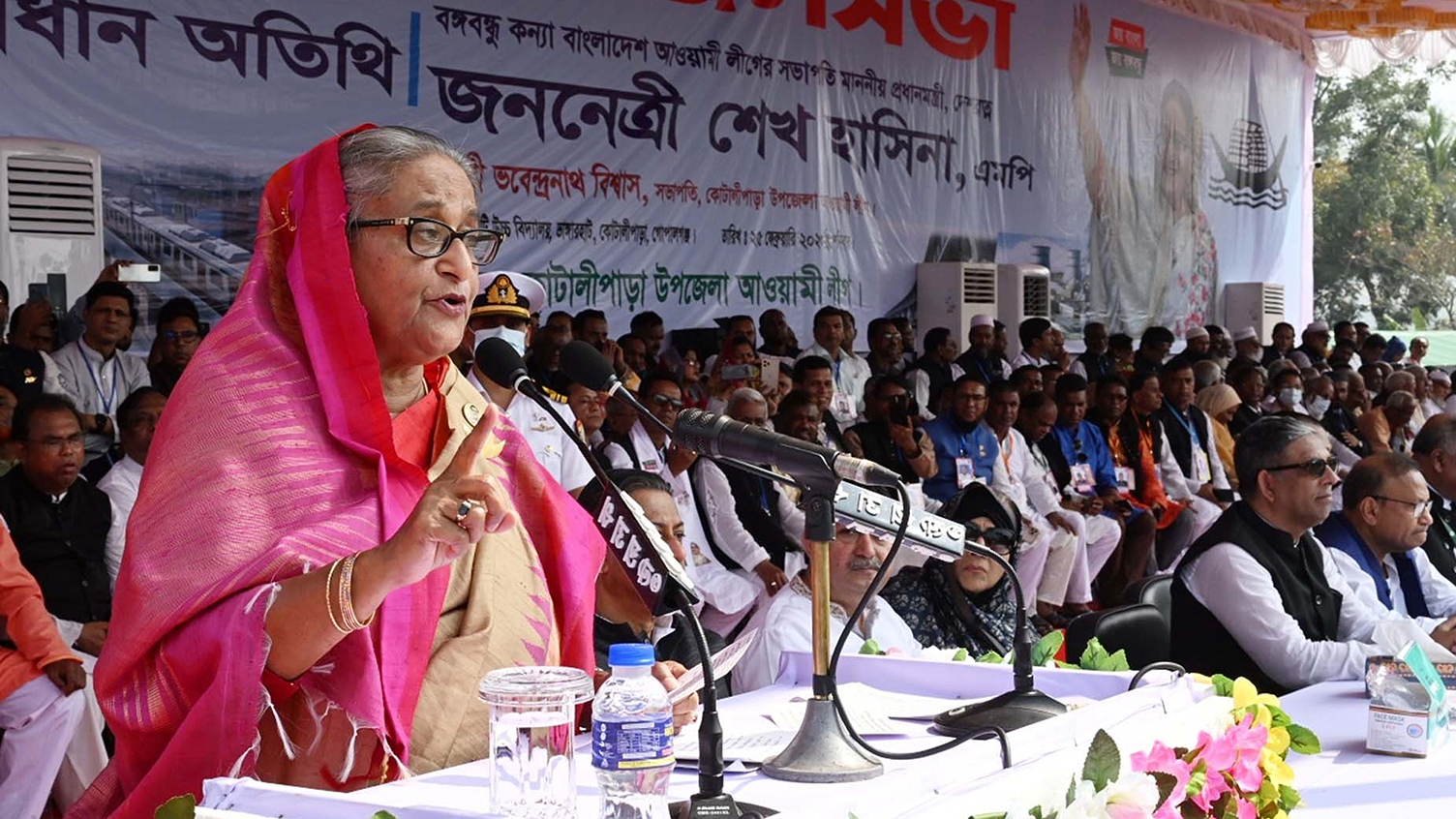
Sheikh Hasina addresses party rally last year (Photo: Delwar Hossain/ Wikimedia Commons)

The protests, initially led by students demanding reforms in the quota system in government jobs, took a violent turn in the last weeks of July

Prime Minister of Bangladesh Sheikh Hasina resigned and left the country, army chief General Waker-Uz-Zaman announced during an address to the nation in the afternoon of Monday, August 5.

The Army chief also claimed to have taken full responsibility over the government, promising that an interim government would be formed soon after consulting all the opposition parties. He also appealed to the protesters to end their demonstrations with a hope that the violence would stop.

Waker-Uz-Zaman promised that he will make sure that all persons responsible for the killing of protesters are held accountable for their acts.

Despite the announcement of Hasina leaving the country, demonstrations continued throughout the day in Bangladesh. There were reports of Hasina’s former official residence being stormed and Dhaka’s international airport being shut down in the afternoon.

Protesters reportedly blocked roads at different places in the country, vandalized the statue of Sheikh Mujibur Rahman, considered the founder of the nation, as well as the offices of Hasina’s Awami League. Attacks were also carried out against the offices of various other parties, and continued into the evening.

Over 300 people, including security personnel, have been killed and thousands of others have been injured in the protests so far.

The protests in the country have been ongoing for over a month now. The first weeks of the protests saw university students demand reforms in the quota system in the recruitment in government jobs, and were largely peaceful. Protests turned violent after they were allegedly attacked by members of the ruling Awami League Party under the cover of security in the third week of July.

Amid the intensification of the protests, the Hasina government called for all universities to be shut down, imposed a curfew and a communication blockade. A shoot on sight order was also issued to the army deployed to control the violence.

Over 200 people were killed and thousands were injured in clashes between the security forces and protesters in the following week of July.

On July 21, the country’s Supreme Court scrapped most of the quota, fulfilling the central demand of the protesters. Yet, the protests continued with growing demands for action against the perpetrators of the violence and against the government itself.

The second round of protests erupted on Sunday, August 3, with thousands gathered in different major cities in the country calling for Hasina to resign. Chittagong, one of the major centers of quota reform protests witnessed the hundred of thousands of people flooding the streets, waving national flags and shouting slogans against Hasina.

Over 100 people, including over a dozen security personnel, have been killed in Sunday’s protests.

Hasina’s government and her Awami League party had alleged that the violent protests were initiated as a part of a conspiracy against the elected government. Hasina had accused the opposition Bangladesh Nationalist Party (BNP) of collaborating with Jamaat-e-Islami, an extremist group, to provoke violence across the country in order to bring regime change in the country as they could not win popular elections.

According to a source on the ground, the violence during the quota reform movement was used by the imperialist powers led by the US to orchestrate regime change in the country. They also claimed that the new regime would be used to undo the secular and progressive reforms initiated by the Hasina government during her four terms. 

In January’s national elections in Bangladesh, Sheikh Hasina had won her fourth straight term as prime minister since 2009. This was her fifth term as prime minister in total. She was first elected as prime minister in 1996. The US had questioned the legitimacy of the last elections in January.

Original article republished from peoples dispatch under a Creative Commons Attribution-ShareAlike 4.0 (CC BY-SA) license.

Continue ReadingSheikh Hasina resigns as prime minister and leaves Bangladesh following mass protests

Challenge racism, stand with the victims of far-right terror

Spread the love

https://morningstaronline.co.uk/article/challenge-racism-stand-victims-far-right-terror

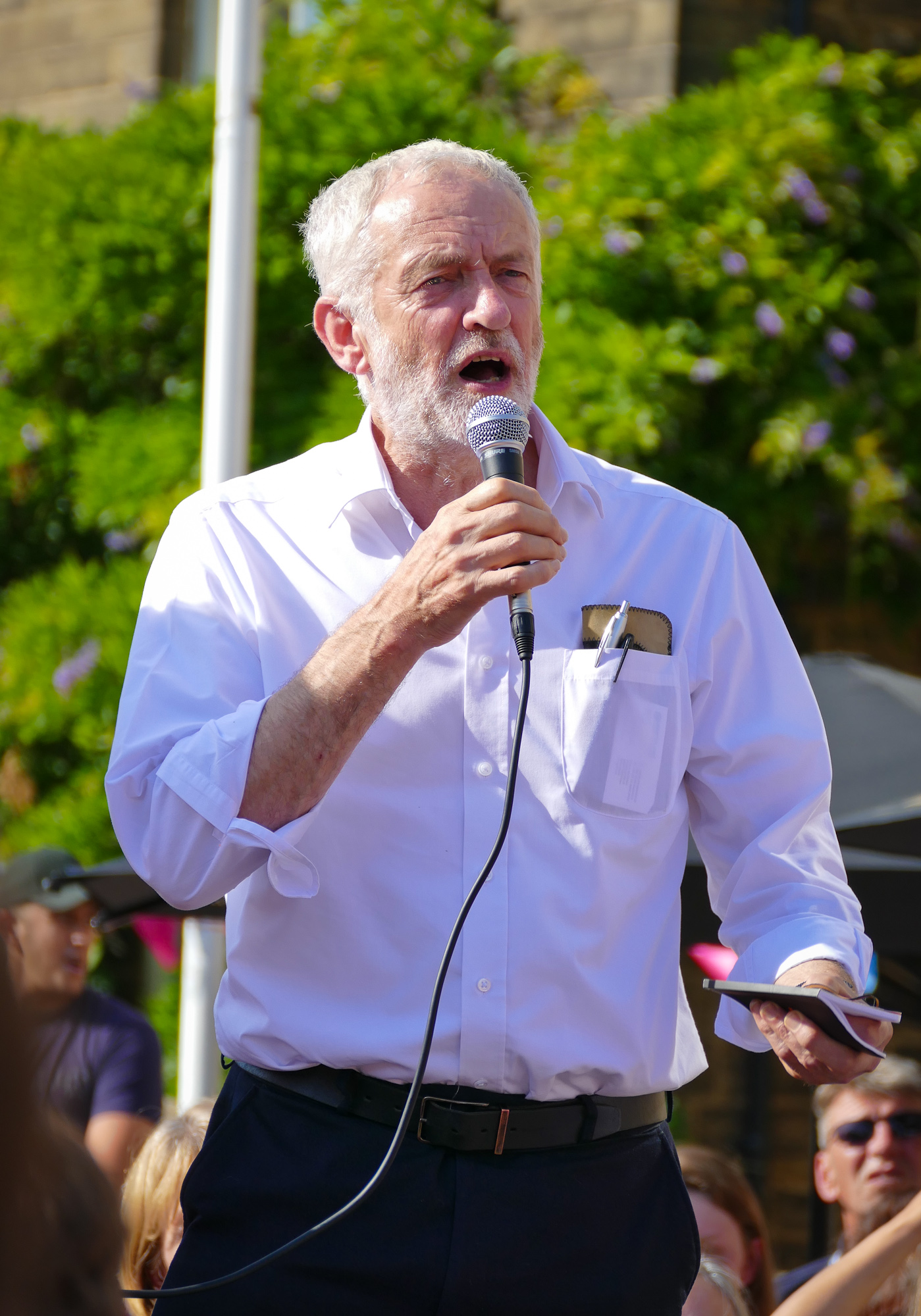
Image of Jeremy Corbyn MP, former leader of the Labour Party
Jeremy Corbyn MP, former leader of the Labour Party

Migrants and refugees are not responsible for Britain’s ills – a message we must make absolutely clear, says JEREMY CORBYN MP

LAST week, a horrendous murder took place in Southport as three children were brutally hacked to death in a violent knife attack. What followed showed both the best and worst of society.

The best was the outpouring of support for the grieving families of the children. The worst was the far-right forces who attacked the mosque in Southport, a hotel housing refugees in Rotherham, and Muslim-run businesses across the country.

These far-right attacks on the Muslim community echo the tactics of the Nazis against Jewish people, shops and businesses in Germany in the 1930s. In both scenarios, the far right use violence against minorities and blame them for poverty, housing shortages and pressures on health and education services.

The emboldening of the racist right has come from the growing use of anti-migrant language by supposedly mainstream politicians, claiming that desperate people crossing the Channel in flimsy boats are an “invading force.”

The same voices seem unable or unwilling to acknowledge that wars cause refugee flows, and that the migrants who have made their homes in Britain work tirelessly to try and make underfunded services work at all.

At the same time, we are witnessing an economic strategy inherited from the Tories which increases the huge wealth gap in our society, perpetuates austerity and ignores the desperate poverty of so many children.

The response of the left must be to stand with the victims of far-right terror, challenge the far-right racism and call for the government to address the common issues facing all communities: the housing crisis, crumbling education and the collapse of our NHS.

Article continues at https://morningstaronline.co.uk/article/challenge-racism-stand-victims-far-right-terror

Continue ReadingChallenge racism, stand with the victims of far-right terror