Israel Launches Massive Attack on Lebanon, Heightening Fears of All-Out War

Spread the love

Original article by JAKE JOHNSON republished from Common Dreams under Creative Commons (CC BY-NC-ND 3.0).

Smoke billows from the site of an Israeli airstrike on Zibqin in southern Lebanon on August 25, 2024. 
(Photo: Kawnat Haju/AFP via Getty Images

“Looks like Israel is now escalating in Lebanon in a major way in the hopes of kicking off a major war in the north that has thus far been kept to more limited exchanges,” warned one analyst.

Israel’s military deployed around 100 fighter jets to launch a massive bombing campaign in southern Lebanon on Sunday, endangering tens of thousands of civilians and heightening the chances of an all-out regional war.

The Israel Defense Forces (IDF) characterized the wave of airstrikes as an effort to preemptively “remove the threat” posed by a purportedly imminent Hezbollah attack, but observers argued the Israeli bombing marked a serious escalation that could further undermine hopes of a cease-fire deal in Gaza.

“Looks like Israel is now escalating in Lebanon in a major way in the hopes of kicking off a major war in the north that has thus far been kept to more limited exchanges,” wrote political analyst Yousef Munayyer. “Just as negotiations for a cease-fire were reportedly advancing.”

Hezbollah said Sunday that it had fired hundreds of drones and rockets at Israeli military sites in retaliation for the assassination of one of the group’s senior commanders last month. Hezbollah said the “first phase” of its response was complete and rejected the IDF’s claim that it preempted the group’s retaliatory action.

The Associated Press reported that “by mid-morning, it appeared that the exchange had ended, with both sides saying they had only aimed at military targets.”

“At least three people were killed in the strikes on Lebanon,” AP noted, “while there were no reports of casualties in Israel.”

Israel Katz, the Israeli foreign minister, wrote on social media following the attack on Lebanon that he “sent a direct message to dozens of foreign ministers worldwide, urging them to support Israel against the Iranian axis of evil and its proxies, led by Hezbollah.”

Sunday’s dangerous back-and-forth, described by one newspaper as the two sides’ biggest exchange of fire since the 2006 war, further intensified concerns that the region is moving toward the precipice of an all-out conflict as Israel’s U.S.-backed assault on the Gaza Strip continues with no end in sight.

A White House spokesperson said Sunday that U.S. President Joe Biden is “closely monitoring events in Israel and Lebanon.”

“At his direction, senior U.S. officials have been communicating continuously with their Israeli counterparts,” the spokesperson said. “We will keep supporting Israel’s right to defend itself, and we will keep working for regional stability.”

One senior U.S. official said Israel did not give the White House advance notice of the Lebanon attack.

Monica Marks, professor of Middle East politics at New York University Abu Dhabi, wrote that the White House’s claim to be promoting regional stability “lands like a bad joke” given ongoing U.S. support for Israel’s “escalatory acts.”

“Lives on the ground are at stake. So are [Democratic presidential nominee Kamala] Harris‘ chances and Biden’s legacy,” Marks added. “D.C. is playing Middle East roulette.”

Israel’s bombardment of Lebanon came after another horrific day in the Gaza Strip, where the IDF killed dozens of Palestinians in southern Gaza. “Among the dead,” according to the AP, “were 11 members of a family, including two children, after an airstrike hit their home in Khan Younis.”

The atrocities preceded a fresh round of high-level cease-fire talks, negotiations that Israeli Prime Minister Benjamin Netanyahu has repeatedly thwarted with hardline demands.

The Washington Post reported Saturday that “Israel and Hamas were sending senior-level delegations to Cairo this weekend as U.S., Qatari, and Egyptian mediators prepared for a high-stakes summit they hope will break the deadlock in negotiations for a cease-fire in the Gaza Strip.”

“Hamas officials arrived in the Egyptian capital Saturday, while Israeli media reported that a team led by the head of Mossad, David Barnea, would travel there Sunday,” the Post added. “The summit, also on Sunday, will include CIA Director William J. Burns, Egyptian intelligence chief Abbas Kamel, and Qatari Prime Minister Mohammed bin Abdulrahman Al Thani.”

Original article by JAKE JOHNSON republished from Common Dreams under Creative Commons (CC BY-NC-ND 3.0).

Continue ReadingIsrael Launches Massive Attack on Lebanon, Heightening Fears of All-Out War

ICC Prosecutor Urges Swift Ruling on Warrants for Israeli, Hamas Leaders

Spread the love

Original article by JESSICA CORBETT republished from Common Dreams under Creative Commons (CC BY-NC-ND 3.0).

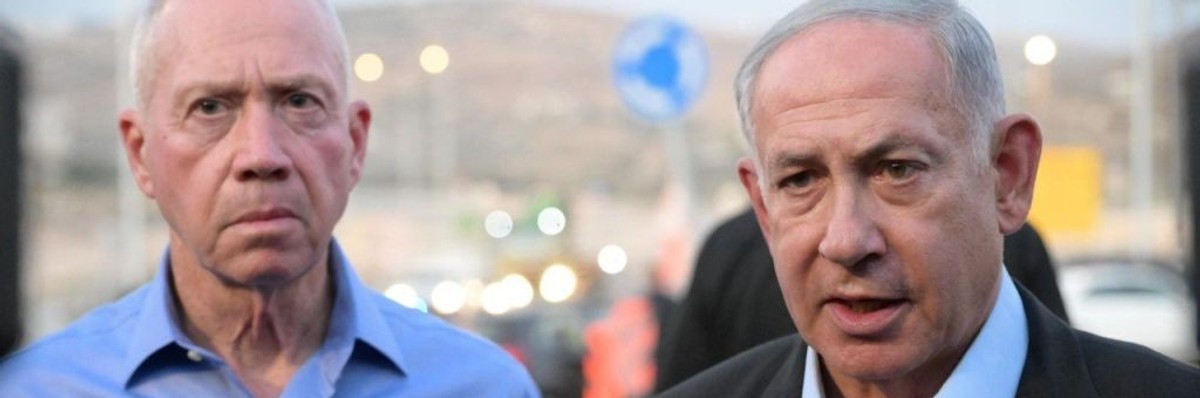
Israeli Prime Minister Benjamin Netanyahu (R) and Israeli Defense Minister Yoav Gallant (L) visit the site of a shooting in Hebron, West Bank on August 21, 2023. (Photo: Amos Ben-Gershom (GPO)/Handout/Anadolu Agency via Getty Images)

“Any unjustified delay in these proceedings detrimentally affects the rights of victims,” the chief prosecutor wrote.

The International Criminal Court’s chief prosecutor argued in a Friday filing that pretrial judges have the jurisdiction to rule on the arrest warrants he is seeking for Israeli and Hamas leaders and must “urgently render its decisions.”

The October 7 attack and Israel’s retaliation in the Gaza Strip led the ICC’s Karim Khan to apply for warrants for Israeli Prime Minister Benjamin Netanyahu and Defense Minister Yoav Gallant as well as three Hamas leaders—Mohammed Diab Ibrahim al-Masri (also known Deif), Ismail Haniyeh, and Yahya Sinwar—in May. Since then, Israel has assassinated Haniyeh and also claimed to have killed Deif, which Hamas denies.

The Associated Pressreported that Khan’s new brief “came in response to legal arguments filed by dozens of countries, academics, victims’ groups, and rights groups either rejecting or supporting the court’s power to issue arrest warrants in its investigation into the war in Gaza and the October 7 attacks by Hamas in Israel.”

The prosecutor wrote that “Israel has occupied Palestine since 1967,” and the International Court of Justice (ICJ) ruled last month that “Israel’s continued presence in the occupied Palestinian territory (OPT),” which includes Gaza, “is unlawful.”

“It is settled law that the court has jurisdiction in this situation,” the prosecutor asserted, citing a February 2021 decision. “Any unjustified delay in these proceedings detrimentally affects the rights of victims.”

“The situation in the OPT, including Gaza, is catastrophic, owing in large part to the ongoing criminality described in the applications,” he added. “The issuance of the requested arrest warrants could avert further harm to the victims who remain in Gaza and to those who were forced to leave but continue to suffer physical and mental harm.”

The Hamas-led October attack on Israel killed over 1,100 people and militants took over 240 others hostage, more than 100 of whom remain in Gaza. Since then, the Israel Defense Forces has slaughtered at least 40,265 Palestinians and injured another 93,144, according to local officials, while leveling civilian infrastructure across the coastal enclave.

The AP noted that “Israel is not a member of the court, so even if the arrest warrants are issued, Netanyahu and Gallant do not face any immediate risk of prosecution. But the threat of arrest could make it difficult for the Israeli leaders to travel abroad.”

U.S. political leaders including President Joe Biden have faced criticism for not only giving Israel billions of dollars in weapons to wage war but also condemning the ICC prosecutor’s pursuit of arrest warrants for Netanyahu and Gallant.

In addition to the potential ICC warrants, Israel faces an ongoing South Africa-led genocide case at the ICJ.

Original article by JESSICA CORBETT republished from Common Dreams under Creative Commons (CC BY-NC-ND 3.0).

Continue ReadingICC Prosecutor Urges Swift Ruling on Warrants for Israeli, Hamas Leaders

eSportswashing: How the Youth Gaming Market Is Being Targeted by Major Climate Polluters 

Spread the love

Original article by Andrew Simms republished from DeSmog.

New research from the Badvertising campaign highlights an alarming trend.

As an insurgent sport among the sweat and strain of more traditional exertions, esports — short for electronic sports and synonymous with gaming — had a chance to chart a new course. Free from the sponsorship links with polluting industries that tarnish many established sports, and with an overwhelmingly young and growing player and fanbase, esports could have created a blueprint for sport in the 21st century and the critical climate issues it faces. 

Unfortunately, esports have fallen into the same trap as football, cricket, and many other popular but easily exploited sports: It has become a playground for some of the world’s biggest polluters to promote themselves and mislead fans. Competitive gaming has made the leap from dimly lit bedrooms to the world stage, but, in the process, has slipped on an oil slick.

New research from the Badvertising campaign highlights the alarming trend of esportswashing. Taking a cue from the old tobacco industry playbook, major polluters are trying to co-opt a new generation and normalise climate polluting products and lifestyles. Since just 2017, at least 33 polluting sponsorship deals have been struck between the global esports industry and high-carbon polluters. Of these, 27 have been deals with car manufacturers, five with major fossil fuel companies, and two with the armed forces of the United States — the planet’s thirstiest consumer of oil.  

Petrostates too, such as Saudi Arabia and Qatar, have sensed the opportunity and spent hugely into the esports sector, sponsoring teams of young gamers and even hosting tournaments in energy-hungry, air-conditioned arenas. In fact, the inaugural Esports World Cup is culminating in Riyadh, Saudi Arabia, where over 1,500 professional gamers have competed across 21 games, with over a million fans following online. 

Despite its relative novelty, esports presents a huge opportunity for polluting companies feeling the heat on climate. It is a booming industry. There are already an estimated 500 million esports fans around the world. While this is just a fraction of the three billion active gamers, there is serious room for expansion — and polluters can see the opportunity to groom the next generation. 

Shrewd Move

Alongside the massive growth of the industry is the esports loyal fanbase. It’s international, overwhelmingly young, and male. In the UK, over 50 percent of esports fans are aged between 18 and 34, and overwhelmingly male. Globally, in 2021, more than six in every 10 internet users watching esports were aged between 16 and 35 years old. To put this youthfulness in perspective, only one-in-four ‘die hard’ football fans globally are between 25 and 34 years old.

Built around this fanbase is a vibrant digital culture and community, buoyed by the proliferation of streaming platforms and threaded together through memes which are indecipherable to outsiders. Like with all great sports, it is the community that brings esports to life and makes it such a spectacle. Tapping into this community, and leveraging its global digital networks, is a shrewd move for companies clinging to a dwindling social license of public acceptance. 

High-carbon industries targeting younger audiences is not new and comes in many forms, but esports presents an opportunity to communicate with hundreds of millions of young and loyal fans. It is an added irony that these young audiences will be the worst hit by climate breakdown — a crisis that the latest sponsor of their beloved esports is disproportionately responsible for.   

Once again, regulators are asleep at the controls. The rise of esportswashing and its potential impact on younger minds requires bolder and better advertising regulation and coordination with the game franchises. But action to date has been limited. 

The immersive nature of esports presents an added challenge for regulators and the limited scope they currently exercise to protect young people from exploitative influences. In-game advertising blurs the divide between what is advertising and what is the game. Take Shell’s foray into Fortnite in 2023, where players were encouraged to fill up their digital cars at a digital petrol station to promote its V-Power Nitro+ fuel. Here, the advertisement was part of the game. It is only a matter of time before other polluting companies take Shell’s lead.

With esports fans and athletes facing a precarious future in a warmer world, those responsible for this burgeoning sport and the community built around it must take the threat posed by polluting sponsorship seriously. To protect athletes, gamers and fans around the world, esports teams and governing bodies need to align their commercial partnerships with their values, duty of care to players and audiences, and policies for a liveable future and thriving environment. And when top gamers and streamers speak out about their fears of climate breakdown, they should be supported and nurtured. 

Esports are on the cusp of repeating the mistake of other traditional sports in letting themselves be used as a billboard to promote polluters, but it is not too late to clean up. Those polluters that are gaming the climate should not be given free reign to game young minds too; or it could soon be game over for everyone.


Andrew Simms
 is co-director of the New Weather Institute, co-founder of the Badvertising campaign, the  Rapid Transition Alliance and assistant director of Scientists for Global Responsibility. Follow on X @AndrewSimms_uk or Mastodon. @andrewsimms@indieweb.social.

Original article by Andrew Simms republished from DeSmog.

Continue ReadingeSportswashing: How the Youth Gaming Market Is Being Targeted by Major Climate Polluters 

Torygraph catches up to Reeves’s lack of due care – almost a year after Skwawkbox

Spread the love

Original article republished from the Skwawkbox.

Labour’s disdain for conducting impact assessments on the effects of its cuts and austerity reaches the ‘MSM’ – 11 months after Skwawkbox exclusively revealed it

The Telegraph has today reported that right-wing Labour Chancellor Rachel Reeves carried out ‘no impact assessment’ before ‘withdrawing winter fuel payments for 10 million pensioners, the Telegraph can reveal’.

The right-wing rag is a little late to the party. Skwawkbox revealed exclusively eleven months ago that Labour undertook no impact for any of its plans on vulnerable people, whether pensioners, the disabled, the poor, the ill or children.

Tragically, the revelation was correct and Labour has begun to implement its red-Tory austerity – supposedly to fix the blue-Tory austerity that wrecked the country – as soon as it was ushered into power by the fascist Reform ‘party’ despite receiving far fewer votes than in 2017 and even the supposed ‘disaster’ of 2019 under Corbyn.

And the party is even trying to cover up how many people the blue-Tory policies killed, presumably so its hands are freer to impose fresh misery and death without scrutiny – as if the UK’s ‘mainstream’ media does much scrutiny in the first place.

Original article republished from the Skwawkbox.

Continue ReadingTorygraph catches up to Reeves’s lack of due care – almost a year after Skwawkbox

Labour conference set to host weapons manufacturers and spy-tech firm

Spread the love

Original article by Ruby Lott-Lavigna republished from Open Democracy under a Creative Commons Attribution-NonCommercial 4.0 International licence

Boeing, Palantir and Babcock listed as sponsors for fringe events run by New Statesman Media Group

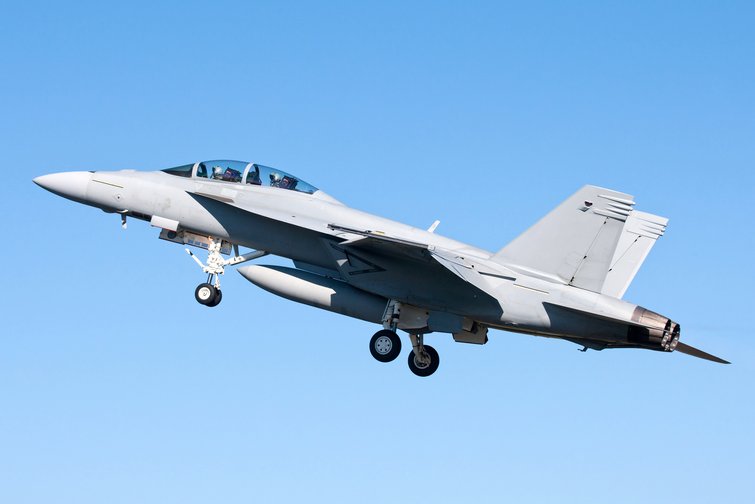
Boeing FA-18F Super Hornet Fighter Aircraft  | Getty Images / Boeing.

Weapons manufacturers, fossil fuel companies and a spy-tech firm are among those sponsoring events at this year’s Labour Party conference.

Boeing and Babcock, manufacturers of missiles or missile compartments, and Palantir, a controversial spy-tech firm funded by the CIA, will sponsor fringe events hosted by centre-left media company the New Statesman Media Group.

Fossil fuel companies, private health firms, major banks and the International Airlines Group, which owns British Airways, are also among those paying to have a presence at the party’s annual conference in Liverpool, which will host politicians and policy makers – and is Labour’s third in person since Keir Starmer took over as leader.

The party has been slammed for playing host to these industries by environmental groups and anti-weapon groups, who call the sponsorships “disgusting and disappointing.” Its own MP Clive Lewis has also questioned why Labour is “cosying up” to some of the organisations involved.

The events, announced today, boast “Labour Party’s biggest names and most exciting talents,” and cover subjects such as the move to net zero, the housing crisis and healthcare. Speakers include shadow health secretary Wes Streeting, as well as Labour’s chair of the levelling up committee Clive Betts and deputy London mayor Tom Copley.

UK-based Babcock, which has arms deals with the government and has recently signed a deal with Israel Aerospace Industries (IAI), will sponsor a talk entitled “Sovereign capability: How can we make, buy and sell British?”. Speaking on the panel will be Babcock’s chief corporate affairs officer, John Howie, alongside Labour’s shadow minister for defence procurement Chris Evans and the party’s shadow international trade minister Nia Griffith.

Spy-tech firm Palantir, whose owner has donated to Donald Trump’s political campaign, will sponsor a talk on Ukraine called “How can we hold aggressors accountable for war crimes and deter future conflict?” Its executive vice president for the UK and Europe will appear on the panel.

Palantir, which has built software to support drone strikes and immigration raids, is tipped to win a £480m deal this year to build a single database that will eventually hold all the data in the NHS.

Energy company SSE, which has been accused of misleading the public over “green investments,” is sponsoring a “Delivering net zero” talk. Its own managing director of corporate affairs, regulation and strategy, will speak on the panel.

Cadent Gas will sponsor an event entitled “How can the energy sector support customers on the journey to net zero?”. Its chief strategy and regulation officer will speak on the panel.

Other events at next month’s conference will be sponsored by companies such as Offshore Energies UK (formerly known as Oil and Gas UK), National Gas, Ovo Energy and housing developer Taylor Wimpey.

Clive Lewis MP told openDemocracy that “people want change under a Labour government” and hosting some of these firms signals that “the same palms are going to be greased”.

“I do not think that organisations like Palantir and others are necessarily the kind of organisations that Labour in the year before a general election should be cosying up to,” said Lewis. “I think they should be saying: ‘Look, we’ll deal with you but frankly, some of you are part of the problem’.

“I think it’s entirely possible to be on the side of entrepreneurs…without necessarily having to get into bed with big oil companies, big corporations or the likes of Palantir – and the Labour Party should be really clear about that.”

He added: “I think there are questions there for the New Statesman and why they’re accepting sponsorship and funding from some of these ethically and morally questionable corporations.”

Campaigners against the arms industry have condemned the decision to allow weapons manufacturers to have a presence at the conference.

“It is disgusting and disappointing to hear that arms companies will be sponsoring talks at the Labour Party conference,” Emily Apple, media coordinator at Campaign Against Arms Trade (CAAT), told openDemocracy. “These companies should not be given this legitimacy or the opportunity to lobby policy makers in order to continue making profits for their shareholders from a deadly trade that causes destruction and misery around the world.”

She added: “Accepting sponsorship from these companies sends a bleak message to anyone thinking a future Labour government will adopt any kind of ethical stance towards the arms trade.”

Environmental groups have also spoken out, warning Labour against forming relationships with oil and gas companies.

“The fossil fuel lobby is no stranger to cosying up with policymakers – they’ve had a lot of success and made a lot of cash from doing so in the past,” Greenpeace UK’s policy director, Doug Parr, told openDemocracy. “But Labour must not make the same costly mistakes as the Conservatives by giving these self-serving climate-wreckers the opportunity to launder their political reputation.

“The next government must have bold policies and a strong commitment to tackling the climate crisis, not another one that ends up in the back pocket of polluters and dodgy operators.”

It’s not the first time the New Statesman Media Group has faced criticism for its choice of sponsors at its Labour Party events. Last year, protesters disrupted a talk sponsored by energy company Drax, which has been accused of polluting majority Black areas in the US.

The New Statesman’s events arm advertises a partnership with the media company as an opportunity to “showcase your brand, generate leads, nurture relationships,” with “policy makers and politicians.”

It also hosts private round table events that are not publicly advertised, which openDemocracy understands can cost a sponsor over £15,000.

openDemocracy has approached the Labour Party and New Statesman Media Group for comment.


Update, 24 August 2023: This article has been amended to reflect that Babcock does not make missiles but missile components and launch systems.

Original article by Ruby Lott-Lavigna republished from Open Democracy under a Creative Commons Attribution-NonCommercial 4.0 International licence

Continue ReadingLabour conference set to host weapons manufacturers and spy-tech firm