Delegates defy Starmer by voting to reject the callous cut to pensioners’ winter fuel allowance after Unite chief’s barn-storming speech
LABOUR conference defied Sir Keir Starmer today and voted to reject the callous cut to pensioners’ winter fuel allowance.
Delegates backed a motion from Unite the union demanding that the government “reverse the introduction of means-testing for the winter fuel allowance.”
It also urged Labour to scrap the “fiscal rules which prevent borrowing to invest” and introduce a wealth tax on the top 1 per cent and an excess profits tax.
In a barn-storming speech, Unite general secretary Sharon Graham recalled how the 1945 Labour government had rebuilt the country despite debt ratios three times the level of today.
She said: “People simply do not understand, I do not understand, how our new Labour government can cut the winter fuel allowance for pensioners and leave the super-rich untouched.
“This is not what people voted for. It is the wrong decision and needs to be reversed.
“We are the sixth-richest economy in the world. We have the money. Britain needs investment, not austerity mark two. We won’t get any gold badge for shaving peanuts off our debt.
“These fiscal rules are self-imposed and the decision to keep them is like hanging a noose around our necks.
A diver checks the coral reefs of the Society Islands in French Polynesia in 2019. (Photo: Alexis Rosenfeld/Getty Images).
“Our updated diagnosis shows that vital organs of the Earth system are weakening, leading to… rising risks of crossing tipping points.”
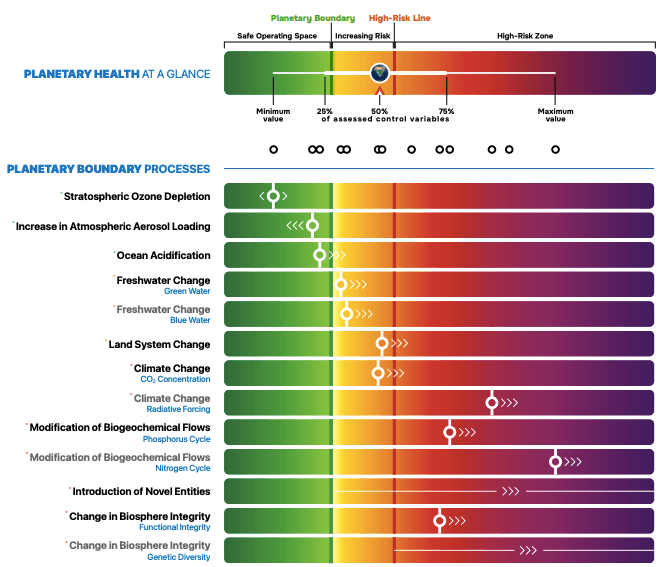
Six of nine planetary boundaries have already been transgressed, and a seventh, for ocean acidification, is on the verge of being breached, according to a major report released Monday.
The 96-page report, produced by the Potsdam Institute for Climate Impact Research (PIK), is the first in a planned series of annual “planetary health checks.”
The authors found that safe planetary boundaries had already been crossed for the climate, freshwater, land use, biogeochemical flows, novel entities, and biosphere integrity—in keeping with a study in Science Advances last year. They found a “clear trend towards further transgression”—moving deeper into the danger zone, where irreversible tipping points are more likely to be triggered—in each of the six categories.
“Our updated diagnosis shows that vital organs of the Earth system are weakening, leading to a loss of resilience and rising risks of crossing tipping points,” Levke Caesar, a PIK climate physicist lead author of the report, said in a statement that announced a “red alert.”
The health check also showed that ocean acidification, a seventh category, has reached a dangerous precipice, putting the foundations of the marine food web at risk. Ocean acidification, which can threaten coral reefs and phytoplankton populations, is caused by the buildup of carbon dioxide from burning fossil fuels and other human activities.
Caesar said a “safe operating space” threshold for acidification could be crossed in the next few years.
“Looking at the current evolution, I’d say it’s really, really difficult to prevent that [boundary] crossing,” she toldMongabay.
A graphic shows the status of nine environmental categories, four of which have been broken down into two control variables. Image from Planetary Health Check 2024. Design by Globaïa.
PIK director Johan Rockström, a co-author of the new report, helped develop planetary boundary research in the late 2000s. In a seminal 2009 paper in Nature, he and his co-authors found that three of the nine boundaries had already been crossed. That number has gradually gone up based on a series of studies over the last decade.
The planet boundary framework, which is often connected to the degrowth movement, emphasizes that the categories are interconnected.
“The interconnectedness of [planetary boundary] processes means that addressing one issue, such as limiting global warming to 1.5°C, requires tackling all of them collectively,” the new report says.
Boris Sakschewski, a climate scientist who, along with Caesar, is a lead author of the report said that, “We know that all planetary boundary processes act together and each one needs protection to protect the whole system.”
The consequences of continued ocean acidification, which is primarily measured by aragonite saturation, would be severe, the report warns.
Ocean acidification is approaching a critical threshold, with significant declines in surface aragonite saturation, particularly in high-latitude regions like the Arctic and Southern Ocean. These areas are vital for the marine carbon pump and global nutrient cycles, which support marine productivity, biodiversity, and global fisheries. The growing acidification poses an increasing threat to marine ecosystems, especially those reliant on calcium carbonate for shell formation.
Some researchers believe that the ocean acidification threshold has already been crossed, especially given regional variability, with cooler polar waters absorbing more carbon dioxide, causing a faster drop in pH levels.
The report was written with a general audience in mind and is not peer-reviewed, though it’s based on peer-reviewed studies, the authors said.
The final pages of the report present solutions, especially agricultural. A radical overhaul of the global food system, heavily dependent on fertilizer and other harmful inputs, will be necessary to reverse the disturbing trends documented in the report, the authors wrote.
“Sometimes overlooked compared to the impacts of energy production and consumption—particularly the use of fossil fuels—the food systems we depend on are among the largest drivers of environmental degradation. The global food system is the single largest driver behind the transgression of multiple planetary boundaries,” the report says.
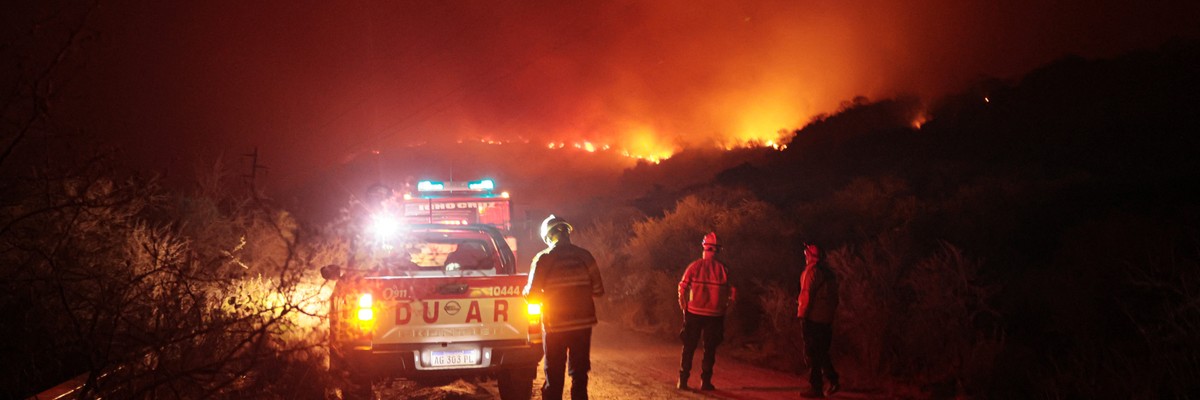
Wildfires are seen in San Marcos Sierra, Cordoba province, Argentina, on September 23, 2024. (Photo: Stringer/AFP via Getty Images)
“The real question isn’t whether we can afford to act, but whether we can afford not to.”
Research published Tuesday estimates that rich countries could mobilize over $5 trillion a year for climate action worldwide by cutting off subsidies to the oil and gas industry, imposing a levy on big polluters, and cracking down on tax evasion by large corporations and the rich.
The new report from Oil Change International (OCI) was released as world leaders gathered in New York City for high-level United Nations General Assembly talks, a meeting that comes less than two months before the COP29 climate summit in Azerbaijan.
OCI’s research, which includes a fact sheet outlining various proposals to raise funds for climate action, stresses that “there is no shortage of public money available for rich countries to pay their fair share on fair terms for climate action at home and abroad.”
“The urgency and extent of growing economic inequality, unfair sovereign debt crises, climate disasters, and fossil fuel profits have created significant momentum towards many of these measures in international and domestic policy spheres,” OCI’s research brief notes. “Finance has been in the spotlight in most major international political fora in the past few years in recognition that our current financial architecture is a major driver of these overlapping crises.”
Among the proposals laid out in OCI’s brief are an equitable end to “public finance, direct subsidies, and state-owned company investments in fossil fuels,” which could raise $846 billion a year globally; a “climate damages tax” on fossil fuel extraction, which could raise $618 billion a year; a 25% minimum corporate tax rate, which could raise $479 billion annually; and a wealth tax on billionaires, which could raise roughly $2.60 trillion a year in the Global North and over $5.6 trillion worldwide.
Laurie van der Burg, OCI’s public finance lead, said that the rich nations most responsible for the climate emergency “owe this money to Global South countries that have not caused this crisis and need fair finance to deliver strong climate plans next year that phase out fossil fuels.”
“This is essential to avoid climate breakdown and save lives,” she added.
The clock is ticking ⏰ Rich nations must deliver a roadmap for at least $1 TRILLION/year by 2025. No more empty promises. It's time to pay up for a just transition! 💚 Read the full report: https://t.co/eKwm0zXitspic.twitter.com/4qjTO5JQ8c
The COP29 climate summit will take place a year after nations agreed at COP28 to transition “away from fossil fuels in energy systems” in a “just, orderly, and equitable manner.”
The success of that pledge, OCI said, depends on rich nations contributing massively to global climate finance after years of falling short of their pledges and continuing to expand fossil fuel extraction and handouts. Worldwide, environmentally harmful subsidies—including fossil fuel subsidies—have surged to $2.6 trillion a year, according to a report released last week.
“Global North countries have a responsibility to redirect their share of these subsidies in support of climate action,” OCI said Tuesday.
The new report comes on the heels of a record-hot summer and amid devastating extreme weather, from massive flooding across Europe and Africa to wildfires in South America.
Andreas Sieber, associate director of policy and campaigns at 350.org, said Tuesday that “the real question isn’t whether we can afford to act, but whether we can afford not to.”
“It is a bitter irony that rich nations hide behind claims of fiscal restraint, yet trillions are still spent on fossil fuel subsidies and militarization,” said Sieber. “The truth is simple: the money exists, but the political will does not. By treating climate finance as a zero-sum game, wealthy countries not only deepen global inequality but also undermine their own futures.”
“The energy transition isn’t charity—it’s an investment in global stability and security,” Sieber added. “Ignoring the need for support only worsens the climate crisis, which knows no borders.”
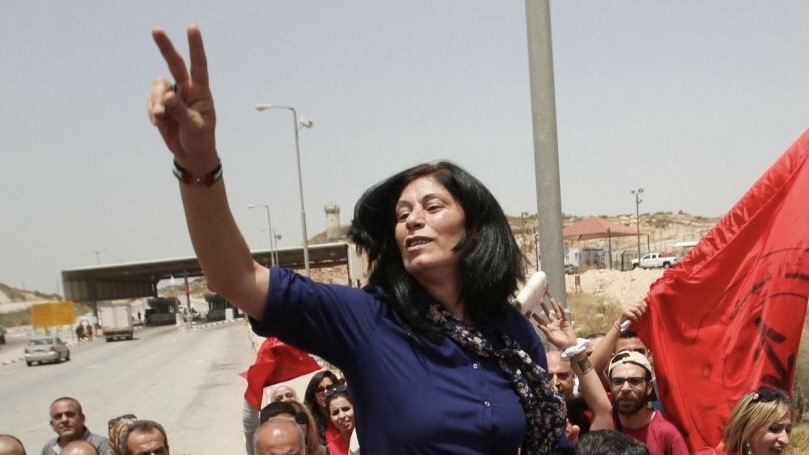
Khalida Jarrar is one of 10,000 Palestinians that has been arrested by Israel in the last year as part of a massive crackdown. Photo: Archive
Legal experts and human rights advocates renew their call for solidarity with Palestinian prisoners detained by Israel since October 2023
Since October 7, 2023, approximately 10,000 Palestinians from across the West Bank and other occupied territories have been imprisoned by Israeli Occupation Forces (IOF) in what human rights lawyers describe as an unprecedented assault on all branches of the resistance movement. Thousands more have been forcibly disappeared from the Gaza Strip, with little information available about their whereabouts.
Amid the increased use of torture and detention of the Palestinian people by Israel, international solidarity movements have intensified campaigns calling for their release.
Among those recently detained from the occupied West Bank is Khalida Jarrar, a prominent human and women’s rights activist, who has faced persecution by Israel on multiple occasions, and is now being held in Neve Tirza prison.
At a briefing on Palestinian political prisoners, organized by the International Peoples’ Assembly (IPA), Tala Nasir from Addameer Association for Prisoner Support and Human Rights, along with human rights lawyer Bilal Naammeh, highlighted the IOF’s violations of basic human rights among prisoners. Nasir pointed out that many arrests in the past year have targeted specific groups of professionals who play an important role in building the material basis of the community, including engineers and health workers. However, anyone can face arrest for something as minor as posting on social media, which occupation forces often manipulate into allegations of supporting resistance groups, including Hamas.
Israel is attempting to practically ban all political participation by Palestinians, Naammeh noted, a threat reinforced through military courts and remote trials designed to instill fear in the population. Since October 2023, these practices have become even more severe than before. Naammeh described how, in court, Israeli lawyers often accuse defendants of being involved in the resistance. When defense lawyers challenge these accusations due to insufficient evidence, they can be sanctioned or temporarily barred from representing clients.
As lawyers are currently the only point of contact between prisoners and the outside world, restricting their access—whether through sanctions or lengthy delays—has profound consequences.
Conditions inside Israeli prisons have also worsened significantly. Access to prisoners is limited, even for representatives of the International Committee of the Red Cross (ICRC). Prisoners face severe shortages of food and water, which has led to weight loss of up to 30 kilograms per person, and are allowed only one hour outside their cells each day, leaving them isolated for the rest of the time, according to Nasir.
The lack of water and hygiene has led to mass outbreaks of disease and infection, including scabies. According to Naammeh, some prisoners with scabies have been tied to their beds to prevent them from scratching. Other reports indicate that the IOF moves prisoners with scabies between sections in order to purposely exacerbate the contagion. Despite the widespread health crisis, medical care remains out of reach for most. Naammeh highlighted that even the most pressing health issues can take up to two months to receive basic medical attention, leaving prisoners in prolonged suffering.
Conditions in the camps where Palestinians from Gaza are held are even worse, the two advocates suggested, but up-to-date information is nearly impossible to obtain. The only reports come from Israeli media or the testimonies of those who have been released. Nasir recounted stories of prisoners enduring extreme torture, including rape. Witnesses described prisoners being forced to bark for food and given only thin mattresses for six hours a day, making proper rest impossible. This treatment extends even to those who are supposed to enjoy specific protection under international law, such as health workers. Nasir explained that dozens of health workers abducted from Gaza are being held under the Unlawful Combatants Law, meaning they could remain imprisoned until the end of the conflict under such conditions.
In response to Israel’s blatant disregard for human rights and international law, Addameer and the IPA renewed their call for the immediate release of all political prisoners and urged international activists to escalate solidarity efforts, including by insisting on adherence to recent International Court of Justice rulings. The organizers reminded participants that even the simplest acts of solidarity can contribute meaningfully to the broader struggle for liberation.