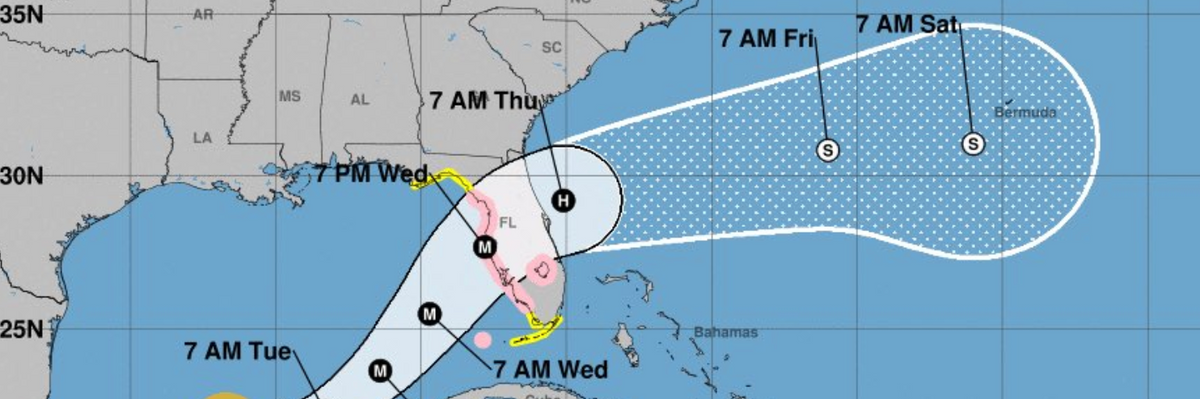
The expected path of Hurricane Milton is seen in a graphic released on October 7, 2024.(Photo: National Hurricane Center)
“The Gulf of Mexico is so warm that the models couldn’t predict how strong Milton has gotten so quickly,” said the Sunrise Movement. “This is a climate emergency.”
“This is not normal,” said climate advocates Monday as they expressed the same shock as weather experts who were reporting on the rapid strengthening of Hurricane Milton, whose winds sped up to 175 miles per hour as Florida residents struggled to recover from last month’s devastating storm, Helene.
Milton was classified as a Category 5 hurricane Monday afternoon—just five hours after it had been designated a Category 2 storm with 100 mile-per-hour winds and 48 hours after it became a tropical storm churning eastward over the Gulf of Mexico.
The winds “explosively” intensified over a matter of hours, according to the National Hurricane Center.
As the hurricane gathered strength, weather analyst Colin McCarthy of U.S. Stormwatch said that “not a single weather model predicted the storm would strengthen this quickly.”
The storm was expected to make landfall on Florida’s Gulf Coast on Wednesday, and Republican Gov. Ron DeSantis—who vehemently denies scientists’ consensus that human-caused climate change is causing more extreme weather—called for widespread evacuations ahead of “life-threatening” hazards.
“If we knew exactly where it’s going to hit, we probably would evacuate fewer people,” DeSantis said Monday morning. “But we don’t know that.”
President Joe Biden declared an emergency in Florida Monday afternoon and ordered federal assistance to the state.
The New York Times reported that Milton could weaken before Wednesday as it makes its way through the Gulf, but that could be accompanied by a widening of the hurricane’s size, threatening a greater portion of the vulnerable state.
“The entire peninsula, the entire west coast, has potential to have major, major impact because of the storm surge,” said DeSantis on Sunday.
Milton is expected to be the second hurricane to hit Florida in two weeks, with parts of the state still reeling from the damage left by Helene.
DeSantis said Monday that emergency workers had picked up 180,000 cubic yards of debris across the state, and said, “There’s still a lot of it.”
The Tampa Bay area, where residents were warned by National Weather Service meteorologist Rick Davis on Monday that Milton could be “the worst hurricane in their lifetime,” was inundated last month with record-high storm surges.
Barrier islands were damaged by Helene, and the destruction of sand dunes has left the area especially exposed to hazards, Davis told The New York Times.
“Just after our latest hurricane, we are extremely vulnerable, especially to surge,” said Davis. “Our ground is extremely saturated from several hurricanes already this year, and we’re going to have river flooding. So people that may be 20 miles inland from the coast won’t get storm surge, but they could get rainfall flooding, river flooding, retention ponds could flood creeks.”
Climatologists have warned that warmer oceans and bodies of water including the Gulf of Mexico are likely to cause more intense hurricane seasons. The Gulf has reached an average surface temperature of nearly 90°F—the hottest it’s been since modern records have been kept, Brian McNoldy, a climate researcher at the University of Miami, toldVox in August.
“The Gulf of Mexico is so warm that the models couldn’t predict how strong Milton has gotten so quickly,” said national climate advocacy group Sunrise Movement.
The Gulf of Mexico is so warm that the models couldn't predict how strong Milton has gotten so quickly.
Officials called on residents to evacuate Monday rather than waiting for the hurricane to get closer to making its expected landfall. More than a dozen school districts in the state announced they were closing ahead of the storm.
But as pro-labor media group More Perfect Union reported, workers on Monday were already sharing stories online of how companies are planning to stay open until at least Tuesday night, making it impossible for people to obey evacuation orders.
One person working in retail management said that “after waiting all weekend to see if the corporate overlords would say we’re closed until further notice, I got notice today that we’re business as usual until Tuesday night… This gives me no time to evacuate or prepare accordingly.”
Hurricane Milton has grown at an astronomical rate into a Category 5 storm.
Workers are already sharing stories of bosses putting them in danger ahead of Milton's landfall.
Workers died during Hurricane Helene because they weren't given time to evacuate. This must stop. pic.twitter.com/HaI4u8LMca
Experienced climbers scale a rock face near the historic Dumbarton castle in Glasgow, releasing a banner that reads “Climate on a Cliff Edge.” One activist, dressed as a globe, symbolically looms near the edge, while another plays the bagpipes on the shores below. | Photo courtesy of Extinction Rebellion and Mark Richards
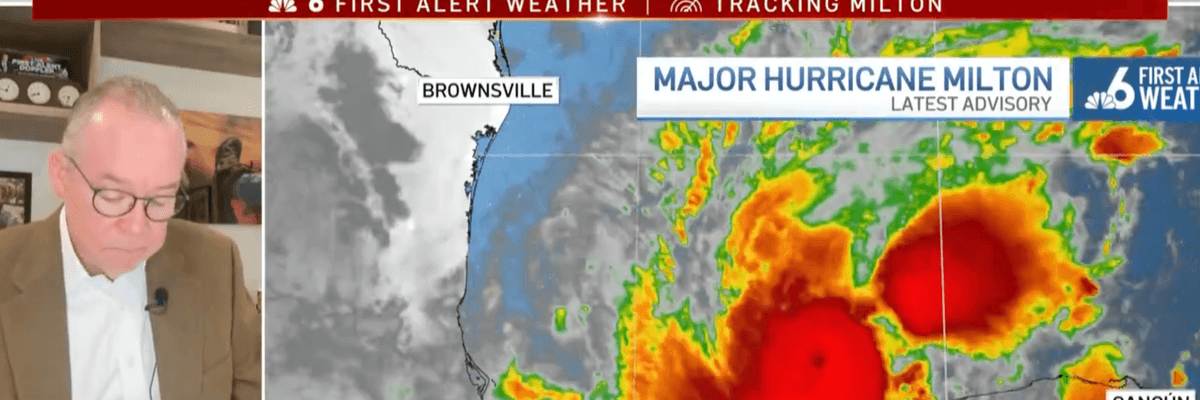
Florida meteorologist John Morales warns residents to evacuate and says the rapid intensifying of Hurricane Milton is due to the climate crisis and planetary heating in a news report on October 7, 2024. (Image: NBC6)
“The warming world has forcibly shifted my manner from calm concern to agitated dismay,” said John Morales. “Now I look at storms differently. And I communicate differently.”
As NBC6 hurricane specialist John Morales in Miami reported on the rapid drop in barometric pressure as Hurricane Milton gained strength in the Gulf of Mexico on Monday, the veteran meteorologist’s voice broke.
“It has dropped 50 millibars in 10 hours,” Morales said, becoming visibly emotional. “I apologize, this is just horrific.”
The storm is expected to make landfall on the west coast of Florida on Wednesday as the state struggles to recover from Hurricane Helene.
Morales spoke as the hurricane’s winds reached 160 miles per hour and climate experts noted that the Gulf of Mexico and Atlantic Ocean’s waters have been abnormally warm.
“The seas are just incredibly, incredibly hot, record hot, as you might imagine,” said Morales. “You know what’s driving that. I don’t need to tell you. Global warming, climate change [are] leading to this and becoming an increasing threat.”
Morales posted the clip on social media later, saying he “debated whether to share” the emotional moment in which he reported on what is likely to be further catastrophic damage to his home state as well as parts of Mexico.
“Frankly, you should be shaken too, and demand climate action now,” said Morales.
A week ago, the meteorologist wrote in the Bulletin of Atomic Scientists that Hurricane Helene, which killed more than 230 people across six states, was “a harbinger of the future.”
“For decades I had felt in control. Not in control of the weather, of course. But in control of the message that, if my audience was prepared and well informed, I could confidently guide them through any weather threat, and we’d all make it through safely,” wrote Morales. “Today as a result of so many compounding climate-driven factors, the warming world has forcibly shifted my manner from calm concern to agitated dismay. Now I look at storms differently. And I communicate differently.”
“No one can hide from the truth,” he added. “Extreme weather events, including hurricanes, are becoming more extreme. I must communicate the growing threats from the climate crisis come hell or high water—pun intended.”
Former U.S. Rep. Debbie Mucarsel-Powell (D-Fla.), who is running for Senate, was among those who applauded Morales’ frank assessment of the crisis facing his state and the country.
“I’ve never seen someone like John Morales get emotional about a storm before. He understands these systems better than most and it should be a warning for all of us to get ready now,” said Mucarsel-Powell. “We MUST have the courage to stand up to climate denialists and take action before it is too late.”
Experienced climbers scale a rock face near the historic Dumbarton castle in Glasgow, releasing a banner that reads “Climate on a Cliff Edge.” One activist, dressed as a globe, symbolically looms near the edge, while another plays the bagpipes on the shores below. | Photo courtesy of Extinction Rebellion and Mark Richards
Drax power plant in Yorkshire. Credit: A.P.S. (UK) / Alamy Stock Photo
Scope of corporate influence underscores concerns the technology will be used to prolong demand for planet-heating natural gas.
This story is the third part of a DeSmog series on carbon capture and was developed with the support of Journalismfund Europeand published in partnership with the Guardian.
The UK government’s move to award £22 billion in subsidies to carbon capture projects followed a sharp increase in lobbying by the fossil fuel industry, DeSmog can reveal.
Oil and gas giants such as Equinor, BP, and ExxonMobil attended 24 out of 44 external ministerial meetings to discuss carbon capture and storage (CCS) in 2023, according to official transparency records.
That represented a surge in activity relative to 2020-2022, when ministers held about half as many meetings to discuss the technology, and oil and gas companies would attend seven to 10 of these discussions each year.
Meeting notes obtained via freedom of information requests showed how oil executives were involved in shaping policy, and used their access to underscore the need to continue developing oil and gas.
During a call in December with three Equinor executives, one of the company’s team told Jeremy Allen, then director of the Department for Energy Security and Net Zero, that Equinor “appreciate[s] the…collaborative approach to policy development.”
An executive from ExxonMobil’s Low Carbon Solutions division “spoke of the outstanding need for oil and gas, at the same time as needing to lower emissions” in a meeting with then energy minister Graham Stuart in March last year at the CERAWeek oil trade show in Houston.
The growing engagement by oil and gas companies has sharpened concerns among climate advocates that industry is skewing the UK’s carbon capture strategy to justify building new gas-fired power plants — prolonging demand for natural gas, a source of planet-heating carbon dioxide (CO2) and methane emissions.
“Fossil fuel companies often have the engineering know-how to build these projects, so the government naturally has to meet with them,” said Laurie Laybourn, environmental policy researcher and associate fellow at the Institute for Public Policy Research think tank. “But that might create a risk whereby these companies unduly influence policy and roll-out in a way that benefits them.”
Others engaging regularly with ministers on CCS policy include heavy manufacturing companies, CCS technology firms, lobby groups, and investment funds.
Researchers, climate groups, and local councils were less well represented, the transparency records showed. No individual organisation from these sectors has attended more than three meetings with ministers on carbon capture since the start of 2020.
Meanwhile, lobby group the Carbon Capture and Storage Association (CCSA) — which represents dozens of fossil fuel companies — attended 20 meetings, and Equinor 16. BP, ExxonMobil, Scottish power company SSE, and Drax, a biomass power plant and the UK’s biggest CO2 emitter, also attended nine meetings each during the same period.
‘Wrong Pathway’
The new Labour government announced plans last week to extend £22 billion in subsidies for carbon capture over 25 years, saying the strategy can help meet climate goals and support a broader revitalization of British industry.
The policy builds on the previous Conservative administration’s plans to establish four CCS “clusters,” where carbon capture would be used to trap some of the CO2 emitted by fossil-fuel burning factories and power plants. Pipelines would then carry the captured gas underground to be stored in depleted oil and gas reservoirs under the North and Irish Seas.
The government’s plans include backing proposals by Equinor and BP — two of the companies that have met most frequently with ministers since January 2020 — to build new “low-carbon” gas-fired power stations fitted with carbon capture units, which are slated to be among the first to receive state support.
A group of scientists and campaigners warned last month that such projects would allow the companies to continue extracting and burning natural gas based on the promises of unproven and expensive carbon capture technology — at the taxpayer’s expense.
“Putting the UK on the wrong pathway could be catastrophic,” said the letter, addressed to Secretary of State for Energy Security and Net Zero Ed Miliband.
Carbon Tracker, a financial think tank, warned in a March report that building new gas-fired power plants “could lock consumers into a high-cost and fossil-based future” and urged the UK to focus on deploying carbon capture in hard-to-decarbonise sectors such as cement.
“These ‘low-carbon’ gas projects are not really low carbon if you look at the whole supply chain,” said the report’s author Lorenzo Sani, referring to the large amount of natural gas, which is mostly comprised of the potent greenhouse gas methane, that leaks during the extraction and transport of the fuel.
“They also continue this paradigm that we have today of linking our economies with fossil fuels, whose markets are volatile and often controlled by external actors to the UK,” Sani added.
‘Struggle to Keep Investors Upbeat‘
The Intergovernmental Panel on Climate Change and International Energy Agency envisage significant deployments of carbon capture for reaching net zero emissions by mid-century.
However, many environmental groups are sceptical. Researchers point to the frequent failure of projects to meet carbon capture targets, cost-overruns, the need for multi-billion dollar subsidies, and the tendency of the oil and gas industry to use the technology to justify investments in new fossil fuel projects — rather than focus on cleaning up existing dirty industries.
The surge in lobbying by companies seeking public money coincided with the previous Conservative administration’s pledge of £20 billion in subsidies for carbon capture projects in March 2023.
Three months after that funding was announced, lobby group the CCSA told ministers its members were concerned about delays and there was a “struggle to keep investors upbeat”, according to meeting notes.
The CCSA has attended more government carbon capture meetings (20) than any other organisation since January 2020, including two meetings between January and March 2024, the latest period for which records are available.
The organisation had a presence at both this and last year’s Labour party conferences. The CCSA’s Head of Communications Joe Butler-Trewin has held various organising and research roles within the party, while CEO Ruth Herbert worked as a civil servant under Miliband, when he was Secretary of State for Energy and Climate Change from 2008 to 2010. Miliband was a guest speaker at the CCSA’s annual meeting last year.
Now Secretary of State for Energy Security and Net Zero, Miliband and the new Labour government announced plans last week to extend £22 billion in subsidies for carbon capture over 25 years, saying the strategy can help meet the country’s climate targets and support a broader revitalization of British industry.
When asked to comment on concerns that their CCS projects may “lock in” fossil fuel dependency, BP and Equinor gave almost identical statements, saying that CCS is essential for the UK’s transition to net zero and will create jobs.
The Department for Energy Security and Net Zero said CCS will play a “vital role” in its plans for a clean energy system by 2030. The department also pointed to independent government advisor the Climate Change Committee’s description of carbon capture as a “necessity, not an option”.
The CCSA did not respond to requests for comment.
‘Outstanding Need for Oil and Gas’
Two meetings with ExxonMobil designated for the discussion of “carbon solutions” were used by both the company and then senior Department for Energy Security and Net Zero minister Graham Stuart to reaffirm the need for continued oil and gas production in the UK, meeting notes show.
On March 8, 2023, Stuart met with at least one executive from ExxonMobil’s Low Carbon Solutions division at the CERAWeek oil trade show. Representatives from the North Sea Transition Authority regulator and the Department for Business and Trade were also present.
According to notes from the meeting, the ExxonMobil executive “spoke of the outstanding need for oil and gas, at the same time as needing to lower emissions.”
Just over three months later, on June 15, Stuart met with representatives from ExxonMobil again to “discuss carbon solutions”.
However, after discussing ExxonMobil’s CCS capabilities, Stuart then told attendees “that the UK government has championed the need for new oil and gas licenses.” An ExxonMobil executive replied that “this was important in attracting new investment.”
Later in the meeting, minutes show that Stuart “reiterated that the Government supports the continued development of oil and gas resources on the UKCS [UK Continental Shelf].”
Four months later, the then Conservative government announced it was granting hundreds of new oil and gas licences in the North Sea.
‘Easily Spun‘
In the March 2023 meeting, ExxonMobil touted the success of carbon capture projects in the United States that had been used to pump more oil using “enhanced oil recovery” — where CO2 is injected into the ground to extract hard-to-reach oil and gas.
Meeting notes show an ExxonMobil executive told Stuart that the company had “captured 40% of all the CO2 that has ever been captured”.
The ExxonMobil employee’s statement appeared to refer to the approximately 120 million tonnes of CO2 captured by its Shute Creek gas-processing plant in Wyoming, which opened in 1986 and often features in ExxonMobil’s promotional materials.
However, 47 percent of the CO2 captured over Shute Creek’s lifetime had been sold for enhanced oil recovery, according to a 2022 study by U.S.-based think tank the Institute for Energy Economics and Financial Analysis. Another 50 percent of the gas was vented back into the atmosphere when it couldn’t be sold. Just three percent was stored.
The meeting notes did not record any discussion of these caveats.
“CCS is technically complex and difficult for anyone but industry experts to fully understand,” said Lindsey Gulden, a former ExxonMobil climate and data scientist. “That means it can be easily spun to give cover to the oil industry as they attempt to navigate the growing public concern over climate change.”
ExxonMobil did not respond to a request for comment.
dizzy: A new government was elected 4 July 2024 while the lobbying will mostly have been with the previous Tory government. It follows that our current government has accepted and progressed with the previous government’s decisions. Is it fair to accuse them of simply rubber-stamping the previous government’s decisions?
Experienced climbers scale a rock face near the historic Dumbarton castle in Glasgow, releasing a banner that reads “Climate on a Cliff Edge.” One activist, dressed as a globe, symbolically looms near the edge, while another plays the bagpipes on the shores below. | Photo courtesy of Extinction Rebellion and Mark Richards
Over the past few weeks, senior figures in the Labour government, including prime minister Keir Starmer, have faced criticism for accepting thousands of pounds worth of gifts from party donors, including clothes, glasses and tickets to must-see events.
While far from the first allegations of ‘sleaze’ against politicians in recent years, it comes just months after Labour made ‘serving the country’ a key theme of their election campaign, with their manifesto accusing the Conservatives and SNP of failing to “uphold the standards expected in public life”.
Labour and Starmer have stressed that their actions were within the rules, with Starmer also deciding to pay back £6,000 worth of gifts that received as donations, a move that eight in ten Britons (79%) support. Nonetheless, the controversy has left a mark on the government.
Heavy black smoke billows from the site of an Israeli air raid that targeted an area in a Beirut suburb on October 5, 2024. (Photo: Marwan Naamani/picture alliance via Getty Images)
“Complete blocks are being destroyed one after another,” Al Jazeera reported.
Israeli forces continued attacks on the outskirts of Beirut and in southern Lebanon on Saturday.
There were 13 Israeli strikes on the southern suburbs of Beirut overnight and another five on Saturday, one of which may have been targeted at paramedics, according toAl Jazeera. The number of casualties is not yet clear.
“There is increasing destruction and it’s clear that complete blocks are being destroyed one after another,” Al Jazeera‘s Ali Hashem reported from Beirut.
“One strike hit near the airport, and we understand another missile hit near a paramedic team to prevent them from getting to the scene of the bigger strike,” he reported.
The Israeli military issued evacuation warnings for certain suburban areas south of Beirut on Friday night, indicating attacks would follow, The New York Times reported.
Israeli forces unleashed a “huge strike” on the same area earlier Friday in an attempt to kill Hashem Safieddine, the presumed successor to recently assassinated Hezbollah leader Hassan Nasrallah, according to the Times. Al Jazeera reported that “bunker buster” bombs were believed to be used in the Friday attack, as they were in Nasrallah’s killing. It’s not clear if Safieddine was killed, though media reports indicate that he likely was.
Israel’s military also continued attacks in southern Lebanon on Saturday.
“From northern Israel, I can see dark gray clouds of dust and smoke rising above two [Lebanese] villages as warplanes zoom overhead and the sound of artillery echoes through the area,” the Times‘ Natan Odenheimer reported Saturday.
An Israeli strike in northern Lebanon killed Hamas commander Saeed Ali on Saturday, the armed Palestinian group said. Hamas has a longstanding presence in Lebanon.
According to Al Jazeera, which cited Israeli media reports, the Israeli military is planning to expand its ground incursion into southern Lebanon, which began earlier this week, and to conduct “large-scale assaults” on Lebanon, Iran, and Gaza. The media outlet didn’t provide details.
Iran fired nearly 200 ballistic missiles at Israel on Tuesday, principally targeting military facilities. Iran said the strikes were retaliation for Israeli assassinations of Hezbollah and Hamas leaders. Most of the strikes were intercepted by Israeli and U.S. forces.
Observers are now watching closely to see how Israel responds, and what role the U.S.—Israel’s chief diplomatic ally and military supplier—might play. President Joe Biden said Friday that he’d advise Israel to consider “alternatives” to striking Iranian oilfields.