‘Very Fabric of Life’ at Risk Without Urgent Action to End Fossil Fuel Era

Spread the love

Original article by Jessica Corbett republished from Common Dreams under Creative Commons (CC BY-NC-ND 3.0).

Flood damage is shown at a bridge across Mill Creek in the aftermath of Hurricane Helene on September 30, 2024 in Old Fort, North Carolina.
 (Photo: Sean Rayford/Getty Images)

“We are on the brink of an irreversible climate disaster. This is a global emergency beyond any doubt.”

As Hurricane Milton barreled toward Florida’s Gulf Coast, demonstrating the dangers of global warming, international scientists on Tuesday published a terrifying annual analysis that highlights the need to swiftly phase out planet-heating fossil fuels.

“Our aim in the present article is to communicate directly to researchers, policymakers, and the public,” the coalition wrote in BioScience. “As scientists and academics, we feel it is our moral duty and that of our institutions to alert humanity to the growing threats that we face as clearly as possible and to show leadership in addressing them.”

“We are on the brink of an irreversible climate disaster. This is a global emergency beyond any doubt. Much of the very fabric of life on Earth is imperiled. We are stepping into a critical and unpredictable new phase of the climate crisis,” warned the 14 experts from Australia, Brazil, China, Denmark, Germany, Switzerland, the United Kingdom, and the United States.

Their latest edition, “The 2024 State of the Climate Report: Perilous Times on Planet Earth,” shows that 25 of the 35 “planetary vital signs” the team uses to track the climate emergency are at record extremes. They include U.S.-heat related mortality, fossil fuel subsidies, coal and oil consumption, carbon dioxide equivalent emissions, per capita meat consumption, global tree cover loss due to fires, ocean acidity and heat content change, glacier thickness change, and ice mass change in Antarctica and Greenland.

“Ecological overshoot, taking more than the Earth can safely give, has pushed the planet into climatic conditions more threatening than anything witnessed even by our prehistoric relatives.”

The report emphasizes that “human-caused carbon dioxide emissions and other greenhouse gases are the primary drivers of climate change. As of 2022, global fossil fuel combustion and industrial processes account for approximately 90% of these emissions, whereas land-use change, primarily deforestation, accounts for approximately 10%.”

“For many years, scientists, including a group of more than 15,000, have sounded the alarm about the impending dangers of climate change driven by increasing greenhouse gas emissions and ecosystem change,” the publication notes. “For half a century, global warming has been correctly predicted even before it was observed—and not only by independent academic scientists but also by fossil fuel companies.”

“Despite these warnings, we are still moving in the wrong direction; fossil fuel emissions have increased to an all-time high, the three hottest days ever occurred in July of 2024, and current policies have us on track for approximately 2.7°C peak warming by 2100,” the article adds. “Tragically, we are failing to avoid serious impacts, and we can now only hope to limit the extent of the damage. We are witnessing the grim reality of the forecasts as climate impacts escalate, bringing forth scenes of unprecedented disasters around the world and human and nonhuman suffering.”

Oregon State University professor William Ripple, who led the team with Christopher Wolf of Terrestrial Ecosystems Research Associates, said in a Tuesday statement that “ecological overshoot, taking more than the Earth can safely give, has pushed the planet into climatic conditions more threatening than anything witnessed even by our prehistoric relatives.”

“We’re already in the midst of abrupt climate upheaval,” Ripple stressed. “For example, Hurricane Helene caused more than 200 deaths in the southeastern United States and massive flooding in a North Carolina mountain area thought to be a safe haven from climate change.”

“Since the publication of our 2023 report, multiple climate-related disasters have taken place, including a series of heatwaves across Asia that killed more than a thousand people and led to temperatures reaching 122°F in parts of India,” he continued. “Climate change has already displaced millions of people, with the potential to displace hundreds of millions or even billions. That would likely lead to greater geopolitical instability, possibly even partial societal collapse.”

To avoid that dark future, the article argues, “we need bold, transformative change: drastically reducing overconsumption and waste, especially by the affluent, stabilizing and gradually reducing the human population through empowering education and rights for girls and women, reforming food production systems to support more plant-based eating, and adopting an ecological and post-growth economics framework that ensures social justice.”

The assessment—whose authors include Michael Mann of the University of Pennsylvania, Naomi Oreskes of Harvard University, and Stefan Rahmstorf and Johan Rockström of the Potsdam Institute for Climate Impact Research—comes just over a month away from the next United Nations Climate Change Conference, COP29, which is scheduled for November 11-22 in Azerbaijan.

Pointing to previous summits, Wolf said Tuesday that “despite six reports from the International Panel on Climate Change, hundreds of other reports, tens of thousands of scientific papers, and 28 annual meetings of the U.N.’s Conference of the Parties, the world has made very little headway on climate change.”

“Humanity’s future depends on creativity, moral fiber, and perseverance,” he warned. “If future generations are to inherit the world they deserve, decisive action is needed, and fast.”

Original article by Jessica Corbett republished from Common Dreams under Creative Commons (CC BY-NC-ND 3.0).

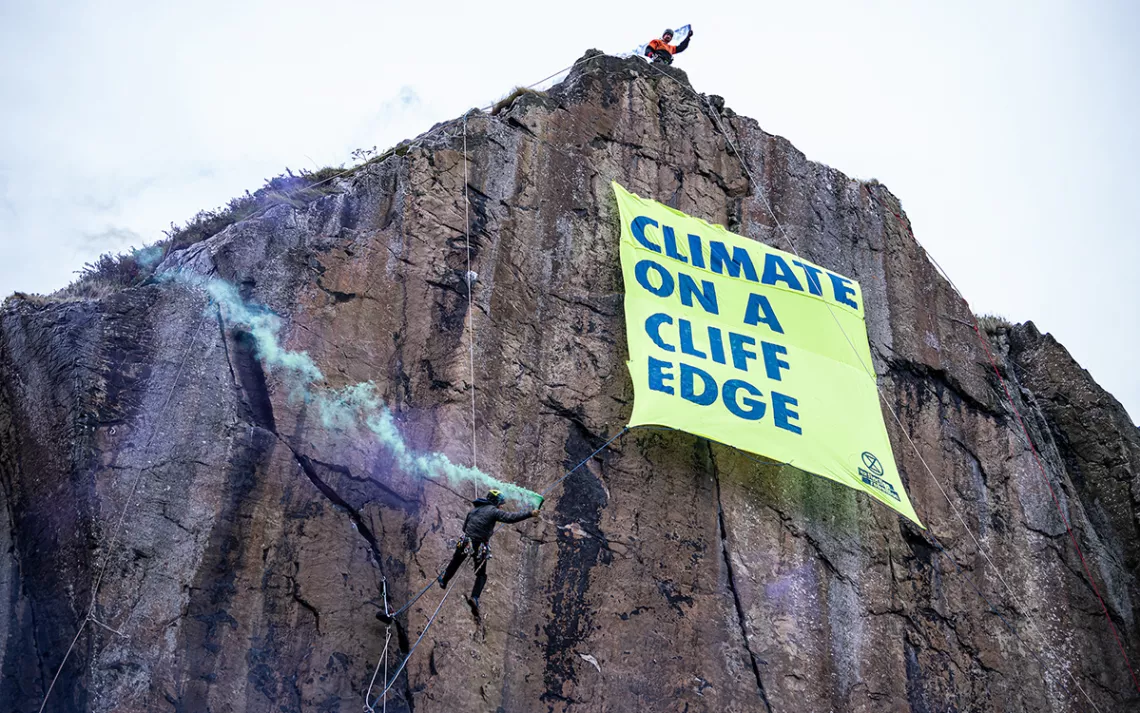
Experienced climbers scale a rock face near the historic Dumbarton castle in Glasgow, releasing a banner that reads “Climate on a Cliff Edge.” One activist, dressed as a globe, symbolically looms near the edge, while another plays the bagpipes on the shores below. | Photo courtesy of Extinction Rebellion and Mark Richards
Continue Reading‘Very Fabric of Life’ at Risk Without Urgent Action to End Fossil Fuel Era

Ex-Israeli PM Says Netanyahu Wants to Draw US Into ‘Reckless’ War With Iran

Spread the love

Original article by Jake Johnson republished from Common Dreams under Creative Commons (CC BY-NC-ND 3.0). 

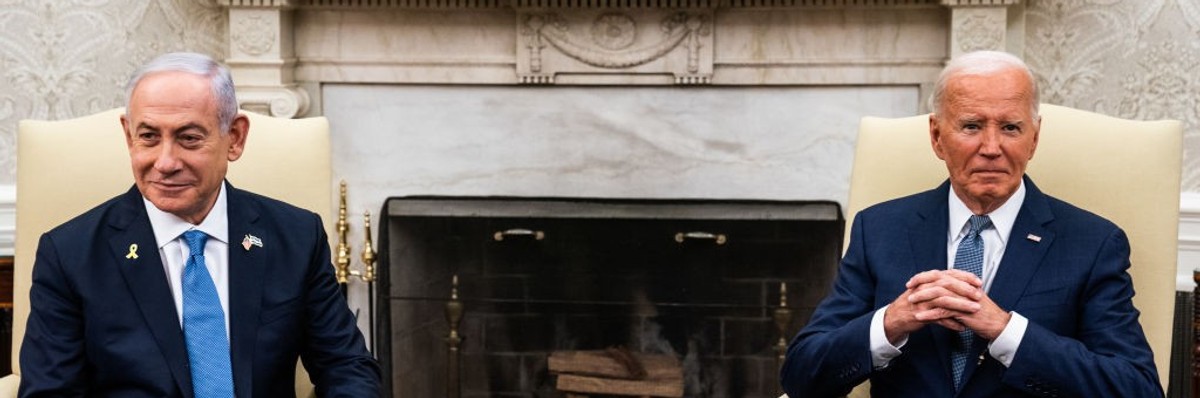
U.S. President Joe Biden was pictured with Israeli Prime Minister Benjamin Netanyahu during a meeting in the Oval Office of the White House on July 25, 2024.  (Photo: Demetrius Freeman/The Washington Post via Getty Images)

“I’m afraid that if Israel will start a war, a comprehensive war against Iran… America will join in to help Israel,” said former Israeli Prime Minister Ehud Olmert. “And that is what Netanyahu believes.”

Former Israeli Prime Minister Ehud Olmert told the British outlet Channel 4 on Monday that he believes current Prime Minister Benjamin Netanyahu wants to drag the U.S. into a war with Iran, an effort that the ex-Israeli leader called “reckless.”

Asked whether he thinks Netanyahu “wants to draw the United States into a confrontation with Iran,” Olmert replied, “I suspect that he does.”

“I think that’s reckless because I’m afraid that if Israel will start a war, a comprehensive war against Iran, and it will expand and Israel will not be in a very comfortable situation, America will join in to help Israel. And that is what Netanyahu believes to be the case,” said Olmert, who served as Israel’s prime minister from 2006 to 2009 and was succeeded by Netanyahu.

Olmert expressed support for Israel’s killing of Hezbollah leader Hassan Nasrallah—a move that prompted Iranian retaliation earlier this month—and said that “something needs to be done” with regard to Iran.

“What needs to be done needs to be done with care, with sensitivity, with responsibility, and with a sense of proportion,” Olmert added. “And I’m not certain that Netanyahu wants this proportion. He looks at the leadership of the international community, the Western world, and he says, ‘Who are they? I’m Bibi Netanyahu.'”

Watch the interview:

Olmert’s remarks came amid growing concern that the U.S.-armed Israeli military could be preparing to bomb Iran’s nuclear energy facilities in response to Iran’s ballistic missile attack last week. The New York Timesnoted Monday that “there is a rising call inside Israel, echoed by some in the United States, to seize the moment” and strike Iranian nuclear facilities.

Former president Donald Trump, the 2024 GOP nominee, said over the weekend that Israel should “hit the nuclear first and worry about the rest later.”

Speaking to reporters last Thursday, U.S. President Joe Biden said that the U.S. and Israel are “discussing” a possible attack on Iranian oil infrastructure. The president has said he would oppose an Israeli attack on Iranian nuclear facilities.

Iran has pledged to retaliate against an Israeli attack with a “crushing” blow, heightening fears of a full-blown regional war as Israel continues its devastating assault on Gaza, the West Bank, and Lebanon.

Dylan Williams, vice president for government affairs at the Center for International Policy, said Monday that “President Biden needs to decide if he is finally going to rein in and end his unconditional arming of Netanyahu, or if he will let Netanyahu draw the United States and its forces into war with Iran—a country that is nearly four times the size of Iraq and has twice the population.”

U.S. Vice President Kamala Harris, the Democratic presidential nominee, has done nothing to distance herself from Biden’s unconditional support for Israel despite vocal calls for her to back an arms embargo against the country.

In a closely watched “60 Minutes” interview that aired late Monday, Harris said that “Israel has a right to defend itself” while conceding that “far too many innocent Palestinians have been killed.”

But she did not say she would be willing to use U.S. military aid to Israel as leverage to secure a cease-fire agreement.

Harris also named Iran when asked which country she considers to be the United States’ “greatest adversary”—an answer that CBSdid not air as part of its televised broadcast of the “60 Minutes” interview.

Harris went on to say that one of her “highest priorities” as president would be to “ensure that Iran never achieves the ability to be a nuclear power.” Asked whether she would take military action in the face of “proof that Iran is building a nuclear weapon,” the vice president responded that she is “not going to talk about hypotheticals.”

Sina Toossi, a senior fellow at the Center for International Policy, called Harris’ answer on Iran “completely out of touch” and said it underscores “the irrational U.S. obsession with Iran, which is driven by politics and donor money, not U.S. interests.”

Last week, a coalition of more than 80 advocacy organizations warned the Biden-Harris administration that “it is not in the national interest for the U.S. to be led into a war with Iran by Benjamin Netanyahu’s government in Israel.”

“It is in the strong national interest to utilize diplomacy, backed by full American leverage—including withholding further offensive weapons transfers to Israel’s military—to move all the parties back from the brink and toward a ceasefire that ends the devastation of Gaza and Lebanon and reverses the slide to regional war,” the groups added.

Original article by Jake Johnson republished from Common Dreams under Creative Commons (CC BY-NC-ND 3.0). 

Continue ReadingEx-Israeli PM Says Netanyahu Wants to Draw US Into ‘Reckless’ War With Iran

Interview: Harris or Trump doesn’t matter for Gaza genocide

Spread the love

Original article by Nandini Naira Archer republished from Open Democracy under a Creative Commons Attribution-NonCommercial 4.0 International licence.

Pro-Palestine protest outside the Democratic National Convention in Chicago in August 2024. | Fatih Aktas/Anadolu via Getty Images

A year on and no end in sight to genocide – thanks to US support for Israel, which will continue beyond election

A year on from the outset of Israel’s war on Gaza, Israeli forces have killed more than 42,000 Palestinians – and this is just the confirmed death toll. A recent study by the Lancet medical journal projected that the death toll could exceed 186,000 when counting indirect deaths – from starvation and diseases due to the Israeli blockade on humanitarian aid, food, water and medicines.

To take stock of where we’re at and whether this nightmare is likely to end any time soon, openDemocracy spoke to Tariq Kenney-Shawa, a foreign policy analyst based in New York and US Policy Fellow at Al-Shabaka: The Palestinian Policy Network.

openDemocracy: It’s been a year since this latest iteration of Israel’s war on Gaza commenced. Is the end in sight? What’s Israel’s end game?

Tariq: Unfortunately, I don’t see any light at the end of the tunnel here. There is no end in sight to Israel’s genocide in Gaza. And that’s mainly because Israel hasn’t faced an ounce of accountability or pressure to de-escalate from the international community (the US and other western benefactors) to end this.

Get our free Daily Email Get one whole story, direct to your inbox every weekday. Sign up now

I’ve tended to be doubtful when people insist that Israel doesn’t have a plan in Gaza and is just destroying and killing for the sake of it. Israel does have a plan and it has been acting on it. It truly sees this moment in history, as well as the blank check from the US, as a golden strategic opportunity to take leaps towards its ultimate goal of ‘maximum land with minimum Palestinians’ and wider regional domination through brute force.

Israel’s end game in Gaza is erasure, and for the last 12 months, they’ve been laying the foundation for a new reality in Gaza for us all to see. In addition to “thinning out the population,” as Netanyahu said, through genocide, collective punishment, and ethnic cleansing, Israel has been effectively chopping up the Strip into smaller, more controllable enclaves that will come to represent the new “facts on the ground.”

openDemocracy: Has anything about the conflict surprised you?

Tariq: I think one of the most surprising aspects about both the genocide in Gaza and now Israel’s escalation across the region is that it has gone on uninterrupted and without international intervention for so long, despite the fact that just about every massacre has been broadcast for the world to see on social media.

As someone who is part of a generation that grew up being taught that the phrase “never again” really meant something, this is what I have found most jarring. Of course, Gaza is not the first time the international “rules-based” order has been exposed as a crutch for Western hegemony. From Vietnam to Iraq, the West’s selective application of international law has long been exposed for what it is. But Gaza is the first postwar genocide both entirely perpetrated by a Western ally and funded, facilitated, and justified by the West itself, not to mention the first to be so thoroughly recorded for the world to see.

openDemocracy: Now with recent escalations including Iran, do you think realistically we’re on the verge of all-out war in the region?

Tariq: I think we are already seeing an all-out regional war by every definition of the term. Israeli fighter jets are bombing Gaza, the West Bank, Lebanon, Syria, Yemen, and Iran. This is not to mention the strikes the US, UK, and other Israeli benefactors have carried out on Israel’s behalf.

It boils down to this: Israel will continue to escalate across the region in hopes of achieving its extremist, expansionist goals as long as the US taxpayer continues to foot the bill and US assets and personnel are off the coast of Haifa to come to Israel’s defence if need be.

openDemocracy: It seems that the Biden administration actually gave Israel the green light to mount large-scale attacks on Lebanon. Has the US ever really been interested in stabilising the region? Does the US want an all-out war?

Tariq: The Biden Administration has either explicitly or implicitly (through uninterrupted weapons transfers and diplomatic shielding) given Israel the green light for a year of genocide and regional escalation.

I believe it is clear that the US ultimately shares the same strategic objectives as Israel, which range from silencing Palestinians once and for all to destroying groups like Hezbollah to causing significant damage to Iran. These are all outcomes that the US would celebrate (just take the public statement the US made following Israel’s assassination of Hassan Nasrallah as one example).

Does the Biden Administration wish Israel could go about some of their operations differently? Perhaps. But at the end of the day, the costs of Israel’s unparalleled violence, the mass death of Arabs and the destruction of their lands, is a price the US is willing to accept. If the US didn’t want an all-out war, they would stop giving Israel all the weapons and diplomatic space to keep escalating at will. Because while every US administration has been pro-Israel, other US presidents have stood up to Israel when they felt US interests were at risk.

openDemocracy: Do you think things will change after the US elections on November 5?

Tariq: Nothing will fundamentally change, regardless of who wins the elections on November 5. For Palestinians, the genocide will continue because neither candidate has exhibited any indication that they intend to hold Israel accountable for war crimes and genocide or use any of the ample leverage that the US has to influence Israel’s conduct.

In fact, it’s the opposite. Donald Trump insists he would let Israel “finish the job” in Gaza, while Kamala Harris promises that she will continue the Biden Administration’s policy of giving Israel “everything it needs” and continues to make it clear that she intends to be a carbon copy of the Biden Administration. The truth is, both Harris and Trump spell continued disaster for both Palestinians and the wider region, and there is no “lesser evil” here.

The truth is, the Biden administration’s resume on Israel-Palestine, even long before October 7, has in many ways mirrored that of Trump’s.

If Biden wanted to make good on his commitment to a “two-state solution,” he would have at least started by reversing the norm shattering pro-Israel policies of his predecessor. The Biden Administration has actually given Israel more military and diplomatic assistance than any previous administration.

The only substantial difference between Trump and Biden has been their rhetoric. But one could argue that Biden’s lofty, yet empty words actually does more harm than good by distracting us from the fact that he has given Israel everything it needed to get away with genocide right in front of our eyes. If Harris wins in November, it will be more of the same, and you don’t need to take my word for it, she has made it abundantly clear herself.

Original article by Nandini Naira Archer republished from Open Democracy under a Creative Commons Attribution-NonCommercial 4.0 International licence.

Continue ReadingInterview: Harris or Trump doesn’t matter for Gaza genocide

Israel’s War on Gaza and Beyond Has Cost US Taxpayers At Least $22.76 Billion: Report

Spread the love

Original article by Brett Wilkins republished from Common Dreams under Creative Commons (CC BY-NC-ND 3.0). 

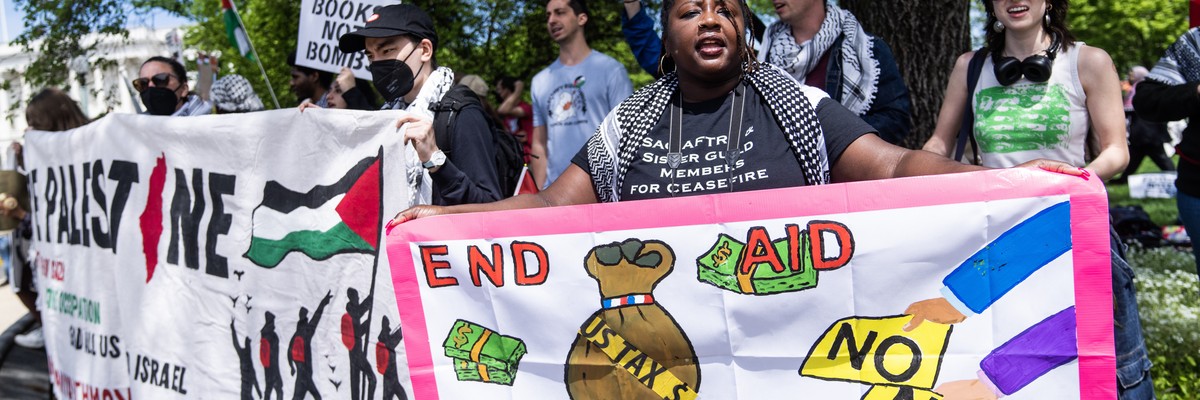
Demonstrators calling for no funding for Israel in the conflict in Gaza are seen outside the U.S. Capitol before the House passed the foreign aid package on Saturday, April 20, 2024. (Photo: Tom Williams/CQ-Roll Call, Inc via Getty Images)

“It has been difficult for the U.S. public, journalists, and members of Congress to get an accurate understanding of the amount of military equipment and financial assistance that the U.S. government has provided.”

U.S. armed aid to Israel and related spending on American militarism in the Middle East cost taxpayers at least $22.76 billion over the past year, according to new research published Monday.

The Costs of War Project at Brown University’s Watson Institute for International & Public Affairs—which has long been the premier source for statistics on the human and economic costs of ongoing U.S.-led post-9/11 wars and militarism in the Middle East and beyond—called the $22.76 billion estimate “conservative.”

“This figure includes the $17.9 billion the U.S. government has approved in security assistance for Israeli military operations in Gaza and elsewhere since October 7—substantially more than in any other year since the U.S. began granting military aid to Israel in 1959,” report authors Linda Bilmes, William Hartung, and Stephen Semler wrote. “Yet the report describes how this is only a partial amount of the U.S. financial support provided during this war.”

In addition to the repeated multibillion-dollar rounds of military aid to Israel, related U.S. operations in the region, particularly bombing and shipping defense in and near Yemen—where Houthi rebels have attacked maritime commerce and launched missiles at Israel—have cost over $2 billion since last October.

“It has been difficult for the U.S. public, journalists, and members of Congress to get an accurate understanding of the amount of military equipment and financial assistance that the U.S. government has provided to Israel’s military during the past year of war,” the report states. “There is likewise little U.S. public awareness of the costs of the United States military’s own related operations in the region, particularly in and around Yemen.”

The analysis adds that regional hostilities “have escalated to become the most sustained military campaign by U.S. forces since the 2016-19 air war” against the so-called Islamic State in Iraq and Syria.

“The Costs of War project has an obligation to look at the consequences of the U.S. backing of Israel’s military operations after October 7, especially as it reverberates throughout the region,” Costs of War director Stephanie Savell said in a statement“Our project examines the human and budgetary costs of U.S. militarism at home and abroad, and for the last year, people in Gaza have suffered the highest consequences imaginable.”

According to the Gaza Health Ministry and international agencies, Israel’s yearlong assault on Gaza has left at least 149,000 Palestinians dead, maimed, or missing, and millions more forcibly displaced, starved, or sickened. U.S. military aid to Israel has continued in successive waves, even as the country stands trial for genocide at the International Court of Justice.

The Hamas-led October 7 attack on resulted in more than 1,100 Israeli and other deaths—at least some of which were caused by so-called “friendly fire” and intentional targeting under the Hannibal Directive—with more than 240 people kidnapped.

Although the Costs of War Project report mainly covers U.S. aid to Israel since last October, it also notes that since 1948—the year the modern state of Israel was founded, largely through the ethnic cleansing of Palestine’s Arabs—American taxpayers have contributed over a quarter trillion inflation-adjusted dollars to the key Mideast ally.

second report published Monday by the Costs of War Project found that around 90% of Gaza’s population has been forcibly displaced by the Israeli onslaught and 96% of Gazans face “acute levels of food insecurity.” The publication cites a letter sent last week by a group of U.S. physicians to President Joe Biden—who has repeatedly declared his “unwavering” support for Israel—stating that “it is likely that the death toll from this conflict is already greater than 118,908, an astonishing 5.4% of Gaza’s population.” That figure includes 62,000 deaths due to starvation.

“In addition to killing people directly through traumatic injuries, wars cause ‘indirect deaths’ by destroying, damaging, or causing deterioration of economic, social, psychological and health conditions,” report author Sophia Stamatopoulou-Robbins wrote. “These deaths result from diseases and other population-level health effects that stem from war’s destruction of public infrastructure and livelihood sources, reduced access to water and sanitation, environmental damage, and other such factors.”

The new report comes less than two weeks after Israel secured yet another U.S. armed aid package, this one worth $8.7 billion. Meanwhile, the Federal Emergency Management Agency said it faced a nearly $9 billion shortfall for Hurricane Helene relief efforts.

Original article by Brett Wilkins republished from Common Dreams under Creative Commons (CC BY-NC-ND 3.0). 

Continue ReadingIsrael’s War on Gaza and Beyond Has Cost US Taxpayers At Least $22.76 Billion: Report