Contemporary genocide and Fascism. It should not be possible, there should be no chance and yet we’ve had a year of it.
continuing
How are they not Fascists?
We have to oppose these Fascist scum and governments that are supporting genocide. We have to be Internationalist in our approach.
We have to oppose our Genocide-supporting governments. Genocide is not acceptable and Starmer supporting and facilitating genocide is not acceptable. He should be arrested as a war criminal
A Palestinian man mourns after an Israeli attack killed members of this family on October 12, 2024. (Photo: Omar al-Qattaa/AFP via Getty Images)
Israeli Prime Minister Benjamin Netanyahu is reportedly “examining a plan to seal off humanitarian aid to northern Gaza,” which could starve hundreds of thousands of Palestinians.
Palestine’s deputy permanent observer to the United Nations said Saturday that “what is happening in northern Gaza now is a genocide within the genocide” as Israeli forces continued to bombard the region and terrorize the hundreds of thousands of people who remain trapped there, in increasingly desperate need of food and other necessities.
Palestinian Ambassador Majed Bamya’s message came after the World Food Program (WFP) warned that Israel’s latest offensive in northern Gaza “is having a disastrous impact on food security for thousands of Palestinian families.”
“Food distribution points, as well as kitchens and bakeries in North Gaza, have been forced to shut down due to airstrikes, military ground operations, and evacuation orders,” the U.N. body said in a statement. “The only functioning bakery in North Gaza, supported by WFP, caught fire after being hit by an explosive munition.”
Antoine Renard, WFP’s country director for Palestine, said that the northern part of the enclave “is basically cut off and we’re not able to operate there.”
“WFP has been on the ground since the onset of the crisis,” said Renard. “We are committed to delivering lifesaving food every day despite the mounting challenges, but without safe and sustained access, it is virtually impossible to reach the people in need.”
What is happening in northern Gaza now is a genocide within the genocide
No shipments of food, water, or medicine have been able to enter northern Gaza in at least two weeks due to Israel’s assault, which has trapped around 400,000 people and killed dozens. Residents have reported witnessing Israeli drones and quadcopters fire on people attempting to flee the famine-stricken area.
Israel’s military said Saturday that even shelters for displaced people in northern Gaza are considered part of a “dangerous combat zone,” further underscoring that there is no safe place in the besieged enclave.
” Israel is exterminating northern Gaza right now,” said Middle East historian and analyst Assal Rad. “There are 400,000 Palestinians there being deliberately starved, with nowhere to go, trapped inside a killing field. There’s no outrage or wall-to-wall media coverage because Israel is the one doing it and the victims are Arab.”
On Sunday, The Associated Press reported that Israeli Prime Minister Benjamin Netanyahu is “examining a plan to seal off humanitarian aid to northern Gaza in an attempt to starve out Hamas militants, a plan that, if implemented, could trap without food or water hundreds of thousands of Palestinians unwilling or unable to leave their homes.”
According to AP, the plan was proposed to Netanyahu and the Israeli parliament by “a group of retired generals.” It would give the hundreds of thousands of Palestinians who remain in the northern third of Gaza a week to leave before the area is declared a “closed military zone.”
“Those who remain would be considered combatants—meaning military regulations would allow troops to kill them—and denied food, water, medicine, and fuel,” AP added. “The plan calls for Israel to maintain control over the north for an indefinite period to attempt to create a new administration without Hamas, splitting the Gaza Strip in two.”
While the Netanyahu government has not yet decided whether to “fully carry out” the plan, the outlet observed, “one official with knowledge of the matter said parts of the plan are already being implemented, without specifying which parts.”
Citing senior defense officials, the Israeli newspaper Haaretz reported Sunday that the Netanyahu government “is not seeking to revive hostage talks and the political leadership is pushing for the gradual annexation of large parts of the Gaza Strip.”
“Army commanders in the field who spoke with Haaretz say the recent decision to launch operations in northern Gaza was taken without any in-depth discussion. They said it appeared that the operations were aimed principally at pressuring local residents, who were again told to evacuate the area for the coast as winter is approaching,” the newspaper continued. “It is possible that the operation is laying the groundwork for a decision by the government to put into effect the so-called surrender or starve plan of Maj. Gen. (ret.) Giora Eiland.”
Much recent media focus has rightly been on the anniversary of the October 7 attacks, where Hamas assailants murdered nearly 1,200 Israelis and foreign nationals and abducted a further 251.
Coverage has also centred on Israel’s expanding ground operation in Lebanon, which follows an intensive bombing campaign of the country’s south, east and capital, Beirut.
But meanwhile, the Israeli military has been continuing its operations in Gaza, where the death toll has risen to 42,000, according to the Hamas-run health ministry. Yet another instance of renewed Hamas paramilitary activity has emerged in Jabalia near Gaza City, an area that had reportedly been brought under the firm control of the Israel Defense Forces (IDF).
The Palestinian suffering has been massive and sustained, and Hamas has been severely damaged. But, in reality, the war in Gaza has become a violent stalemate with neither party able to win, yet neither likely to lose.
Israeli prime minister Benjamin Netanyahu, though, is determined to press on in Gaza while extending the war to Lebanon.
Netanyahu’s main problem has been the depth of opposition facing him in Israel over the fate of the hostages. This was exemplified by a general strike in support of a hostage deal in early September and the sheer size of some of the demonstrations against his government in recent months.
However, that has changed with the start of Israel’s military actions in Lebanon, and has given Netanyahu breathing space. At the end of September, polling indicated that Netanyahu’s rightwing Likud party would now win more seats than any other if a general election was held.
That popularity may persist for now, depending partly on what the IDF does next. But the longer-term course of the war is probably contingent on the far-right components of Netanyahu’s governing coalition, and especially the rise of messianic Judaism.
Messianic Judaism is best seen as an amalgam of ultra-orthodox Judaism and religious nationalism. The movement, which has grown in Israel in recent years, seeks a pure Jewish state. This includes the rebuilding of the Temple of Solomon on the site of Islam’s third-most holy site, the Al-Aqsa Mosque, in the Old City of Jerusalem.
It has also become increasingly significant in the military. This is partly because many soldiers have been educated in religious military schools, and a high proportion of young army recruits come from religious families.
Indeed, some of the most active Israeli military units in the Gaza war are drawn specifically from such cohorts, an example being the Netzah Yehuda (Judah Forever) battalion.
Messianic Judaism is an element in Israeli politics that is underestimated in political analysis. This is despite the especially hard line it takes in terms of what is acceptable in ending the war, offering support to Netanyahu’s government on its own terms.
A state built out of conflict
In three distinct periods, the Israeli state has moved markedly to the right. The first followed the Yom Kippur war in 1973. The second occurred after the influx of hundreds of thousands of immigrants from the old Soviet bloc in the 1990s. And the third was a reaction to the second intifada (or uprising) in the early 2000s.
The latest move to the right was reflected by a growth in support for the Likud party, as well as smaller parties that were strongly Zionist and deeply opposed to any Palestinian influence on Israeli politics.
From 2010 onwards, there appeared to be a more stable period. The IDF maintained rigorous control over Gaza and the occupied West Bank, and there was a stalemate in Lebanon. Hezbollah’s rocket attacks into northern Israel were rare and Israeli troops stayed mainly south of the border.
However, the loss of life and the capture of hostages on October 7 was a massive and visceral shock. It was clear from the start that the government’s response would be overwhelming and focused on the destruction of Hamas.
A year later and that possibility seems diminished. But if there is ever to be a more peaceful coexistence between Israel and Palestine then the position of hardline Israelis has to be recognised, especially given their strong role in the current Netanyahu government.
To put it bluntly, in their view something has to be done about the Palestinians. As the Economist newspaper put it on August 29, the hardliners “want to annex the West Bank, topple the Palestinian Authority, permanently reoccupy and resettle Gaza, and push Palestinians abroad”.
They also want Israel to move away from secularism. According to the same article, Netanyahu’s aborted plan to curb judicial power in the early months of this government was only the first step to achieving this.
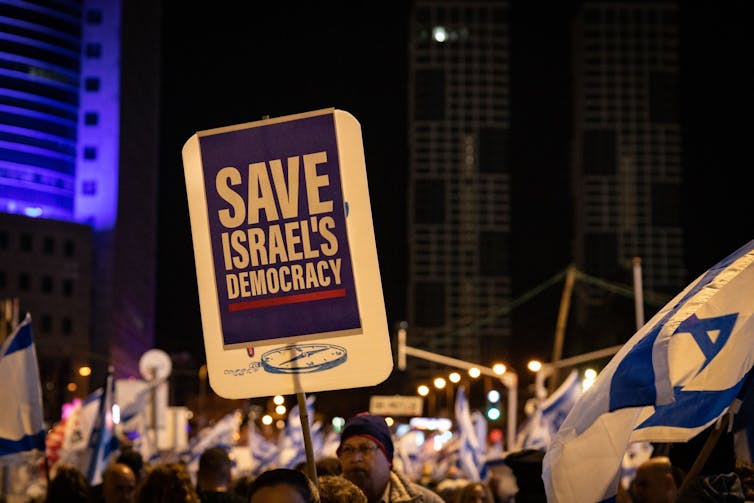
The government’s push for a wide-ranging judicial reform in 2023 sparked massive protests. Noa Ratinsky / Shutterstock
His government’s aim, the article argues, is to eradicate the secular “deep state” and seize control of the army, security agencies and courts. Their problem is that such an aim, if ever a possibility, is hugely constrained by the near-global perception of Israel as close to a rogue state.
What is already clear, though, is that Israeli society is becoming more hawkish. This is probably aided by substantial recent emigration, including a “brain drain” from the secular elite.
For now, the Netanyahu government may seem secure. But political stability is hard won and all too easily lost, especially at a time of accelerated war-making.
Destroyed buildings at a commercial street that was hit Saturday night by Israeli airstrikes, are seen in Nabatiyeh town, south Lebanon, October 13, 2024
ISRAELI Prime Minister Benjamin Netanyahu demanded today that the United Nations remove its peacekeepers from Lebanon’s “danger zone.”
He told UN secretary-general Antonio Guterres: “Your refusal to evacuate the Unifil soldiers makes them hostages of Hezbollah.
“Mr secretary-general, get the Unifil forces out of harm’s way. It should be done right now, immediately.”
Israeli forces have been responsible for wounding five UN peacekeepers since Thursday.
Mr Netanyahu’s demand came after 40 countries with troops in Unifil demanded security guarantees for the peacekeepers.
The UN Interim Force in Lebanon (Unifil) has been operating since 1978, when it was deployed following an invasion by Israel.
The forces currently has more than 10,000 soldiers from 50 countries and around 800 civilian staff.
Their role is to maintain calm and reduce tensions along the “blue line” dividing Lebanon from Israel and the Israeli-occupied Golan Heights.