Looking messy

I’m aware that formatting is messed up on the desktop on the first page. Looking for the problem, might not find it, posting this just might fix it. We’ll see.
I’m aware that formatting is messed up on the desktop on the first page. Looking for the problem, might not find it, posting this just might fix it. We’ll see.
Original article by Julia Conley republished from Common Dreams under Creative Commons (CC BY-NC-ND 3.0).

As the deadline set by the Biden administration last month for Israel to step up aid deliveries to Gaza passed on Tuesday, human rights groups demanded that the U.S. stick to its commitment to holding the Israeli government accountable for what one advocate called “a campaign of ethnic cleansing.”
But the White House’s refusal over the last 13 months to follow U.S. and international law provoked doubt that it would do so.
U.S. Secretary of State Antony Blinken and Defense Secretary Lloyd Austin wrote a letter to Israeli Prime Minister Benjamin Netanyahu’s government on October 13, giving Israel 30 days to allow at least 350 humanitarian aid trucks per day into Gaza, open a fifth crossing into the enclave, and ensure access to northern Gaza for aid groups, among other specific steps outlined in the letter.
Noncompliance would violate National Security Memorandum 20, which President Joe Biden issued in February to demand credible assurances from Israel that it was acting according to international law, and Section 620I of the Foreign Assistance Act, which prohibits the U.S. from providing military aid to countries that are blocking U.S. humanitarian aid.
Advocates have said for months that Israel and the U.S. have been violating both statutes, as mounting evidence has shown U.S. weapons have been used in Israeli attacks on civilians and United Nations experts have warned Gaza has descended into famine.
Louise Wateridge, a senior emergency officer for the U.N. Relief and Works Agency for Palestine Refugees in the Near East (UNRWA), said Tuesday that the Biden administration’s warning 30 days ago did not improve conditions in Gaza, with aid entering the enclave “at its lowest level in months.”
“Thousands and thousands of people have been killed senselessly. They have been killed because there is lack of aid, because the bombs have continued, and because we have not been able to even reach them under the rubble,” Wateridge said at a press briefing in Geneva. “The average for October was 37 trucks a day into the entire Gaza Strip… That is for 2.2 million people… Children are dying. People are dying every day.”
With the number of daily deliveries since October 13 far below the level stipulated by the Biden administration, Wateridge emphasized that “anything that happens now is already too late.”
As the deadline passed, Israel appeared eager to put new humanitarian aid efforts on display, with the Coordinator of Government Activities in the Territories (COGAT) posting on social media an image of a convoy delivering what it said were “hundreds of food and water packages to the Jabaliya and Beit Hanoun areas in 6n Gaza.”
The military also arranged a photo call on Monday where journalists “were invited to film around eight aid truc ks passing into Gaza,” reported Jon Donnison at the BBC. “They were laden with sacks of flour, rice, and toilet paper, among other things.”
“So, aid is getting into Gaza,” wrote Donnison. “But nowhere near enough.”
Before Israel began its bombardment of Gaza in October 2023, about 500 aid trucks entered the enclave each day.
A spokesperson for COGAT told the BBC Tuesday that “most aspects [of Blinken’s demands] have been met and those which have not are being discussed.”
Sorry, this content could not be embedded.
X
U.N. officials said this week that aid workers have been unable to deliver relief even after the Israel Defense Forces gave approval for deliveries in northern Gaza, which has been cut of from virtually all aid for more than a month. Israeli troops on the ground have restricted aid despite the IDF’s approval.
In southern Gaza, hundreds of trucks containing aid have been sitting on the enclave’s side of the border with Egypt because U.N. workers cannot reach them due to “lawlessness, theft, and Israeli military restrictions,” according to The Associated Press.
As the deadline passed Tuesday, a coalition of human rights groups including Oxfam, Refugees International, and Save the Children released a scorecard assessing Israel’s progress in complying with the conditions set by Blinken and Austin on October 13.
They found “outright failure” by Israel to meet 15 out of 19 measures of compliance, and said the IDF has only partially complied with the remaining four.
Israel has failed to allow 350 aid trucks into Gaza over the last month, said the groups, and has not ended the isolation of northern Gaza or allowed the International Committee of the Red Cross (ICRC) access to Palestinians detained by Israel, among other requirements set last month.
“The U.S. government once again laid out basic measures for how the government of Israel must follow international law and allow for aid delivery in Gaza,” said Oxfam America president and CEO Abby Maxman. “Since then, we have seen Israeli forces accelerate their efforts to bombard, depopulate, deprive, and erase the Palestinian population of the North Gaza governorate. We are witnessing a campaign of ethnic cleansing.”
“Oxfam and partner organizations are unable to provide any support to the remaining civilians in the North Gaza governorate, where people are dying every day,” added Maxman. “jAccess to the rest of Gaza is also severely restricted, with civilians facing starvation and relentless violence. The U.S. must finally make this overdue call to suspend deadly arms sales to Israel or be complicit in the horrific atrocities unfolding before our eyes.”
Michelle Nunn, president and CEO of CARE, said that with the letter sent to Netanyahu’s government last month, the U.S. “created a critical opportunity to respond to the facts on the ground, and to insist upon accountability to our own laws.”
“It is imperative to act now to prevent further loss of innocent life, the deepening of an extraordinary humanitarian crisis, and the continued erosion of U.S. credibility as an upholder of international humanitarian law,” said Nunn.
The analysis, added Refugees International president Jeremy Konyndyk, “demonstrates that the Israeli government is violating its obligations under U.S. and international law to facilitate humanitarian relief for suffering Palestinians in Gaza.”
“With experts again projecting imminent famine in north Gaza, there is no time to lose,” he added. “The United States must impose immediate restrictions on security cooperation with Israel as required under Section 620I of the Foreign Assistance Act.”
Original article by Julia Conley republished from Common Dreams under Creative Commons (CC BY-NC-ND 3.0).
Original article by Jake Johnson republiahed form Common Dreams under Creative Commons (CC BY-NC-ND 3.0).

Climate campaigners didn’t sugarcoat their reactions to a Dutch court decision on Tuesday that overturned a landmark 2021 ruling ordering the oil behemoth Shell to cut its planet-warming emissions nearly in half by the end of this decade.
“We are shocked by today’s judgment,” said Donald Pols, director of Milieudefensie, the Netherlands-based environmental group that originally filed suit against Shell in 2018.
“It is a setback for us, for the climate movement, and for millions of people around the world who worry about their future,” Pols said of Tuesday’s ruling by the Hague Court of Appeal. “But if there’s one thing to know about us, it’s that we don’t give up. This setback will only help us grow stronger. Large polluters are powerful. But united, we as people have the power to change them.”
The original 2021 ruling, as CNBC noted, marked “the first time in history that a company was found to have been legally obliged to align its policies with the Paris Agreement” and “sparked a wave of lawsuits against other fossil fuel companies.”
Despite acknowledging that Shell has “an obligation toward citizens to reduce CO2 emissions,” the appeals court on Tuesday scrapped a legal mandate compelling the company to slash its emissions by 45% by 2030 compared with 2019 levels, saying it was “unable to establish that the social standard of care entails an obligation for Shell to reduce its CO2 emissions by 45%, or some other percentage.”
“It is primarily up to the government to ensure the protection of human rights,” the court added.
Laurie van der Burg of Oil Change International said in response that “while we mourn today’s setback, the ruling establishes a responsibility for Big Oil and Gas to act that future litigation can build on.”
“The court ruled protection against climate change is a human right, and corporations have a responsibility to reduce their emissions,” she added. “As far as we know, this is the first case where a court has acknowledged that new investments in oil and gas are incompatible with international climate goals.”
“Today’s ruling underscores the importance of world leaders now negotiating at the U.N. Climate Summit in Baku taking responsibility.”
Shell, which is responsible for just over 2% of global CO2 emissions, said in a statement that it was “pleased” with the court’s ruling and claimed to be “making good progress in our strategy to deliver more value with less emissions.”
But research by the human rights organization Global Witness has found that Shell has consistently overstated the scale of its investments in green energy—including by characterizing fossil fuels as “renewable.”
“Even as Shell claims to be reducing its oil production, it is planning to grow its gas business by more than 20% over the next few years, leading to significant additional emissions,” Global Witness wrote in a complaint to the U.S. Securities and Exchange Commission last year.
Andy Palmen, the director of Greenpeace Netherlands, said Tuesday that while campaigners working toward a just phaseout of fossil fuel emissions are “disappointed that Shell is being allowed to continue polluting,” they “will not give up the fight.”
“This only motivates us more to take action against major polluters,” said Palmen. “It really gives hope that the court finds that Shell must respect human rights and has a duty to reduce its CO2 emissions.”
“Today’s ruling underscores the importance of world leaders now negotiating at the U.N. Climate Summit in Baku taking responsibility,” Palmen added, referring to the COP29 gathering that kicked off on Monday in Azerbaijan’s capital city. “The summit in Dubai last year marked the end of coal, oil, and gas, now governments must come up with concrete plans to move away from fossil fuels.”
The Dutch appeals court’s ruling came in the wake of new research showing that oil and gas production surged to an all-time high in 2023—the hottest year on record.
“The oil and gas industry is not transitioning,” the environmental group Urgewald and dozens of other NGOs found. “In fact, 95% of the upstream companies on [the Global Oil and Gas Exit List] are still exploring or developing new oil and gas resources. This includes the oil and gas producers TotalEnergies, Shell, BP, Eni, Equinor, OXY, OMV, and Ecopetrol, which all claim to be targeting net zero emissions by 2050.”
Nils Bartsch, head of oil and gas research at Urgewald, said Tuesday that the 2023 oil and gas production record is “deeply concerning.”
“If we do not end fossil fuel expansion and move towards a managed decline of oil and gas production,” said Bartsch, “the 1.5°C goal will be out of reach.”
Original article by Jake Johnson republiahed form Common Dreams under Creative Commons (CC BY-NC-ND 3.0).
Original article by Zeke Hausfather republished from Carbon Brief under a CC license.

This year is now virtually certain to beat 2023 as the hottest year on record, Carbon Brief analysis shows.
It will also be the first full year to surpass 1.5C above pre-industrial levels across the majority of observational records.
In this latest “state of the climate” quarterly update, Carbon Brief finds:
In this latest quarterly state of the climate assessment, Carbon Brief has analysed records from five different research groups that report global surface temperature records: NASA’s GISTEMP; NOAA’s GlobalTemp; Hadley/UEA’s HadCRUT5; Berkeley Earth; and Copernicus/ECMWF.
The figure below shows Carbon Brief’s estimate of where 2024 temperatures will end up in each of the groups, based on the year to date and expected El Niño-Southern Oscillation (ENSO) conditions in the tropical Pacific for the remainder of the year.
The dots reflect the best estimate, while the whiskers show the two sigma (95%) confidence interval of the projections. The prior record year (2023 in all groups) is shown by the coloured square. https://interactive.carbonbrief.org/state-of-the-climate/24-Q3/projections.htmlCarbon Brief’s project of 2024 annual global average surface temperatures for each group, along with 95% confidence intervals and prior record (2023) values. 1.5C above pre-industrial (1850-1900) levels is shown by a dashed line. The average projection represents a composite of all five records following the WMO approach. Chart by Carbon Brief.
In all cases, the projected global average temperature for 2024 is virtually certain to exceed the prior record set in 2023.
Three of the five groups (Hadley, Berkeley and Copernicus/ECMWF) are very likely to show annual temperatures exceeding 1.5C above pre-industrial levels (defined here as the 1850-1900 period), while the NASA record has a roughly 40% chance of exceeding 1.5C. Only NOAA’s record is unlikely to show global temperatures above 1.5C this year.
These differences in warming since pre-industrial across different datasets primarily result from choice of ocean records used, as well as differences in approaches to filling in gaps between observations in the early part of the records (e.g. pre-1900s). It reflects the uncertainty in the degree of warming since the mid-1800s, with projected 2024 temperatures ranging from 1.44C (NOAA) to 1.61C (Berkeley Earth).
The figure also provides a composite average of the five different datasets, following the approach used in the sixth assessment report (AR6) from the Intergovernmental Panel on Climate Change (IPCC) and by the WMO. Carbon Brief’s analysis finds that 2024 will be the first year above 1.5C in the composite average.
This provides a way to determine the first year where we can reasonably say that the world has passed that warming level – even though 2023 exceeded 1.5C in the Berkeley Earth dataset and 2024 will not exceed 1.5C in the NOAA dataset.
(It is important to note that exceeding 1.5C in a single year is not equivalent to breaching the Paris Agreement limit. The goal is generally considered to refer to long-term warming – typically over two or three decades – rather than annual temperatures that include the short-term influence of natural fluctuations in the climate, such as El Niño.)
The figure below shows the annual temperatures from each of these groups between 1970 and present, with the year-to-date 2024 temperatures for each record shown as individual points. https://interactive.carbonbrief.org/state-of-the-climate/24-Q3/records_2024_to_date.htmlAnnual global average surface temperatures from NASA GISTEMP, NOAA GlobalTemp, Hadley/UEA HadCRUT5, Berkeley Earth and Copernicus/ECMWF (lines), along with 2024 temperatures to date (January-September, coloured shapes). Each series is aligned by using a 1981-2010 baseline, with warming since pre-industrial based on the IPCC AR6 estimate of warming between pre-industrial and the 1981-2010 period. Chart by Carbon Brief.
There is strong agreement between the different temperature records, with all of them showing approximately 1C warming between 1970 and present. Global temperatures have been around 1.3 above pre-industrial levels in recent years (with a range of 1.2C to 1.4C across the different temperature datasets, reflecting that the differences between them are larger in the 1800s and early 1900s).
As the chart below shows, 2024 (purple line) started out remarkably warm as a result of a strong El Niño event that built in 2023 (red) and peaked near the beginning of the year.
However, global temperatures have remained quite elevated despite the fading of El Niño conditions, setting records through June and remaining quite close to 2023’s exceptional highs in recent months.
Overall, 2024 has set or tied all-time records for seven of the 10 months available to-date in the ERA5 record. (This record uses weather model-based reanalysis to combine lots of different data sources over time.)https://interactive.carbonbrief.org/state-of-the-climate/24-Q3/monthly_global_temperature_anomalies_Q3_2024.htmlTemperatures for each month from 1940 to 2024 from Copernicus/ECMWF ERA5. Anomalies plotted with respect to a 1850-1900 baseline. Chart by Carbon Brief.
While human emissions of CO2 and other greenhouse gases are responsible for effectively all of the Earth’s long-term warming, temperatures in any given year are strongly influenced by short-term variations in the Earth’s climate that are typically associated with El Niño and La Niña events.
These fluctuations in temperature between the ocean and atmosphere in the tropical Pacific help make some individual years warmer and some cooler.
The figure below shows a range of different ENSO forecast models produced by different scientific groups. The values shown are sea surface temperature variations in the tropical Pacific – the El Niño 3.4 region – for three-month periods.
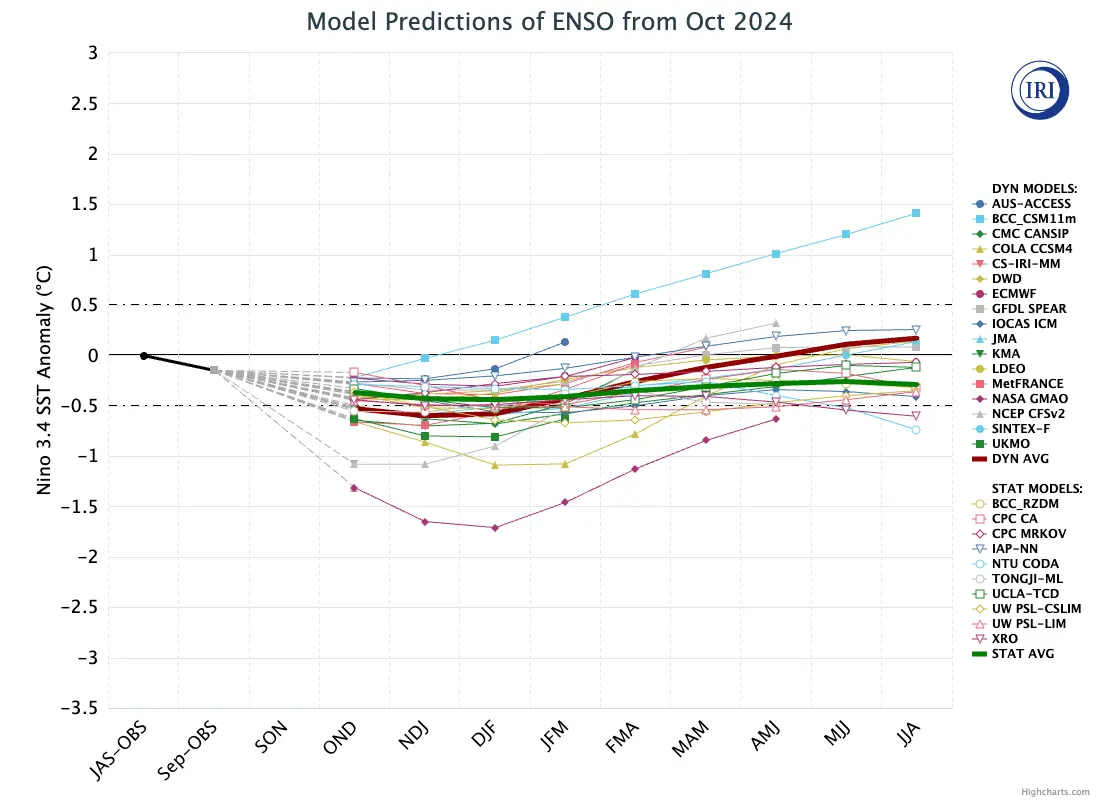
Most models expect neutral conditions in the tropical Pacific, with only a few crossing the -0.5C Niño 3.4 sea surface temperature (SST) anomaly that represents the development of a formal La Niña event.
This should result in relatively cooler temperatures in 2025, though it is possible that the year ends up warmer than anticipated given the continuation of high temperatures in recent months – despite the absence of El Niño conditions.
While global average temperatures are an important indicator of changes to the broader climate system over time as a result of human activities, these impacts will differ as some regions experience more rapid warming or extreme heat events than is reflected in the global average.
The figure below shows the parts of the world that saw record warm or cold temperatures over the first three quarters of 2024 (January through to September) in the Berkeley Earth dataset compared to all prior years since global temperature record began in 1850.
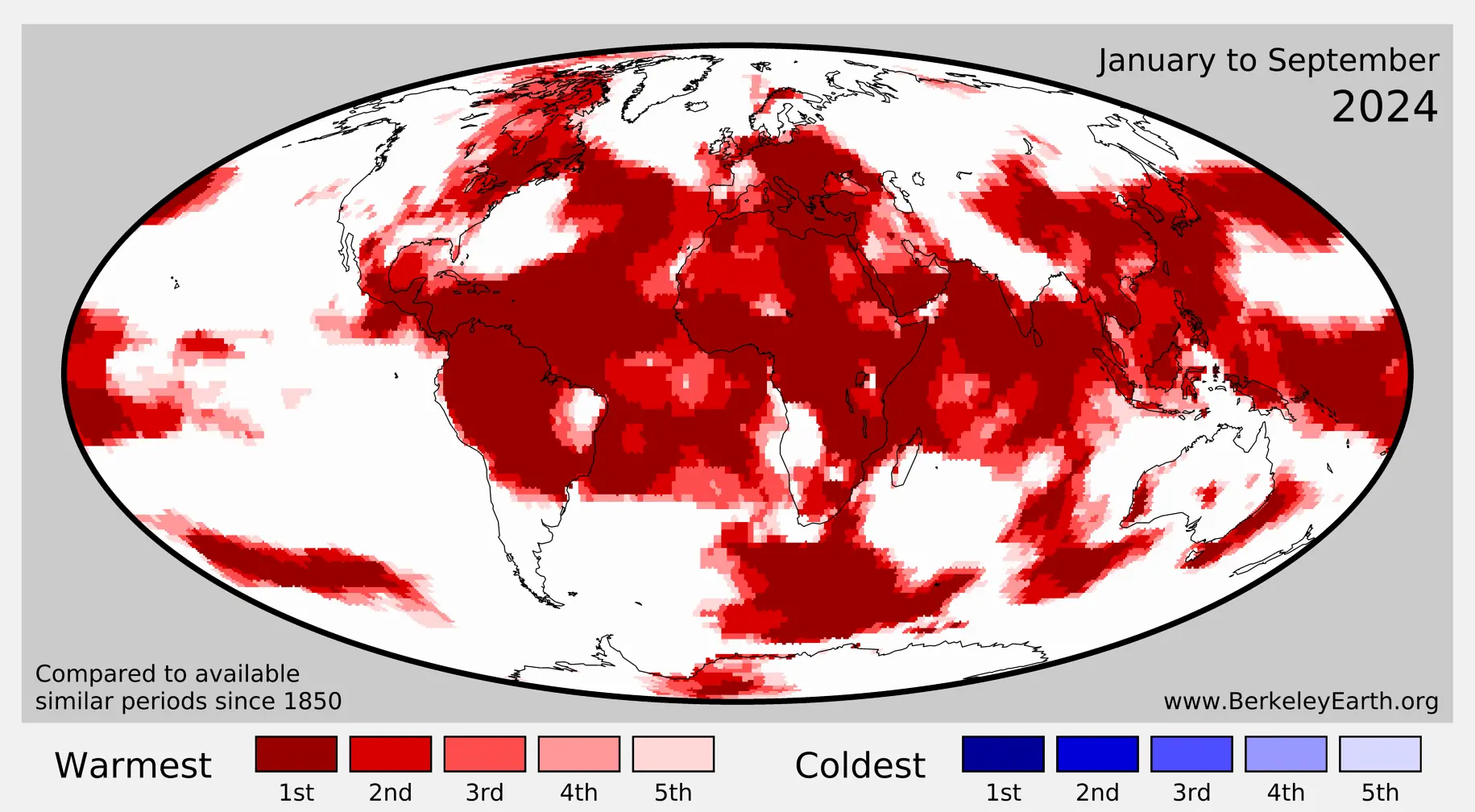
Notably, no area on Earth saw record cold (or even the second, third, fourth or fifth coldest temperatures on record). Nearly all of Central America and large parts of South America saw their warmest year to date on record, as did much of eastern Europe, Africa, China, south-east Asia, and Korea.
The figure below shows the temperature anomaly over the first nine months of the year compared to the 1951-80 baseline period used by Berkeley Earth. Warming was particularly pronounced over land regions, with many areas already showing warming of 1.5C or 2C above that baseline.
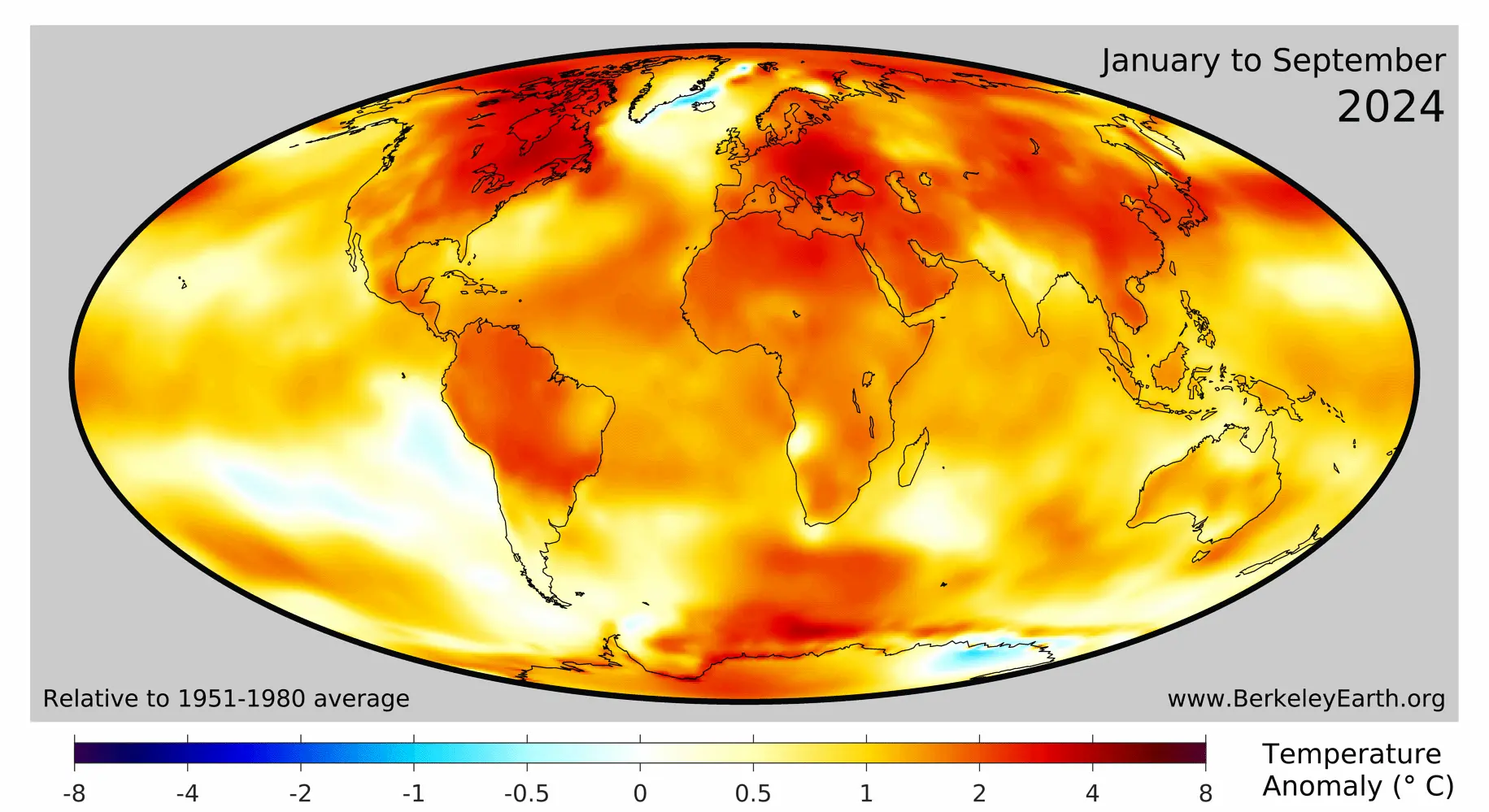
Climate models provide physics-based estimates of future warming given different assumptions about future emissions, greenhouse gas concentrations and other climate-influencing factors.
The figure below shows the range of individual models forecasts featured in AR6 – known collectively as the CMIP6 models – between 1970 and 2030, with grey shading and the average projection across all the models shown in black. Individual observational temperature records are represented by coloured lines.https://interactive.carbonbrief.org/state-of-the-climate/24-Q3/model_obs_comps_Q3_2024.htmlTwelve-month average global average surface temperatures from CMIP6 models and observations between 1970 and 2024. Models use SSP2-4.5 forcings after 2015.Anomalies plotted with respect to a 1981-2010 baseline. Chart by Carbon Brief.
While global temperatures were running below the pace of warming projected by climate models for much of the period between 2008 and 2022, the past two years have been closer to the model average.
However, the CMIP6 models may be biassed a bit too warm, with a subset of “hot” models pushing up the average. The IPCC used an approach that weighted models based on how well they reproduced historical temperatures, rather than simply averaging all the models together.
Excluding these hotter models from the analysis results in observations over recent years much closer to the multi-model average and near the centre of the uncertainty range across all models. It also reveals that the past two years – 2023 and 2024 – have been near the upper end of the model range.https://interactive.carbonbrief.org/state-of-the-climate/24-Q3/model%20_obs_comps_filtered_Q3_2024.htmlTwelve-month average global average surface temperatures from CMIP5 models and observations between 1970 and 2024. Models use SSP2-4.5 forcings after 2015. Anomalies plotted with respect to a 1981-2010 baseline. Chart by Carbon Brief.
Highly accurate observations of Arctic and Antarctic sea ice have been available since polar-observing satellites became available in the late 1970s.
Arctic sea ice extent during the first three-quarters of 2024 has been below or at the low end of the historical 1979-2010 range, but has not seen any record daily lows.
Antarctic sea ice, on the other hand, set new all-time low records for a few days in July and September, and has generally been the second lowest on record (after 2023) from June onwards.
The figure below shows both Arctic (red) and Antarctic (blue) sea ice extent in 2024, the historical range in the record between 1979 and 2010 (shaded areas) and the record lows (dotted black line).
Unlike global temperature records (which only report monthly averages), sea ice data is collected and updated on a daily basis, allowing sea ice extent to be viewed through to the present day.https://interactive.carbonbrief.org/state-of-the-climate/24-Q3/sea_ice.htmlArctic and Antarctic daily sea ice extent from the US National Snow and Ice Data Center. The bold lines show daily 2024 values, the shaded area indicates the two standard deviation range in historical values between 1979 and 2010. The dotted black lines show the record lows for each pole. Chart by Carbon Brief.
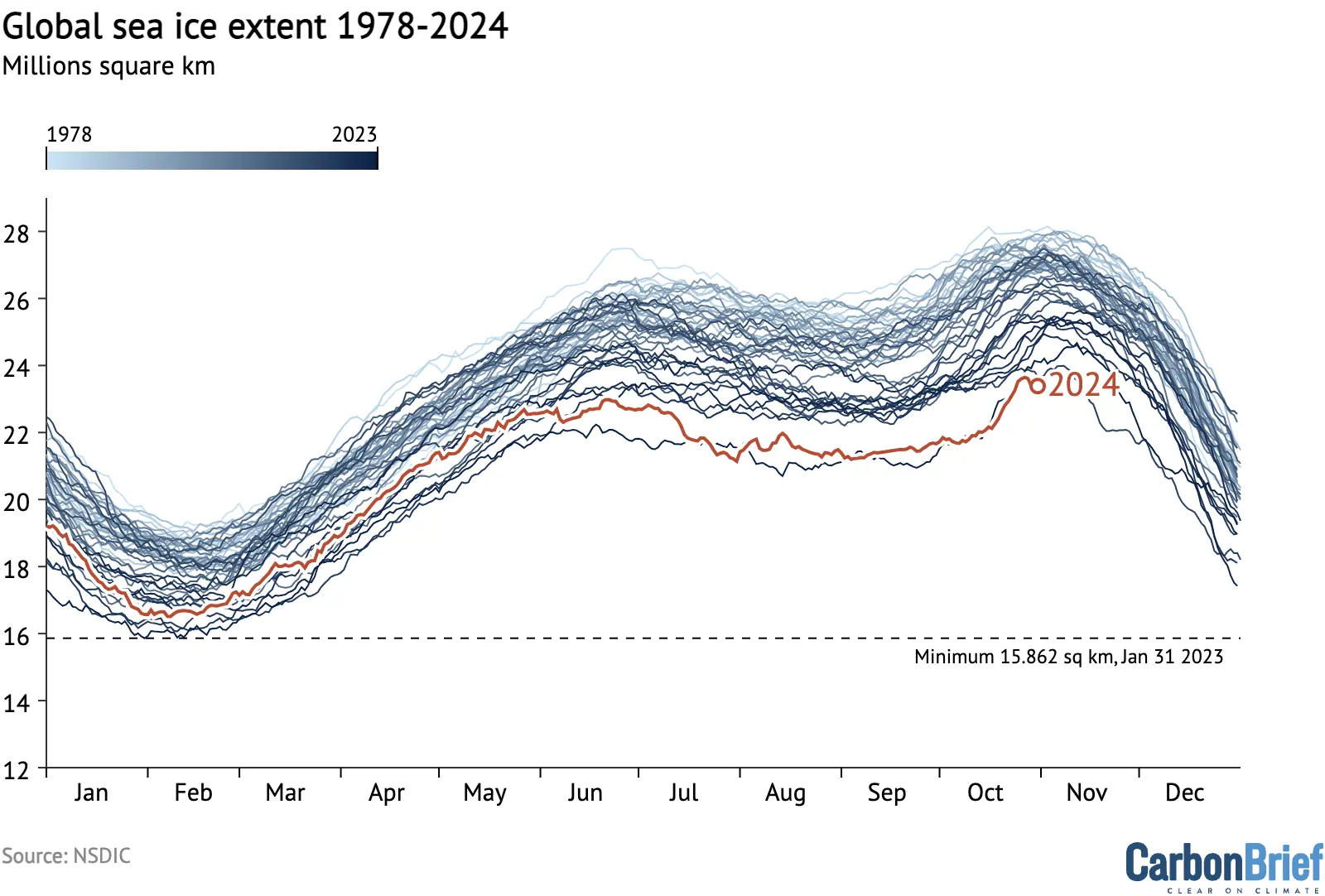
Global sea ice extent is estimated by combining both Arctic and Antarctic sea ice extent. The figure below shows global sea ice extent in each year, with 2024 shown in red. Currently global sea ice extent is at record-low levels, below the prior record for this date set in 2023.
A statistical multivariate regression model was used to estimate the range of likely 2024 annual temperatures for each group that provides a temperature record. This model used the average temperature over the first six months of the year, the average ENSO 3.4 region value during the first nine months of the year and the average predicted ENSO 3.4 value during the last three months of the year to estimate the annual temperatures.
The model was trained on the relationship between these variables and annual temperatures over the period of 1950-2023. The model then uses this fit to predict both the most likely 2024 annual value for each group, as well as the 95% confidence interval. The predicted ENSO 3.4 region values for the last three months of 2024 are taken from the IRI plume forecast.
The percent likelihood of different year ranks for 2024 is estimated by using the output of the regression model, assuming a normal distribution of results. This allows Carbon Brief to estimate what percent of possible 2024 annual values fall above and below the temperatures of prior years for each group, as well as the likelihood of the year exceeding 1.5C in each record.
Original article by Zeke Hausfather republished from Carbon Brief under a CC license.
Original article by multiple authors republished from Carbon Brief under a CC license.
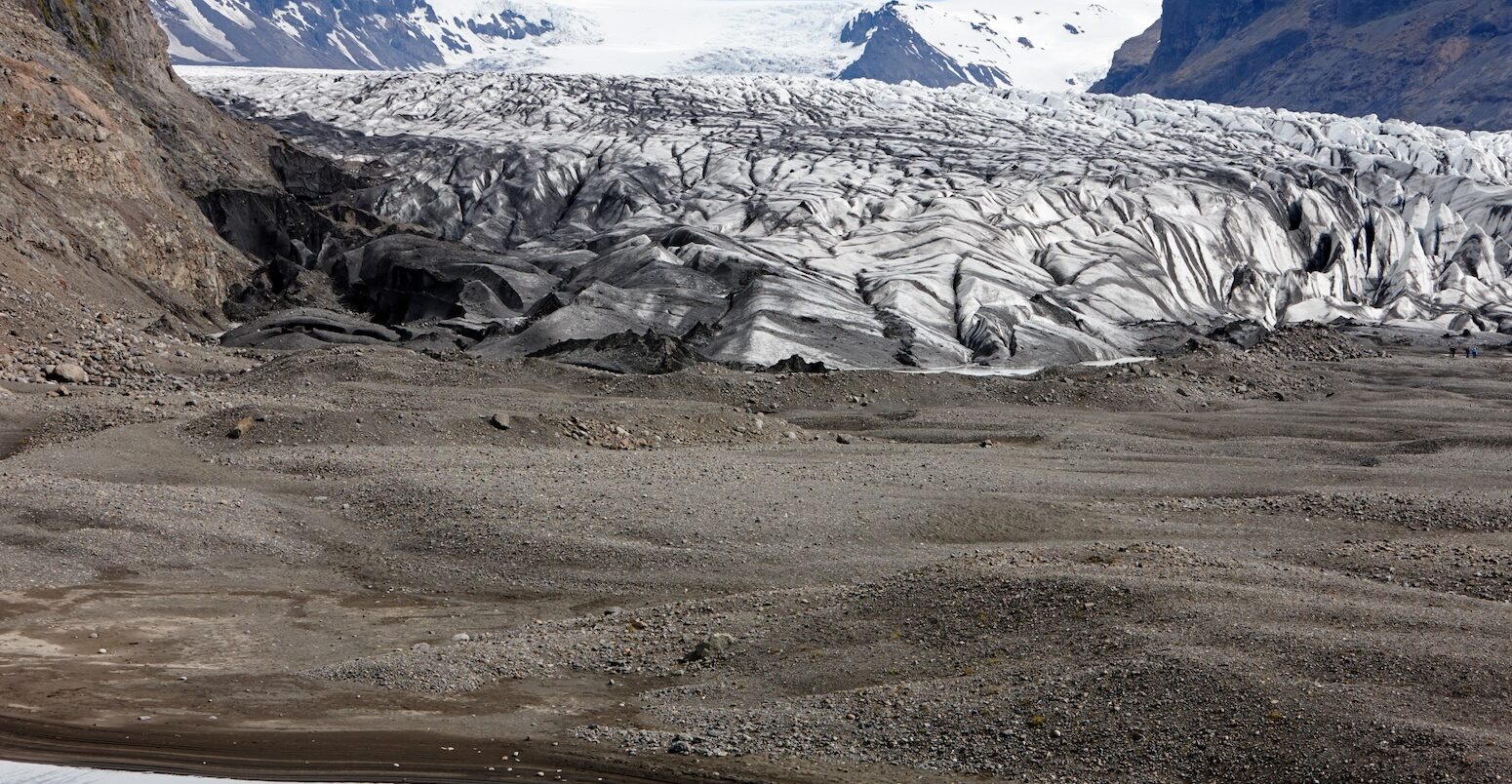
With average global temperatures set to see another record high this year, the chances of holding warming to no more than 1.5C continue to dwindle.
Keeping warming below 1.5C by the end of the century – in line with the long-term goal of the Paris Agreement – now likely involves “overshooting” 1.5C and then bringing temperatures back down later by removing carbon dioxide (CO2) from the atmosphere.
(What this means for “net-negative” emissions is covered in a previous guest post.)
This raises a number of unknowns in terms of what overshoot means for the impacts of climate change on the planet, people and ecosystems.
For example, even if global temperatures can be brought back down again by the end of the century, will the impacts of climate change also reduce? Will coral reefs be able to recover or will glaciers reform? What will it mean for the world’s coastlines, food production and endangered species?
For the past three years, we have been working on a Horizon Europe-funded project called PROVIDE to dive deeper into what overshoot really looks like for countries, regions and cities.
This data is available on the Climate Risk Dashboard – a tool to help people see how climate change will affect them and how it depends on the actions taken today.
Until carbon emissions are reduced to net-zero, the world will not stop warming. Delay will result in ever more intense climate impacts – and increase the risk of crossing irreversible thresholds.
One of the clearest and most acute impacts of climate change is on extreme heatwaves. Our findings suggest that, were global average temperatures to decline, extreme heat events in most locations will also decrease, on average.
But achieving a new balance in local climates would be a slow process, influenced by ongoing climate system adjustments for decades – if not centuries – to come.
Reversing climate change would most probably take several decades, even if overshoot is limited to a few tenths of a degree. This implies that the climate risks that generations alive today will be exposed to are largely determined by collective actions today.
We can illustrate these differences for the risks of extreme heat stress for the Indian city of Chennai, one of 140 cities for which we modelled urban heat stress risks at 100-metre spatial resolution.
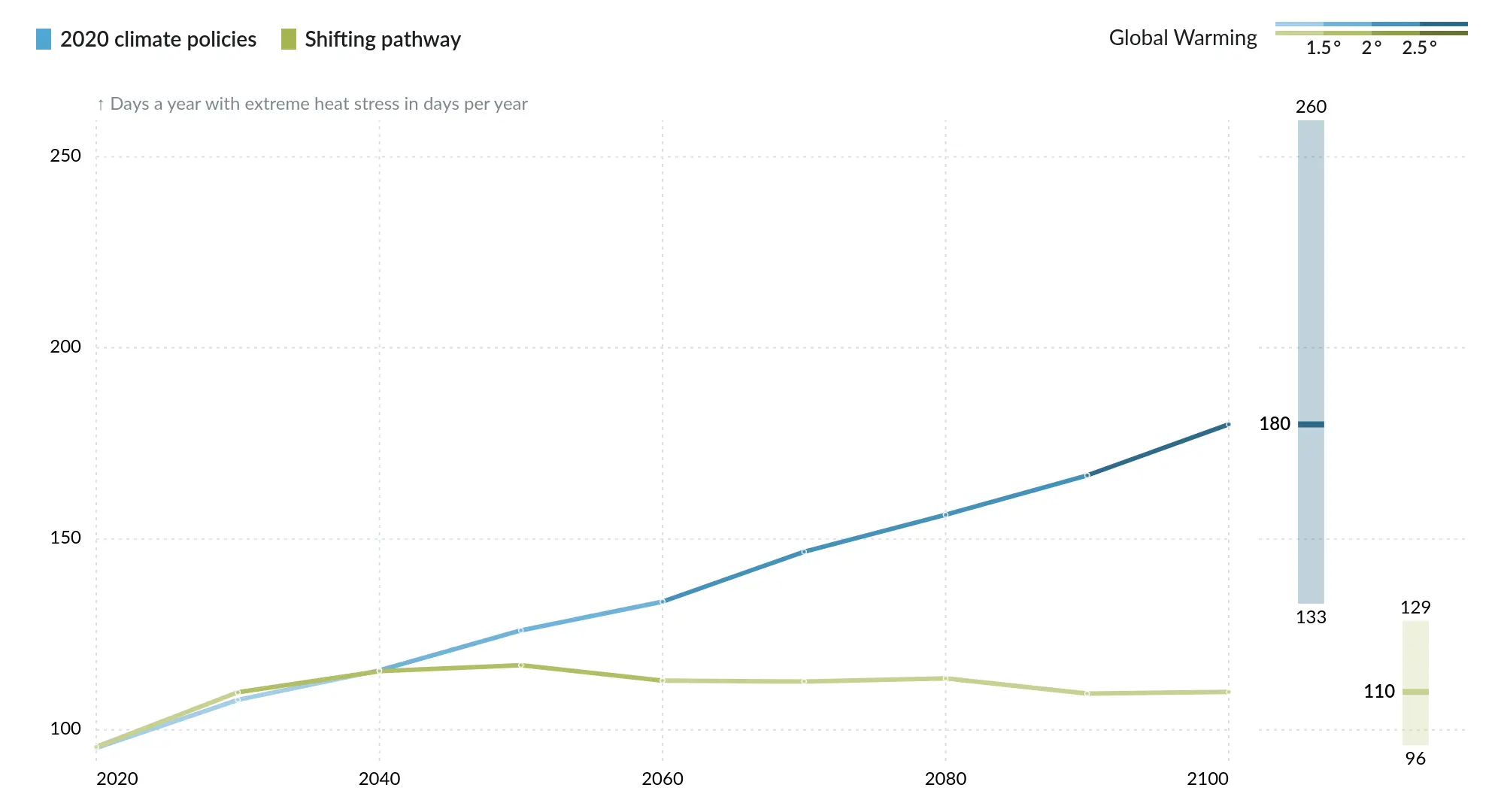
The chart below shows the projected annual number of days of extreme heat stress in Chennai – defined as days where wet-bulb globe temperature (WBGT) goes over 31C. (WBGT is a metric that combines air temperature, humidity and exposure to direct sunlight.)
This level of heat stress approaches the limits of human survivability (without adaptation) – for example, physical outdoor labour is almost impossible under these conditions.
Under current 2020 climate policies, leading to a best estimate of about 3C of warming in 2100, extreme heat days increase pretty much unchecked. By the end of the century, around half of the days (180) per year would experience extreme heat stress conditions (or even higher).
In contrast, in a 1.5C low-overshoot scenario (the IPCC Shifting Pathway), the number of extreme heat stress days would peak mid-century at around 120 days , before declining again to around 110 days by 2100 as global average temperature decreases from just above 1.5C to around 1.3C. This is a modest decline in extreme heat risk, yet a profound difference from a 3C world.
There are many other impacts of climate change that will be irreversible – for centuries to millennia – at peak temperatures, let alone if society is able to bring warming back down.
Coral reef loss, glacier loss, sea level rise and the loss of many species and ecosystems all fall into this category.
Yet, a lot of these losses can still be avoided by stringent mitigation. For example, our multi-scenario framework allows us to explore glacier futures showing unavoidable, or “locked-in”, risks even under the lowest emission scenario we have explored, and compare them with the avoidable risks through stringent mitigation.
Below, we provide an example for glacier volume projections for Peru, where glaciers serve as an essential freshwater resource during the extremely dry season of June to September. Due to past warming, glacier loss will continue over the coming decades. Under a current policy scenario (blue dots), 50% of the glacier volume might be lost as early as 2050.
Yet this does not need to happen. In fact, stringent mitigation pathways (green dots) are still possible that give a four-in-five chance of preserving 50% of today’s glacier ice in Peru, avoiding the worst and helping to maintain some of their vital uses.

Climate change represents a major threat to biodiversity globally. We modelled species at risk from local extinction for about 135,000 terrestrial fungi, plants, invertebrates and vertebrates based on the Wallace Initiative.
Under the assumption that the 1950-2000 reference climate was suitable for the species at question, we model the proportion of species for which the local climate becomes unsuitable under ongoing climate change.
In the chart below, we illustrate the risks to species in one of the countries with the world’s richest terrestrial biodiversity, Brazil. Under the current policy scenario (blue dots), the likelihood of 50% of species being at risk of local extinction rises to 74% by 2100. Yet, our analysis shows that this likelihood can still be avoided almost entirely by stringent mitigation (green dots).

It is important to highlight that species loss does depend on a range of factors – of which climate suitability is only one. Yet there is a range of other human-caused stressors to biodiversity loss and a complex interdependencies of species and food webs in particular in the most biodiverse ecosystems implies the risk of knock-on effects and ecosystem tipping points.
We also note that our results do not necessarily imply global species extinction and do not allow us to quantify if and how species survival under different overshoot trajectories would emerge.
Overshoot outcomes matter for climate risk assessments. Yet, in contrast with the prominence of overshoot pathways in the climate mitigation literature, their implications for adaptation planning have not been widely explored.
Overshoot would increase the threat of climate change that society needs to adapt to – and make that adaptation more difficult. Some options may become unavailable due to limits of adaptation.
Also, timescales matter. Reversing an overshoot will take decades. Even assuming reversibility of climate hazards in the future as temperatures come down, this might only matter for adaptation decisions that involve a planning horizon of 50 years or more.
This is illustrated in the chart below, from our recent Nature study. This shows a stylised trajectory of warming (top chart) with overshoot (red bars) and how it compares to planning horizons for some example adaptation options (green bars), the lifetime of those measures (blue bars) and the intergenerational equity they involve (bottom chart).
The possibility of reversing long-term impacts in the future does not reduce the urgent need to act now on closing the wide gap in current adaptation efforts.

While our results clearly underscore the importance of limiting peak warming to as low as possible, there are also very good arguments for aiming for a long-term global temperature decline, irrespective of the peak warming level.
For a wide range of time-lagged climate impacts, such as ice sheet, peatland and permafrost loss, as well as large-scale irreversible tipping points, achieving temperature decline well below 1.5C is key to limiting long-term risks from global warming.
Overshoot is clearly not an alternative way to achieve a similar climate outcome. Effectively limiting climate risks requires restricting peak warming as low and as close to 1.5C as possible – and then aim for long-term decline to reduce the climate impact legacy of human-caused emissions.
This guest post is by:
Dr Carl-Friedrich Schleussner leads the integrated climate impact group at the International Institute for Applied Systems Analysis (IIASA) and is a scientific advisor at Climate Analytics, Berlin.
Prof Rachel Warren, professor of global change and environmental biology at the University of East Anglia.
Dr Fabien Maussion, associate professor in glaciology at the School of Geographical Sciences, University of Bristol, UK.
Dr Niels Souverijns, urban climatologist at VITO Belgium and guest professor at KU Leuven.
Dr Quentin Lejeune, a climate scientist who has led the development of the PROVIDE Climate Risk Dashboard at Climate Analytics.
Original article by multiple authors republished from Carbon Brief under a CC license.