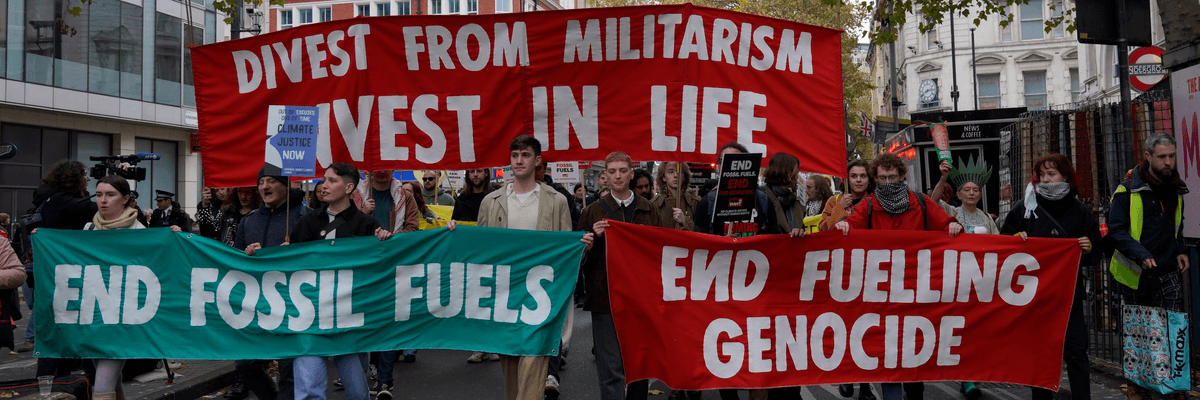
Activists march in London to demand an end to fossil fuels and militarism on November 16, 2024. (Photo: Denise Baker)
“We won’t stop until political leaders divest from war and destruction—and invest in a just, ecological, and equitable transition,” said one campaigner.
Thousands of climate justice advocates took to the streets of London on Saturday to demand the U.K. government “end its reliance on fossil fuels, commit to paying climate reparations, and end its complicity in the genocide in Gaza.”
Organizers said more than 60 groups—including Extinction Rebellion, Friends of the Earth, Greenpeace, Amnesty International U.K., Palestine Solidarity Campaign, War on Want, and Just Stop Oil—took part in the March for Global Climate Justice. The demonstration took place amid yet another shambolic United Nations Climate Change Conference and as Israeli forces continue a war on Gaza that U.N. experts this week called “consistent with the characteristics of genocide.”
More than two dozen associated protests were held in cities and towns across Britain and Ireland, including Dublin, Edinburgh, Manchester, and Sheffield. Over 150 actions around the world are planned for what organizers are calling a Global Day of Action for Climate Justice on Saturday.
“Thousands of us united today in a historic mobilization on the streets of London, across Great Britain, and worldwide to demand an end to the era of fossil fuels and an end to the genocide in Gaza,” Climate Justice Coalition national coordinator Angus O’Brien said in a statement.
“The issues we face are global, and so is our response,” O’Brien added. “We won’t stop until political leaders divest from war and destruction—and invest in a just, ecological, and equitable transition.”
Lauren MacDonald, the lead campaigner at Stop Rosebank, said: “Every day we are witnessing the worsening effects of climate change as they creep closer and closer to home. All this while governments insist on pandering to the demands of mega-polluters in an endless cycle of ignorance that endangers us all.”
“Oil money has been linked to violence throughout history—and this is no different now,” MacDonald continued. “Even the Rosebank oil field here in the U.K. will see £253 million in revenue flow towards a company that has been flagged by the U.N. for human rights violations in Palestine.”
Earlier this week, green groups including Oil Change International, Friends of the Earth Palestine/PENGON, and Tipping Point U.K. highlighted how fossil fuel companies including Britain’s BP “enable and profit from Israel’s genocide in Gaza” and perpetuate “a long history of the industry’s complicity in mass atrocities worldwide.”
Joanna Warrington, a campaigner at Fossil Free London—a group known for its bold direct action protests—said Saturday that “in gleaming London offices, fossil fuel giants like BP line their pockets while our planet burns and millions suffer.”
“Every day, they stop at nothing to maximize their profits, fueling genocide, corrupting politics, and pushing our climate closer to collapse,” she continued. “We are marching today to demand that the U.K. government breaks free from the grip of mega polluters, stands up to their relentless greed, and stops enabling the violence and destruction they profit from.”
“Another world is not just possible—it’s essential,” Warrington added, “and it starts with holding fossil fuel corporations accountable.”
MacDonald asserted that “if we want to maintain a liveable climate, and sever the toxic links between fossil fuels and atrocities across the globe, we must do everything we can to make a rapid and fair transition away from oil and gas.”
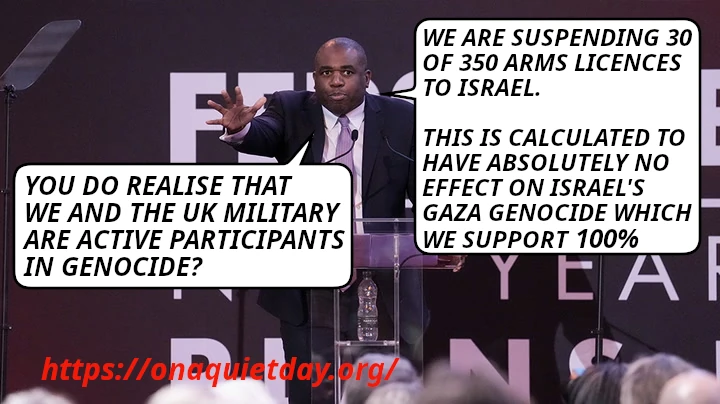
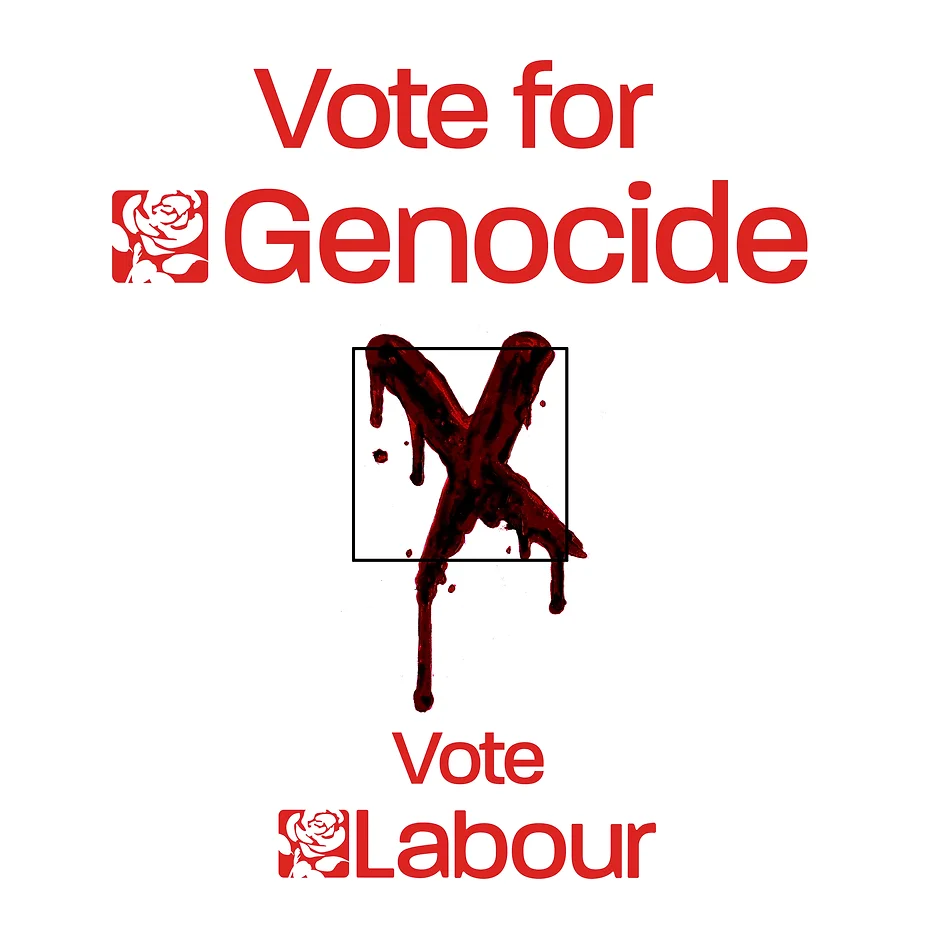
Genocide denier and Current UK Prime Minister Keir Starmer is quoted that he supports Zionism without qualification. He also confirms that UK air force support has been essential in Israel’s mass-murdering genocide. Includes URLs https://www.declassifieduk.org/keir-starmers-100-spy-flights-over-gaza-in-support-of-israel/ and https://youtu.be/O74hZCKKdpAGenocide denying UK Foreign Secretary David Lammy says that UK is suspending 30 of 350 arms licences to Israel. He also confirms the UK government’s support for Israel’s Gaza genocide and the UK government and military’s active participation in genocide.Vote For Genocide Vote Labour.
Italian Prime Minister Giorgia Meloni and British Prime Minister Keir Starmer take a walk after meeting to discuss migration in Rome | Filippo Monteforte/AFP/Getty Images. All rights reserved
There’s no smuggling ‘kingpin’ to take down. Instead, Labour’s security rhetoric risks putting more people in danger
Labour lost no time burying the Conservatives’ tawdry Rwanda plan in favour of something a little more, well, Churchillian. In July, as he welcomed European leaders to Winston’s birthplace of Blenheim Palace, Keir Starmer framed border security not as some nationalist vote-fishing expedition but rather as a pragmatic British undertaking “at the heart of the Government’s reset with Europe”.
It would also involve fighting them on the beaches. Gangs would be suitably smashed, he told his guests, by a new Border Security Command armed with “counter terrorism-style powers”. Elsewhere Starmer has also enthused over Giorgia Meloni’s ‘upstream’ fight against irregular migration — including offshoring asylum processing to Albania and outsourcing crackdowns to Tunisia.
So far, so familiar. If there’s anything European political leaders of different stripes and nationalities have united around since the 1990s, it’s more border security. But what will a counterterror-style crackdown actually achieve this time around?
Is Labour offering anything new on migration?
For some of those relieved to see Rishi Sunak exit stage right, his meaningless “stop the boats” sign tucked under his arm, there are grounds for optimism. The counterterror rhetoric, they say, hides humane openings elsewhere, especially when it comes to breaking the massive backlog of asylum cases. Respecting the European Court of Human Rights also looks like a welcome return to normality – and legality.
Starmer has further promised that his approach will be more cost-efficient. That’s easy enough to believe, as it’s hard to imagine anything more wasteful than spending “£700m to persuade four volunteers to go to Rwanda,” as Starmer himself described it. Supporters will add that smuggling is a rapacious business. Going after its economics is key, as is respectful collaboration with partner states rather than grandstanding. Reinstating EU returns (lost after Brexit), cracking down on smugglers, and expediting asylum cases will work where ‘invasion’ rhetoric failed.
In this take, Starmer offers strategic “competence with compassion” that also helps placate the tabloids. It’s a method that, if it works out, means everybody wins except the cold-hearted smugglers.
Not so fast. A brief look at the past decades’ border dynamics suggests that Starmer’s initiatives may well end up being as gimmicky as those they replace. If politicians genuinely want to stop profiteering as people drown in the English Channel or the Mediterranean Sea, they must first understand the drivers of migration and the smuggling business. Otherwise they will simply fail again – with more lives lost, and even harder rhetoric to come from the hard right.
Smuggling 101: supply and demand
It’s peculiar how difficult it is for mainstream politicians, who are otherwise so keen on market economics, to learn that human smuggling is a market driven by demand. It responds to incentives, and its strongest incentive by far is the disappearance of legal routes. The market is further buoyed by crackdowns of the kind seen around the Channel Tunnel in recent years. The displacement of routes has predictably increased danger and desperation – and thus reliance on professional smugglers. The border security system perversely feeds on the very problem it ostensibly combats.
True, deterrence-signalling measures may put a damper on the market – for a while. Cue Starmer’s nod towards Italy, where Meloni and her authoritarian Tunisian partner claim credit for bringing down maritime migration this past year. But sooner or later, the market will re-emerge unless the underlying dynamics and drivers are addressed.
Ever-tougher approaches targeting the supposed ‘kingpins’ have merely shifted the modus operandi
Reproducing new versions of the same threat and then combating them again is bad enough. But Starmer’s reference to counterterrorism — now accompanied by a doubling of the funding for the new Border Security Command — raises additional red flags.
Consider the US Homeland Security behemoth spawned by the George W. Bush administration after 9/11. Rather than changing dynamics at the US-Mexico border – the stage of spectacular enforcement all through the 1990s – it worsened it.
The cartels started playing an unpaid role in ‘prevention through deterrence’. At the same time, border crackdowns and technology imported from the war on terror pushed migrants away from smaller smuggling operations and into the hands of larger, more predatory players with the necessary economic margins.
Yet that inconvenient reality was never really acknowledged. As I heard some years ago, Customs and Border Protection bureaucrats repeatedly magicked up models showing their method ‘works’ by denting the revenue of smugglers and ramping up deterrence. It didn’t. Instead it reproduced a deadly dynamic and spawned fresh political crises.
Or consider Italy itself. Rome has deployed anti-mafia methods against smugglers, but it has little to show for these efforts except perverse results such as jailing a presumed “Al Capone of the desert”, who was later released in a case of mistaken identity. As the man’s lawyer said, “After three years, finally the judge confirmed what we have been saying: we had a farmer in jail and a smuggler at large.” The prosecutors kept insisting they had the right man, waging a war less on smugglers than on reality.
Fighting an elusive enemy
For years, ever-tougher approaches targeting the supposed ‘kingpins’ have merely shifted the modus operandi, in Libya and elsewhere. Instead of piloting a boat, the smugglers make passengers steer it. The latter then bear the legal — or lethal — consequences when it is seized or sinks.
People on the move, of course, also adapt their behaviour to crackdowns. As one Senegalese man explained to me 15 years ago, before his wooden fishing boat approached the Canary Islands, he threw “food, GPS and the compass into the sea”. The shift in tactics in response to enforcement has hugely increased the risk, pushing responsibility of the vessels onto migrants who cannot navigate or do not want to be seen doing so.
It is possible that Labour’s smuggling crackdown will not get stuck either in the bureaucratic swamp of ‘Homeland Security’, or get distracted by the catch-the-small-fry fracas. But its own alarmist rhetoric, combined with tabloid and Tory pressure, feed bureaucratic incentives to produce ‘results’ – and these are the easiest ways of showing such results. So beware the hyperbole: it makes meaningful ‘results’ more difficult to achieve.
Underneath all the tactics and rhetoric, however, a more fundamental analytical problem is lurking. Unless the threat has been correctly diagnosed, there’s little chance the remedy will work.
Starmer’s approach is based on the idea that smuggling is in the hands of very well-organised, transnational crime. That there is, somewhere, a kingpin to take down. But while it is true that human smuggling has become more predatory, profitable and professional as the market has grown with each short-sighted crackdown, that model is, at absolute best, extraordinarily incomplete.
The outsourcing of draconian migration controls has benefited repressive state and para-statal actors, while increasing the very dangers that drive people to move
Precision is needed, not alarmism. On the Spanish borders, for instance, politicians, police and reporters for years talked of ‘mafias’, even while small operators and migrants themselves kept organising crossings.
‘Upstream’, in North Africa and the Sahel, the authorities themselves are involved. They benefit from the security largesse provided by their European ‘partners’ in fighting irregular migration, and from the ever-increasing bribes needed to evade their own controls. Rather than a straightforward ‘battle’ between clear adversaries, we see here more of a symbiosis between the border security and smuggling businesses.
The outsourcing of draconian migration controls has benefited repressive state and para-statal actors, such as Libya’s militias, while increasing the very dangers that are driving people to move with the aid of smugglers. If we account for this political dynamic, Meloni’s ‘success’ looks fragile indeed. It is based on a drop of arrivals in 2024 from the previous year. Yet the chaos in Italian ports in 2023 was, to no small extent, the result of Tunisia’s president using African migrants as a bargaining chip with Europe.
Kelly Greenhill has called it “weapons of mass migration”. It’s something the EU says it wants to combat. Instead, European leaders seem to be rewarding it.
The smuggler factory
A ‘counterterror’ approach to smuggling, combined with further reliance on non-European buffer states, risks further skewing the border-crossing market from smaller players to more organised and rapacious ones while shifting the risks from smugglers to their increasingly desperate passengers. This, in turn, risks fuelling the trend towards captive markets that we see today from Libya to northern Mexico.
It’s been said many times that a ‘war on smugglers’ swiftly turns into a war on migrants. As David Keen and I show in our book Wreckonomics, politicians have kept learning the wrong lessons from their various short-sighted ‘wars’ against smuggling, terror, crime and drugs.
They keep choosing to go in hard with the security theatre and target the symptoms not the causes, hoping to reap short-term electoral rewards. They keep producing figures showing that the ‘fight’ is succeeding – and numbers may even really go down for a bit. But they don’t create sustained change. Look at the long term and we see above all a displacement of routes and methods – whether in the Channel, the Mediterranean or across the Rio Grande – with a corresponding boost for the smuggling market.
Starmer may still play smart and prioritise reinstating European returns, speeding up processing, and going after the big players and the money. The UK does not have Italy’s Mediterranean border, after all, and its main ‘outsourcing’ partner is France not Libya.
But in this context, it’s all the more worrying that we hear the language of counterterror and ‘upstream’ controls dominate the messaging. If the measures don’t match the problem, and if the relevant actors themselves remain poorly understood, the problem will simply keep being reproduced — as indicated by the past two decades of Labour and Tory enforcement efforts around the Channel.
For a more visionary political figure there is surely a chance here to offer a different kind of security
To Starmer’s supporters — eyeing tabloids and Faragists on the warpath — the gambit may still look appealing, or at least like some kind of lesser evil. Yet here awaits one further fallacy. For if there’s one other group besides smugglers that has predictably and consistently gained from ‘securitisation’ over the past decades, it is the far right.
Offering a lighter version of hard-right securitisation simply increases voter appetite for the full-fat version. The political appeal of repeatedly announcing an ‘emergency’ or ‘invasion’ is not based on numbers. Channel crossings, we know, are vanishingly small relative to overall immigration into the UK. But if the big politics of ‘small boats’ is not driven by numbers, the corollary is that even if Starmer were to get numbers down temporarily, the appetite for more border security would remain.
Starmer’s problem today is that of the left in general, which increasingly finds itself trapped in security logics — something we’ve equally seen in the recent US elections. This is unfortunate, since for a more visionary political figure there is surely a chance here to offer a different kind of security.
Instead of dismissing legal pathways, for instance, these could be reframed as bringing humanity, control and predictability to migration policy — while fundamentally creating a disincentive to use smugglers, as border guards themselves often insist.
Instead of trumpeting ‘counterterror’, there is scope for a sophisticated overarching strategy against organised crime and exploitative actors that targets the regulations and loopholes that these actors feed upon. This means working inland, where the exploitation of migrant labour, for instance, is a huge and neglected problem. Waiting in the wings is also a much wider conversation about how politicians’ economic choices and foreign policy fuel migration and displacement.
But all this involves open democratic debate and oversight. Counterterror approaches have tended to do the opposite: fuel a fear-based politics, increase secrecy, sidestep audits, benefit the big criminal players and corrupt partner authorities. They also unfailingly feed the very crises forcing people to leave countries such as Afghanistan in the first place.
A Churchillian rhetoric of unity-through-security is tempting. So is the language of counterterror. But to end with a warning from the failed war on terror, let’s perhaps listen to Richard C. Holbrooke, the US special representative to Afghanistan and Pakistan, who said: “We may be fighting the wrong enemy in the wrong country.”
Starmer may at least be in the right country. But if he insists on misunderstanding the problem he will confront the wrong enemy yet again.
Explore the rest of the series
This series looks at how the UK, EU and bordering countries are increasingly treating migration as a criminal offence, and targeting migrants and solidarity actors in the name of ‘anti-smuggling’ and ‘border control’.
Caught in the net: how migration became a criminal offence Melissa Pawson, Vicky Taylor
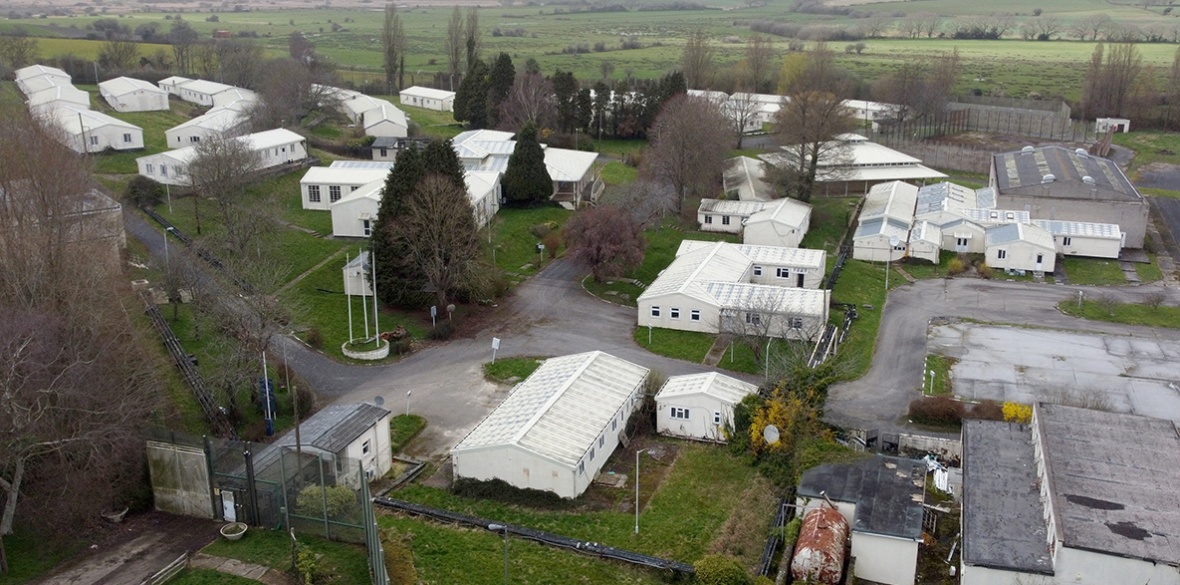
A view of HMP Northeye in Bexhill-on-Sea, East Sussex, which the Home Office bought for £15 million
Government urged to put ‘clear distance between it and the cruel, wasteful camps policy held by the previous one’
THE HOME OFFICE failed to rule out housing asylum-seekers in an asbestos-filled former prison today after the government’s spending watchdog blasted the Tories for wasting £15 million on it.
Tory ministers Robert Jenrick and Oliver Dowden “cut corners” and made “poor decisions” when they paid for the Northeye site in East Sussex, a damning National Audit Office (NAO) report said.
The “rushed and misjudged” decision was made despite the “technical due diligence and approvals process not having been undertaken.”
Shadow justice secretary Mr Jenrick announced that Northeye would be developed to house 1,200 people a month after an environmental review had identified a contamination risk from “asbestos-containing materials in existing buildings and contaminated ground” in February 2023.
The diligence report also estimated the cost of repairs to buildings at the site to be £20m.
…
Jeff Newnham, who leads the Save Northeye campaign against the development, told the Star that the asbestos-contamination risks were widely known following a fire at the former prison in the 1980s.
Labour said the report “raises serious questions about [new Tory leader] Kemi Badenoch’s judgement to appoint someone to her shadow cabinet who has no regard for public money.”
But the Home Office declined to rule-out housing asylum-seekers at the site themselves when asked by the Morning Star today.
The department has not finalised its plans for Northeye but insisted that it “will always act in the best interests of the taxpayer.”