Original article republished from MEMO under a Creative Commons Attribution-NonCommercial-ShareAlike 4.0 International License.
Former Labour Party leader Jeremy Corbyn makes a speech attending a protest against the Israeli army’s attack on displaced civilians in Al-Mawasi, on September 12, 2024 in London, United Kingdom. [Raşid Necati Aslım – Anadolu Agency]
Former Labour leader, Jeremy Corbyn, and the Independent Alliance of MPs have issued two letters challenging Prime Minister, Keir Starmer, and Attorney-General, Lord Hermer, KC, over their position on Israel’s genocide in Gaza.
The letters follow Starmer’s recent denial in Prime Minister’s Questions that Israel is committing genocide in Gaza, a stance echoed by Foreign Secretary, David Lammy, who claimed such descriptions “undermine the seriousness of that term”.
In their letter to Starmer, the MPs directly challenge his “flippant denial of genocide”, stating it “egregiously downplays the suffering of Palestinians and shows blatant disregard for international law.” They remind the Prime Minister that genocide’s legal definition focuses on intent rather than numbers killed, citing Article 2 of the Genocide Convention.
“It is difficult to avoid the conclusion that your denial of the genocide in Gaza is rooted in the knowledge that, if you accepted the true scale of what is happening, you would be admitting your government’s ongoing complicity in crimes against humanity,” the letter states.
In their letter to Starmer, the MPs specifically ask whether the Prime Minister “sought or received any legal advice from the Attorney-General over the definition of genocide and its applicability to the situation in Gaza.” The letter demands to know if he has “received any other legal advice on this matter” and when such advice will be made public.
The group’s letter to Attorney-General, Lord Hermer, KC, specifically questions whether he has provided legal advice to the Prime Minister regarding the definition of genocide and its applicability to Gaza. They ask whether “the Prime Minister and the Foreign Secretary have publicly contradicted the findings of UN reports and pre-empted decisions of international courts on this issue.” Isreal is currently under investigation by the International Court of Justice (ICJ) for genocide.
The intervention comes as multiple international bodies have called Israel’s aggression in Gaza genocide. A UN Special Committee recently concluded that “the policies and practices of Israel during the reporting period are consistent with the characteristics of genocide,” including “the targeting of Palestinians as a group” and using “starvation as a weapon of war.” The MPs note that the ICJ ruled in January that Palestinians face a “real and imminent risk of irreparable prejudice” to their right to be protected from genocide.
Both letters demand transparency about any legal advice received regarding the definition of genocide and its application to Gaza. The Independent Alliance, which includes MPs Adnan Hussain, Ayoub Khan, Iqbal Mohamed, Jeremy Corbyn, and Shockat Adam, also calls for an end to UK arms sales to Israel.
The parliamentary challenge coincides with Pope Francis’s call for an investigation into whether Israel is committing genocide in Gaza, adding to growing international pressure for accountability over Israel’s military onslaught which has claimed the lives of 44 thousand Palestinians, the overwhelming majority of whom are women and children.
Original article republished from MEMO under a Creative Commons Attribution-NonCommercial-ShareAlike 4.0 International License.
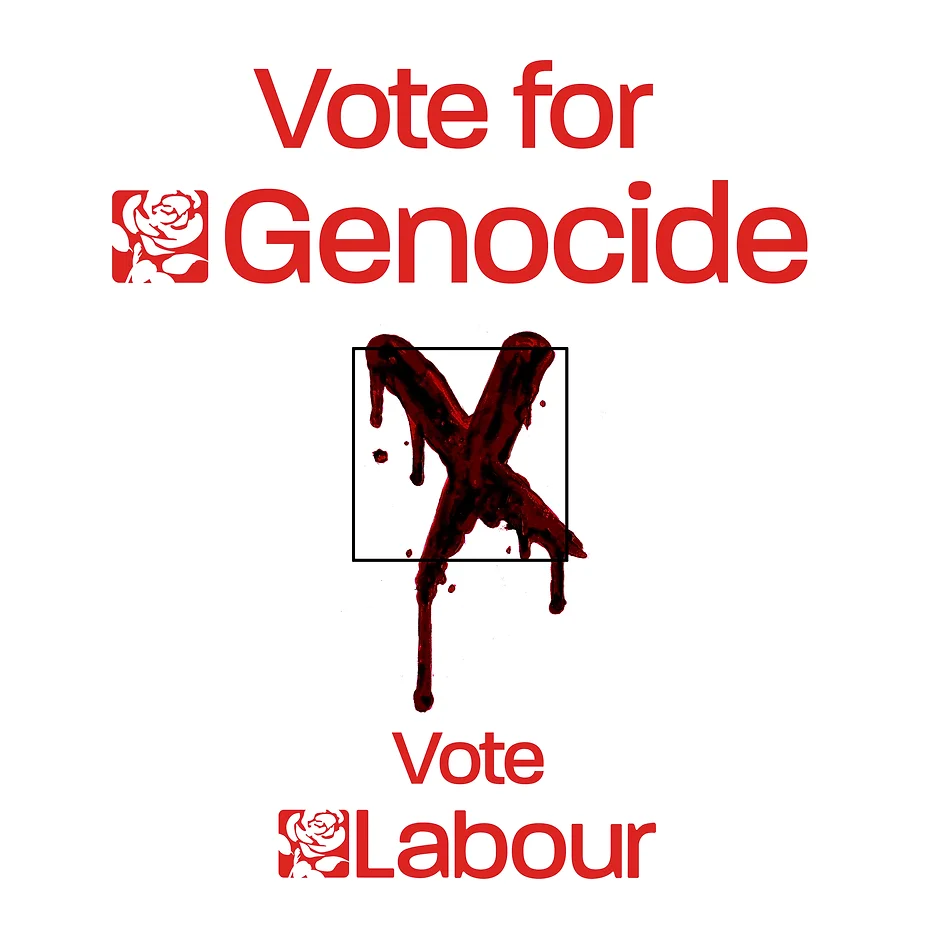
Genocide denier and Current UK Prime Minister Keir Starmer is quoted that he supports Zionism without qualification. He also confirms that UK air force support has been essential in Israel’s mass-murdering genocide. Includes URLs https://www.declassifieduk.org/keir-starmers-100-spy-flights-over-gaza-in-support-of-israel/ and https://youtu.be/O74hZCKKdpAGenocide denying UK Foreign Secretary David Lammy says that UK is suspending 30 of 350 arms licences to Israel. He also confirms the UK government’s support for Israel’s Gaza genocide and the UK government and military’s active participation in genocide.
Original article by Misbah Khan republished from TBIJ under a Creative Commons Attribution-NonCommercial-NoDerivs 3.0 Unported License.
Israeli blockades and bombings have left doctors without basic medicines to treat infections
Content warning: This story contains graphic images and descriptions of injuries
There is a growing and dire public health crisis taking place in Gaza. Israeli blockades and hospital bombings are fuelling a superbug emergency, with civilians who survive starvation and injury later facing untreatable, life-threatening infections.
Doctors on the ground told the Bureau of Investigative Journalism (TBIJ) they were treating wounds infested with maggots and using vinegar to fight infections.
“Wounds are left open much longer [and the] injured are delayed in receiving proper care or not able to get care at all, which increases the risk of infections and emergence of antimicrobial resistance [AMR],” says Krystel Moussally, an epidemiologist monitoring the situation for Doctors without Borders (MSF).
The infections are so severe that they don’t respond to many of the antibiotics that are designed to treat them. Badly infected wounds can lead to limb amputations and, in some cases, death.
Vinegar is being used to disinfect and treat wounds because other medicines are unavailable. Dr Khaled al Shawwa
Medical organisations, including MSF and Medical Aid Palestine, say that targeted bombings of hospitals and humanitarian aid blockades are restricting access to healthcare in Gaza, exacerbating infections that don’t respond to essential medicines.
In some cases, doctors have run tests to discover that infections can be fought with certain antibiotics – but have not been able to get their hands on the life-saving drugs.
‘I’ve never seen these types of cases before’
As explosions sound in the background, Dr Alaa Alshurafa tries to relay her day-to-day experience treating superbug infections in Gaza city. Over a WhatsApp call that keeps cutting out, she conveys the damage these drug-resistant infections are inflicting in the war zone.
Dr Alaa, 30, was forced to flee her home in northern Gaza with her family after the war began. Despite this, she is serving as a doctor at one of the medical points set up by The International Federation of Red Cross and Red Crescent Societies (IFRC) in Gaza city.
Every morning, before she leaves for work, she checks that no one on her route has reported a warning from the Israeli Defense Force of a potential airstrike. The clinic is a 15-minute walk from where she lives. She has to do the journey on foot, leaving her exposed to a potential attack by drone, air or sniper.
Dr Alaa al Shurafr’s walk to her clinic takes her past rubble. Dr Alaa al Shurafr
Once she does arrive at the clinic, the medical point is flooded with more than a hundred patients a day.
When she spoke to TBIJ, she was facing an outbreak of impetigo, a highly contagious bacterial skin infection most common in children. It causes blisters and itchy sores and is usually treated with an antibiotic cream.
“I’ve never seen these types of cases before,” Dr Alaa said. “It’s a very severe form of impetigo, an extensive form which includes faces and the whole body. We don’t have sufficient antibiotics.”
What little medicine is available is extremely expensive and while it does work sometimes, it is not always effective. “I’ve seen many cases that come again and again because of failure of treatment,” she said. “The rate of reinfection [could be] because of overcrowding and maybe misuse of antibiotics or nonadherence to the antibiotic regime plays a role.”
The most common type of bacteria that leads to impetigo is Staphylococcus aureus. A drug-resistant variant of this bacteria is behind the MRSA superbug.
70% of Staphylococcus aureus infections in wounded patients in Gaza are the MRSA superbug strain
MRSA infections are resistant to many common antibiotics, making them severe and even potentially fatal.
Moussally, the MSF epidemiologist, said: “It might be that this type of infection is difficult to treat not only because of [lack of] access to oral antibiotics, but more so because of a high resistance of the Staphylococcus bacteria causing it.”
Without adequate laboratory testing it is hard to say if the bacteria has developed stronger resistance.
Moussally’s work tracking drug-resistant bacteria in Gaza dates back to before 7 October and the start of the war. Then, MSF could monitor infections through labs at Nasser and Al-Awda Hospitals in Gaza. But over the course of the war, both hospitals have been besieged and attacked, making lab tests extremely challenging.
However, data collected by MSF at the hospitals from 2019 to 2023 showed that more than 70% of Staphylococcus aureus in wounded patients was the MRSA superbug strain.
Even before the war, superbugs were already a problem in Gaza; TBIJ reported on the issue as far back as 2018.
Open wounds left to fester
Content warning: graphic imagery below
In Gaza’s remaining hospitals, surgeons are overwhelmed by critical cases. Patients with open, but not initially deadly, wounds that need reconstructive surgery are lower priority, and often forced to wait or seek help at Red Cross and Red Crescent medical points.
Any length of time a person spends with their flesh or, in many cases, bone exposed raises the risk of superbugs and – as multiple doctors report – maggots.
“It is not uncommon to see explosive injury patients with limb injuries and open fractures to develop infections either from the wound itself or from… operations,” says Dr Abdulwhhab Abu Alamrain, who currently works in the orthopaedic department of a government hospital.
A leg injury, which developed a drug-resistant infection, sustained by a 35-year-old man in an explosion in September
Pseudomonas aeruginosa is another highly drug-resistant bacteria. It can infect wound dressings, causing bandages to turn green and smell like mown grass. Doctors in Dr Abdulwhhab’s orthopaedic department have seen cases; tests, available at a few private labs still operating in Gaza and seen by TBIJ, show some Pseudomonas infections don’t respond to any antibiotics at all.
Dr Abdulwhhab said: “This results in two options, either amputation or refusal [of an amputation] and face death. Unfortunately, we have seen many cases that have died either because of refusal or because they accept [the amputation] at the last moment [and die] waiting for surgery or on the operation table.”
Lessons from history
This is not the first time war has worsened a superbug crisis. During the war in Iraq, a lethal strain of the drug-resistant bacteria Acinetobacter baumannii infected American soldiers. Media at the time called it ‘Iraqibacter’.
The superbug infections weren’t confined to the borders of Iraq. Injured soldiers lost limbs, suffered sepsis, and some died back home in US hospitals after their wounds became infected with the bacteria.
The emergence of this strain of Acinetobacter baumannii was detected after its spread in the US hospitals. But due to the lack of testing capacity in Iraq, the extent to which it affected Iraqi civilians at the time is unknown.
“Iraq is a lesson about what war has done and why we have an ongoing crisis of AMR in a place like Iraq. We need to learn these lessons,” said Dr Omar Dewachi, an Iraqi medical anthropologist who narrates the touring exhibit The Pathogen of War.
Acinetobacter baumannii infections have also been reported in Gaza.
Using vinegar as medicine
With so many patients and so few drugs, some doctors report resorting to using vinegar to disinfect and treat wounds.
Moussally said: “Partially functioning hospitals are overcrowded with a huge caseload of injuries, lack of basic supplies needed to treat infections and do proper wound care management and are functioning with sub-standard infection prevention and control measures being the best they can do under the conditions they face. All of this drives AMR.”
Dr Khaled al Shawwa came home to Gaza city from Jerusalem to visit his family for the weekend on 5 October 2023 – two days before the Hamas attacks. He has been in Gaza ever since. He was previously a GP and had just completed his surgical qualification in Jerusalem.
He now works in the outpatient department at a clinic set up by MSF. There he deals with 80-130 patients a day. He told TBIJ: “We see Pseudomonas very frequently and sometimes we use vinegar, we apply it on the wounds. Nurses have a bottle of vinegar on the wound-dressing shelf.”
(Video may not appear for users who do not accept cookies)
The World Health Organization has repeatedly raised concerns about drug-resistant strains of Pseudomonas.
The best practice to prevent bacteria gaining resistance to even more antibiotics is to treat infections carefully with specific drugs, preferably after lab testing to make sure the medicine will work. In Gaza, however, doctors have to work with what they have.
“Drugs are not always available. We are guided by the availability of the drugs and availability of the tests. Where I work, the drugs come in shipments and donations. In some shipments you have one or two types of antibiotics. You don’t have many options … It’s not your decision,” Dr Khaled said.
Despite the limited resources, he and his colleagues at the local pharmacies have concocted a mixture of available antibiotics and steroids to try to treat difficult infections. “You have to do anything. You can’t just leave the patients alone.”
Israel Defense Forces did not respond to TBIJ’s request for comment.
Header image: The wreckage of an ambulance at the Kamal Adwan Hospital in northern Gaza. Credit: AFP via Getty Images.
Reporter: Misbah Khan Video editor: Katia Pirnak Global Health editor: Fiona Walker Deputy editors: Chrissie Giles and Katie Mark Editor: Franz Wild Production editor: Frankie Goodway Fact checker: Somesh Jha Additional contributor: Hitham Toman
TBIJ has a number of funders, a full list of which can be found here. None of our funders have any influence over editorial decisions or output.
Original article by Misbah Khan republished from TBIJ under a Creative Commons Attribution-NonCommercial-NoDerivs 3.0 Unported License.
Genocide denier and Current UK Prime Minister Keir Starmer is quoted that he supports Zionism without qualification. He also confirms that UK air force support has been essential in Israel’s mass-murdering genocide. Includes URLs https://www.declassifieduk.org/keir-starmers-100-spy-flights-over-gaza-in-support-of-israel/ and https://youtu.be/O74hZCKKdpAGenocide denying UK Foreign Secretary David Lammy says that UK is suspending 30 of 350 arms licences to Israel. He also confirms the UK government’s support for Israel’s Gaza genocide and the UK government and military’s active participation in genocide.
Downing Street accepts ‘clear risk’ that fighter jet parts sold to Israel could be used to violate international humanitarian law, High Court hears
THE British government accepts there is a “clear risk” that parts for lethal fighter jets might be used by Israel to violate international humanitarian law but continues to export them anyway, the High Court heard today.
Global Legal Action Network (Glan) and human rights group Al-Haq have brought legal action against the Department for Business and Trade, accusing it of breaking its own rules by continuing exports if there is such a risk.
Between October and May, former business secretary Kemi Badenoch approved over 100 licences to Israel throughout its brutal onslaught on Gaza.
In September, the new Labour government eventually moved to ban just 30 out of 361 licences, excluding components for F-35 jets.
Described by its manufacturer Lockheed Martin as the “most lethal” fighter jet in the world, F-35s have been used extensively in Israel’s bloodshed.
Capable of dropping 2,000lb bombs, they are linked to the murder of 90 people in the al-Mawasi “safe zone” in July.
There are 79 companies registered in Britain that hold licences to export parts for the jet.
Genocide denier and Current UK Prime Minister Keir Starmer is quoted that he supports Zionism without qualification. He also confirms that UK air force support has been essential in Israel’s mass-murdering genocide. Includes URLs https://www.declassifieduk.org/keir-starmers-100-spy-flights-over-gaza-in-support-of-israel/ and https://youtu.be/O74hZCKKdpAGenocide denying UK Foreign Secretary David Lammy says that UK is suspending 30 of 350 arms licences to Israel. He also confirms the UK government’s support for Israel’s Gaza genocide and the UK government and military’s active participation in genocide.Vote For Genocide Vote Labour.
Pope Francis speaks on December 25, 2023 in the Vatican City.(Photo: Alessandra Benedetti/Corbis via Getty Images)
The pontiff’s call comes as the International Court of Justice is reviewing evidence in a South Africa-led genocide case against Israel.
In a new book set to be released this week, Pope Francis I endorsed a genocide investigation into Israel’s war on Gaza—which has killed or maimed more than 150,000 Palestinians and forcibly displaced, starved, or sickened millions more over the past 13 months.
“In the Middle East, where the open doors of nations like Jordan or Lebanon continue to be a salvation for millions of people fleeing conflicts in the region: I am thinking above all of those who leave Gaza in the midst of the famine that has struck their Palestinian brothers and sisters given the difficulty of getting food and aid into their territory,” the pontiff wrote in his latest book, which goes on sale in some countries on November 19.
“According to some experts, what is happening in Gaza has the characteristics of a genocide,” the Pope added. “It should be carefully investigated to determine whether it fits into the technical definition formulated by jurists and international bodies.”
The Pope’s words echo last week’s finding by a United Nations expert panel that Israel’s annihilation of Gaza is “consistent with the characteristics of genocide.”
The International Court of Justice—a U.N. organ—is currently weighing a South Africa-led genocide case against Israel backed by more than 30 nations and regional blocs as well as hundreds of groups and experts around the world.
Meanwhile, the prosecutor of the International Criminal Court is seeking arrest warrants for Israeli Prime Minister Benjamin Netanyahu and former Israel Defense Minister Yoav Gallant, as well as three former Hamas leaders assassinated by Israel, for alleged war crimes and crimes against humanity, including extermination.
Many jurists, scholars, and other experts—including some of Israel’s leading Holocaust historians—have called Israel’s policies and actions in Gaza genocide. Early in the war, Raz Segal—an Israeli historian and professor of Holocaust and genocide studies at Stockton University in New Jersey—called Israel’s Gaza onslaught “a textbook case of genocide.”
Many Palestinian Christians have been killed, injured, or otherwise harmed by Israeli forces during the bombardment, invasion, and siege of Gaza. With just 800 to 1,000 people believed remaining in Gaza, members of the world’s oldest Christian community warned early in the war that they were “under threat of extinction.”
In their most infamous attack on Gaza Christians, Israeli forces bombed the 12th century Saint Porphyrius Greek Orthodox Church, Gaza’s oldest, in October 2023, killing 18 Palestinians including numerous children. Among the victims were two women and an infant related to former Republican U.S. Congressman Justin Amash of Michigan.
After an Israeli sniper fatally shot an elderly woman and her daughter on the grounds of a Catholic church in Gaza City last December, Pope Francis condemned what he called an act of “terrorism.”
Amid the death and destruction wrought by Israel’s assault on Gaza, last December’s Christmas celebrations were canceled in Bethlehem, the purported birthplace of Jesus Christ.
“How can we celebrate when we feel this war—this genocide—that is taking place could resume at any moment?” asked Palestinian Lutheran pastor Munther Isaac at the time.
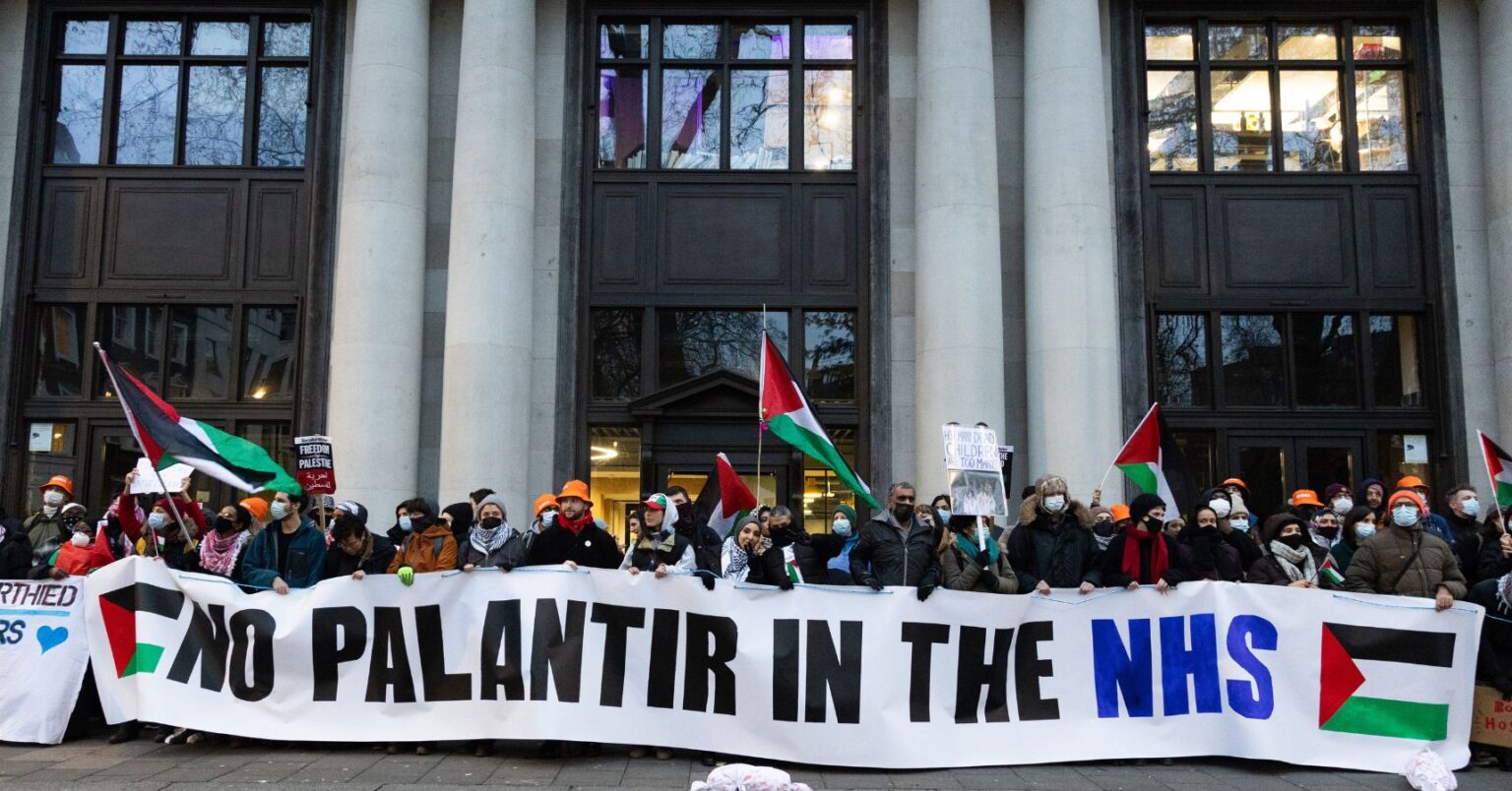
Health workers and activists ramp up their campaign to oppose surveillance company Palantir’s role in managing NHS data
Health workers and activists in Britain are intensifying their campaign against US-based surveillance and data company Palantir, as Keir Starmer’s government accelerates its push to involve the notorious firm in managing National Health Service (NHS) data.
Palantir first gained a foothold in the NHS during the COVID-19 pandemic, securing contracts outside standard procurement processes and enjoying popularity among high-ranking health officials. The company, infamous for its involvement in operations such as the US-led invasions of Afghanistan and Iraq and migrant persecution under the US Immigration and Customs Enforcement (ICE), soon expanded its role in Britain. By last year, it had won a £330 million (USD 417 million) contract to implement the Federated Data Platform (FDP), intended to modernize medical data management across England.
Not all NHS institutions are currently able to share data because of differing systems. Both Conservative and Labour governments have identified this as the main reason for bottlenecks in the health system and claimed that resolving the problem would lead to improvements to care. However, organizations like Medact, Just Treatment, and Corporate Watch warn that entrusting this task to Palantir could deepen issues rather than solve them.
Similarly, many health experts have highlighted how the FDP would effectively lock the NHS into dependency on Palantir. The company’s systems are designed in a way to make data extraction difficult and integration with industry-standard analytics costly and complicated, so users are compelled to keep using them. “Palantir’s system pushes people to its own proprietary systems; and switching costs [for the NHS] will be very high,” Doctors’ Association and Foxglove warned in a 2023 report.
The current government is pushing forward with this form of private sector expansion in the NHS despite warnings from trusts and experts that the results will fall far short of expectations. In fact, some NHS organizations being forced to adopt the FDP under Labour’s administration have said that the new platform could result in a loss of functionality compared to the systems they currently rely on.
While there is general agreement among analysts that data sharing and usage within the NHS could be significantly improved, they argue that these improvements can and should be achieved through local and regional initiatives. In contrast to the top-down model ushered in by the FDP, these initiatives would build on existing systems and expertise, avoiding handing over control to a private company with a track record of human rights abuses.
Concerns that the FDP could make the NHS entirely dependent on Palantir are sharpened by fears over how patient data might be used. As one of the world’s largest public healthcare systems, the NHS holds an unique health dataset. While such data has immense potential to strengthen public services, entrusting it to corporate partners poses great risks. For instance, it could be exploited for purposes such as tracking and criminalizing migrants—a practice that has been systematically pursued under Britain’s hostile environment policies.
Palantir takes pride in finding new applications for data, specifically to reinforce Western dominance. Given that the full scope of the FDP remains unclear, there is significant concern that NHS data could also be exploited to boost Palantir’s surveillance tools. These tools are already being deployed in Israel’s ongoing genocide against Palestinians in the Gaza Strip.
Palantir’s leadership has been outspoken in its support for Israel, openly aligning with Benjamin Netanyahu’s government even as it proceeded to kill tens of thousands of Palestinians. The company is actively testing—or rather, showcasing—its artificial intelligence (AI) models through Israel’s attacks in Palestine and Lebanon. This indicates a clear intent to monetize these tools further by marketing them to other states preparing to go on killing sprees.
Handing over NHS medical data to Palantir would deepen the Starmer administration’s complicity in Israel’s war crimes, health justice organizations warn. Such a move risks staining the NHS’s reputation, turning its dataset into a tool for oppression internationally while undermining public trust in the healthcare system at home.
Many had hoped that a change in government in July would mean an end to the FDP. However, “instead of hitting reset, Labour hit accelerate,” Just Treatment remarked during a No Palantir in the NHS meeting in November. This response reflects Labour’s priorities when it comes to the public healthcare provider. “If the government were setting out to implement reforms in the way that our data is held to improve health outcomes and improve the NHS, they would be going about it in a way that maximizes public trust, maximizes public and health service and health worker support for those initiatives,” the organization remarked during the meeting.
Instead, the government appears more interested in using national health data for economic gain. This approach aligns closely with recommendations from neoliberal policy advisors, such as those at the Tony Blair Institute for Global Change, who have recently called for the use of NHS data as a means to boost Britain’s economic standing.
Although the implementation of the FDP is progressing, activists argue that it is not too late to stop it—especially if local groups escalate their efforts. They emphasize that by increasing pressure, health workers and activists could not only push for the cancellation of Palantir’s FDP contract but also demand the termination of all agreements with companies complicit in Israel’s occupation. While Palantir is currently a key focus, the organizations highlighted that this campaign is just the beginning, serving as a starting point for broader action.