Rising desertification shows we can’t keep farming with fossil fuels
Spread the love
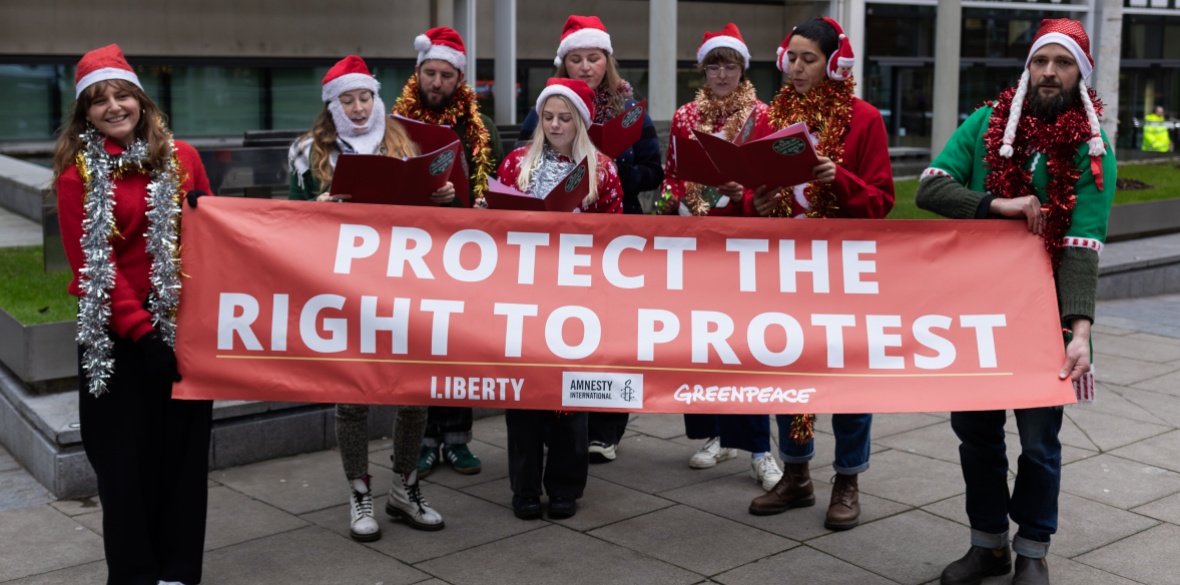
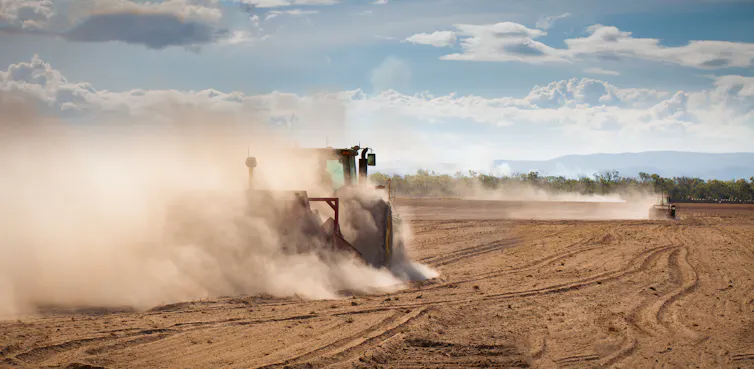
Johan Larson/Shutterstock

Jack Marley, The Conversation

Three-quarters of Earth’s land has become drier since 1990.

Droughts come and go – more often and more extreme with the incessant rise of greenhouse gas emissions over the last three decades – but burning fossil fuels is transforming our blue planet. A new report from scientists convened by the United Nations found that an area as large as India has become arid, and it’s probably permanent.

A transition from humid to dry land is underway that has shrunk the area available to grow food, costing Africa 12% of its GDP and depleting our natural buffer to rising temperatures. We have covered several consequences of humanity’s fossil fuel addiction in this newsletter. Today we turn to the loss of life-giving moisture – what is driving it, and what we are ultimately losing.


Imagine weekly climate newsletter

This roundup of The Conversation’s climate coverage comes from our award-winning weekly climate action newsletter. Every Wednesday, The Conversation’s environment editor writes Imagine, a short email that goes a little deeper into just one climate issue. Join the 40,000+ readers who’ve subscribed.


Why is the land drying out so fast? It’s partly because there is more heat trapped in the atmosphere by greenhouse gases emitted from burning fossil fuels. This excess heat has exacerbated evaporation and is drawing more moisture out of soil.

‘Oil, not soil’

Climate change has also made the weather more volatile. When drought does cede to rain, more of it arrives in bruising downpours that slough the topsoil.

A stable climate would deliver a year’s rain more evenly and gently, nourishing the soil so that it can nurture microbes that hold onto water and release nutrients.

This is the kind of soil that industrial civilisation inherited. It’s disappearing.

“Soil is being lost up to 100 times faster than it is formed, and desertification is growing year on year,” says Anna Krzywoszynska, a sustainable food expert at the University of Sheffield.
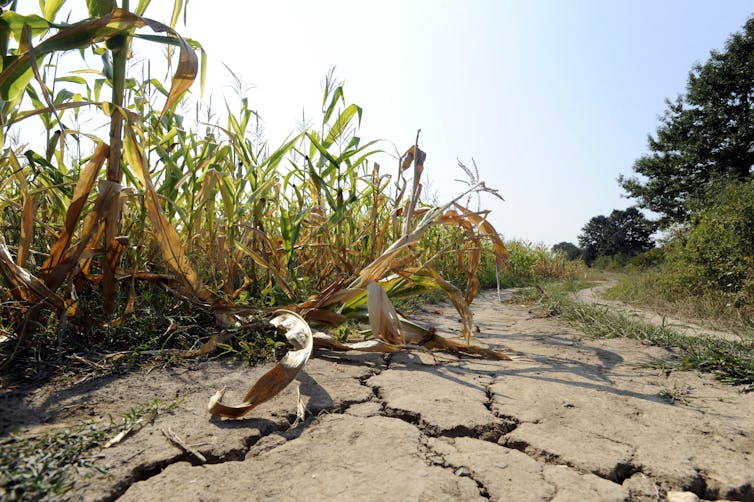
A wilting corn crop in dry, cracked soil.
Humid and fertile farmland is becoming increasingly arid. Nikola Fific/Shutterstock

“The truth is, the modern farming system is based around oil, not soil.”

Fossil fuels have unleashed agriculture from the constraints of local ecology. Once, the nutrients that were taken from the soil in the form of food had to be replaced using organic waste, Krzywoszynska says. Synthetic nitrogen fertilisers, made with fossil energy at great cost to the climate, changed all that.

Next came diesel-powered machinery that brought more wilderness into cultivation. Farm vehicles as heavy as the biggest dinosaurs now churn and compact the soil, making it difficult for earthworms and assorted soil organisms to maintain it.

Tractors and chemicals served humanity for a long time, Krzywoszynska says. But soil is now so degraded that no amount of fossil help can compensate.

“Across the world, soils have been pushed beyond their capacity to recover, and humanity’s ability to feed itself is now in danger.”

Green pumps and white mirrors

The primary way that we have been making up for lost food yield is turning more forests into farms. This is accelerating our journey towards a drier, less liveable world because forests, if allowed to thrive, create their own rain.

“Water sucked up by tree roots is pumped back into the atmosphere where it forms clouds which eventually release the water as rain to be reabsorbed by trees,” say Callum Smith, Dominick Spracklen and Jess Baker, a team of biologists at the University of Leeds who study the Amazon rainforest.

“In the Amazon and Congo river basins, somewhere between a quarter and a half of all rainfall comes from moisture pumped from the forest itself.”

Some experts have argued that the UN report understates Earth’s growing aridity by overlooking the water that is held in snow caps, ice sheets and glaciers. Climate change is melting this frozen reservoir, which also serves as a seasonal source of water.

A blue glacier surrounded by water.
Rising temperatures are depleting stores of freshwater, including glaciers. Kavram/Shutterstock

“And as water in its bright-white solid form is much more effective at reflecting heat from the sun, its rapid loss is also accelerating global heating,” says Mark Brandon, a professor of polar oceanography at The Open University.

How do we adapt our relationship with the land to remoisturise the world? Krzywoszynska argues that there is no easy solution, but the future of food-growing “is localised and diverse”.

“To ensure that we eat well and live well in the future, we’ll need to reverse the trend towards greater homogenisation which drove food systems so far.”

The good news, according to Krzywoszynska, is that farmers are experimenting with methods that restore the soil even as they produce a diverse range of nutritious food. These innovators need rights and secure access to the land, the opportunity to share their experiences and financial and political support.

“Regenerating land is a win-win, for humans and their ecosystems, if we dare to look beyond the immediate short-term horizon,” she says.

Jack Marley, Environment + Energy Editor, The Conversation

This article is republished from The Conversation under a Creative Commons license. Read the original article.
Continue ReadingRising desertification shows we can’t keep farming with fossil fuels

Amnesty Urges War Crimes Probe of ‘Indiscriminate’ Israeli Attacks on Lebanon

Spread the love

Original article by Brett Wilkins republished from Common Dreams under Creative Commons (CC BY-NC-ND 3.0). 

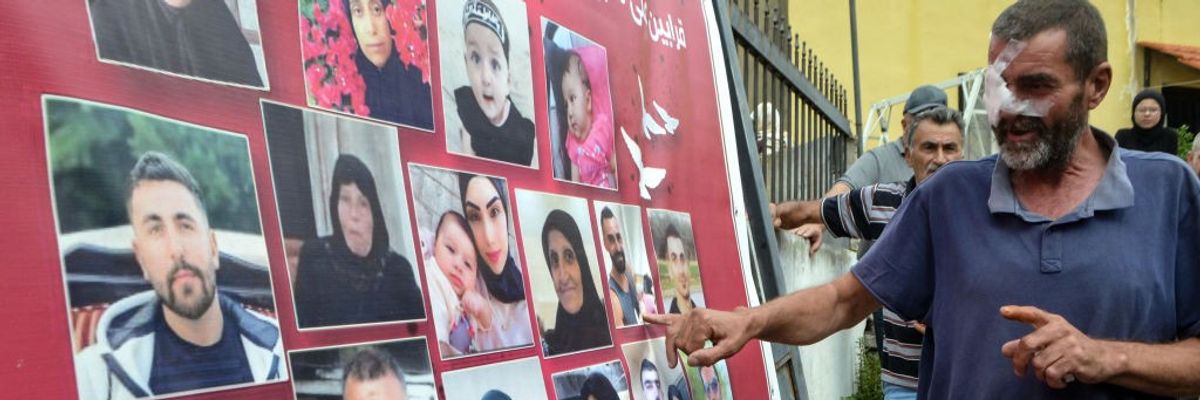
A wounded man points to photos of civilians killed during an October 16, 2024 Israeli airstrike on the village of Aitou, Lebanon. (Photo: Fathi al-Masri/AFP via Getty Images)

“The latest evidence of unlawful airstrikes during Israel’s most recent offensive in Lebanon underscores the urgent need for all states, especially the United States, to suspend arms transfers,” said one campaigner.

Amnesty International on Thursday called for a war crimes investigation into recent Israeli airstrikes in Lebanon that killed dozens of civilians, as well as a suspension of arms transfers to Israel as it attacks Gaza, the West Bank, and Syria.

In a briefing paper titled The Sky Rained Missiles, Amnesty “documented four illustrative cases in which unlawful Israeli strikes killed at least 49 civilians” in Lebanon in September and October amid an Israel Defense Forces (IDF) campaign of invasion and bombardment that Lebanese officials say has killed or wounded more than 20,000 people.

“Amnesty International found that Israeli forces unlawfully struck residential buildings in the village of al-Ain in northern Bekaa on September 29, the village of Aitou in northern Lebanon on October 14, and in Baalbeck city on October 21,” the rights group said. “Israeli forces also unlawfully attacked the municipal headquarters in Nabatieh in southern Lebanon on October 16.”

Erika Guevara Rosas, Amnesty’s senior director for research, advocacy, policy, and campaigns, said in a statement that “these four attacks are emblematic of Israel’s shocking disregard for civilian lives in Lebanon and their willingness to flout international law.”

https://twitter.com/ReinaWehbi/status/1867142527435809200?ref_src=twsrc%5Etfw%7Ctwcamp%5Etweetembed%7Ctwterm%5E1867142527435809200%7Ctwgr%5Ebe8b67de6ddfba791c9b6966c51d43dbeed2529f%7Ctwcon%5Es1_c10&ref_url=https%3A%2F%2Fwww.commondreams.org%2Fnews%2Famnesty-international-lebanon

Sorry, this content could not be embedded.
WordPress / X [Think that this is an X issue that they can’t afford to fix.]

The September 29 attack “destroyed the house of the Syrian al-Shaar family, killing all nine members of the family who were sleeping inside,” the report states.

“This is a civilian house, there is no military target in it whatsoever,” village mukhtar, or leader, Youssef Jaafar told Amnesty. “It is full of kids. This family is well-known in town.”

On October 16, Israel bombed the Nabatieh municipal complex, killing Mayor Ahmad Khalil and 10 other people.

“The airstrike took place without warning, just as the municipality’s crisis unit was meeting to coordinate deliveries of aid, including food, water, and medicine, to residents and internally displaced people who had fled bombardment in other parts of southern Lebanon,” Amnesty said, adding that there was no apparent military target in the immediate area.

In the deadliest single strike detailed in the Amnesty report, IDF bombardment believed to be targeting a suspected Hezbollah member killed 23 civilians forcibly displaced from southern Lebanon in Aitou on October 14.

“The youngest casualty was Aline, a 5-month-old baby who was flung from the house into a pickup truck nearby and was found by rescue workers the day after the strike,” Amnesty said.

Survivor Jinane Hijazi told Amnesty: “I’ve lost everything; my entire family, my parents, my siblings, my daughter. I wish I had died that day too.”

https://twitter.com/MiddleEastEye/status/1846925123871216071?ref_src=twsrc%5Etfw%7Ctwcamp%5Etweetembed%7Ctwterm%5E1846925123871216071%7Ctwgr%5Ebe8b67de6ddfba791c9b6966c51d43dbeed2529f%7Ctwcon%5Es1_c10&ref_url=https%3A%2F%2Fwww.commondreams.org%2Fnews%2Famnesty-international-lebanon

Sorry, this content could not be embedded.
[X can’t afford to fix this]

As the report notes:

A fragment of the munition found at the site of the attack was analyzed by an Amnesty International weapons expert and based upon its size, shape, and the scalloped edges of the heavy metal casing, identified as most likely a MK-80 series aerial bomb, which would mean it was at least a 500-pound bomb. The United States is the primary supplier of these types of munitions to Israel.

“The means and method of this attack on a house full of civilians likely would make this an indiscriminate attack and it also may have been disproportionate given the presence of a large number of civilians at the time of the strike,” Amnesty stressed. “It should be investigated as a war crime.”

The October 21 strike destroyed a building housing 13 members of the Othman family, killing two women and four children and wounding seven others.

“My son woke me up; he was thirsty and wanted to drink. I gave him water and he went back to sleep, hugging his brother,” survivor Fatima Drai—who lost her two sons Hassan, 5, and Hussein, 3, in the attack—told Amnesty.

“When he hugged his brother, I smiled and thought, I’ll tell his father how our son is when he comes back,” she added. “I went to pray, and then everything around me exploded. A gas canister exploded, burning my feet, and within seconds, it consumed my kids’ room.”

Guevara Rosas said: “These attacks must be investigated as war crimes. The Lebanese government must urgently call for a special session at the U.N. Human Rights Council to establish an independent investigative mechanism into the alleged violations and crimes committed by all parties in this conflict. It must also grant the International Criminal Court jurisdiction over Rome Statute crimes committed on Lebanese territory.”

“Israel has an appalling track record of carrying out unlawful airstrikes in Gaza and past wars in Lebanon taking a devastating toll on civilians.”

Last month, the court issued arrest warrants for Israeli Prime Minister Benjamin Netanyahu and former Israeli Defense Minister Yoav Gallant for alleged war crimes and crimes against humanity in connection with Israel’s 433-day Gaza onslaught, which has left more than 162,000 Palestinians dead, maimed, or missing in the embattled enclave.

The tribunal also issued a warrant for the arrest of Hamas leader Mohammed Diab Ibrahim Al-Masri for alleged crimes committed during and after the October 7, 2023 attack on Israel, in which more than 1,100 people were killed and over 240 others were kidnapped.

Meanwhile, the International Court of Justice is weighing a genocide case brought by South Africa against Israel. Last week, Amnesty published a report accusing Israel of genocide in Gaza.

The United States—which provides Israel with tens of billions of dollars in military aid and diplomatic cover—has also been accused of complicity in Israeli war crimes in Palestine and Lebanon.

“Israel has an appalling track record of carrying out unlawful airstrikes in Gaza and past wars in Lebanon taking a devastating toll on civilians,” Guevara Rosas said. “The latest evidence of unlawful air strikes during Israel’s most recent offensive in Lebanon underscores the urgent need for all states, especially the United States, to suspend arms transfers to Israel due to the risk they will be used to commit serious violations of international humanitarian law.”

Original article by Brett Wilkins republished from Common Dreams under Creative Commons (CC BY-NC-ND 3.0). 

Continue ReadingAmnesty Urges War Crimes Probe of ‘Indiscriminate’ Israeli Attacks on Lebanon

Israeli air strikes in Gaza kill at least 28 Palestinians

Spread the love

https://morningstaronline.co.uk/article/israeli-air-strikes-in-gaza-kill-at-least-28-palestinians

Asma Al Habash, mourns her brother and his family, victims of an Israeli army strike on the Nuseirat refugee camp, at the Al-Aqsa Martyrs hospital in Deir al-Balah, Gaza Strip, December 12, 2024

PALESTINIAN medical officials say Israeli air strikes today killed at least 28 people in the Gaza Strip, including seven children.

This came hours after the United Nations general assembly overwhelmingly approved a resolution demanding an immediate ceasefire in Gaza.

The latest Israeli killing spree took place in the built-up Nuseirat refugee camp, according to the al-Aqsa Martyrs Hospital in the nearby city of Deir al-Balah.

Two other strikes killed 15 men, part of local committees set up by displaced Palestinians to secure aid convoys.

The Nasser Hospital in the southern city of Khan Younis received the bodies.

The hospital said eight were killed in a strike near the southern border town of Rafah and seven others in a strike 30 minutes later near Khan Younis.

Meanwhile the UN general assembly overwhelmingly approved resolutions on Wednesday demanding an immediate ceasefire in Gaza and backing the UN agency for Palestinian refugees that Israel has moved to ban.

https://morningstaronline.co.uk/article/israeli-air-strikes-in-gaza-kill-at-least-28-palestinians

Continue ReadingIsraeli air strikes in Gaza kill at least 28 Palestinians

Carollers sing ‘Away in a Police Car’ outside Home Office and demand repeal of anti-protest laws

Spread the love

https://morningstaronline.co.uk/article/carollers-sing-away-police-car-outside-home-office-and-demand-repeal-anti-protest-laws

Protesters sing Christmas carols outside the Home Office, December 12, 2024 Photo: Talia Woodin @taltakingpic

“AWAY in a police car” echoed outside the Home Office on Wednesday as campaigners belted out renditions of Christmas carols, calling for the government to repeal draconian anti-protest laws.

Dressed in Christmas jumpers and Santa hats, carollers from Amnesty International UK, Greenpeace and Liberty sang festive songs including The Twelve Days of Protest and Silent Protest.

They then handed in a petition to the Home Office, calling on it to scrap protest restrictions introduced by previous governments, alongside a letter to Home Secretary Yvette Cooper demanding an urgent meeting to discuss the state of protest rights in Britain.

A series of repressive laws have made the right to protest increasingly hard to exercise.

They include the Police, Crime, Sentencing and Courts Act 2022, which allows police to ban or restrict “unacceptable” protests, and the Public Order Act 2023 which criminalised protesters “locking on” and fastening themselves to each other or objects.

Punitive jail terms handed out since their enactment include one Just Stop Oil protester being sentenced to six months for slow marching on a road for 30 minutes, while five others from the group received a combined 21 years for co-ordinating a non-violent action over Zoom.

Article continues at https://morningstaronline.co.uk/article/carollers-sing-away-police-car-outside-home-office-and-demand-repeal-anti-protest-laws

Continue ReadingCarollers sing ‘Away in a Police Car’ outside Home Office and demand repeal of anti-protest laws