A preschool age child playing with plastic building blocks
CHARITIES called for action yesterday after research revealed that most children living in poverty in Wales live in a family with at least one child under four years old.
The study from Barnardo’s Cymru and the Bevan Foundation found that the birth of a baby often leads to a drop in household income while costs increase.
This, combined with low maternity pay, meagre social security benefits and the rising costs of essentials, can push families with young children into poverty.
Sarah Row, a child services manager for nearly 10 years, said she had been shocked by the scale of poverty, poor housing and mental health problems affecting the lives of children and their parents in recent months.
Working in some of South Wales’s poorest communities, she has come across examples of young children sleeping on mattresses black with mould and others spending the night on the floor.
“I have never seen things this bad,” Ms Row said.
“Parents are often reluctant to admit just how bad things are, as they feel ashamed they cannot feed and clothe their children or keep them warm.”
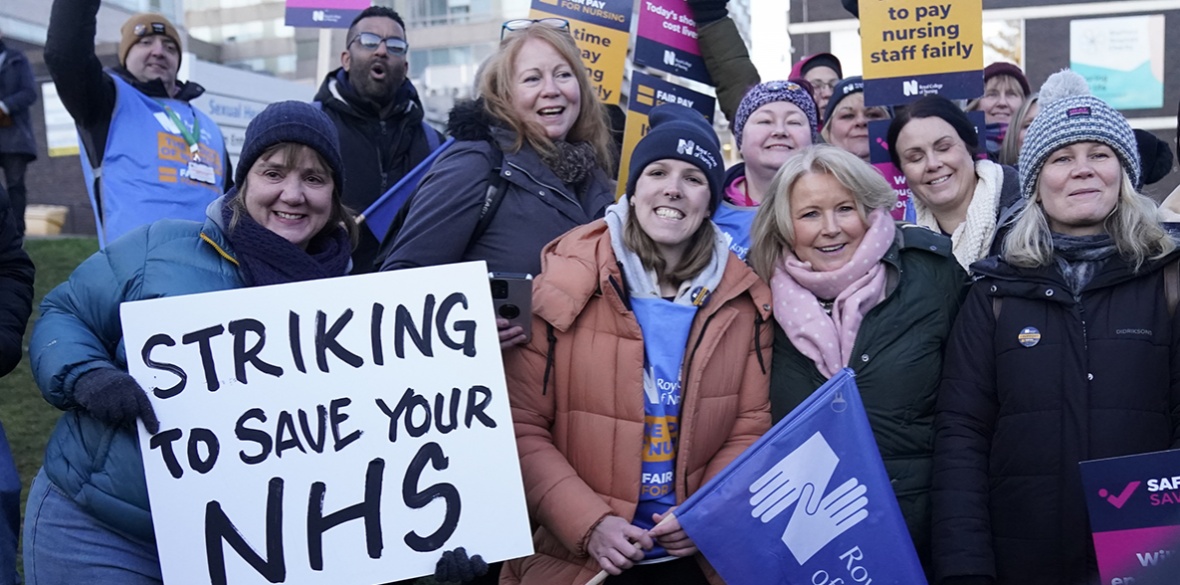
Royal College of Nursing (RCN) chief executive Pat Cullen (second right front row) joins members of the RCN on the picket line outside the Royal Hallamshire Hospital, Sheffield, as nurses take industrial action over pay, January 18, 2023
TEACHER and NHS worker unions threatened strike action today over government-backed below-inflation public-sector pay rises.
The Department of Health and Social Care, the Cabinet Office and the Department for Education have recommended 2.8 per cent unfunded rises for 2025-26 to pay review bodies after Chancellor Rachel Reeves ordered all departments to cut costs by 5 per cent.
TUC general secretary Paul Nowak said: “There are real concerns across the trade union movement about the government’s recommendation.
“The government must now engage unions and the millions of public-sector workers we represent in a serious conversation about public service reform and delivery.
“It’s hard to see how you address the crisis in our services without meaningful pay rises.
“And it’s hard to see how services cut to the bone by 14 years of Tory government will find significant cash savings.
“In the longer term, we need a spending review that gives hope to those delivering and relying on our public services.”
Zeynep Tufekci (New York Times, 12/6/24) “can’t think of any other incident when a murder in this country has been so openly celebrated.”
The early morning murder of UnitedHealthcare CEO Brian Thompson was met on social media with a “torrent of hate” for health insurance executives (New York Times, 12/5/24). Memes mocking the insurance companies and their callous disregard for human life abound on various platforms (AFP, 12/6/24).
Internet users are declaring that the man police believe to be the shooter, 26-year-old Luigi Mangione, is certifiably hot (Rolling Stone, 12/9/24; KFOX, 12/10/24). A lookalike contest for the shooter was held in lower Manhattan (New York Times, 12/7/24).
If so many people are unsympathetic at best in response to such a killing, that might be a reason to revisit why health insurance companies are so loathed. The rage “was shocking to many, but it crossed communities all along the political spectrum, and took hold in countless divergent cultural clusters,” the New YorkTimes (12/6/24) noted. Mangione was reportedly found with an anti-insurance manifesto that stated “these parasites had it coming” (Newsweek, 12/9/24), echoing a resentment largely felt by a lot of Americans, and targeted fury at UnitedHealthcare specifically.
UnitedHealthcare has always stood out for exceptionally high rate of claims denial generally in the industry (Boston Globe, 12/5/24; Forbes, 12/5/24). For example, a Senate committee found that “UnitedHealthcare’s prior authorization denial rate for post-acute care jumped from 10.9% in 2020 to 22.7% in 2022” (WNYW, 12/7/24).
The Times (12/5/24) reported that the Senate committee found that “three major companies—UnitedHealthcare, Humana and CVS, which owns Aetna—were intentionally denying claims” related to falls and strokes in order to boost profits. UnitedHealthcare “denied requests for such nursing stays three times more often than it did for other services.”
Increasing dissatisfaction
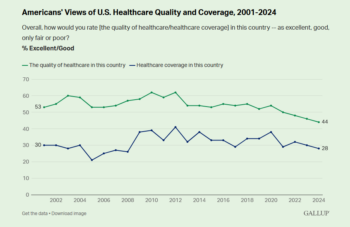
The perception of the quality of US healthcare has been on the decline since 2012 (Gallup, 12/6/24).
On top of that, Americans generally believe their insurance-centered system is a mess. Gallup (12/6/24) reported that “Americans’ positive rating of the quality of healthcare in the US is now at its lowest point in Gallup’s trend dating back to 2001.”
It continued:
The current 44% of US adults who say the quality of healthcare is excellent (11%) or good (33%) is down by a total of 10 percentage points since 2020 after steadily eroding each year. Between 2001 and 2020, majorities ranging from 52% to 62% rated US healthcare quality positively; now, 54% say it is only fair (38%) or poor (16%).
As has been the case throughout the 24-year trend, Americans rate healthcare coverage in the US even more negatively than they rate quality. Just 28% say coverage is excellent or good, four points lower than the average since 2001 and well below the 41% high point in 2012.
Most Americans are unsatisfied with the healthcare system, say the health insurance system is confusing and opaque, and many have skipped or delayed care because of a bad experience or the lack of timely appointments. A small, but not insignificant number, of Americans believe they have had a negative health outcome as result of their experiences within the healthcare system.
When this inefficient system doesn’t literally kill Americans, it can still kill them financially. “Almost a third of all working adults in the United States are carrying some kind of medical debt—that’s about 15% of all US households,” Marketplace (3/27/24) reported. It added: “This debt is also the leading cause of bankruptcies in the country.”
Many news outlets’ pontificators, however, were incensed that anyone would voice frustration with health insurance when an industry CEO has fallen.
‘Not the time to offer criticism’
After Brian Thompson’s killing, the New York Post (12/5/24) condemned those on social media who “swooned over his killer, speculated on his motives, and wondered if Timothée Chalamet would play him in the movie.”
Responding to the memes and the jokes, many of which were more about the unjust health insurance system than support for vigilante murder, the New York Post editorial board (12/5/24) asked:
Do the jokes point to a society that has become so desensitized by the coarseness of online discussion, so disassociated from kindness, that a baying mob cheers a man’s murder and cries out for more?
And upon Mangione’s arrest, the Post (12/9/24) complained that on social media, “tasteless trolls showered praise on the Ivy League grad.” The Post (12/11/24) also fretted about fake “Wanted” posters for insurance company executives that the paper considered a “a fear-mongering social media stunt to incite hysteria,” adding that the “murder has also spawned a stream of merchandise sympathetic towards the 26-year-old being sold by online retailers, forcing Amazon to pull them from its website.”
Fox News (12/6/24) quoted one of its own contributors, Joe Concha, saying, “I think this encapsulates the far left’s worldview: If you run a company that isn’t to their liking, you deserve to die.” The network (12/7/24) praised Democratic Sen. John Fetterman of Pennsylvania for “tearing into” a New York article (12/7/24) that the outlet characterized as saying “resentment over denied insurance claims made…Thompson’s murder inevitable.”
The dismay was felt in other corners of right-wing media. At the Free Press (12/5/24), the brainchild of anti-woke crusader Bari Weiss, Kat Rosenfield wrote:
The people celebrating Brian Thompson’s murder by turning him into an avatar for everything wrong with the American healthcare system remind me of nothing so much as Hollywood screenwriters, cunningly manipulating an audience into cheering on unforgivable acts of fictional violence.
This is not the time to offer your criticisms of the health-insurance industry. And there is never a time to believe that corporate executives are, by their very nature, evil people who deserve to be killed. Yet that is what you’ll see if you go on social media right now and look at comments on news stories about this assassination.
Yet all of these outlets at the same time have run support for Daniel Penny, the man recently acquitted for killing a Black homeless man on the New York City subway (National Review, 6/17/23; Free Press, 10/20/24; New York Post, 12/4/24; Fox News, 12/6/24). These outlets likewise expressed support for Kyle Rittenhouse after he gunned down Black Lives Matter protesters (National Review, 11/19/21; Free Press, 11/17/21; New York Post, 11/19/21; Fox News cited by Media Matters, 11/11/21), and for George Zimmerman when he shot Trayvon Martin (National Review, 6/22/20; New York Post, 7/15/13; Fox News, 7/18/12). In other words, it’s fine to defend vigilantes when they kill unarmed Black people or anti-racist activists, but when a CEO’s life is taken, we must solemnly stay silent on the reasons why such a person might be targeted or why bystanders might not be crying.
Piers Morgan (New York Post, 12/10/24) made this clear when he said “I cheered when I heard” Penny’s acquittal, and felt “shocked and saddened when I saw the footage” of the Thompson shooting. “Those two reactions would surely be the correct and appropriate ones for anyone with an ounce of fairness and humanity in their heart,” he said—because Thompson was “a non-violent, non-threatening, non-criminal man in the street,” whereas Penny’s victim was “a dangerous, mentally ill, homeless man.”
Blame it on Medicare
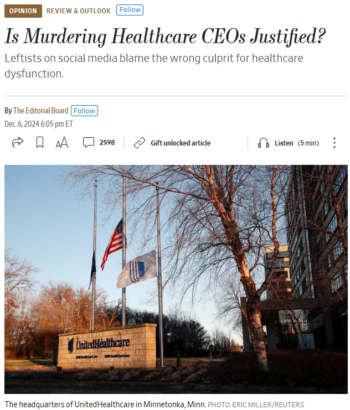
The Wall Street Journal (12/6/24) made the absurd claim that a medical system based on private insurance is better than any other kind of healthcare system.
It was the Wall Street Journal, the more erudite of Murdoch’s media properties, that really addressed the question of why people might hate health insurance companies. The anger was misdirected, the editorial board (12/6/24) said. Rather, we should look to federally funded healthcare if we want to get mad: “Medicare and Medicaid, two government programs, cover about 36% of Americans,” the paper observed; because they “pay doctors and hospitals below the cost of providing care…many providers won’t see Medicaid patients, resulting in delayed care.”
It’s an odd argument, given that people who receive Medicaid report being happier with their health insurance than people who get it through their employers or pay for it themselves—and people with Medicare are the happiest of all (KFF, 6/15/23). If the federal programs are underpaying healthcare providers, the obvious solution would be to increase funding for them—an initiative the Journal would be unlikely to support.
The board (Journal, 10/10/24) later dismissed critiques of the health insurance industry and passed off Mangione as a “disturbed individual” radicalized by the Internet and said it is “a dreadful sign of the times that Mr. Mangione is being celebrated.”
Journal editorial board member Allysia Finley (12/8/24) followed up by placing the blame on the Affordable Care Act (aka “Obamacare”). “Having insurance doesn’t change people’s behavior,” she wrote, but does “cause them to use more care.” The situation, she said, “has gotten worse since Obamacare expanded eligibility” for Medicaid. This portrait of US patients overusing healthcare like sweet-toothed children let loose in a candy store is belied by (among other things) the fact that Americans live 4.7 fewer years than the average of comparable countries (KFF, 1/30/24).
The Journal editorial went on to complain that “some providers prescribe treatments and tests that may be medically unnecessary,” and so “insurers have tried to clamp down on such abuse by requiring prior authorization.” While this “can result in delayed care that is medically necessary…it’s also how insurers control costs.”
In reality, doctors are complaining that insurance bureaucrats are impeding their ability to deliver needed healthcare because of this cost-slashing system (Forbes, 3/13/23). The American Medical Association found “94% of doctors say prior authorization leads to delays in patient care” (Chief Medical Executive, 3/14/23); “one in three doctors (33%) say prior authorization has led to serious adverse events with their patients.”
Journal editorialists appear to believe that doctors are jauntily giving away expensive blood pressure medicine and signing up patients for brain surgery for no particular reason, and the only thing that can stop this carnival of care is some bureaucrat who is trained to say “no.” The reality is that the private insurance system “saves insurance companies money by reflexively denying medical care that has been determined necessary by a physician,” as pediatrician William E. Bennett Jr. (Washington Post, 10/22/19) wrote. This is why people are so unsympathetic to Thompson, who was paid an estimated $10 million annually for imposing medical austerity on patients and providers (PBS, 12/7/24).
Pity the insurance giants
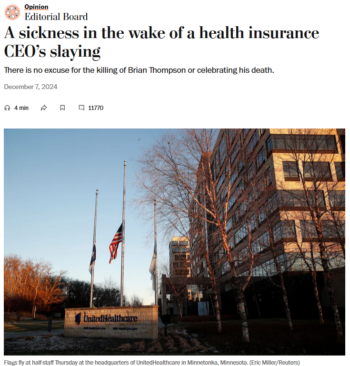
The Washington Post (12/7/24) criticized those who tried to use Thompson’s killing “as an occasion for policy debate about claim denial rates by health insurance companies.” (Note that both the Post and the Wall Street Journal used the same photo of flags at half-mast.)
Right-wing media weren’t the only engaging in scolding. At the Jeff Bezos–owned Washington Post, the editorial board (12/7/24) criticized those “who excuse or celebrate the killing,” as well as those “who do not countenance the killing itself” but “have nevertheless tried to treat it as an occasion for policy debate about claim denial rates by health insurance companies, an admittedly legitimate issue.” The Post added that debate was “fine in principle, but we’re skeptical that this particular moment lends itself to nuanced discussion of a complicated, and heavily regulated, industry.”
The editors nevertheless spent a lengthy paragraph explaining to readers that “controlling healthcare costs requires difficult trade-offs,” and that “even the most generous state-run health systems in other countries also have to face” these trade-offs. The editorial attempted to summon sympathy for
insurers, whose profits are capped by federal law, [and] must contend with consumer demand for ready access to high-priced specialists and prescription drugs—and, at the same time, premiums low enough that people can afford coverage.
Note that insurance company profits are “capped” by requiring them to spend at least 80% of premiums on claims, a percentage known as their loss ratio—but those claims can be paid to providers that are owned by the insurers themselves, “a loophole that makes loss ratio requirements meaningless” (Physicians for a National Healthcare Program, 7/16/21). United Healthcare has been particularly aggressive at this, which is part of the reason its “capped” profits soared to $22.4 billion in 2023.
As for the Post’s assertion that insurance providers should keep “premiums low enough that people can afford coverage,” KFF (10/9/24) found that “Family premiums for employer-sponsored health insurance rose 7% this year to reach an average of $25,572 annually, marking the “second year in a row that premiums are up 7%.” The Center for American Progress (11/29/22) found that employer sponsored insurance “premiums have risen above the rate of inflation and have outpaced wage growth” over the course of a decade. “Escalating grocery bills and car prices have cooled, but price relief for Americans does not extend to health care,” USA Today (10/9/24) reported.
The Post added that all this talk about how Americans are being tortured by the insurance system should wait until next year, “when Congress is to consider whether to keep temporary Obamacare enhancements that have boosted enrollment.”
It is easy to see the material interests of the Washington Post‘s owner at work. Jeff Bezos’ Amazon does not run a health insurance company, but it is fully entrenched in the for-profit medical system. It offers a health insurance marketplace through AmazonFlex, acquired the healthcare provider One Medical last year (NPR, 11/12/23; Forbes, 4/5/24), and offers a pharmacy and other health services.
As one of the world’s richest people, Bezos might have another reason to be worried about people cheering on the murder of CEOs: Amazon is often hated for its monopoly-like grip on online retail (FTC, 9/26/23), as well as charges of price-gouging (Seattle Times, 8/14/24) and union-busting (Guardian, 4/3/24).
‘Last or near last’
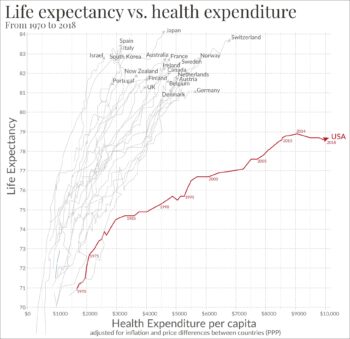
The failure of the US healthcare system in one chart: life expectancy plotted against healthcare spending.
The Washington Post‘s line about the comparable ills of “generous state-run health systems” echoed a similar argument from the Wall Street Journal‘s editorial, which concluded:
Government healthcare is a recipe for more care delays and denials. Witness the fiasco in the United Kingdom, where the Labour government reports that more than 120,000 people died in 2022 while on the National Health Service’s waitlist for treatment. To adapt a famous Winston Churchill phrase, private insurance is the worst form of healthcare, except for all others.
The statement that the British or European health systems are worse for people than the US private insurer–dominated system is simply false. Just months ago, the Commonwealth Fund (NBC, 9/19/24) found that the United States
ranks as the worst performer among 10 developed nations in critical areas of healthcare, including preventing deaths, access (mainly because of high cost) and guaranteeing quality treatment for everyone.
The US “ranked last or near last in every category except one,” precisely because
the complex labyrinth of hospital bills, insurance disputes and out-of-pocket requirements that patients and doctors are forced to navigate put the US second to last in administrative efficiency.
The Commonwealth Fund (CNN, 1/31/23) also found that
the United States spends more on healthcare than any other high-income country, but still has the lowest life expectancy at birth and the highest rate of people with multiple chronic diseases.
Healthcare providers in Mexico and Costa Rica are huge draws for Americans in need of care who can’t make it through America’s Kafkaesque system (NPR, 3/8/23). Spain and Portugal are attracting American retirees, and good low-cost health care is one incentive (Travel + Leisure, 6/20/24).
Retreat to the castle
Apparently the CEOs that Fox News (11/13/24) is so concerned about don’t qualify as “professional elites.”
While the Washington Post’s position clearly falls in line with its material allegiance to a system where its owner sits at the apex, the positions from Murdoch are more interesting. As the Democratic Party has lost support among the working class (NPR, 11/14/24; USA Today, 11/30/24), Murdoch’s outlets have touted Donald Trump and the Republican Party as alternatives for working-class voters.
Murdoch and other purveyors of Republican propaganda have promoted the idea that Democrats serve only financial elites and Hollywood producers, and that protectionist policies under Trump will help US workers (New York Post, 7/16/24; Fox News, 11/13/24). Republicans were able to woo voters by complaining about the high price of gasoline and groceries under the Biden administration (CNBC, 8/7/24).
Now Murdoch outlets are fully retreating into their elite castle and telling the rabble to stop complaining about the lack of access to healthcare. The Republicans and their news outlets have worked hard to recharacterize themselves as something more populist, but the Thompson killing has brought back the old narrative that they are, proudly, the champions of the 1 Percent.
FAIR’s work is sustained by our generous contributors, who allow us to remain independent. Donate today to be a part of this important mission.
Antarctica, the world’s most remote, harsh and pristine continent, is not free from marine pollution. Where human activity goes, plastic debris inevitably follows.
What might the early explorers of this icy wilderness think today, upon discovering a continent transformed by permanent fishing activities, research stations, military presence, tourism, and all their environmental impacts? Among these, plastic pollution stands out, as it has created a unique new ecological niche in the ocean.
Once it gets into the water, plastic debris provides surfaces that can be quickly colonised by microbial communities, forming a biofilm. This plastic-borne community is known as the plastisphere, and it poses a serious threat to marine ecosystems, particularly in the cold, understudied waters of the Southern Ocean.
The plastisphere: an emerging threat
As plastic debris drifts through the ocean, the plastisphere develops through typical ecological succession, eventually becoming a complex and specialised microbial community. Plastics not only provide shelter for these microorganisms but also act as a vector, allowing potentially harmful pathogens like Vibrio spp., Escherichia coli, and bacteria carrying antibiotic resistance genes, to spread across marine environments, even reaching remote, untouched areas.
Beyond being a home for microbes, the plastisphere can disrupt the natural balance of ocean life at the microscopic level. These changes don’t stay in the water, as they can spread outward, potentially affecting how the ocean absorbs carbon and produces greenhouse gases. This has consequences for the air we breathe around the world.
However, it’s not all bad news, as bacteria known for their potential to degrade plastics or hydrocarbons – such as Alcanivorax sp., Aestuariicella sp., Marinobacter sp. and Alteromonas sp. – are frequently identified on plastics.
The Antarctic plastisphere under the microscope: bacteria colonizing polystyrene. Author’s own
A hostile research environment
We currently know very little about the plastisphere, especially in the Southern Ocean, where uncovering its dynamics is key to understanding its impacts on one of the planet’s most remote and vulnerable marine environments. For this reason, our recent study sought to investigate the abundance and diversity of microbial communities in the Southern Ocean plastisphere, particularly following the initial colonisation of plastic debris.
Working in Antarctica is not an easy task. Just reaching this continent is a challenge, and once there, scientists have to contend with harsh environmental conditions: freezing temperatures, powerful winds, icebergs, and the constant pressure of limited time to carry out their work. These challenges make every moment in the field both demanding and invaluable.
This is why we approached our study with a controlled and manageable experiment. We set up aquariums filled with seawater collected near the Spanish research station on Livingston Island, South Shetlands. Inside, we placed small, rounded pellets of the three most common types of plastic polluting the sea – polyethylene, polypropylene, and polystyrene. We left them at environmental conditions (around 0 ºC and between 13 – 18 h of sunlight) for 5 weeks, aiming to recreate the most plausible outcomes in the field.
We compared the colonisation of plastics with glass, an inert surface. Samples of plastics and glass were collected periodically to track bacterial colonisation.
Plastisphere dynamics in Antarctica
Studying bacteria means making the invisible visible, so we combined several techniques to get a better picture of the plastisphere. Using scanning electron microscopy, we obtained biofilm images. We combined flow cytometry and bacterial culture to count total cells and colonies, and we sequenced the 16S rRNA gene to identify the succession of bacterial settlers.
This meticulous approach revealed that time was the key driver of change. Microbes quickly colonised the plastic, and within less than two days, bacteria like genus Colwellia were already fixed in the surface, showing a clear progression from initial settlers to a mature diverse biofilm including other genera like Sulfitobacter, Glaciecola or Lewinella.
These species, although also detected in water, show a clear preference for the social life of a biofilm community. Moreover, we did not detect clear differences between the bacterial communities from plastics and glass, suggesting that any stable surface can host these communities.
While similar processes happen in the other oceans, in Antarctica the process seems slower. The region’s lower temperatures slow bacterial development.
Plastic-eating bacteria?
One key discovery was the presence of Oleispira sp. on polypropylene. This bacteria is hydrocarbon-degrading, meaning it belongs to a group of microorganisms that can break down oil and other pollutants.
Their role within the Antarctic plastisphere raises important questions, like whether these kinds of bacteria could mitigate the impacts of plastic pollution. If so, they could be key to the future of Antartica and our oceans.
However, there is still much to be discovered, particularly regarding their potential for bioremediation in extreme environments. Understanding these processes could pave the way for innovative strategies to address the growing challenge of plastic waste in marine ecosystems.
Labour ministers quizzed over arms exports to Israel. (Photo: UK Parliament)
UK trade department approved 34 military export licences to Israel in the two months since David Lammy announced a partial arms embargo, new data shows.
Labour government hasn’t completed a review on Israel’s compliance with international humanitarian law since July
Foreign Office has not asked to see footage from RAF spy flights over Gaza, which could provide evidence of Israeli war crimes
“No particular appetite” to restrict exports of F-35 components to Israel, even as minister admits US government can track whether British-made spare parts are being sent to Israel
Keir Starmer’s government has continued to approve arms exports to Israel even after some licences were suspended in September, it can be revealed.
31 “standard” and three “open” licences for military goods have been issued to Israel since 2 September, when UK foreign secretary David Lammy announced partial restrictions on arms sales to Israel.
Those items included “components for trainer aircraft” and “commercial aircraft” which were “not assessed to be used in relation to current military operations in Gaza”.
However, training aircraft can still be used to instruct Israeli pilots on how to conduct offensive operations in Gaza.
35 “standard” and six “open” licences were also approved for items classed as “non-military” such as telecommunications equipment and imaging cameras.
The UK government refused to issue a further 18 licences to Israel for “components for combat aircraft and naval vessels, as well as components for targeting and radar equipment”.
The information is contained in new data released this week on an “ad hoc” basis by Britain’s trade department in response to “significant parliamentary and public interest” in the issue.
The data was evaluated at parliament’s trade committee on Tuesday, during which ministers admitted that the UK government has still not determined whether Israel’s bombing of Gaza amounts to a violation of International Humanitarian Law (IHL).
The committee was told that the UK government has not updated its assessment on Israel’s compliance with IHL since 31 July, some four and a half months ago. Previous assessments have taken less than half that time to finalise.
One minister further confirmed that there was “no appetite” for stopping the export of F-35 fighter jet components for use by Israel, despite concerns that this breaches Britain’s legal obligations.
It comes days after Amnesty International accused Israel of committing a genocide in Gaza and warned the UK to “immediately suspend the direct and indirect supply, sale or transfer, to Israel of all weapons” in order to “stop fuelling violations of international law”.
UK Foreign Minister David Lammy confirms that UK government and military are active participants in Israel’s genocides and that the F-35 parts that they suspended from supplying to Israel are instead simply diverted via the United States. He says see https://youtu.be/QILgUHrdWREGenocide denier and Current UK Prime Minister Keir Starmer is quoted that he supports Zionism without qualification. He also confirms that UK air force support has been essential in Israel’s mass-murdering genocide. Includes URLs https://www.declassifieduk.org/keir-starmers-100-spy-flights-over-gaza-in-support-of-israel/ and https://youtu.be/O74hZCKKdpA