Israel Steps Up Attacks in Gaza and Lebanon

Spread the love

Original article by Common Dreams Staff republished from Common Dreams under Creative Commons (CC BY-NC-ND 3.0).
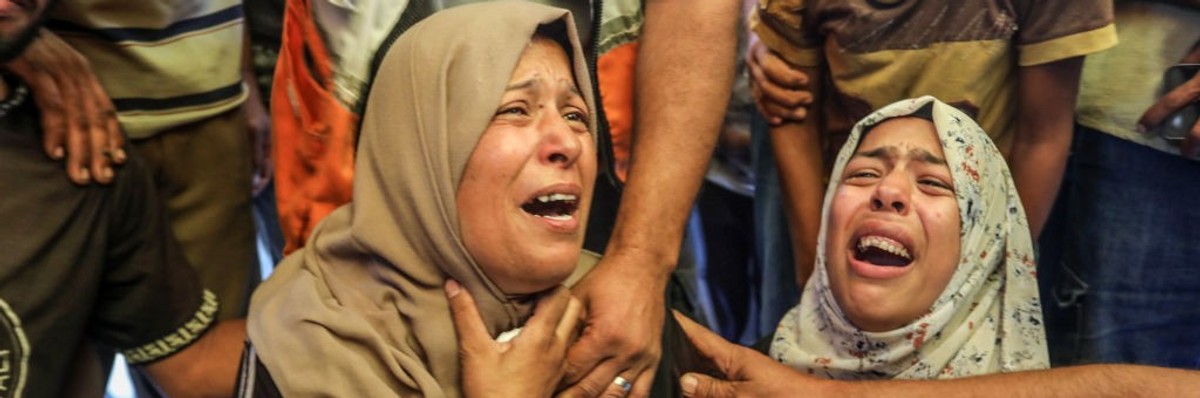
Palestinians mourn the loss of loved ones in Israeli attacks in Khan Younis, Gaza on October 6, 2024. (Photo: Abed Rahim Khatib/Anadolu via Getty Images)

The Israeli military announced a “new phase” of the war in Gaza while conducting its most severe airstrikes so far in Beirut.

Israeli forces stepped up attacks in both the Gaza Strip and Lebanon overnight and into Sunday.

Israeli forces bombed a mosque and a school-turned-shelter in Gaza, killing 26 and injuring dozens more, according to the Palestinian health ministry; the Israeli military described the two sites as Hamas “command and control centers” but provided no evidence.

The Israeli military also on Sunday announced a “new phase” of the war in Gaza, issuing new evacuation orders that cover most of the northern part of the enclave, The New York Timesreported. The military said it would send more soldiers and weapons to Gaza to “destroy terrorist infrastructures and undermine Hamas’ capabilities until all the war’s goals are achieved.”

Al Jazeera‘s Moath al-Kahlout reported that “the situation here in northern Gaza is deteriorating as the Israeli army intensifies its bombing.” He said that children, women, and journalists were among the victims.

“An entire family was killed by the Israeli army in the overnight attacks,” he added.

Meanwhile, Israel conducted the “most severe” airstrikes so far on Beirut, “pounding” the city overnight, according toThe Guardian. The strikes were in southern Beirut and its suburban outskirts, which are seen as a Hezbollah stronghold and have been heavily targeted by Israeli forces for the past two weeks.

Al Jazeera journalist Ali Hashem, reporting from Beirut, described a “massive air strike” on Sunday near the city’s international airport—an area that Israel has been bombarding for days. He said that daytime strikes are particularly harrowing.

“During the nights there are warnings,” Hashem reported. “During the days there are no warnings.”

Hashem said that emergency services have been prevented from getting into the suburban area where many of the strikes are taking place.

The Lebanese health ministry said Sunday that 23 people were killed and 93 injured in Israeli strikes on Saturday.

The Israeli military continues to advance its ground incursion in southern Lebanon. On Sunday, it ordered people in 25 villages to evacuate immediately, “signaling it’s expanding its ground offensive,” Al Jazeera reported

Filippo Grandi, the United Nations’ high commissioner for refugees, visited Beirut on Sunday and called for a cease-fire—saying it was “desperately needed”—and international humanitarian aid.

Original article by Common Dreams Staff republished from Common Dreams under Creative Commons (CC BY-NC-ND 3.0).

Continue ReadingIsrael Steps Up Attacks in Gaza and Lebanon

Israel Killed 28 Lebanese Medical Workers in 24 Hours, 73 Since War’s Start: WHO

Spread the love

Original article by Brett Wilkins republished from Common Dreams under Creative Commons (CC BY-NC-ND 3.0). 

A broken stethoscope and surgical glove are seen after Israeli warplanes bombed a building in the Bachoura area of Beirut, Lebanon on October 3, 2024. (Photo: Murat Sengul/Anadolu via Getty Images)

“I’m afraid first about my safety and about my family’s safety because there’s no safe place in Lebanon now,” said one physician.

The head of the United Nations World Health Organization said Thursday that Israeli forces killed 28 healthcare workers in Lebanon over the previous 24 hours, and that 73 medical personnel are among the nearly 2,000 Lebanese killed during Israel’s bombing and invasion of its northern neighbor.

“In southern Lebanon, 37 health facilities have been closed, while in Beirut, three hospitals have been forced to fully evacuate staff and patients, and another two were partially evacuated,” WHO Director-General Tedros Adhanom Ghebreyesus said during a press conference in Geneva. “And yet healthcare continues to come under attack. In Lebanon alone, 28 health workers have been killed in the last 24 hours.”

Tedros said the WHO “calls on urgent facilitation of flights to deliver health supplies to Lebanon,” adding, “Lives depend on it!”

Lebanese Health Minister Firas Al-Abiad said separately Thursday that more than 40 paramedics and firefighters have been killed by Israeli forces over the previous three days.

Dr. Abdinasir Abubakar, the acting WHO representative in Lebanon, said that “most of those healthcare workers killed in the last 24 hours, most of them—actually, all of them—were on duty.”

“Some of them were in the ambulances, some of them were in the health facilities,” Abubakar added. “They were on duty trying to help civilians who have been wounded in the conflict.”

Dr. Fathalla Fattouh, the head cardiovascular and thoracic surgeon at Rafik Hariri University Hospital (RHUH) in Jnah, just outside Beirut, described the chaos he witnessed firsthand, including “a surge of nearly identical injuries—amputations, eye trauma, and shattered hip and femur bones—straining the hospital’s capacity to a near-breaking point.”

“We were forced to make difficult decisions,” he added. “I believe that we did our best relying on available capacities, but with the escalation of events we need to plan for the worst.”

Sara, a surgeon at the hospital, said that “there are only two hospitals in Lebanon prepared to treat burn patients, and once they were at capacity, we were left with nowhere to send the patients we received.”

“It was a feeling of helplessness that we had never experienced before,” she added.

Some doctors admitted fearing for their lives.

“It’s hard to work in fear,” Dr. Mohammad Taoube, who heads the emergency room at an undisclosed hospital in southern Lebanon, told Sky News on Wednesday. “I’m afraid first about my safety and about my family’s safety because there’s no safe place in Lebanon now.”

According to figures provided by the WHO Regional Office for the Eastern Mediterranean, Israeli forces have killed 1,974 people in Lebanon—including at least 127 children—while wounding 9,384 others in recent weeks.

At least one American has been killed by Israeli bombing of Lebanon this week. Hajj Kamel Ahmad Jawad, 56, of Dearborn, Michigan was killed Tuesday while in Nabatieth in southern Lebanon caring for his sick mother and volunteering to help elderly, disabled, and injured patients at a local hospital.

The Nabatieth area has come under heavy Israeli bombardment. Local journalists said the city’s main hospital “came under direct Israeli fire” on Friday and that two nurses were killed.

Lebanese officials said Friday that more than 1.2 million people have been forcibly displaced amid Israel’s recent bombing and invasion of their country. The Israeli campaign comes amid attacks by the political and paramilitary group Hezbollah, whose rockets and other projectiles have killed or wounded scores of Israelis and forced tens of thousands from their homes.

Residents of southern Lebanon described the terror of coming under Israeli bombardment and having to flee for their lives. One woman, Fatima, and her 14-year-old daughter Zeinab said they were in their home preparing for a school exam when the shelling started.

“My mother told us to pack our things quickly, and we left in a rush,” Zeinab told the U.N. Children’s Fund on Thursday. “My siblings were crying. The journey was terrifying.”

“The shelling was all around us, and the sound of explosions echoed everywhere,” she said while crying. “We miss home dearly and yearn to return.”

Tedros noted that since last October, when Hezbollah began launching rockets at Israel in solidarity with Gaza after Hamas-led militants attacked Israel, over 1 million Lebanese have been displaced, with many seeking refuge in neighboring Syria.

He also said that “since the 7th of October last year, more than 1,500 people have been killed in Israel, almost 42,000 in Gaza, and more than 700 in the West Bank.”

“In addition,” Tedros added, “more than 10,000 people are missing in Gaza, and 1.9 million people are displaced, while 101 hostages taken from Israel remain in Gaza.”

Hundreds of Palestinians working in the health sector have been killed in Gaza by Israeli forces, who have deliberately targeted medical workers. Israeli troops have also allegedly tortured doctors and other medical workers after kidnapping them from the coastal enclave.

Tedros on Thursday stressed the need for “deescalation of the conflict; for healthcare to be protected and not attacked; for access routes to be secured and supplies delivered; and for a cease-fire, a political solution, and peace.”

“The best medicine,” he said, “is peace.”

Original article by Brett Wilkins republished from Common Dreams under Creative Commons (CC BY-NC-ND 3.0). 

Continue ReadingIsrael Killed 28 Lebanese Medical Workers in 24 Hours, 73 Since War’s Start: WHO

Greta Thunberg Detained at Brussels Climate Protest Against Fossil Fuel Subsidies

Spread the love

Original article by Edward Carver republished from Common Dreams under Creative Commons (CC BY-NC-ND 3.0). 

Swedish activist Greta Thunberg is detained during a climate protests against fossil fuel subsidies in Brussels on October 5, 2024. (Photo: John Thys/AFP via Getty Images)

Renowned activist Greta Thunberg was detained on Saturday at a climate protest in Brussels aimed at ending European Union fossil fuel subsidies.

The protest included hundreds of campaigners from Extinction Rebellion and other groups; they came together under the name United for Climate Justice (UCJ). One group of them marched in an area near the European Parliament, while another group that included Thunberg blocked a section of the Boulevard du Jardin Botanique.

“Our politicians have failed us,” Paolo Destilo, a UCJ spokesperson, told Politico. “European leaders’ continued support for the fossil fuel industry raises serious questions about their commitment to effective climate action.”

Another UCJ spokesperson, Angela Huston Gold, pointed to devastating floods that recently hit Europe and Africa as a warning sign for the planet.

“Increasingly frequent and extreme natural disasters are likely to claim a billion victims by the end of the century, mainly due to the use of fossil fuels,” Huston Gold said in a statement, citing a 2023 study in Energies, a journal. “To avoid ecological and social collapse, fossil fuel subsidies must end now.”

The European Commission published a report last year showing that the EU spent 123 billion euros ($135 billion) on fossil fuel subsidies in 2022, an increase on previous years that was caused by policy decisions following Russia’s invasion of Ukraine. (2022 was the last year included in the report.) The Organization for Economic Co-operation and Development listed still higher figures for 2022.

EU’s Eighth Environment Action Program, which entered into force in May 2022, calls for a phaseout of fossil fuel subsidies, but national governments haven’t taken action, so progress is “uncertain,” according to the European Environment Agency, which is part of the EU.

Thunberg on Saturday told Politico that European Commission President Ursula von der Leyen, who’s been in office since 2019, was not a green champion.

UCJ on Tuesday sent an open letter to von der Leyen and other EU institutional leaders calling for a phaseout of fossil fuel subsidies by 2025. “The EU should provide technical and financial assistance to member states facing challenges in meeting phaseout deadlines and offer incentives for achieving milestones ahead of schedule,” it says.

Staffers at the European Commission were in fact among the demonstrators in Brussels on Saturday, Politico reported.

“There’s a lot of tools the institutions have now to fight climate change, but since the [European Parliament elections in June] there’s been a lot of backtracking,” one commission staffer told Politico, given anonymity in order to speak freely.

“It’s now all about competitiveness and the ‘clean industrial deal,’ whatever that means,” the staffer added. “The urgency has been lost—the Parliament has shifted to the right, the commission in many ways has shifted to the right—and discussion of the climate has faded into the background.”

Thunberg, who’s now 21, came to fame as a 15-year-old activist in Sweden who helped form the global school strikes for climate movement. She’s been arrested numerous times, including at a pro-Palestinian demonstration in Denmark earlier this month.

Thunberg and other activists who sat with interlocked arms on the Boulevard du Jardin Botanique were arrested and taken to the police station, according to The Brussels Times.

Original article by Edward Carver republished from Common Dreams under Creative Commons (CC BY-NC-ND 3.0). 

Continue ReadingGreta Thunberg Detained at Brussels Climate Protest Against Fossil Fuel Subsidies

Greens respond to UK government carbon capture plans

Spread the love
Green Party Co-leader Adrian Ramsay October 2023.

Reacting to the government announcement of investment in carbon capture and storage projects, Green MP and party co-leader Adrian Ramsay said: 

“Labour has spent too long listening to the pleadings of energy companies for major public investment in unproven technological solutions like carbon capture that simply won’t deliver the immediate real change we need.  

“This announcement is no substitute for the urgent and immediate investment needed in home and business insulation to cut energy use and the increased renewables funding that is badly needed to meet future energy needs.” 

Continue ReadingGreens respond to UK government carbon capture plans

The UK’s £22 billion bet on carbon capture will lock in fossil fuels for decades

Spread the love
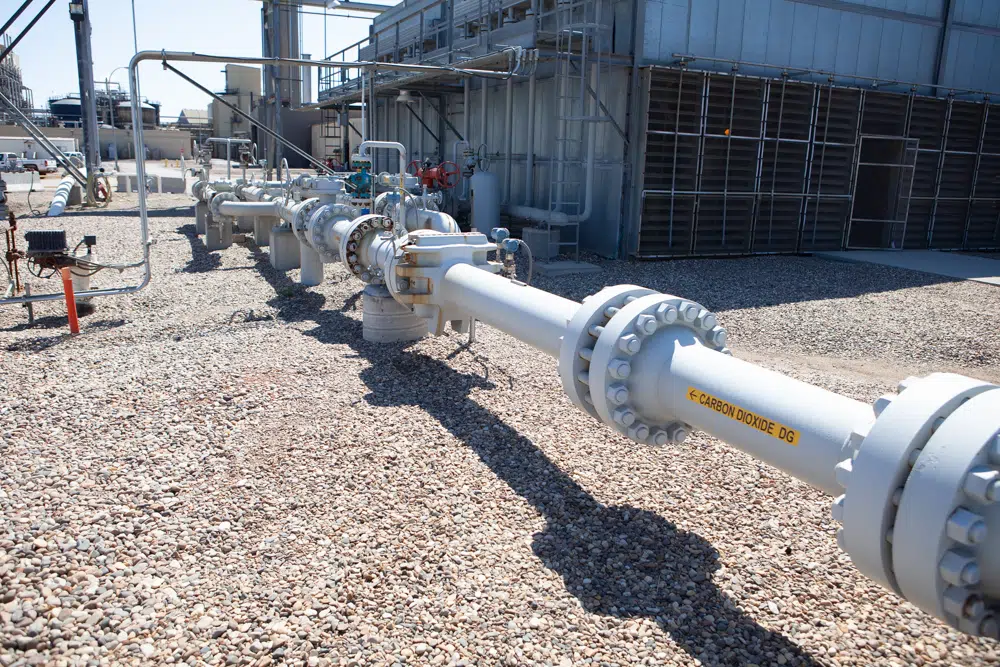
Carbon dioxide runs through pipes at a North Dakota CCS plant. Credit: Buchsbaum Media.

Mark Maslin, UCL

The UK government has announced it will invest almost £22 billion in carbon capture and storage (CCS) projects over the next 25 years. The technology works by capturing CO₂ as it is being emitted by a power plant or another polluter, then storing it underground.

This sounds great in theory. However, it seems Labour has been swayed by the fossil fuel lobby, which has pushed CCS for years. This announcement represents a massive bet on a still unproven technology, and will lock the UK into fossil fuel dependence for decades to come. The Climate Change Act mandates the UK should achieve net zero emissions by 2050, yet this will be impossible if carbon capture leads to the UK building new gas power stations instead of wind and solar farms.

I was one of several leading climate scientists who recently signed a letter to the energy security and net zero secretary, Ed Miliband, in which we pointed out the many issues with the current plans.

Even if the technology worked perfectly, it still locks the UK into a reliance on natural gas (which is basically methane, a potent greenhouse gas) for generations to come. This will result in the UK being reliant on imported natural gas past 2050, which has significant upstream emissions from methane leaks, transport and processing.

That then exposes the UK to the continued volatility of the global energy markets, which in part caused the country’s cost of living crisis. (Renewables don’t have this problem, since the wind and sun don’t need to be imported from overseas.)

Overpromising, underdelivering

In the letter, we pointed out that carbon capture projects have a very poor track record of overpromising and underdelivering. Most current CCS capacity is within natural gas processing facilities, where CO₂ must be separated out to produce marketable products. Almost 80% of the CO₂ captured is reinjected into oil fields to facilitate oil extraction.

The track record of adding carbon capture to power plants is much worse, with the vast majority of projects abandoned. Just two commercial-scale coal-fired power plants are operating with CCS: Boundary Dam in Canada and Petra Nova in the US. Both have experienced consistent underperformance, recurring technical issues and ballooning costs.

In any case, Britain just closed down its last coal power plant. And it’s actually harder to capture CO₂ from gas power plants than from coal, since CO₂ is found in lower concentrations in the emitted gases.

Large power plant cooling towers
Britain’s last coal power station, Ratcliffe-on-Soar, has been shut down. Chris Dukes / shutterstock

One argument for CCS is that it can be used in the production of so-called “blue hydrogen”, which is derived from natural gas and can in theory be used to heat homes or power cars. Yet many projects doing this around the world have been abandoned.

A wide range of uses have been promoted for hydrogen, but not all are practical or competitive. The claim that hydrogen should have a significant role in heating buildings has been comprehensively disproved, while direct electrification is increasingly emerging as a better solution for industrial process heating.

Better ways to spend £22 billion

That £22 billion earmarked for CCS projects should instead be invested in proven technologies such as renewable energy, and on upgrading the UK national grid.

We do not deny that both carbon capture and “green” hydrogen (derived from water not methane) may be needed for specific uses in a zero-carbon economy. Carbon capture and storage should be used on existing fossil fuel infrastructure to reduce its emissions as it is phased out, while green hydrogen will be an important way of storing and transporting green energy around the world. It will also be essential to reduce the emissions from steel production.

But the science is very clear: it makes no sense to use hydrogen as a way of heating buildings or driving our transport systems.

As the world leaders agreed and declared at the most recent UN climate summit, COP28 in Dubai, we must transition away from fossil fuels in a just, orderly and equitable manner in order to achieve net zero by 2050. This will not happen if the UK and other countries lock themselves into a fossil fuel-based pathway with inevitable upstream emissions, displacing genuinely zero or low-carbon electricity generation.

Mark Maslin, Professor of Natural Sciences, UCL

This article is republished from The Conversation under a Creative Commons license. Read the original article.

Local opposition to CCS projects have delayed their construction. Credit: Matt Hrkac/Flickr (CC BY NC ND 2.0)
Continue ReadingThe UK’s £22 billion bet on carbon capture will lock in fossil fuels for decades