Carbon capture: a decarbonisation pipe dream
Spread the love

Relearning lessons of the past

1 September 2022 (IEEFA): Underperforming carbon capture projects considerably outnumber successful projects globally, and by large margins, with both the technology and regulatory framework found wanting, finds a new report by the Institute for Energy Economics and Financial Analysis (IEEFA).

The report, The Carbon Capture Crux – Lessons Learned, studies 13 flagship large-scale carbon capture and storage (CCS)/carbon capture utilisation and storage (CCUS) projects in the natural gas, industrial and power sectors in terms of their history, economics and performance. These projects account for around 55% of the total current operational capacity worldwide.

Author Bruce Robertson says seven of the thirteen projects underperformed, two failed, and one was mothballed

“CCS technology has been going for 50 years and many projects have failed and continued to fail, with only a handful working.

“Many international bodies and national governments are relying on carbon capture in the fossil fuel sector to get to Net Zero, and it simply won’t work.

“Although some indication it might have a role to play in hard-to-abate sectors such as cement, fertilisers and steel, overall results indicate a financial, technical and emissions-reduction framework that continues to overstate and underperform.”

IEEFA’s study found that Shute Creek in the U.S. underperformed its carbon capture capacity by around 36% over its lifetime, Boundary Dam in Canada by about 50%, and the Gorgon project off the coast of Western Australia by about 50% over its first five-year period.

“The two most successful projects are in the gas processing sector – Sleipner and Snøhvit in Norway. This is mostly due to the country’s unique regulatory environment for oil and gas companies,” says co-author Milad Mousavian.

“Governments globally are looking for quick solutions to the current energy and ongoing climate crisis, but unwittingly latching onto CCS as a fix is problematic.”

Last week the Australian government approved two new massive offshore greenhouse gas storage areas, saying CCS “has a vital role to play to help Australia meet its net zero targets. Australia is ideally placed to become a world leader in this emerging industry”.

However, Robertson says, carbon capture technology is not new and is not a climate solution.

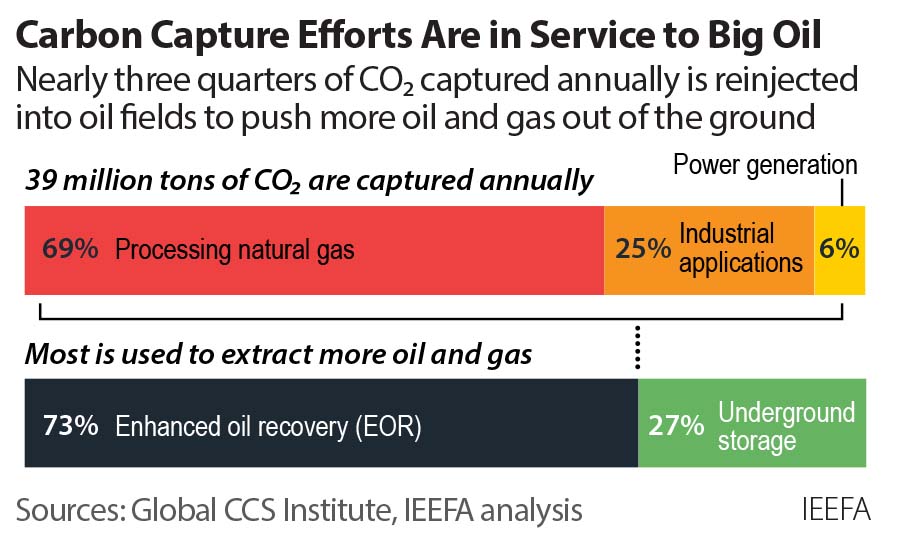
“As our report shows, CCS has been around for decades, mostly serving the oil industry through enhanced oil recovery (EOR). Around 80–90% of all captured carbon in the gas sector is used for EOR, which itself leads to more CO2 emissions.”

About three-quarters of the CO2 captured annually by multi-billion-dollar CCUS facilities, roughly 28 million tonnes (MT) out of 39MT total capture capacity globally, is reinjected and sequestered in oil fields to push more oil out of the ground.

The International Energy Agency says annual carbon capture capacity needs to increase to 1.6 billion tonnes of CO2 by 2030 to align with a net zero by 2050 pathway.

“In addition to being wildly unrealistic as a climate solution, based on historical trajectories, much of this captured carbon will be used for enhanced oil recovery,” says Robertson.

History shows CCS projects have major financial and technological risks. Close to 90% of proposed CCS capacity in the power sector has failed at implementation stage or was suspended early — including Petra Nova and the Kemper coal gasification power plant in the U.S. Further, most projects have failed to operate at their theoretically designed capturing rates. As a result, the 90% emission reduction target generally claimed by the industry has been unreachable in practice.

Finding suitable storage sites and keeping it there is also a major challenge—the trapped CO2 underground needs monitoring for centuries to ensure it does not come back to the atmosphere.

The report identifies interim considerations for CCS projects if no alternative solutions to emissions reduction are found.

  • Safe storage locations must be identified, and a long-term monitoring plan and compensation mechanism in case of failure developed.
  • The CCS project must not promote enhanced oil recovery.
  • To avoid project liability being handed over to taxpayers, as is currently the situation with Gorgon, large oil and gas companies mainly benefiting from CCS at their gas developments must be liable for any failure/leakage and monitoring costs of CCS projects, specifically if they get subsidies, grants and tax credits for capturing the carbon.
  • It must not be used by governments to greenlight or extend the life of any type of fossil fuel asset as a climate solution.

Robertson says more research could be done on CCS applications in industries where emissions are hard to abate such as, cement, as an interim partial solution to meeting net zero targets.

“As a solution to tackling catastrophic rising emissions in its current framework however, CCS is not a climate solution.”

The reportThe Carbon Capture Crux – Lessons Learned

Continue ReadingCarbon capture: a decarbonisation pipe dream

Coming Soon

Spread the love
Greenpeace activists display a billboard during a protest outside Shell headquarters on July 27, 2023 in London.
Greenpeace activists display a billboard during a protest outside Shell headquarters on July 27, 2023 in London. (Photo: Handout/Chris J. Ratcliffe for Greenpeace via Getty Images)

I need to do an article about the UK government’s insane pursuit of Carbon Capture and Storage, accepting fossil fuel industry lies and continuing to subsidise the fossil fuel industry to destroy the climate.

Continue ReadingComing Soon

Cable Street 88 years on: battling fascists then and now

Spread the love

https://morningstaronline.co.uk/article/cable-street-88-years-battling-fascists-then-and-now Many articles from the Morning Star today

A mural depicting the Battle of Cable Street Photo: Maggie Jones / Creative Commons

DAVID ROSENBERG assesses the far-right threat in the wake of the summer’s Islamophobic pogroms and asks what lessons we can learn from the 1930s

Labour Prime Minister Keir Starmer spoke of “thuggery” and was especially concerned that police were attacked, though the main targets of what anti-fascist activists prefer to label “pogroms” by an insurgent far-right were long-settled Muslim communities and current asylum-seekers, including many Muslims. Yet Starmer would not let the word “Islamophobia” cross his lips.

There were attempts to set fire to hotels temporarily housing refugees, and threats made against law firms and advice centres that support asylum-seekers.

The state’s law and order-centred response to far-right pogroms in 2024 mirrors its responses to Cable Street. For several months in 1936, Jews experienced repeated street violence from Oswald Mosley’s fascists, culminating in Mosley’s threat to march thousands of Blackshirted fascists through the East End’s most heavily Jewish-populated streets on Sunday October 4.

Grassroots Labour members and trade unionists wanted to confront them, but Labour’s aloof hierarchy colluded with Tory and Liberal leaders to denounce plans for a counter-demonstration. From the relative comfort of the West End, the Jewish Board of Deputies made the same call.

Thankfully, many Jews completely ignored them, following the lead instead of the Jewish People’s Council against Fascism and Antisemitism (JPC), formed in the East End, and the Communist Party which had many local Jewish members. Trade unionists and Labour members, especially from the Labour League of Youth, joined the mass blockade at Gardiner’s Corner, and dockers from Irish Catholic families whom Mosley had tried to woo helped reinforce the barricades in Cable Street.

https://morningstaronline.co.uk/article/cable-street-88-years-battling-fascists-then-and-now Many articles from the Morning Star today

Zionist Keir Starmer is quoted "I support Zionism without qualification." He's asked whether that means that he supports Zionism under all circumstances, whatever Zionists do.
Zionist Keir Starmer is quoted “I support Zionism without qualification.” He’s asked whether that means that he supports Zionism under all circumstances, whatever Zionists do.
Continue ReadingCable Street 88 years on: battling fascists then and now

Morning Star Editorial: The Tories are in denial. Unfortunately, so is Labour

Spread the love

https://morningstaronline.co.uk/article/editorial-tories-are-denial-unfortunately-so-labour Many articles from the Morning Star today

Prime Minister Keir Starmer congratulates Chancellor of the Exchequer, Rachel Reeves after she addressed the Labour Party Conference in Liverpool, September 23, 2024

LABOUR has not felt threatened by the Conservative Party conference in Birmingham this week.

Its just-defeated rival is without a leader and has less than a third as many MPs as the government.

The Tories are in denial: not one speaker addressed the real causes of electoral defeat.

But this is less reassuring than it should be, because Labour too is in denial — about the nature of its victory and the urgency of delivering palpable improvements in living standards and public services.

The explanation for the collapse in Conservative support between 2019 and 2024 is straightforward. It was the sharp decline in quality of life felt by the majority of British people.

The most immediate cause was the cost-of-living crisis. While the inflationary crisis was global, British people were hit unusually hard because it came after more than a decade of falling real-terms wages.

Furthermore an asset-stripped, privatised utilities sector had not bothered to invest in reserves to mitigate shocks: Britain has gas reserves amounting to just 12 days’ usage, compared to 89 days in Germany or 103 in France, for example, leading to weaker resilience in the face of global price fluctuations. To cap it all our government of the rich, for the rich and by the rich did not take serious steps to control runaway prices.

At the same time, years of austerity and privatisation began to hit home across essential services.

https://morningstaronline.co.uk/article/editorial-tories-are-denial-unfortunately-so-labour Many articles from the Morning Star today

Rachel Reeves says that there are difficult choices ahead, that the poor have to make sacrifices and thanks for her new clothes.
Keir Starmer says pensioners can freeze to death and poor children can starve and be condemned to failure and misery all their lives.
Angela Rayner wears her "benefits in kind" donation from multi-millionaire Lord Alli.
Angela Rayner wears her “benefits in kind” donation from multi-millionaire Lord Alli.
Continue ReadingMorning Star Editorial: The Tories are in denial. Unfortunately, so is Labour