EVASIVENESS on whether Britain will comply with the International Criminal Court (ICC’s) arrest warrant for Israeli Prime Minister Benjamin Netanyahu exposes government hypocrisy.
It underlines the crisis engulfing the Western-defined and policed “rules-based international order” and the dilemmas this poses for liberal imperialists like Keir Starmer.
Neither he nor Home Secretary Yvette Cooper can risk slamming the arrest warrant as “outrageous,” as US President Joe Biden does.
Washington has never signed up to the ICC. Its political leaders are open about being rule-makers not rule-takers, insisting other countries comply with the court’s rulings — as when Secretary of State Antony Blinken demanded that every ICC member honour the arrest warrant for Russia’s Vladimir Putin — while rejecting its jurisdiction over anything the United States or its citizens do.
Britain’s role is subordinate. It belongs to the ICC and claims respect for the court’s neutrality.
Hence Cooper’s mealy-mouthed talk of “proper processes that need to be followed.” In fact, as the chair of the foreign affairs select committee Emily Thornberry acknowledges, the proper process is straightforward: “If Netanyahu comes to Britain, our obligation under the Rome Convention would be to arrest him under the warrant from the ICC… we are required to, because we are members.”
But to admit that would raise questions the Starmer government is determined to ignore. If the prime minister of Israel is a wanted war criminal, systematically starving the civilian population of northern Gaza among other crimes, how can Britain justify continued support for his war — which it continues to provide, for all the empty talk about immediate ceasefires, through arms sales, shared surveillance flight data and allowing the use of RAF bases on Cyprus to supply its military?
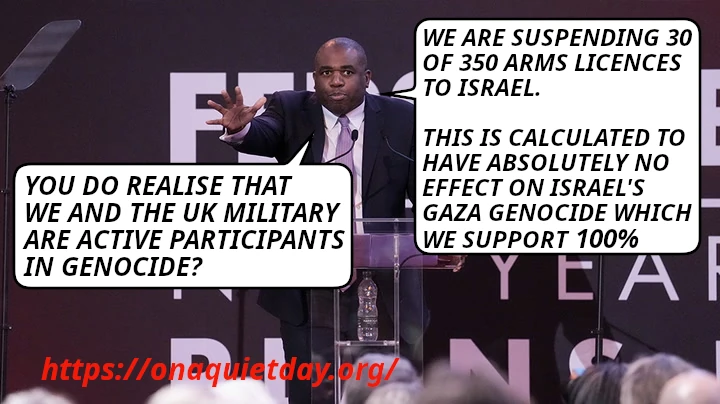
Genocide denier and Current UK Prime Minister Keir Starmer is quoted that he supports Zionism without qualification. He also confirms that UK air force support has been essential in Israel’s mass-murdering genocide. Includes URLs https://www.declassifieduk.org/keir-starmers-100-spy-flights-over-gaza-in-support-of-israel/ and https://youtu.be/O74hZCKKdpAGenocide denying UK Foreign Secretary David Lammy says that UK is suspending 30 of 350 arms licences to Israel. He also confirms the UK government’s support for Israel’s Gaza genocide and the UK government and military’s active participation in genocide.
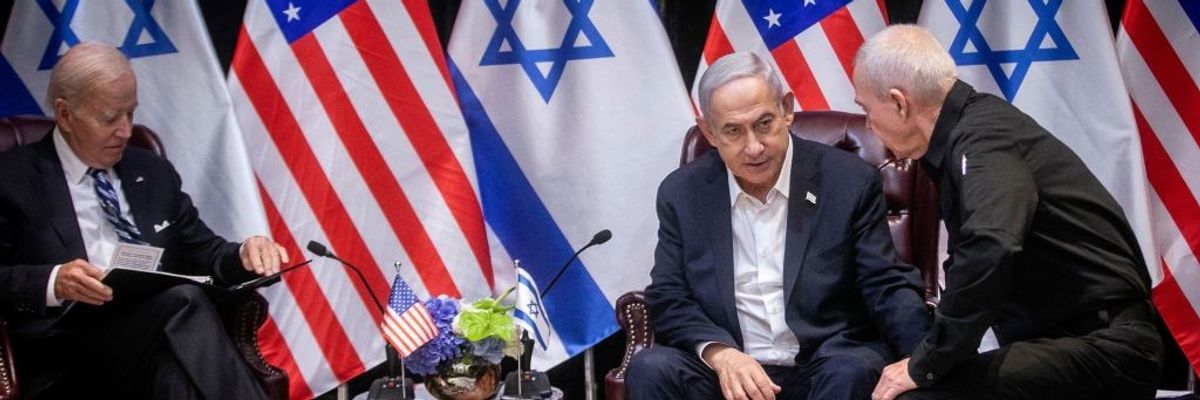
Israeli Prime Minister Benjamin Netanyahu (center) confers with Defense Minister Yoav Gallant (R), during their meeting with U.S. President Joe Biden at the start of the Israeli war cabinet meeting, in Tel Aviv on October 18, 2023. The International Criminal Court issued arrest warrants for both Netanyahu and Gallant this week. (Photo by Miriam Alster / POOL / AFP via Getty Images)
Their entanglement in Israel’s war makes U.S. leaders vulnerable to legal accountability not just for aiding and abetting crimes, but for direct complicity in their commission.
The International Criminal Court (ICC) issued historic arrest warrants on Thursday for Israeli Prime Minister Benjamin Netanyahu and former Defense Minister Yoav Gallant, charging them with war crimes and crimes against humanity. This unprecedented move against Israeli officials holds profound implications not only for Israeli leaders but also for their enablers, including the United States. As the Biden administration continues to provide billions in military aid to Israel, these warrants serve as both a warning and a call to action. To avoid complicity in these crimes, top U.S. officials should immediately halt military assistance or risk legal repercussions for continued support of Israeli war crimes.
Significantly, the ICC also has a history of issuing sealed indictments that remain confidential until the targeted individuals enter a member state. This means that beyond Netanyahu and Gallant, other Israeli officials, most likely soldiers documented committing gross crimes, likely face undisclosed warrants, with far-reaching implications for Israeli military forces and those who support their actions.
As the Biden administration continues to provide billions in military aid to Israel, these warrants serve as both a warning and a call to action.
This development should serve as a wake-up call for the U.S. government. The Biden administration continues to provide billions of dollars in unrestricted military aid to Israel—$17.9 billion this year alone—despite a majority of Americans who now oppose such aid. Israeli forces have used these weapons to commit the very crimes for which the ICC has issued arrest warrants. This is not just morally indefensible; it is legally risky. Article 25(3)(c) of the Rome Statute explicitly outlines criminal liability for aiding and abetting war crimes. While the U.S. is not an ICC member state, its officials and leaders could still face prosecution for enabling crimes under the court’s jurisdiction, such as the crimes underway in Palestine.
It’s important to note that the Biden administration has not only armed Israel but has also contributed directly to operations on the ground, including intelligence sharing, targeting data, and direct military combat in Yemen and Iraq targeting armed groups who are fighting Israel. This entanglement in Israel’s war makes U.S. leaders vulnerable to legal accountability not just for aiding and abetting crimes, but for direct complicity in their commission. This moment calls for more than celebration—it demands meaningful and decisive action. For justice to prevail, the international community should rise to the occasion and ensure accountability at every level. A critical first step lies with the 124 member states of the ICC. These nations should publicly commit to upholding their obligations under international law by affirming their readiness to arrest Israeli officials if they enter their jurisdiction. Notably, countries such as the Netherlands, France, Canada, Spain, and Italy have already signaled their intent to enforce the ICC’s arrest warrants for Netanyahu and Gallant.
By cutting ties with leaders implicated in war crimes and crimes against humanity, nations can exert pressure on Israel to change course and demonstrate their commitment to upholding justice and human rights.
Beyond national commitments, ICC member states could leverage international mechanisms to restrict the movement of indicted individuals. They should work collectively to request Interpol Red Notices for Netanyahu, Gallant, and any other officials facing charges. These notices would alert law enforcement worldwide to the existence of arrest warrants, ensuring that the accused cannot travel freely without risk of apprehension and extradition. Such measures are not merely symbolic; they serve as a tangible step toward accountability, signaling to perpetrators and their supporters that the international community will not tolerate impunity.
Equally important is the need for countries to reevaluate and sever their political and military ties with Israel’s leadership, at least as long as Netanyahu serves as Israel prime minister. This includes halting weapons sales and other forms of military cooperation with the Netanyahu government. Military aid and arms exports fuel the very crimes that the ICC is now investigating, making complicity in these actions inexcusable. By cutting ties with leaders implicated in war crimes and crimes against humanity, nations can exert pressure on Israel to change course and demonstrate their commitment to upholding justice and human rights. These steps, taken collectively, would not only support the ICC’s mission but also strengthen the principles of accountability and rule of law in international relations.
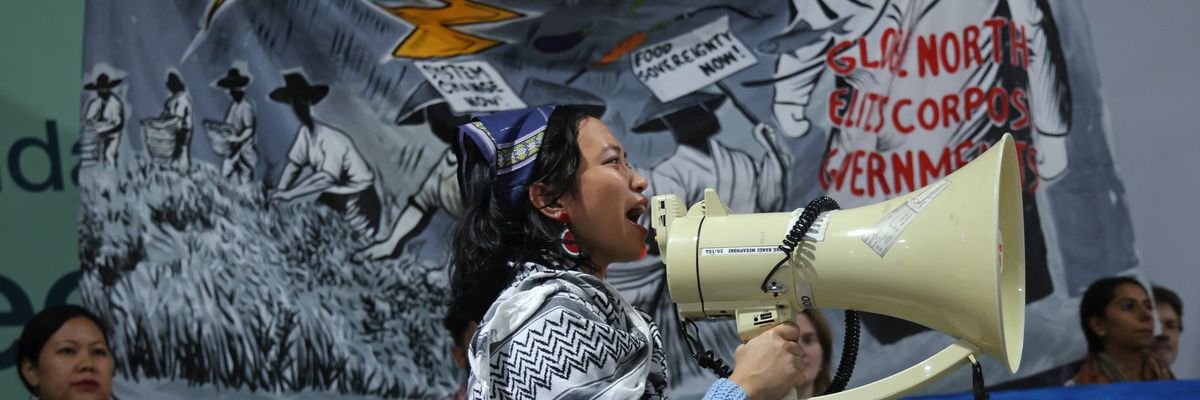
Activists demonstrate against industrial agriculture and agribusiness lobbyists on day eight at the UNFCCC COP29 Climate Conference on November 19, 2024 in Baku, Azerbaijan. (Photo by Sean Gallup/Getty Images)
“By the end of the UN climate talks, we must see at least a trillion dollars in public finance on the table,” said one campaigner.
As the clock winds down at the UN climate summit taking place in Baku, Azerbaijan, green groups are sounding the alarm Thursday following the release of a draft climate finance deal that they say falls short of what’s needed to support climate-vulnerable countries and adequately address the planetary crisis.
“The clock is ticking. COP29 is now down to the wire,” said UN Secretary-General António Guterres on Thursday, just a day before the two-week conference is set to conclude.
Finance has been a major focus of this year’s summit. Under the 20125 Paris Agreement, countries are supposed to come up with a “new collective quantified goal”—or NCQG in COP jargon—that will govern how much money from rich countries will be transferred to developing countries in order to help the latter cut their emissions and adapt to climate change.
No equivalent climate finance arrangement has been agreed to before, though countries at the summit broadly agree that richer countries, who are responsible for much of historic CO2 emissions, should help poorer and more climate-vulnerable nations deal with natural disasters and their transition to green energy.
The draft text that dropped early Thursday, however, was received poorly.
Oxfam International’s climate justice lead, Safa’ Al Jayoussi, said “COP29 must do more than simply repeat the same threadbare promises. Rich countries have spent decades now stalling and blocking genuine progress on climate finance. This has left the Global South suffering the most catastrophic consequences of a climate crisis they did not create. The draft text scandalously misses the crucial element of declaring a clear public commitment to a new climate finance goal.”
Instead of specifying how much annually should be funneled towards developing countries via climate finance, the NCQG draft text displayed “X” in place of any actual figures or monetary commitments.
Oscar Soria, a director at the Common Initiative think tank, told the Guardian: “The negotiating placeholder ‘X’ for climate finance is a testament of the ineptitude from rich nations and emerging economies that are failing to find a workable solution for everyone.”
“By the end of the UN climate talks, we must see at least a trillion dollars in public finance on the table,” added Andreas Sieber, 350.org associate director of policy and campaigns. Economists told the summit attendees last week that developing countries need at least $1 trillion annually by 2030 to deal with climate change.
A specific and shared concern from campaigners was the draft text’s inclusion of carbon market schemes as a way “to scale up” climate finance. While the draft promotes “high-integrity voluntary carbon markets” and other “instruments that mobilize new sources of climate finance and private finance” as part of the equation, critics have long warned that these market-based approaches are nothing but false solutions designed to benefit corporate investors, wealthier nations, and the fossil fuel industry itself.
“Labelling carbon credits as climate finance—which they are unreservedly not—should be axed from the text or risk creating a dangerous escape route for polluters. The same goes for explicitly allowing investments in fossil fuel infrastructure. This is fundamentally incompatible with the goals of the Paris Agreement,” said Laurie van der Burg, Oil Change International’s global public finance manager, in response to the draft text.
While Article 6 of the Paris Agreement allows for the international transfer of carbon credits, groups warned the changes in the COP29 draft would dramatically strengthen the foothold of such schemes.
“Shockingly, COP29 is set to agree to carbon markets that are even worse than the voluntary carbon markets,” said Kirtana Chandrasekaran, a climate campaigner with Friends of the Earth International. “We know these markets have failed. They are riddled with fraud and they do not reduce emissions or provide finance. Communities everywhere and, in fact, the planet itself is on the line.”
Without addressing these concerns, advocates of a meaningful deal at the conference say COP29 is headed for failure.
As 350.org‘s Sieber argued, paying the “historic debt that rich countries owe will enable all nations to take action on climate at home and meet the collective goal agreed last year at COP28—to triple renewable energy, and transition away from fossil fuels. Right now, we only see cowardice and a void in leadership, ignoring the undeniable science that we can’t keep polluting our planet with dirty oil, gas and coal.”
“The time to course correct is now—the European Union and other rich countries must stop playing poker with the planet and humankind’s future at stake,” Sieber added. “It’s time to put their cards on the table and commit real, transformative funding—no more excuses, no more delays, it’s time.”
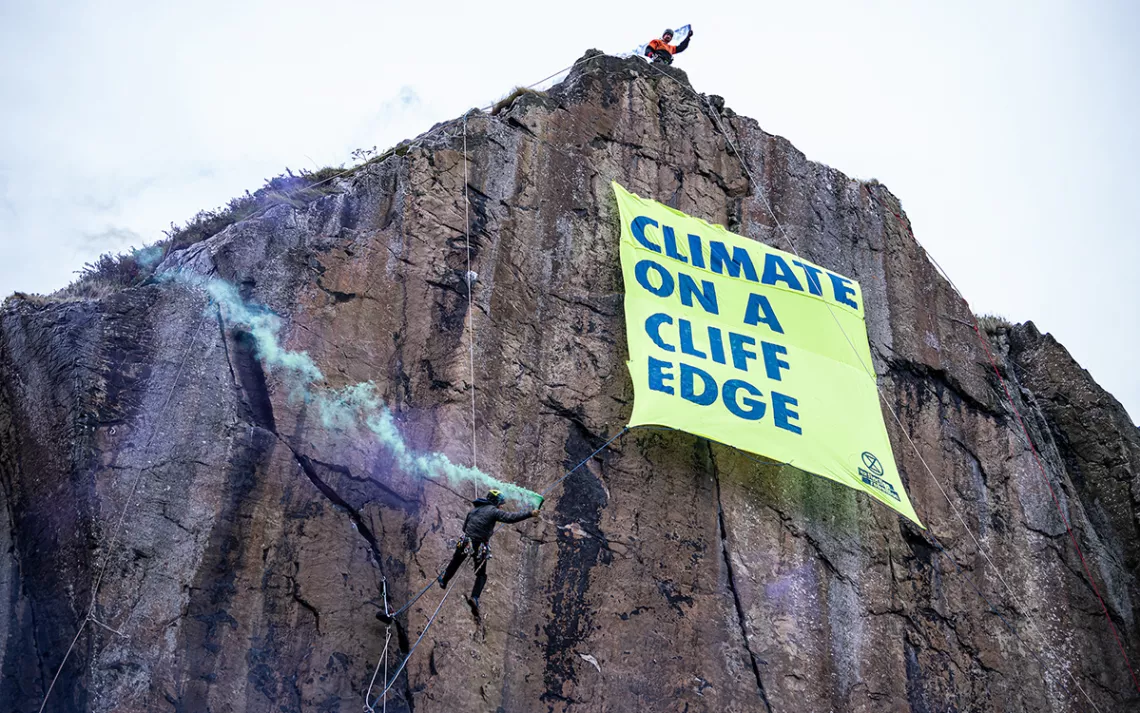
Experienced climbers scale a rock face near the historic Dumbarton castle in Glasgow, releasing a banner that reads “Climate on a Cliff Edge.” One activist, dressed as a globe, symbolically looms near the edge, while another plays the bagpipes on the shores below. | Photo courtesy of Extinction Rebellion and Mark RichardsOrcas comment on killer apes destroying the planet by continuing to burn fossil fuels. Second version, corrected text.
ExxonMobil CEO Darren Woods sits during testimony before the U.S House Committee on Oversight and Reform on October 28, 2021. (Photo: Screenshot/C-SPAN)
Public pensions must exit Exxon to protect workers’ savings and retirement.
It is no secret that ExxonMobil poses some of the most powerful opposition to climate action at every level of government. Environmentalists have long pointed out that Exxon Knew about climate change, and instead of pivoting their business model to a more sustainable energy future, buried the evidence and began a decades-long disinformation campaign.
Leaders across the country have wisened up to the oil major’s dirty politics, which is why the House Oversight Committee has been investigating Exxon and its peers, and state attorneys general have sued the company for damages. Most recently, California AG Rob Bonta, alongside environmental organizations like the Sierra Club, sued the company for lying to the public about the recyclability of plastics.
If the tide is turning against Exxon, why haven’t investors caught on?
Unrestricted funding for companies engaged in fossil fuel expansion threatens workers’ right to dignified retirement safety, a right that unions have fought hard to win.
ExxonMobil sparked headlines and investor outrage this spring when the company sued its own shareholders over a climate-related shareholder resolution. Public pensions representing trillions in worker savings across the country pushed back and mounted a vote-no effort against CEO Darren Woods and Director Joseph Hooley, but Wall Street asset managers watered down their efforts instead offering unwavering support of Exxon.
To add insult to injury, Woods made an appearance at the Council of Institutional Investors—a nonprofit dedicated to advocating for the investor rights of public, union, and private employee benefit funds—in September. There, he promised to continue to crack down on “extreme” investors who are concerned that the company’s business model has loaded the economy with systemic financial risks and instability. Never mind that such a definition of extreme would describe many of the institutions present, which represent over 15 million workers and $5 trillion in assets under management.
But perhaps most indicative of ExxonMobil’s commitment to business-as-usual pollution is the bonds they’ve issued this fall, with a maturity date of 2074.
These long-dated bonds represent unrestricted funds for ExxonMobil to continue to pursue fossil fuel expansion and plastic pollution well past most of the world’s—and investors’—Net Zero by 2050 goals. This is an especially risky gamble for investors with long-term obligations, including public pension funds that manage millions of workers’ retirement savings.
Not only is the future of oil and gas uncertain, but prolonged pollution wrought by disinformation and investor cash increases economy-wide systemic risks. Investors—and the everyday people who rely on institutions to manage their savings—will be left holding the purse strings as climate change wreaks havoc. Moreover, bond ownership does not come with the shareholder rights investors hope to use to influence company behavior. This gives Exxon complete freedom to use the funds however it wishes, even if that’s out of alignment with investor interests.
This increasing risk is why we joined California Common Good and pension beneficiaries to testify during a recent CalPERS Board meeting to ask CalPERS to issue a moratorium on purchasing Exxon bonds.
The Sierra Club represents millions of members, many of whom are saving for retirement in the face of an uncertain future and working tirelessly to protect the communities and places they love. Whether relying on a public pension plan or a private asset manager, our members rely on investment professionals to keep their futures in mind. Unrestricted funding for companies engaged in fossil fuel expansion threatens workers’ right to dignified retirement safety, a right that unions have fought hard to win. That’s why we call on investors, particularly public pension funds, to refuse to participate in Exxon’s bond issuances.
Experienced climbers scale a rock face near the historic Dumbarton castle in Glasgow, releasing a banner that reads “Climate on a Cliff Edge.” One activist, dressed as a globe, symbolically looms near the edge, while another plays the bagpipes on the shores below. | Photo courtesy of Extinction Rebellion and Mark RichardsOrcas comment on killer apes destroying the planet by continuing to burn fossil fuels. Second version, corrected text.
Former Brazilian President Jair Bolsonaro speaks during a rally on September 7, 2024 in São Paulo, Brazil. (Photo: Allison Sales/picture alliance via Getty Images)
“Well, look at this thing called ‘accountability,'” said one MSNBC host.
The Brazilian Federal Police on Thursday indicted former President Jair Bolsonaro and 36 others for allegedly plotting the “violent overthrow of the democratic state” after the country’s current leftist president, Luiz Inácio Lula da Silva, defeated the right-wing leader in 2022.
“The final report has been sent to the Supreme Court with the request that 37 individuals be indicted for the crimes of the violent overthrow of the democratic state, coup d’ etat, and criminal organization,” police said in a statement about the conclusion of the two-year investigation.
As The New York Times explained: “Although the police in Brazil can make recommendations about criminal prosecutions, they do not have the power to formally charge Mr. Bolsonaro. The country’s top federal prosecutor, Paulo Gonet, must now… decide whether to pursue charges against Mr. Bolsonaro and compel him to stand trial before the nation’s Supreme Court.”
The recommendations for charges came after the arrest of four members of the military and a federal police officer earlier this week over an alleged plot to kill Lula and Vice President Geraldo Alckmin before they were sworn in, as well as Supreme Court Justice Alexandre de Moraes. Police said that “a detailed operational plan called ‘Green and Yellow Dagger’ was identified, which would be executed on December 15, 2022, aimed at the murder of the elected candidates for president and vice president.”
According to CNN, “Police reportedly allege that Bolsonaro had ‘full knowledge’ of a plan to prevent Lula and his government from taking office after his election victory.”
Bolsonaro has repeatedly denied any wrongdoing, including with two other pending cases: In March he was indicted for allegedly falsifying his Covid-19 vaccination data and in July he was indicted for crimes including embezzlement related to alleged misappropriation of diamond jewelry and other state property. Those indictments came after Brazil’s highest election authority last year barred him from running for any public office for eight years over his lies about the 2022 contest.
In addition to Bolsonaro, the other three dozen people indicted on Thursday include “some of the most important members of his far-right administration,” The Guardian reported. As the newspaper detailed:
They included Bolsonaro’s former spy chief, the far-right Congressman Alexandre Ramagem; the former defense ministers, Gen. Walter Braga Netto and Gen. Paulo Sérgio Nogueira de Oliveira; the former minister of justice and public security, Anderson Torres; the former minister of institutional security, Gen. Augusto Heleno; the former navy commander Adm. Almir Garnier Santos; the president of Bolsonaro’s political party, Valdemar Costa Neto; and Filipe Martins, one of Bolsonaro’s top foreign policy advisers.
Also named is the right-wing blogger grandson of Gen. João Baptista Figueiredo, one of the military rulers who governed Brazil during its 1964-85 dictatorship.
The list contains one non-Brazilian name: that of Fernando Cerimedo, an Argentinian digital marketing guru who was in charge of communications for Argentina’s president, Javier Milei, during that country’s 2023 presidential campaign. Buenos Aires-based Cerimedo is close to Bolsonaro and his politician sons.
Given that Bolsonaro previously traveled to the United States when faced with legal trouble shortly after his loss two years ago, in this case, “precautionary measures have been issued, including a ban on international travel, which led to the confiscation of Bolsonaro’s passport months ago,” EL País noted Thursday.
vBolsonaro was among the right-wing leaders around the world who celebrated U.S. President-elect Donald Trump’s victory earlier this month. The Brazilian—who is sometimes called the “Trump of the Tropics” and like the American incited an insurrection after his last electoral loss—said that the impact of Trump’s win “will resonate across the globe… empowering the rise of the right and conservative movements in countless other nations.”
Trump’s return to office is expected to at least stall if not end his various legal issues, including for trying to overturn his 2020 loss.