A lifeguard hut rests on its side after Hurricane Milton, October 11, 2024, at Clearwater Beach, Fla.
RICH countries received strong criticism at the Cop29 conference in Azerbaijan today for wanting to spend more on wars and weapons than on preventing climate change.
“Global military spending stands at $2.5 trillion (£1.9trn) annually,” Panamian climate envoy Juan Carlos Monterrey Gomez told delegates at the faltering annual talks sponsored by the United Nations.
“For some, $2.5trn dollars to kill each other, it’s not enough, but $1trn to save lives is unreasonable.”
“Causing our own extinction is the most ridiculous thing. At least the dinosaurs had an asteroid. What is our excuse?”
Palestinian Environment Quality Authority chairwoman warned that Israel is committing “ecocide” after over a year of bombardments in Gaza.
“Protection of the environment is actually not an ancillary issue, it is not a secondary option, it is a basic right that is related to all of us as human beings,” she said.
…
Brazilian President Luiz Inacio Lula da Silva urged developed nations to consider moving their 2050 emission goals forward to 2040 or 2045.
“The G20 is responsible for 80 per cent of greenhouse-effect emissions,” he said. “Even if we are not walking the same speed, we can all take one more step.”
Meanwhile, a new scientific study has found that climate change has made Atlantic hurricanes about 18mph stronger in the last six years.
PENSIONER anger erupted at Labour as government figures conceded that 100,000 older people risk being pushed into poverty by the cut in winter fuel payments.
The National Pensioners Convention (NPC) renewed demands that ministers do a U-turn on the controversial cut, announced by Chancellor Rachel Reeves shortly after assuming office.
NPC general secretary Jan Shortt said she was “gravely concerned” by figures included in an analysis revealed by the Department for Work and Pensions this week.
These showed that the removal of the benefit will plunge around 50,000 pensioners into relative poverty next year, and the same number again by the end of the decade.
Ms Shortt said: “We find it completely unacceptable that an extra 50,000 to 100,000 older people will fall into poverty as a result of the decision to means-test the winter fuel payment.
“The message to older people is that the government is happy to accept them as collateral damage. The government must know these older people are not the ‘broadest shoulders’ they keep saying must pay to fix the economic deficit.
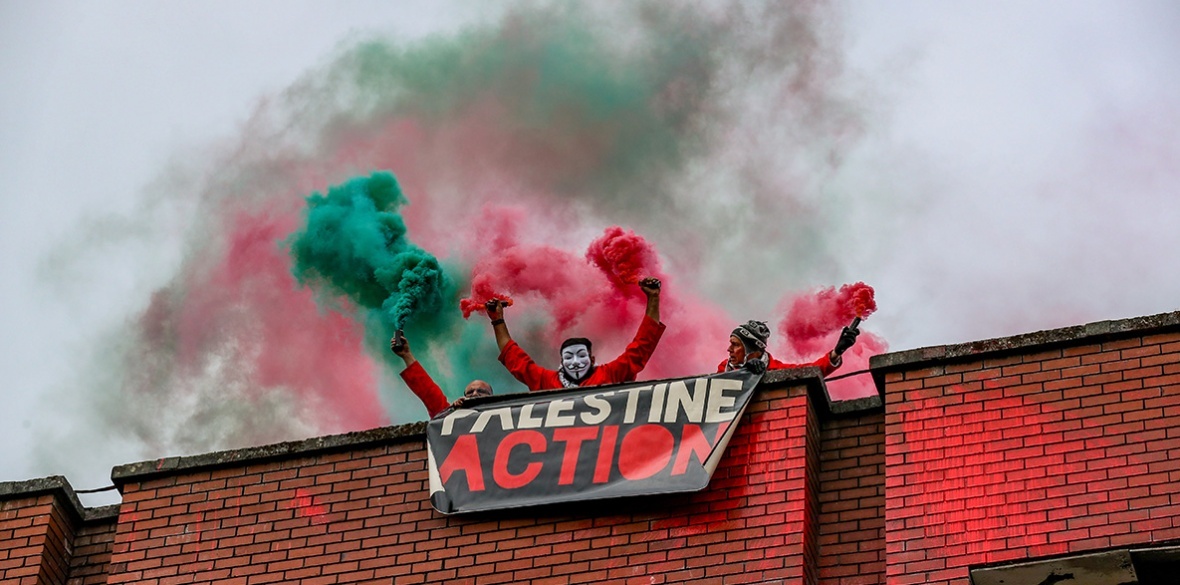
Palestine Action activists occupying the site of Elbit Ferranti in Oldham, Greater Manchester in 2021
COUNTER-TERRORISM police have arrested 10 more Palestine Action activists in connection to a protest at a “research hub” belonging to Israel’s largest weapons firm Elbit Systems.
Another 10 had already been detained when the action took place on August 6.
…
Despite being arrested under the Terrorism Act, which allows police to detain suspects up to 14 days without charge, the activists were all charged with non-terror offences, such as criminal damage and aggravated burglary.
Police confirmed that 10 more were arrested under the Terrorism Act on Tuesday in connection with the incident.
…
A spokesperson for the group accused the British state of “acting to protect the interests of a foreign genocidal regime, over the rights and freedoms of its own citizens.”
They added that the real terrorists were “those assisting and arming Israel’s genocide.”
It comes a month after counterterrorism police raided the home of Asa Winstanley, a journalist covering the occupation of Palestine.
…
Cage International head of campaigns Naila Ahmed said: “The British government continues to build an infrastructure of authoritarian laws.
“This is beyond a question of complicity; the UK police are now acting as an extension of a genocidal entity, abusing and exploiting any and every power at their disposal to intimidate and crush resistance to the mass killing of humans in Gaza.”
Original article by Fin Johnston republished from TBIJ under a Creative Commons Attribution-NonCommercial-NoDerivs 3.0 Unported License.
Project has sold credits to EasyJet, British American Tobacco and Ernst & Young
A carbon offsetting project set up by Harvard University’s endowment fund has sold millions of junk credits to major international companies, the Bureau of Investigative Journalism (TBIJ) can reveal.
After establishing the scheme in 2012 on land it has bought in Uruguay, Harvard ended its involvement when it sold the land across two deals in 2017 and 2019 worth a combined $450m. But the project is still active today and has sold enough credits to have supposedly offset over 5 million tonnes of CO2 emissions – roughly equivalent to what a million cars would produce in a year.
EasyJet, British American Tobacco and Ernst & Young are all among the biggest buyers of credits from the project.
The current owner of the project told TBIJ it had received no revenues from sales of carbon credits to these companies. A spokesperson for the Harvard fund said it does not comment on individual investments.
The project was given the green light to sell carbon credits in 2012 by Verra, the carbon credit standards body. But in 2022 it was given a rating of zero by an agency that assesses the effectiveness of carbon offsetting schemes.
The rating means that the credits, which should each represent one tonne of emissions avoided or removed from the atmosphere, represent no change. In other words, the project has had no effect on the environment at all.
The Guanaré Forest Plantations Project, a vast reforesting scheme, was set up following the 2006 purchase of an area of land in eastern Uruguay about the size of Washington DC. It was ultimately paid for by the university’s endowment fund, Harvard Management Company (HMC), a $50bn vehicle which invests to support research and student bursaries.
Though the land was bought through two companies set up by HMC, and the running of the project was outsourced to a Uruguayan forestry company, all the money made from sales of carbon credits went to the Harvard fund.
[section omitted: What is carbon offsetting?]
Carbon offsets allow companies to make up for the carbon emissions they create by paying to avoid or remove emissions elsewhere. Each carbon credit represents a ton of carbon dioxide either removed from the atmosphere or prevented from entering it in the first place.
Offsetting has been the subject of much debate. Some argue it is necessary and provides much-needed incentives for investors to channel their money into green initiatives. Others have said it offers polluting companies a way to avoid reducing their own greenhouse gas emissions.
The $2bn global market for carbon offsets has been hit by a number of recent scandals – with reports claiming that many credits do not represent genuine carbon reductions.
On day one of this year’s Cop climate talks in Baku, an early agreement was reached over rules around the creation of a global carbon market, in theory paving the way for rich countries to pay for cheap climate action abroad.
The coffee company Lavazza also bought credits from the project to offset the emissions of a supposedly “carbon neutral” coffee capsule it launched in 2022.
Renoster, the agency that gave the project a zero rating, raised three criticisms of the scheme. The first hinged on a factor known as “additionality”, which exists to prevent companies from going about their normal business – for example running a commercial timber project – and selling carbon credits on top. If a project could run without carbon finance, then it cannot be considered additional.
Documents submitted to Verra state that the project’s objective is to create “high value” timber products. Renoster ruled that carbon finance had ultimately made no difference. “We believe that these trees were going to be planted regardless of the project,” it said.
The second criticism was that the scheme’s “baseline assumptions” were wrong. A baseline number is something given to every carbon offsetting project, against which its removals are measured. The project had a baseline of 0, meaning no emissions whatsoever would have been removed from the atmosphere if the scheme did not exist.
Renoster said that baseline was “not a reasonable assumption for the region” because large portions of nearby land were already being converted from pasture to eucalyptus plantations.
Renoster’s third criticism was that the project was unlikely to run its full course, which was projected to be 100 years.
“We do not believe that Guanaré’s carbon credits represent true emissions reductions,” Renoster’s chief science officer, Elias Ayrey, told TBIJ. “We would not consider carbon neutrality claims based on these particular credits to be legitimate.”
The current owners of the project said: “Carbon credits have been critical for achieving the rates of return that investors required when the project started.” They said this cash means they can let the trees grow for longer before they are harvested.
A second agency, BeZero Carbon, also assessed the project and raised similar concerns around additionality and baseline assumptions. It found that the project had a “low” likelihood of achieving the purported emissions avoidance or removal.
The project has also been criticised by World Rainforest Movement, an organisation that monitors the Uruguayan forestry industry, which said: “Industrial tree plantations in Uruguay have led to land concentration by a small group of corporations and investment funds. They replace an extremely important ecosystem – grasslands – to plant tree monocultures, destroying biodiversity and watersheds.”
A BAT spokesperson told TBIJ that its carbon neutrality claim was independently validated in 2021. Lavazza said it had removed the claims from its products and is dedicated to transparency in all its sustainability initiatives.
An EasyJet spokesperson told TBIJ that it transitioned away from offsetting in 2022 but until then “had robust due diligence processes in place”.
Ernst & Young said it selects offsetting projects which have been certified against internationally recognised standards and continues to work on its due diligence procedures. It said it retired all remaining credits in this project in 2023.
This story was updated on 20 November 2024 to clarify the response given to TBIJ by the Harvard fund.
Reporter: Fin Johnston Global health editor: Fiona Walker Deputy editor: Chrissie Giles Editor: Franz Wild Impact producer: Paul Eccles Production editor: Alex Hess Fact checker: Somesh Jha
TBIJ has a number of funders, a full list of which can be found here. None of our funders have any influence over editorial decisions or output.
Original article by Fin Johnston republished from TBIJ under a Creative Commons Attribution-NonCommercial-NoDerivs 3.0 Unported License.
Zelensky meets Starmer and NATO secretary general Mark Rutte. (Photo: Simon Dawson / No 10 handout)
British aid is being used to open up Ukraine’s wrecked economy to foreign investors and enhance trade with the UK.
Amid the devastating war in Ukraine, British economic aid to the country is focused on promoting pro-private sector reforms and on pressing the government to open up its economy to foreign investors.
Recently-published Foreign Office documents on its flagship aid project in Ukraine, which supports privatisation, note that the war provides “opportunities” for Ukraine delivering on “some hugely important reforms”.
The government in Kyiv has in recent months been responding positively to these calls. Last month, president Volodymyr Zelensky signed a new law expanding the privatisation of state-owned banks in the country.
It follows the Ukrainian government’s announcement in July of its ‘Large-Scale Privatisation 2024’ programme that is intended to drive foreign investment into the country and raise money for Ukraine’s struggling national budget, not least to fight Russia.
Large assets slated for privatisation currently include the country’s biggest producer of titanium ore, a leading producer of concrete products and a mining and processing plant.
Ukraine envisaged privatising the country’s roughly 3,500 state-owned enterprises in a law of 2018, which said foreign citizens and companies could become owners.
The process stalled as a result of coronavirus and then Russia’s invasion in February 2022. But hundreds of smaller-scale enterprises are now being privatised, bringing in revenues of UAH 9.6bn (£181m) in the past two years.
“The resumption of privatisation amid the full-scale war is an important step, which is already yielding results,” Ukraine’s economy minister Yulia Svyrydenko said last month.
Another law enacted in June 2023 allows large-scale assets to be sold to foreigners or Ukrainians during the current martial law regime.