Israeli Prime Minister Benjamin Netanyahu (left) and Defence Minister Yoav Gallant attend a press conference in the Kirya military base in Tel Aviv, Israel, October 28, 2023
ACTIVISTS and experts welcomed the arrest warrants for Israeli Prime Minister Benjamin Netanyahu and his former defence minister Yoav Gallant issued by the International Criminal Court today.
Leading Hamas official Mohammed Deif also had a warrant issued against him.
The warrants accused each of them of war crimes and crimes against humanity over the 13-month war in Gaza and the October 2023 attack on Israel respectively.
The three-judge panel was unanimous in its decision to issue warrants for Mr Netanyahu and Mr Gallant, saying that “there are reasonable grounds to believe that both individuals intentionally and knowingly deprived the civilian population in Gaza of objects indispensable to their survival, including food, water and medicine and medical supplies, as well as fuel and electricity.”
…
The court’s action turns Mr Netanyahu and the others into internationally wanted suspects.
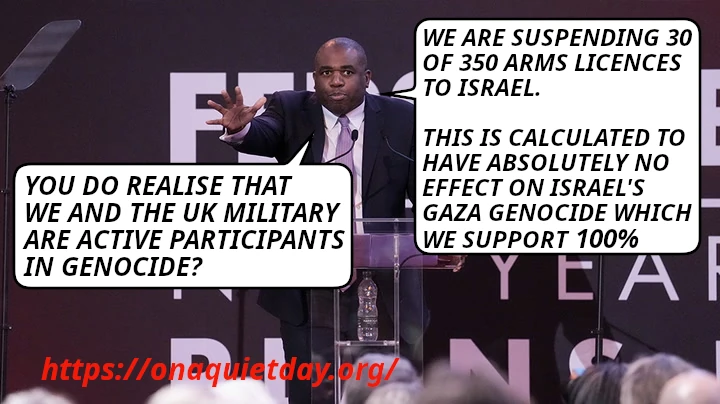
Zionist Keir Starmer is quoted “I support Zionism without qualification.” He’s asked whether that means that he supports Zionism under all circumstances, whatever Zionists do.Genocide denying UK Foreign Secretary David Lammy says that UK is suspending 30 of 350 arms licences to Israel. He also confirms the UK government’s support for Israel’s Gaza genocide and the UK government and military’s active participation in genocide.
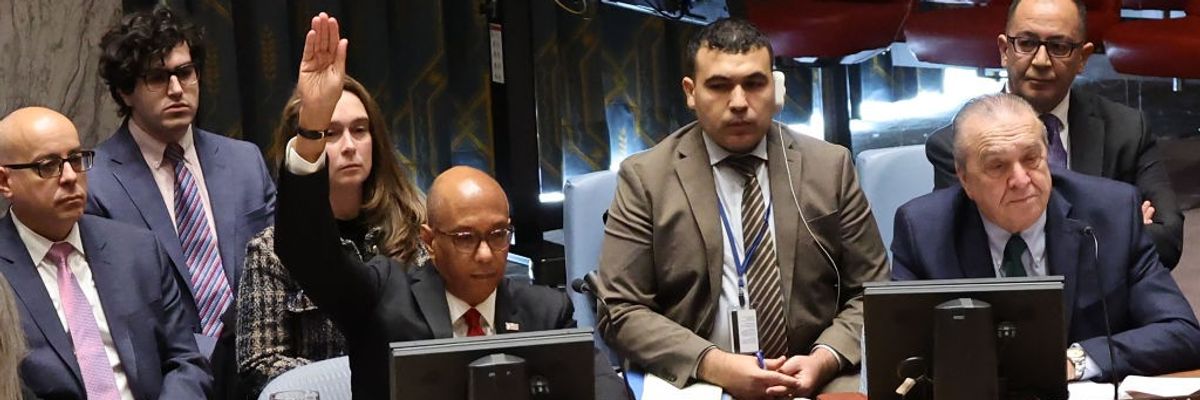
U.S. Ambassador Robert Wood raises his hands to veto a draft resolution during a United Nations Security Council meeting at the U.N. headquarters in New York City on November 20, 2024. (Photo: Michael M. Santiago/Getty Images)
The U.S. government, said one human rights lawyer, “proves once again to the world that it is fully committed to the continuation of the genocide in Palestine.”
The Biden administration faced fierce criticism on Wednesday after using its veto power at the United Nations Security Council to block a resolution demanding an immediate, unconditional, and permanent cease-fire in Israel’s assault on the Gaza Strip.
The vetoed measure also called for all parties to implement a U.N. Security Council (UNSC) resolution passed in June—which would lead to the release of all hostages—and to enable Gaza civilians’ immediate access to basic services and humanitarian assistance.
Jess Peake, who directs the International and Comparative Law Program at the University of California, Los Angeles, condemned the U.S. decision as “absolutely unforgivable” while Nina Turner, a senior fellow at the Institute on Race, Power, and Political Economy, declared that “this is absurd.”
Mai El-Sadany, executive director of the Tahrir Institute for Middle East Policy in Washington, D.C., called it “yet another shameful abuse of the UNSC veto by the U.S. to perpetuate a war that violates U.S. law and U.S. international legal commitments.”
“Today’s message is clear to the Israeli occupying power—you may continue your genocide… with complete impunity.”
Human rights attorney Craig Mokhiber, who last year resigned as the New York director for the Office of the High Commissioner for Human Rights over the United Nations’ response to Gaza, said Wednesday that “the U.S. has just vetoed another cease-fire resolution in the U.N. Security Council, and, in doing so, proves once again to the world that it is fully committed to the continuation of the genocide in Palestine.”
Mokhiber also called for action at the United Nations General Assembly (UNGA), where there is no U.S. veto power.
“Even as we seek accountability for Israeli perpetrators, we must also seek accountability for complicit U.S. actors,” he said. “Israeli/U.S. impunity threatens the entire world. And the U.N. must now move to take concrete action in the UNGA.”
The 14-1 vote at the UNSC marked the fourth time the United States has blocked a Gaza resolution since Israel began its retaliation for the Hamas-led October 7, 2023 attack. All five permanent members of the Security Council—the U.S., the United Kingdom, Russia, France, and China—have veto power. The other seats are filled on a rotating basis and lack that authority.
The 10 nonpermanent members—Algeria, Ecuador, Guyana, Japan, Malta, Mozambique, Sierra Leone, Slovenia, South Korea, and Switzerland—were behind the push to pass this draft resolution. Those who supported it represent “the collective will” of the international community, Algerian Ambassador Amar Bendjama said after the vote, according to U.N. News.
“It is sad day for the Security Council, for the United Nations, and the international community as a whole,” Bendjama said, stressing that it has been “five months since the adoption of Resolution 2735, five months during which the Security Council remained idle—remained hand-tied.”
“Today’s message is clear to the Israeli occupying power—you may continue your genocide… with complete impunity. In this chamber—you enjoy immunity,” he added. “To the Palestinian people, another clear message—while the overwhelming majority of the world stands in solidarity with your plight, others remain indifferent to your suffering.”
Israel faces a South Africa-led genocide case at the International Court of Justice over its assault on Gaza, which as of Wednesday has killed at least 43,985 Palestinians, according to local officials. Another 104,092 people have been wounded, and most of the enclave’s 2.3 million residents have been repeatedly displaced as Israeli forces have devastated civilian infrastructure.
U.S. Ambassador Robert Wood said Wednesday that “we made clear throughout negotiations we could not support an unconditional cease-fire that failed to release the hostages.”
“This resolution abandoned that necessity,” he argued. “For that reason, the United States could not support it.”
The U.S. government has been widely accused of complicity in genocide for arming Israeli forces over the past 13 months—including by progressives in Congress. Sen. Bernie Sanders (I-Vt.) on Wednesday planned to force a vote on resolutions that would block American weapons sales to Israel on the grounds that they violate federal law.
The Kremlin fired a new intermediate-range ballistic missile at Ukraine on Thursday in response to Kyiv’s use this week of American and British missiles capable of striking deeper into Russia, President Vladimir Putin said.
In a televised address to the country, the Russian president warned that U.S. air defense systems would be powerless to stop the new missile, which he said flies at ten times the speed of sound and which he called the Oreshnik — Russian for hazelnut tree. He also said it could be used to attack any Ukrainian ally whose missiles are used to attack Russia.
“We believe that we have the right to use our weapons against military facilities of the countries that allow to use their weapons against our facilities,” Putin said in his first comments since President Joe Biden gave Ukraine the green light this month to use U.S. ATACMS missiles to strike at limited targets inside Russia.
Pentagon deputy press secretary Sabrina Singh confirmed that Russia’s missile was a new, experimental type of intermediate range missile based on it’s RS-26 Rubezh intercontinental ballistic missile.
“This was new type of lethal capability that was deployed on the battlefield, so that was certainly of concern,” Singh said, noting that the missile could carry either conventional or nuclear warheads. The U.S. was notified ahead of the launch through nuclear risk reduction channels, she said.
New details have emerged in the case of the Palestinian surgeon who was tortured to death and sexually abused by Israeli forces. Meanwhile, the health situation in Gaza remains dire.
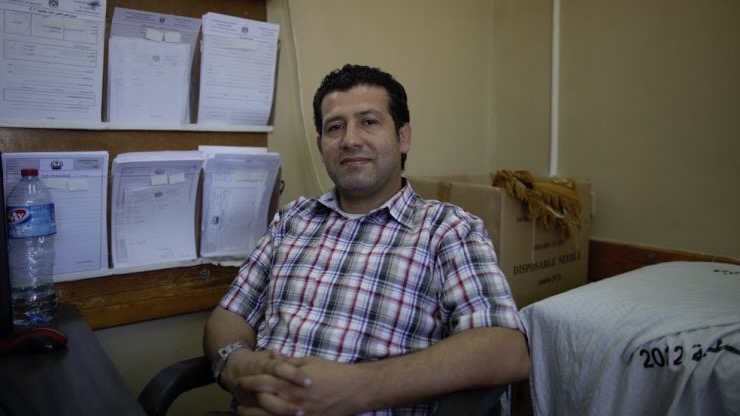
New reports have surfaced regarding the death of Palestinian surgeon Dr. Adnan Al-Bursh, who was abducted by Israeli armed forces in December 2023 during an attack on Al-Awda Hospital in northern Gaza. His case sheds further light on the abuse endured by health workers in Israeli prisons and detention camps. Palestinian prisoner associations had previously reported that Dr. Al-Bursh died as a result of torture. Now, testimonies from other detainees reveal that his abuse included sexual abuse.
These reports indicate that Israeli soldiers subjected Al-Bursh to exceptionally harsh treatment as soon as they identified him at Al-Awda Hospital. Dr. Khalid Hamouda, another physician detained by Israeli forces, recounted the severe injuries Dr. Al-Bursh sustained during his imprisonment in Sde Teiman concentration camp. At one point, Dr. Al-Bursh had difficulty walking or using the toilet without help, and feared his ribs had been broken in the beatings. Dr. Hamouda described meeting him in this state before Dr. Al-Bursh was transferred to Ofer prison.
When Dr. Al-Bursh was transferred to the new facility, fellow prisoners described his state as “deplorable.” They recounted visible injuries across his body, evidence of severe assault, and reported that he had been left naked “in the lower part of his body.” Soon after, he died.
“A doctor. A stellar surgeon. The embodiment of Palestinian ethics. Likely raped to death,” UN Special Rapporteur Francesca Albanese wrote on X following the release of the new reports. She condemned the lack of reaction to the atrocities committed by Israeli soldiers, stating, “The racism of Western media who are not covering this, and Western politicians who are not denouncing this, together with the thousand other testimonies and allegations of rape and other forms of mistreatment and torture that Palestinians have suffered in Israeli jails, is absolutely sickening.”
Accounts of torture and abuse similar to what Dr. Adnan Al-Bursh endured have been shared by other health workers recently released from Israeli detention. Many have highlighted that health workers represent a significant proportion—up to one quarter in some camps—of the total number of detainees held by Israeli Occupation Forces (IOF). This supports reports that the IOF systematically targets health workers in an effort to undermine Palestinian resistance and destroy any prospects for rebuilding.
Among those who described their imprisonment is Dr. Khaled Al Serr, a doctor originally employed at the Nasser Medical Complex, who spent six months in detention. He described following a similar path to Dr. Al-Bursh, being transferred from Sde Teiman to Ofer prison, where he endured regular beatings, including to intimate areas. “It was humiliating, but worse than that, they treated us like criminals,” he said in recent interviews. “We were just doctors trying to save lives.”
Despite targeted attacks and the acute shortage of medical supplies, nurses, doctors, and other health workers in Gaza continue to provide care under dire circumstances. Recent efforts by the World Health Organization (WHO) and other UN agencies finally succeeded in reaching the few remaining hospitals in northern Gaza to facilitate medical evacuations and deliver some essential supplies, including fuel, food, and medicine. However, these missions were obstructed by Israeli soldiers, who blocked parts of the deliveries. This has led to even more uncertainty about how much longer these facilities can remain operational.
The consequences of shortages and ongoing attacks in Gaza are escalating by the day. Hunger is spreading rapidly, with health and nutrition experts warning that signs of famine in the northern regions are becoming increasingly alarming. They are urgently calling for the immediate delivery of food across the Strip and an end to Israeli obstructions of humanitarian aid, emphasizing that delays will have fatal outcomes. People will die of hunger even before a famine is officially declared, and this would have “irreversible consequences that can last generations,” warned Rein Pulsen of the Food and Agriculture Organization.
The number of people hospitalized due to hunger, including many children, is rising, with their health further deteriorated by critical living conditions. Infectious diseases are spreading, compounded by the destruction of water and sanitation infrastructure. Most forcibly displaced people are living in makeshift tents and are forced to rely on improvised absorption trenches for sanitation. These trenches, mostly dug by the displaced themselves, pose severe risks: children have fallen into them, collapses caused by oversaturation are not uncommon, and they have become breeding grounds for diseases like cholera. “We relieve ourselves in a pit that smells and certainly causes us disease, but we have no choice but to use it,” Abdul Salam Al-Aswad, one of the displaced, told The Electronic Intifada.
The impact on chronic diseases in Gaza is equally worrying. Cancer patients are being denied access to lifesaving care, while Israeli bombardments have exposed thousands of pregnant women to toxic materials found in explosives. Doctors have noted a troubling increase in infants born with congenital conditions, such as underdeveloped lungs, limbs, and other severe abnormalities, warning of correlations with the use of white phosphorus. Without adequate medical care in Gaza and with medical evacuations systematically denied, many of these children die.
As an immediate ceasefire is the only true solution to the destruction of healthcare in Gaza, health workers and activists are urging more international pressure on Israel. This pressure is essential not only to stop the attacks, but also to ensure the entry of medical supplies and, critically, food into the besieged Strip, offering at least some immediate relief.
People’s Health Dispatchis a fortnightly bulletin published by thePeople’s Health Movementand Peoples Dispatch. For more articles and subscription to People’s Health Dispatch, clickhere.