LA fires show the human cost of climate-driven ‘whiplash’ between wet and dry extremes

Spread the love
Allison Dinner / EPA

Doug Specht, University of Westminster

October to April is normally considered to be the wet season in California, yet this January, the region is experiencing some of the most devastating fires it’s ever seen.

As of January 10, five major fires in and around Los Angeles have burned over 29,053 acres, leading to the evacuation of more than 180,000 people, the destruction of over 2,000 buildings (mainly homes), and an estimated damage cost of at least US$52 billion (£42.5 billion). Ten lives have been lost, and these numbers are expected to rise as the fires continue to burn.

The exact causes of each fire are still under investigation. However, several factors have contributed to their rapid spread and intensity.

The seasonal Santa Ana winds are particularly strong this year, bringing low humidity, dry air and high wind speeds. Southern California has received less than 10% of its average rainfall since October 2024, creating dry conditions that make the area highly vulnerable to fire.

Unusually wet winters in both 2022-23 and 2023-24 led to increased vegetation growth, providing more fuel for the fires. This cycle of wet and dry extremes, known as “hydroclimate whiplash”, is part of the increasingly intense climate cycles caused by climate change.

Hydroclimate whiplash can occur virtually anywhere. These cycles can cause extreme wildfires, such as those in California, where rapid vegetation growth is followed by drying. They can also exacerbate flooding when unusually heavy rains hit the dry-baked ground, then run off over the land rather than seeping in, leading to flash flooding.
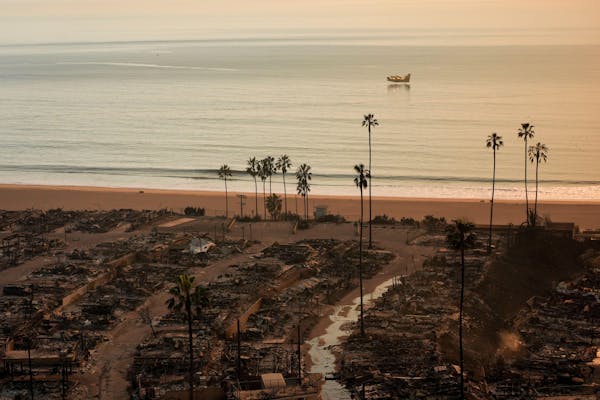
In Los Angeles, some neighbourhoods have been almost entirely destroyed. Jae C. Hong / Alamy

The human impact of hydroclimate whiplash

Rapid transitions between extreme wet and dry conditions have significant and wide-ranging impacts on people, a focus of my academic research, affecting everything from public health to economic stability and social equity.

As we have seen in California, there is the immediate impact of loss of life, property and livelihoods. We have also seen this during whiplash-induced floods and landslides, such as those experienced across California in 2023 and east Africa in 2024, when years of drought were followed by weeks of rain.

Fires exacerbate respiratory and cardiovascular diseases through their polluting smoke. Flooding creates conditions for waterborne illnesses such as cholera, leptospirosis or norovirus to rip through populations. Extreme swings in temperature can also create more heat-related illnesses, as human bodies struggle to adapt quickly. It is estimated that the health-related impacts of climate change will cost US$1.1 trillion by 2050.

But this number pails into insignificance against the projected US$12.5 trillion in economic losses worldwide due to climate change by 2050. Critical infrastructure, including water supply systems, wastewater treatment plants and transportation networks, is at risk of damage or destruction. Food insecurity and scarcity will also increase during hydroclimate whiplash events.

And these impacts are not evenly distributed. While this month’s wildfires are affecting some of the richest communities in the US, it is generally low-income communities and vulnerable populations that are disproportionately affected, with limited resources to prepare for or recover from extreme events. Across the world, poorer populations are experiencing a 24%-48% increase in drought-to-downpour events, exacerbating their vulnerability and widening the health equity gap.

All these events and concerns also lead to mental health issues such as anxiety, depression and post-traumatic stress disorder (PTSD), resulting from displacement and trauma. Such human impacts are harder to measure, and often under-reported.

Adaptation and resilience

As climate change intensifies hydroclimate whiplash events, the human impacts are expected to grow more severe. Addressing these challenges will require coordinated efforts across multiple sectors, with a focus on both mitigation and adaptation strategies to protect human health, economic stability and social equity.

Governments and local authorities will need to implement co-management approaches for both drought and flood risks, alongside developing more flexible water management systems and infrastructure. Investing in natural infrastructure to enhance biodiversity and ecosystems will reduce risks to humans, both by restricting the effects of climate change and lowering the risks of fire and flooding.

As individuals we can often feel powerless, but environmental campaigns and movements have been highly successful in changing government policies. In the UK, the 2008 Climate Change Act and the net zero by 2050 legislation were the direct result of citizen lobbying and action, and the same can be said for numerous renewable energy transition policies around the world.

In California, we have seen the devastating effect of hydroclimate whiplash – and this won’t be the last we see. By calling on our governments to produce adaptation and resilience strategies that recognise climate change as a long-term human and economic risk factor, we can be more prepared for these events.

Doug Specht, Reader in Cultural Geography and Communication, University of Westminster

This article is republished from The Conversation under a Creative Commons license. Read the original article.
Continue ReadingLA fires show the human cost of climate-driven ‘whiplash’ between wet and dry extremes

Gaza Journalists Demand End to Israel’s Impunity for ‘Genocide Against Us’​

Spread the love

Original article by Jessica Corbett republished from Common Dreams under Creative Commons (CC BY-NC-ND 3.0). 

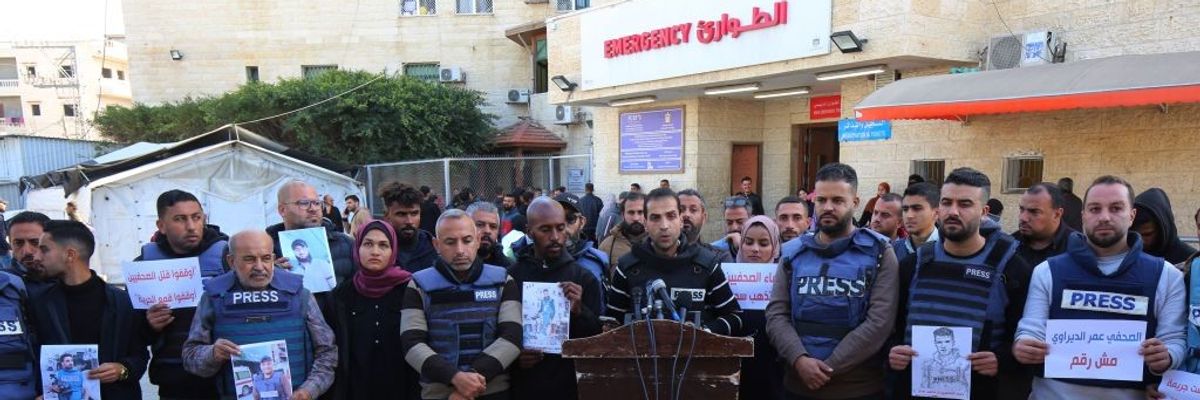
Palestinian journalists protest against the Israeli attacks on the media workers across the Gaza Strip outside al-Aqsa Martyrs Hospital in Deir al-Balah on January 8, 2025. (Photo: Rizek Abdeljawad/Xinhua via Getty Images)

“We have been let down by the international community, particularly the international media organizations,” said Abubaker Abed, sharing a message from Palestinian journalists.

Palestinian journalists gathered outside al-Aqsa Martyrs Hospital in Deir al-Balah this week to call attention to Israeli forces’ genocidal assault on the Gaza Strip, their slaughter of those reporting on the ground, and the global community’s failure to hold Israel accountable for the bloodshed.

On Thursday, the day after the event, Abubaker Abed, a Palestinian sports journalist now covering Israel’s war on Gaza, shared on social media a short video of his remarks in English, which he said were delivered on behalf of all the reporters in blue vests who surrounded him and the podium.

Since the Hamas-led October 7, 2023 attack on Israel, Palestinian reporters across Gaza have covered what Abed called “the most well-documented and first livestreamed genocide in history,” as Israel—armed by the United States—has launched airstrikes and ground raids, and stopped humanitarian aid and international media from entering the coastal enclave.

Abed said that “we’ve been reporting tirelessly, extensively, and thoroughly on this genocide. It’s indeed a genocide against us, which we’ve been documenting in makeshift tented camps and workplaces… You’ve seen us shedding tears over our loved ones, colleagues, friends, and family members. You’ve seen us killed in every possible way. We’ve been immolated, incinerated, dismembered, and disemboweled—and recently, we’ve been freezing to death.”

“What more ways should you be seeing us killed, then, so that you can move and act and stop the hell inflicted upon us? There are no words to describe what we’ve been going through, because you’ve seen our bodies, how they’ve become fragile, skinny, and fatigued, but we never stopped,” he continued, highlighting how Palestinian journalists have worked “to help the population that has seen every sort of torture and tasted every type of death,” while the world has refused to “stop Israel’s impunity against us.”

https://twitter.com/AbubakerAbedW/status/1877305118414033001?ref_src=twsrc%5Etfw%7Ctwcamp%5Etweetembed%7Ctwterm%5E1877305118414033001%7Ctwgr%5E6f9451540a9c36500a4683b3249ea8618fe64c56%7Ctwcon%5Es1_c10&ref_url=https%3A%2F%2Fwww.commondreams.org%2Fnews%2Fjournalist-killed-in-gaza

Sorry, this content could not be embedded.

X

“Our message is very clear: We are journalists, and we are Palestinian journalists. We have been let down by the international community, particularly the international media organizations,” Abed declared. “We haven’t seen any sort of support—a single word of support. Even the press vests we’re wearing right now mark us as a target. They do not protect us at all, because we are Palestinians. Maybe if we were Ukrainians or of any other citizenship, with blond hair and blue eyes, the world would rage and rant for us. But because we are Palestinians, we have only one right, which is to die and be maimed.”

“We are just documenting a genocide against us,” he concluded. “After almost a year and a half, we want you to stand foot-by-foot with us, because we are like any other journalists, reporters, and media workers all across the globe—no matter the origin, the color, or the race. Journalism is not a crime. We are not a target.”

Some journalists around the world reposted Abed’s video and called out their colleagues for ignoring Israel’s decimation of Gaza or reporting on it in ways favorable to the far-right Israeli government and its supporters, including the United States.

“The past 15+ months have been one of the most shameful periods in the history of Western journalism,” said Jeremy Scahill, co-founder of Drop Site News, which has published Abed’s reporting from Gaza. “The refusal of so many journalists to speak out in defense of our Palestinian colleagues in Gaza as they and their families have been hunted down and killed is a bloody stain.”

The New Yorker editor Erin Overbey similarly said that “the staggering silence of Western journalists this past year as their Palestinian colleagues have been targeted, intimidated, and killed by Israeli forces during the genocide in Gaza will go down as one of the most shameful periods in media/journalism and human rights history.”

British writer Owen Jones said: “How to describe the refusal of Western journalists to speak out about the biggest slaughter of journalists in the history of human civilization? Damning. Racist. Nauseating. You will never be forgiven. History will damn those who stayed silent—every last fucking one.”

Hamza Yusuf, a London-based British Palestinian writer, said that “we will never forget that whilst Palestinian journalists in Gaza were being systematically slaughtered by Israel, their industry peers at best looked on with indifference and at worst used their positions and their coverage to whitewash Israel’s crimes. Blood on their hands.”

https://twitter.com/QudsNen/status/1876954617981829224?ref_src=twsrc%5Etfw%7Ctwcamp%5Etweetembed%7Ctwterm%5E1876954617981829224%7Ctwgr%5E6f9451540a9c36500a4683b3249ea8618fe64c56%7Ctwcon%5Es1_c10&ref_url=https%3A%2F%2Fwww.commondreams.org%2Fnews%2Fjournalist-killed-in-gaza

As of Thursday, health officials in Gaza put the death toll from Israel’s 15-month assault at 46,006, with at least 109,378 other Palestinians wounded, the vast majority of the enclave’s population displaced, and civilian infrastructure in ruins. Israel faces global accusations of genocide, including in a case at the International Court of Justice.

Figures for press deaths have varied. The International Federation of Journalists—which works with its affiliate, the Palestinian Journalists’ Syndicate, to verify information—has documented the killings of 148 Palestinian media workers while the Committee to Protect Journalists has a list of 152 confirmed fatalities, at least 13 of which the group classifies as murders by Israeli forces.

At the end of last year, Al Jazeera published a long-form article titled “Know Their Names” and reported that “from October 7, 2023, to December 25, 2024, at least 217 journalists and media workers had been killed in Gaza. Five more were killed on December 26 when an Israeli airstrike targeted a news van near al-Awda Hospital.”

“Eighty percent of the journalists and media workers killed were between the ages of 20 and 40, a stark statistic that captures the young age of those who risk their lives to document the conflict,” according to Al Jazeera. “They were reporters and writers, photographers and video directors, analysts and editors, sound engineers and voiceover artists, and even founders of media outlets. Their stories remind us of the heavy price paid by those who strive to document humanity’s darkest moments.”

Original article by Jessica Corbett republished from Common Dreams under Creative Commons (CC BY-NC-ND 3.0). 

Experiencing issues with this image not appearing. I suspect because it's so critical of Zionist Keir Starmer's support of and complicity in Israel's genocides.
Genocide denier and Current UK Prime Minister Keir Starmer is quoted that he supports Zionism without qualification. He also confirms that UK air force support has been essential in Israel’s mass-murdering genocide. Includes URLs https://www.declassifieduk.org/keir-starmers-100-spy-flights-over-gaza-in-support-of-israel/ and https://youtu.be/O74hZCKKdpA
Continue ReadingGaza Journalists Demand End to Israel’s Impunity for ‘Genocide Against Us’​

‘Pesticides buzz off’: More than 1.6 million people call for a ban on bee-killing pesticides

Spread the love

petition signed by more than 1.6 million people urging the government to enforce a total ban on bee-killing neonicotinoid pesticides has been handed in to the Department of Environment, Farming and Rural Affairs (Defra) by environmental campaigners [1].

The petition, which was coordinated by Greenpeace UK, has amassed a staggering 1,645,000 signatures from the British public and was delivered directly to Defra for the environment minister, Emma Hardy. It was delivered in the form of a bee hotel by campaigners dressed in ‘worker’ bee outfits carrying placards reading, ‘Pesticides Buzz Off’, ‘Protect Our Bees’ and ‘Bee Safe’. They were joined by Siân Berry, Green Party MP for Brighton Pavilion, who is a supporter of the campaign.

Separately, 15 leading climate and nature charities – including Pesticide Action Network, RSPB, Wildlife Trusts and Greenpeace – have written to the environment minister, calling for an end to the emergency authorisation of neonicotinoids on sugar beet crops [2].

In the letter they state: “By not allowing another emergency use of neonicotinoids, there will be more incentive for British Sugar and the government to fund research into alternatives, and to adopt nature-friendly farming approaches including Integrated Pest Management (IPM).”

Greenpeace UK’s campaigner, Anthony Lewis, said: “Using neonicotinoids to ‘protect’ crops is like setting fire to your house to protect it from burglars. Yes, it will destroy pests, but it will also kill bees and other vital pollinators we depend on for the food we’re trying to grow. It’s absurd.

“Bee populations have been decimated over recent years, with the use of neonicotinoids one of the drivers of this decline. As leading environmental charities and experts on nature protection, along with 1.6 million members of the public, we implore the government to implement a full and final ban on the use of all bee-killing pesticides once and for all.”

Bees are essential for our survival – pollinating much of our food and playing a critical role in sustaining ecosystems around the world. However, wild bee populations have fallen by a third, with the use of pesticides on farms a key contributor to their rapid decline. 

The use of neonicotinoids, which are particularly lethal to bees and other vital pollinators, was outlawed across Europe in 2018. However, despite the ban, the previous UK government approved the ‘emergency’ authorisation of these deadly chemicals for four years in a row, against the scientific advice of the government’s own Expert Committee on Pesticides.

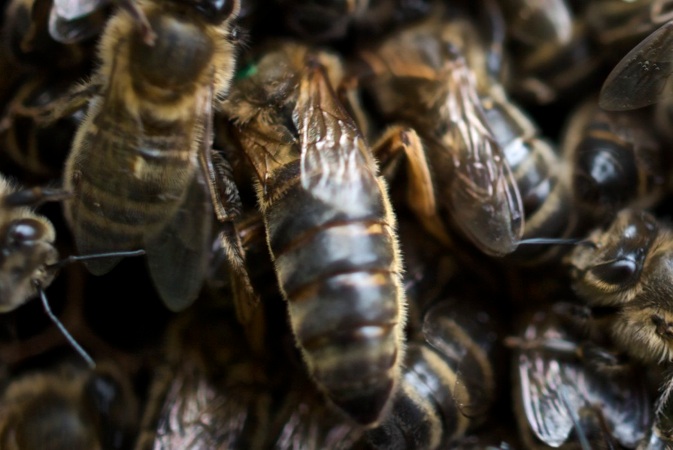
image of black bees
Black bees

During its election campaign, the Labour Party made a commitment to end these exemptions for bee-killing pesticides and the government announced last month that it was drawing up plans to outlaw the use of some neonicotinoids. However, whatever the proposals being brought forward in future, another ‘emergency’ derogation could be allowed. A decision on whether to grant this emergency authorisation again this year is expected imminently.  

Continue Reading‘Pesticides buzz off’: More than 1.6 million people call for a ban on bee-killing pesticides

Charges dropped for dozens of Greenpeace activists in plastic pollution protest outside Unilever HQ

Spread the love
Greenpeace activists Shut Down Unilever HQ in Plastic Pollution Protest in London. Climbers secure a huge 13 x 8 metre canvas to the front of the building. The artwork displays a powerful advertising subversion featuring a young girl peeling back Dove’s iconic ‘Real Beauty’ branding to reveal real examples of the toxic plastic waste churned out by the brand.
Greenpeace activists Shut Down Unilever HQ in Plastic Pollution Protest in London. © Kristian Buus / Greenpeace.

The Crown Prosecution Service (CPS) has dropped all charges against 34 Greenpeace activists who blockaded Unilever’s London headquarters last September. The decision was made just days before the start of what would have been the largest ‘locking on’ trials ever seen in the UK.

Eight protesters had been facing charges of Aggravated Trespass and a further 26 protesters were charged with the new offence of ‘locking-on’ introduced in the Public Order Act 2023. The letter from the CPS said the charges were dropped because “there is not enough evidence to provide a realistic prospect of conviction”. The first trials were due to begin on 15 January at City of London Magistrates’ Court. 

The charges related to 5 September 2024 when Greenpeace activists blockaded the entrances to Unilever House in protest at the firm’s ongoing failure to tackle plastic pollution. Climbers scaled the building and attached a huge artwork to the outside wall. Activists also blocked the entrances to the building, locking themselves onto large models of the company’s flagship Dove products and a ‘Dead Dove’ parody of the company logo.

Will McCallum, Co-Executive Director of Greenpeace UK said: “This is a bolt of good news in an otherwise bleak landscape for protest rights. Our activists were facing a combined total of up to 15 years in prison for standing up to one of the world’s largest plastic polluters. The invented crime of ‘locking-on’ is just one new tool in a well-stocked legal arsenal that is being used to stifle dissent and send peaceful protesters to jail. Previous governments brought in these laws and powers, but the responsibility lies with Keir Starmer to end their chilling effect on democracy and repeal them.”

The crime of ‘locking-on’ was one of a number of offences and powers created by recent Conservative governments to crack down on peaceful protest. It has resulted in hundreds of protesters being arrested, often for as little as walking down a street. Last year saw five climate activists sentenced to a total of 21 years in prison for taking part in a Zoom call to discuss a planned protest.

Greenpeace’s protest was part of an ongoing campaign against Unilever after the corporate giant announced a major rollback of plastic reduction targets last year. A Greenpeace International report showed that it was the largest corporate seller of single-use plastic sachets, selling the equivalent of 1,700 a second. 

Daniel Jones, interim head of Greenpeace’s plastics campaign, said: “This is an important milestone in our campaign against Dove’s toxic brand of beauty. We reluctantly staged our protest last September after months of failed talks with Unilever and multiple attempts to raise our concerns in other ways. Since then, Unilever has come back to the table and has begun playing a more constructive role in negotiations for a Global Plastics Treaty. We won’t stop until the company commits to reducing plastic production – particularly of its super-polluting plastic sachets.”

‘Locking-on’ involves protesters attaching themselves to another person, building or object to make it harder for police to remove them. It has long been used as a tactic by protesters, including by the Suffragettes. The Public Order Act 2023 contained the new offences of locking-on and being ‘equipped for locking on’.

Continue ReadingCharges dropped for dozens of Greenpeace activists in plastic pollution protest outside Unilever HQ

Keir Starmer needs reminding that the NHS is not for sale

Spread the love
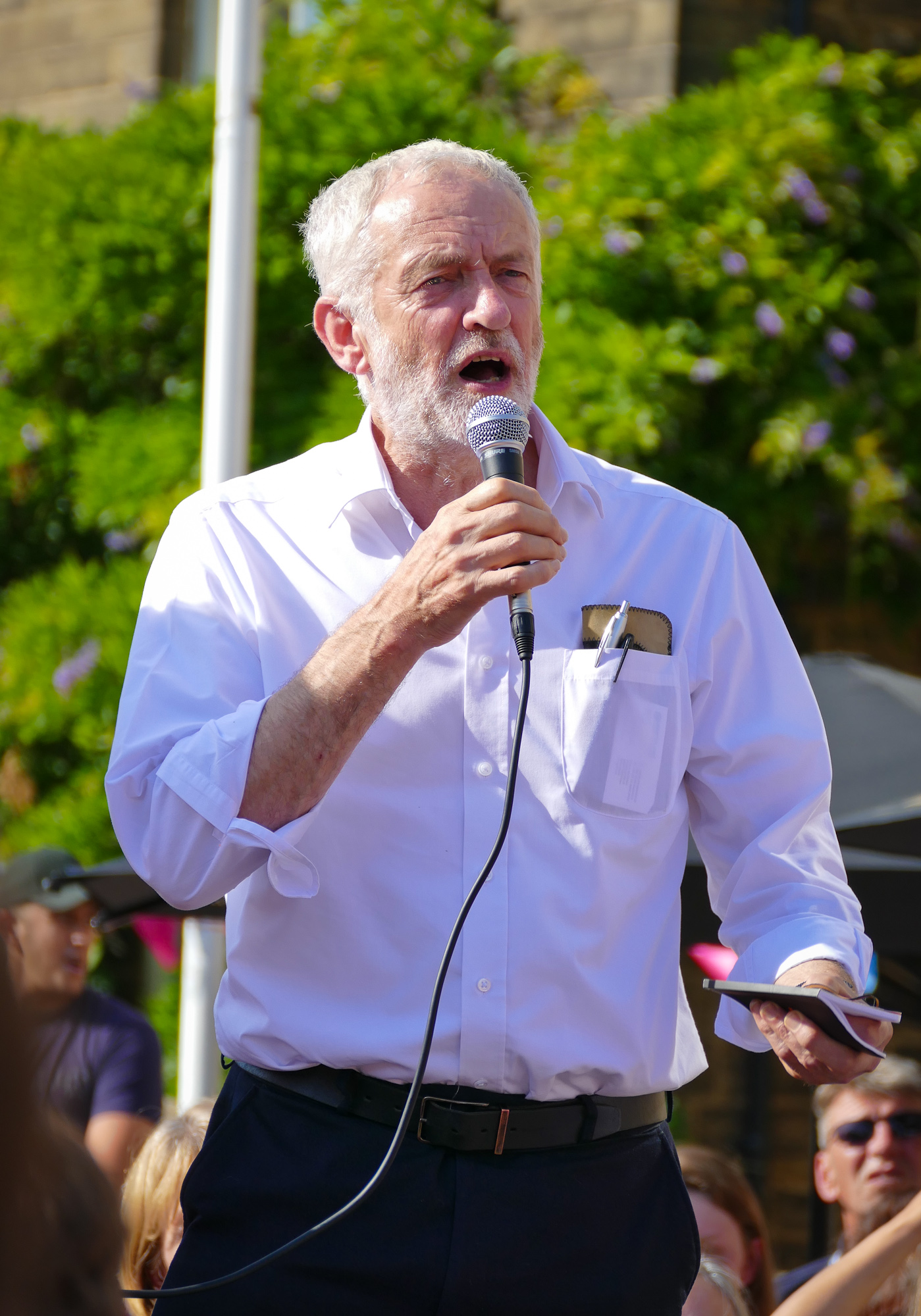
Image of Jeremy Corbyn MP, former leader of the Labour Party
Jeremy Corbyn MP, former leader of the Labour Party

https://www.independent.co.uk/voices/keir-starmer-pfi-nhs-privatisation-wes-streeting-jeremy-corbyn-b2675678.html

As the government unveils its plans for NHS patients to be treated privately in a bid to cut the waiting list backlog, former Labour MP Jeremy Corbyn says this administration is repeating the mistakes of the last

During the general election, I stood on a platform that pledged to defend a fully public, fully funded healthcare system. We knew Labour’s decision to drop its previously held manifesto promise that “the NHS is not for sale” was no accident. We said the future of our NHS was on the line – and we were right.

This week, the government announced that private operators will receive an extra £2.5bn a year in government funding. Under their plans, the role of the private sector in providing outpatient appointments will rise by 20 per cent. Meanwhile, the secretary of state for health, Wes Streeting, refuses to rule out the involvement of the private sector in a reformed care service – a refusal he will no doubt maintain for the next four years until elderly and disabled people are finally allowed to hear his plans.

To the prime minister and health secretary, welcoming privatisation is proof of their commitment to pragmatism. “We will not let ideology… stand in the way.” To anyone who knows the reality of privatisation, their dogmatic refusal to look at the evidence is the very definition of ideology itself.

A privatised health service leads to worse quality care, higher mortality rates and a reduction in staffing. Privatisation has even been linked to higher rates of patient infections, in part because cleaning staff are typically the first to be cut in the name of efficiency. There is only one beneficiary of privatisation: investors and shareholders making money out of people’s ill health.

https://www.independent.co.uk/voices/keir-starmer-pfi-nhs-privatisation-wes-streeting-jeremy-corbyn-b2675678.html

NHS emblem
NHS emblem

Continue ReadingKeir Starmer needs reminding that the NHS is not for sale