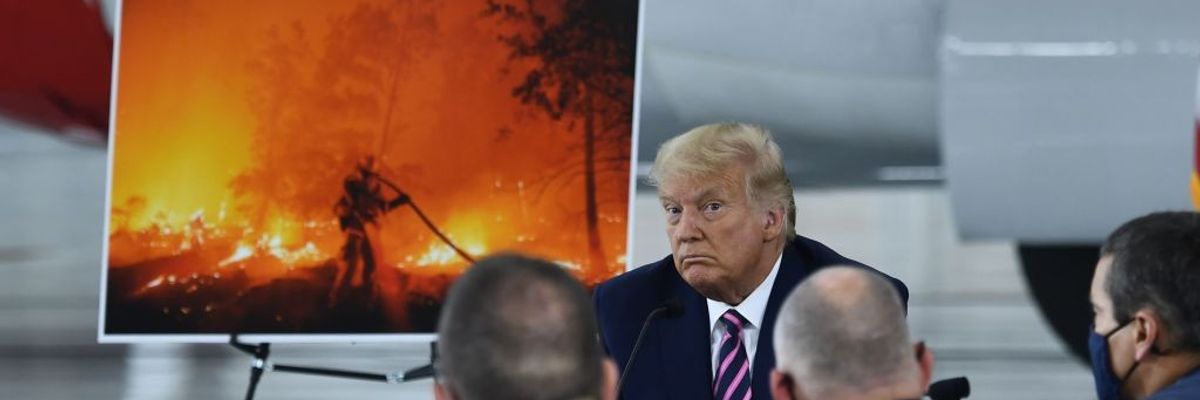
Then-U.S. President Donald Trump listened to California Gov. Gavin Newsom at Sacramento McClellan Airport in McClellan Park, California on September 14, 2020. (Photo: Brendan Smialowski/AFP via Getty Images)
“The fossil fuel industry invested $75 million to secure Trump’s victory, and now they’re expecting a return,” said the executive director of Oil Change International.
The fossil fuel industry pumped tens of millions of dollars into President-elect Donald Trump’s successful bid for a second White House term—and it could begin seeing a return on its investment on his very first day in office.
Trump pledged on the campaign trail to be a “dictator” on day one in the service of accelerating U.S. fossil fuel production, which is already at record levels as nations around the world—including the United States—face the devastating consequences of planet-warming emissions.
Soon after his inauguration on Monday, Trump is expected to begin signing executive orders—some of them likely crafted by fossil fuel industry lobbyists—revoking climate-protection rules implemented by his predecessor and paving the way for new liquefied natural gas export permits, among other gifts to the industry.
Citing “several fossil fuel industry lobbying groups helping shape Trump’s energy agenda,” Business Insiderreported Thursday that Trump “could direct federal agencies to approve new terminals to export liquefied natural gas (LNG) and start unwinding restrictions on oil and gas leasing on federal lands and waters.”
The president of the American Petroleum Institute, the oil and gas industry’s powerful lobbying group, said earlier this week that his organization is “excited” about the prospect of Trump lifting the LNG pause.
A study published Friday warns that a flurry of LNG terminal approvals would “deliver a windfall for U.S. fracking companies and exporters of liquefied methane” while “extending an export explosion that’s pushing up prices for American consumers while harming the climate and vulnerable communities.”
“Trump is handing these companies a blank check to expand their operations at precisely the moment we need to end fossil fuel extraction.”
Trump, whose Cabinet is set to be packed with fossil fuel industry allies, has also said he would immediately move to roll back President Joe Biden’s ban on offshore oil and gas drilling across more than 625 million acres of U.S. coastal territory—even though the law Biden used does not give presidents the power to undo previous offshore drilling bans.
In a statement on Friday, Oil Change International (OCI) listed a number of other actions Trump could take on day one, including withdrawal from the Paris climate accord, an emergency declaration to boost fossil fuel production, an expansion of drilling on public lands, and an attempt to revive the Keystone XL pipeline.
OCI dubbed the agenda “Trump’s day one climate destruction package.”
“The fossil fuel industry invested $75 million to secure Trump’s victory, and now they’re expecting a return,” said Elizabeth Bast, OCI’s executive director. “By appointing fossil fuel CEOs to key Cabinet positions and planning to dismantle critical environmental protections, Trump is handing these companies a blank check to expand their operations at precisely the moment we need to end fossil fuel extraction.”
“As Trump returns to office, we’re witnessing the deadly price tag of fossil fuel industry control over our democracy,” Bast said. “From the still-burning wildfires in Los Angeles to the destruction left by Hurricane Helene in Asheville, to the unprecedented droughts and floods devastating Southern Africa, the climate crisis is accelerating. These deadly disasters are driven by fossil fuel executives who put their profits ahead of our future.”
E&E News reported Friday that Trump “could sign somewhere between 50 and 100 executive orders” on the first day of his second term. One of the first targets, according to the outlet, will be Biden’s early executive order directing federal agencies to take part in a “government-wide approach to the climate crisis.”
Trump is also expected to take aim at renewable energy initiatives, including wind projects and an electric vehicle tax credit implemented under the Inflation Reduction Act.
In response to Trump’s planned actions, climate activists said the movement for a livable future must mobilize around the world and fight back in every way possible.
“One man and one election may temporarily cloud the horizon, but they cannot halt the relentless momentum of climate action,” Dean Bhekumuzi Bhebhe, senior just transitions and campaigns adviser at Powershift Africa, said Friday. “If anything, such moments are an invitation for historically polluting nations to step forward, not with the rhetoric of obstruction, but with the deeds of redemption. The world is watching, and we’ve seen enough bluster, now it’s time for genuine action. The stakes are no longer abstract, lives are being lost every day.”
The fires that have engulfed Los Angeles cap the hottest decade in history.
Each year in the last ten was record-warm, but 2024 was the warmest ever recorded. Last year, Earth was 1.6°C hotter than the temperature average of the late 19th century, which was before widespread fossil fuel burning had significantly altered the climate.
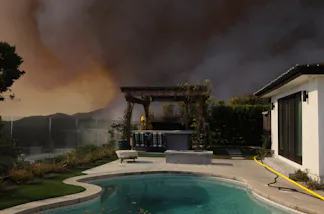
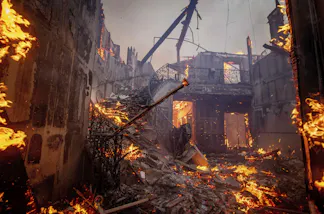
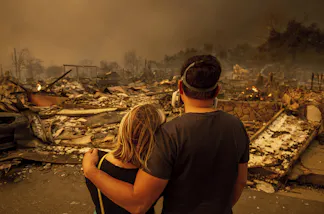
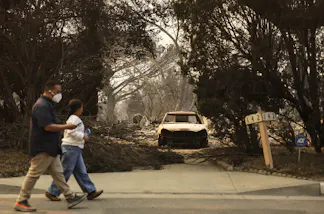
Still, the conflagrations which have so far claimed 25 lives and razed thousands of homes are not inevitable – even on our overheating planet.
“While climate change sets the stage for larger and more intense fires, humans are actively fanning the flames,” says Virginia Iglesias, a climate scientist at the University of Colorado Boulder.
Extreme heat dries out vegetation and the soil. Wildfires ignite more easily, spread faster and burn with greater intensity in these conditions, as parched land is more flammable. In the western US, aridity caused by climate change has helped double the amount of combustible forest since 1984.
Nights are warming faster than days globally, and dusk has brought no reprieve from the fires menacing the residential areas of Pacific Palisades and Altadena. It’s been more than a week since the first spark but firefighters warn several more may pass before the flames are fully contained.
High winds and whiplash
Something is filling the fires with oxygen and spreading their embers to dry brush. The Santa Ana winds that blow down the San Gabriel Mountains between autumn and January lose moisture and gain heat as they rush downslope, and these gusts reached hurricane strength (exceeding 80 miles per hour) at the start of 2025.
“When the wind is blowing like this, there is very little chance of stopping fires,” says Jon Keeley, a plant ecologist at the University of California, Los Angeles.
Gusts have whipped the fire front onward and made containing the blazes difficult. EPA-EFE/Allison Dinner
Santa Ana would cause much less havoc in a more typical wet season, which runs from October to April in California. Ming Pan, a hydrologist who tracks the state’s water supplies, estimates that soil moisture in southern California is in the bottom 2% of historical records for early January.
In other words, the area around LA is about as dry as scientists have ever known it to be at this time of year. Why? Well, southern California has received less than 10% of the rain it would normally get from October onward. But it had the opposite problem last winter.
“Unusually wet winters in both 2022-23 and 2023-24 led to increased vegetation growth, providing more fuel for the fires,” says Doug Specht, a geographer at the University of Westminster.
“This cycle of wet and dry extremes, known as ‘hydroclimate whiplash’, is part of the increasingly intense climate cycles caused by climate change.”
Affluent LA is the most recent arena of climate disaster to capture the world’s attention. Yet it is the poorest 20% of humanity who have felt the sting of whiplashes between drought and downpour most keenly according to Specht.
When unusually heavy rain meets baked ground that cannot easily absorb it, as it did across much of east Africa in spring 2024, flash floods and landslides follow.
‘Perpetually on the brink of catastrophe’
Now we come to the more immediately tractable causes of these fires.
“Fire is a natural process that has shaped ecosystems for over 420 million years,” Iglesias says.
“Indigenous people historically used controlled burns to manage landscapes and reduce fuel buildup. However, a century of fire suppression has allowed vast areas to accumulate dense fuels, priming them for larger and more intense wildfires.”
European colonisation has transformed relationships with the land. Subsequent arrivals to southern California have included invasive plants capable of overrunning native flora and forming dense, uninterrupted fuel beds.
The legacy of these fires may be more invasive plants, and more flammable landscapes. That’s because invasive species are typically better at exploiting extreme weather, their tendrils colonising land disturbed by fire before native species can recover.
The overwhelming majority of wildfires that affect people are also ignited by them, intentionally or otherwise. Lightning has been ruled out for the LA fires so that leaves a wealth of human explanations: arson, unattended campfires, overheating engines or sparks from power lines that utilities have neglected to replace.
“More people now live in and at the edges of wildland areas, and the power grid has expanded with them. That creates more opportunities for fires to start,” Keeley adds.
The Eaton fire which erupted near Altadena on January 7 would have probably burned out in citrus orchards 50 years ago. Today, there is no buffer between homes and the wildland, Keeley says.
Fast-moving wildfires have engulfed residential neighbourhoods with stunning speed. EPA-EFE/Allison Dinner
Whether it was wise to bring flammable homes and cars into this fire-adapted wildland is a debate that should have started nearly a century ago, after the catastrophic Malibu fire in 1930. It didn’t, and late urban historian Mike Davis had a lot to say about why.
“Davis, who died in 2022, painted a vivid, if pessimistic picture of Los Angeles as both a real and imagined city perpetually on the brink of catastrophe,” says Alexander Howard, a senior lecturer in English and writing at the University of Sydney.
“Davis’ Los Angeles is a place where – as he comprehensively details – commercial greed overrides common sense and the social good, where institutional racism marginalises vulnerable communities, and where wilful political inertia ensures history repeats itself with devastating consequences.”
Davis criticised liberal California politicians who greeted each new fire with calls to cut greenhouse gas emissions, but continued to allow real estate developers to “profitably but insanely, [build] in high-fire-risk areas”.
Although motivated by greed, these developers were not alone in their assessment of southern California as a tranquil paradise ripe for luxury housing. LA’s urbanisation occurred “during one of the most unusual episodes of climatic and seismic benignity” according to Davis, who traced natural disasters and climate change back several centuries.
“These spans are too short to serve as reliable proxies for ecological time or to sample the possibilities of future environmental stress,” he writes. “In effect, we think ourselves gods upon the land but we are still really just tourists.”
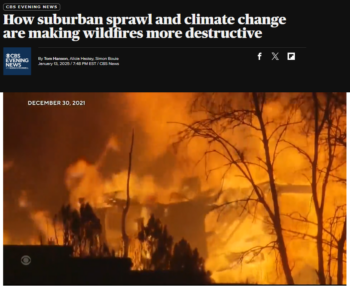
CBS Evening News (1/13/25) cited Colorado’s 2021 Marshall Fire as another example of how climate disruption is making wildfires more destructive.
The devastation of the ongoing Los Angeles fires is an alarm going off, but also the result of society having hit the snooze button long ago (Democracy Now!, 1/9/25; CBS, 1/13/25). Game-changing fires destroyed Paradise, California (NPR, 11/8/23), in 2023, and Lahaina, Hawaii, in 2024—clear warnings, if any were still needed, that the climate catastrophe had arrived.
“The evidence connecting the climate crisis and extreme wildfires is clear,” the Nature Conservancy (7/9/24) said. “Increased global temperatures and reduced moisture lead to drier conditions and extended fire seasons.”
The scientific journal Fire Ecology (7/24/23) reported that “climate change is expected to continue to exacerbate impacts to forested ecosystems by increasing the frequency, size and severity of wildfires across the western United States.”
Now we are watching one of America’s largest cities burn. It’s a severe reminder that the kind of disruption we experienced in the beginning of the Covid pandemic in 2020 is the new normal under climate change.
The right-wing media, however, have found a culprit—it’s not climate change, but Democratic Party–led wokeness. The coverage demonstrates once again that the W-word can be used to blame literally anything in the Murdoch fantasyland.
‘Preoccupation With DEI’
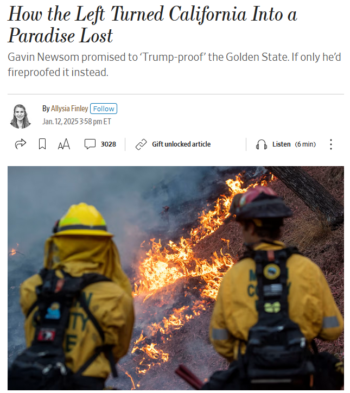
Alyssia Finley (Wall Street Journal, 1/12/25): “A cynic might wonder if environmentalists interfered with fire prevention in hope of evicting humans.” Another cynic might wonder if the Journal publishes smears without evidence as part of its business model.
“Megyn Kelly sounded off on Los Angeles Fire Department Chief Kristin Crowley and Mayor Karen Bass,” the New York Post (1/8/25) reported. Former Fox News host Kelly said “that the officials’ preoccupation with diversity, equity and inclusion [DEI] programs distracted them from the city’s fire-combating duties.”
Wall Street Journal editorial board member Allysia Finley (1/12/25) echoed the charge: “Bloated union contracts and DEI may not have directly hampered the fire response, but they illustrate the government’s wrongheaded priorities.” In other words, the paper didn’t have evidence to blame the fires on firefighter salaries or department diversity, but decided to insinuate as much anyway.
Other conservative journalists were more direct, like CNN pundit Scott Jennings, who went on CNN NewsNight (1/8/25) to assert:
As a matter of public policy in California, the main interest in the fire department lately has been in DEI programming and budget cuts, and now we have this massive fire, and people are upset.
As the Daily Beast (1/9/25) noted, “His response was part of a Republican kneejerk reaction that included President-elect Donald Trump blaming ‘liberals’ and state Gov. Gavin Newsom.”
The Washington Post (1/10/25) reported that Trump-supporting X owner Elon Musk
has been inundating his 212 million followers with posts casting blame for the blazes on Democrats and diversity policies, amplifying narratives that have taken hold among far-right activists and Republican leaders.
Liel Leibovitz, editor-at-large at the conservative Jewish magazine Tablet, blamed the LA devastation on the “woke religion” (New York Post, 1/9/25).
“There are many things we’ve learned that the Los Angeles Fire Department needs—and more women firefighters isn’t one of them,” moaned National Review editor-in-chief Rich Lowry (New York Post, 1/15/25). “Los Angeles for years has been in the grips of a bizarre obsession with recruiting more women firefighters.”
Blaming gay singers
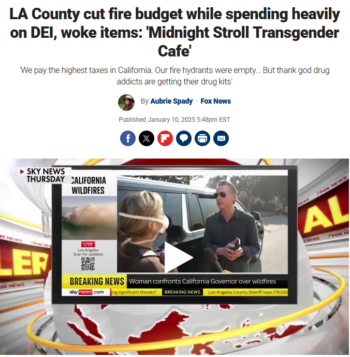
Mentioned by Fox News (1/10/25): $13,000 allocated to Lesbian, Gay, Bisexual and Transgender Heritage Month programs. Not mentioned by Fox News: a $126 million boost to the LAPD budget.
Fox & Friends (1/9/25, 1/9/25) blamed the city’s Democratic leaders and the fire chief for the destruction. Fox NewsDigital (1/10/25) said:
While Los Angeles officials were stripping millions in funding from their fire department ahead of one of the most destructive wildfires in state history, hundreds of thousands of dollars were allocated to fund programs such as a “Gay Men’s Chorus” and housing for the transgender homeless.
You may notice the shift from “millions” to “hundreds of thousands”—the latter, obviously, can’t explain what happened to the former. What can far better explain it is that the city focused much more on funding cops than firefighters (Intercept, 1/8/25). The mayor’s budget plan offered “an increase of more than $138 million for the Los Angeles Police Department; and a decrease of about $23 million for the LA Fire Department” (KTTV, 4/22/24). KABC (1/9/25) reported more recent numbers, saying the “fire department’s budget was cut by $17.6 million,” while the “city’s police department budget increased by $126 million,” according to the city’s controller.
And in 2023, the LA City Council approved salary increases for cops over objections that these pay boosts “would pull money away from mental health clinicians, homeless outreach workers and many other city needs” (LA Times, 8/23/23). The cop-pay deal was reportedly worth $1 billion (KNBC, 8/23/23).
LAFD cuts under Mayor Bass were, in fact, big news (KTTV, 1/15/25). Fox overlooked the comparison with the police, one regularly made by city beat reporters who cover public safety and city budgets, and went straight to blaming gay singers.
Crusade against ‘woke’
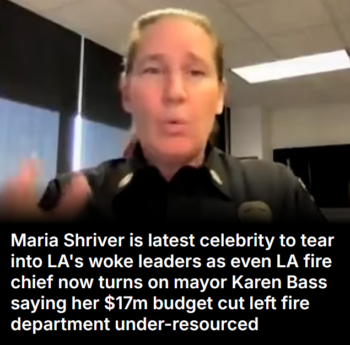
Contrary to the Daily Mail‘s headline (1/14/25), former California first lady Maria Shriver Maria Shriver did not “tear into LA’s woke leaders”; rather, she complained about LA’s insufficient funding of public needs.
Or take the Daily Mail (1/14/25), a right-wing British tabloid with a huge US footprint, whose headline said former California first lady “Maria Shriver Is Latest Celebrity to Tear Into LA’s Woke Leaders.” But the story went on to say that Shriver had decried the cuts to the LAFD, citing no evidence that she was fighting some culture war against women firefighters.
Shriver, the ex-wife of actor and former California Gov. Arnold Schwarzenegger, was pointing the finger at austerity and calling for more public spending. In other words, Shriver was siding with LAFD Chief Kristin Crowley, who had complained that city budget cuts had failed her department (CNN, 1/12/25). The Mail’s insistence on calling this a crusade against “woke” is just another example of how tediously the conservative media apply this word to almost anything.
While these accusations highlight diversification in the LA firefighting force, the right never offers real evidence that these hiring practices lead to any kind of hindering of fire response, as University of Southern California education professor Shaun Harper (Time, 1/13/25) noted. If anything, the right admits that miserly budgeting, usually considered a virtue in the conservative philosophy, is the problem.
Equal opportunity disasters
These talking points among right-wing politicians and their sycophants in the media serve several purposes. They bury the idea that climate change, driven by fossil fuels and out-of-control growth, has anything to do with the rise in extreme weather. They pin the blame on Democrats: LA is a blue city in a blue state. And they continue the racist and sexist drumbeat that all of society’s ills can be pinned on the advancement of women and minorities.
There is, of course, an opportunity to look at political mismanagement, including the cutbacks in the fire department. But natural disasters—intensified by climate change and exacerbated by poor political leadership—have ravaged unwoke, Republican-dominated states, as well, meaning Democrats don’t have a monopoly on blame.
Hurricane Ian practically destroyed Sanibel Island in Florida, a state that has been living with Trumpism for some time under Gov. Ron DeSantis. Hurricane Helene also ravaged that state, as well as western North Carolina, a state that went to Trump in the last three elections. Hurricane Harvey drowned Texas’ largest city, Houston, and the rest of Texas has suffered power outages and shortages, due to both extreme cold and summer spikes in energy demand.
Climate change, and the catastrophes it brings to the earth, does not discriminate against localities based on their populations’ political leanings. But conservative media do.
Metastasizing mythology
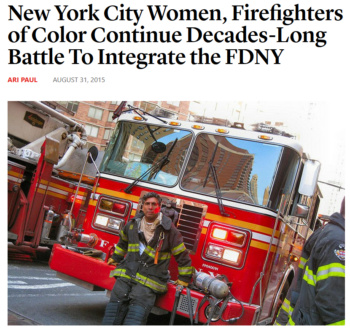
Ari Paul (In These Times, 8/31/15): “The more progress made in racial and gender diversity, the more white male firefighters will denounce the changes and say that increased diversity is only the result of lowering standards.”
Meanwhile, real firefighters know what the real problem is. The Western Fire Chiefs Association (3/5/24) said:
Global warming pertains to the increased rise in Earth’s average surface temperature, largely caused by human activity, such as burning fossil fuels and deforestation. These practices emit greenhouse gases like carbon dioxide (CO2), methane (CH4) and nitrous oxide (N2O) into the atmosphere. These gases trap heat, resulting in a gradual increase in global temperatures over time. Recent data on fire and trends suggests that global extreme fire incidents could rise by up to 14% by the year 2030, 30% by 2050, and 50% by the end of the century. The impact of global warming is seen particularly in the western United States, where record-setting wildfires have occurred in recent years. Fourteen of the 20 largest wildfires on record have been in California over the past 15 years.
Conservative media can ignore all this, because the notion that cultural liberalism has tainted firefighting isn’t new. I covered efforts to diversify the New York City Fire Department as a reporter for the city’s labor-focused weekly Chief-Leader, and I saw firsthand that the resistance to the efforts were based on the idea that minority men weren’t smart enough and women (white and otherwise) weren’t strong enough (PBS, 3/28/06; New York Times, 3/18/14; In These Times, 8/31/15).
What I found interesting in that case was that other major fire departments had achieved higher levels of integration, and no one was accusing those departments of falling behind in their duties. At the same time, while the FDNY resisted diversification, the New York Police Department, almost worshipped by right-wing media, embraced it (New York Post, 9/8/14, 6/10/16).
This racist and sexist mythology has metastasized in the Republican Party and its propaganda apparatus for years. With Trump coming back into power, these media outlets will feel more empowered to regurgitate this line of thinking, both during this disaster in LA and in the disasters ahead of us.
FAIR’s work is sustained by our generous contributors, who allow us to remain independent. Donate today to be a part of this important mission.
As Los Angeles battles historic wildfires, residents are demanding accountability for why the city’s fire department faced budget cuts while greater disaster preparedness measures were overlooked. These frustrations have fueled questions about the prioritization of aid to Israel and Ukraine.
Just months before the wildfires ravaged the city, LA Mayor Karen Bass approved the budget for the next fiscal year, which included a $17.5 million reduction to the fire department’s funding. The department’s budget slashed to $819.64 million, prompted warnings from Fire Chief Kristin Crowley, who cautioned that the cuts were already impeding emergency response capabilities.
All of this comes amid a revelation that the State of California has sent approximately $610 million in taxpayer funds to Israel, making it the most significant state contributor to Israeli aid in the U.S. This disparity gained attention online after Republican Speaker of the House Mike Johnson suggested imposing conditions on federal disaster relief for Los Angeles.
U.S. House Speaker Mike Johnson has been a staunch advocate of unconditional aid for Israel, notably championing a $74 billion aid package in April 2024 that included $60 billion for Ukraine and $14 billion for Israel, despite mounting public and congressional pressure to curtail such transfers. Specifically, the Leahy Law, named after its author, former Senator Patrick Leahy, prohibits the transfer of military aid to nations credibly accused of committing human rights abuses. In a recent Washington Post op-ed, Leahy urged that the law be applied to Israel, arguing that ongoing rights violations demand accountability and adherence to U.S. legal standards.
In October 2024, U.S. President Joe Biden drafted a $100 billion aid package for Ukraine and Israel—a striking coincidence, as this is the same amount now proposed to confront the devastating wildfires in Los Angeles. The announcement of a one-time payment of $770 to each wildfire victim by the administration has drawn mixed reactions, with some calling it a necessary gesture while others see it as woefully inadequate. This announcement came mere days after the White House informed Congress of its intention to send an additional $8 billion in military aid to Israel.
Although the aid package isn’t a cash handout to Israelis, the cost of the military aid package would be the equivalent of handing each Israeli over $820. Israel is the largest recipient of U.S. aid in history, amounting to a total of over $250 billion in American taxpayers’ dollars, at least $25 billion of which has been publicly disclosed to have been sent since the beginning of the war in Gaza. At a time when U.S. domestic crises demand urgent attention, the government’s unwavering commitment to foreign aid for Israel continues unabated.
The concern extends beyond monetary figures. Cities across the U.S. struggle to provide safe drinking water, veterans face mounting suicides due to inadequate access to healthcare, and Los Angeles grapples with a homelessness crisis. Experts estimate that $22 billion—roughly equivalent to the aid Israel received in a year—could eliminate homelessness in LA over the course of a decade. Meanwhile, Israelis enjoy clean drinking water year-round and are even expanding their control to include six key water sources in southern Syria, in contravention of international law.
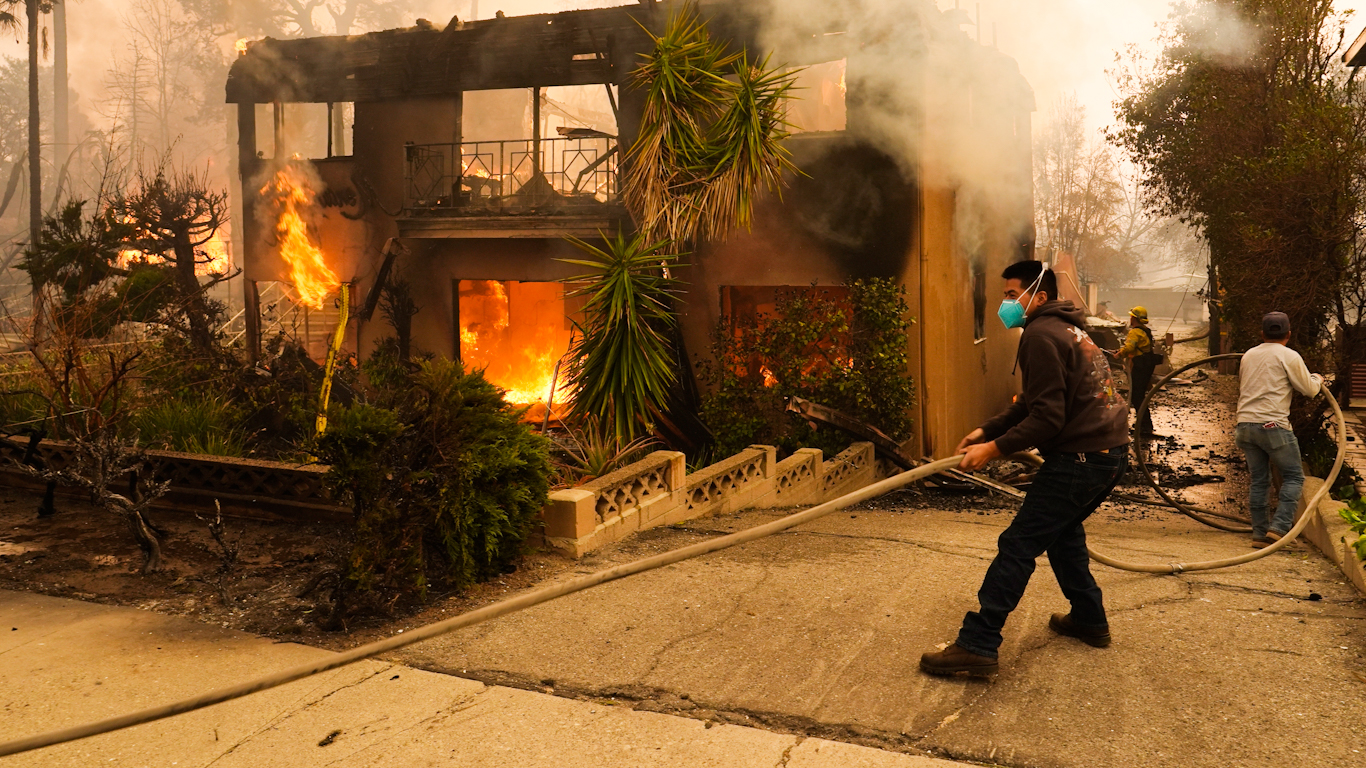
Feature photo | Locals help a firefighter stretch a hose as an apartment building burns, Jan. 8, 2025, in the Altadena section of Pasadena, Calif. Chris Pizzello | AP
Robert Inlakesh is a political analyst, journalist and documentary filmmaker currently based in London, UK. He has reported from and lived in the occupied Palestinian territories and hosts the show ‘Palestine Files’. Director of ‘Steal of the Century: Trump’s Palestine-Israel Catastrophe’. Follow him on Twitter @falasteen47
This article is licensed under a Creative Commons Attribution-NonCommercial-ShareAlike 3.0 International License.
Palestinians in the Bureij Refugee Camp, strive to maintain their routines under challenging conditions, surrounded by destroyed buildings, as the implementation of a ceasefire agreement is anticipated in the coming days in Gaza City, Gaza on January 17, 2025. [Moiz Salhi – Anadolu Agency]
Qatar’s Foreign Ministry announced on Saturday that the ceasefire agreement for the Gaza Strip will go into effect at 8.30 a.m. local time (0630GMT) on Sunday, Jan. 19, Anadolu Agency reports.
Ministry spokesperson Majed Al-Ansari confirmed the development on X: “As coordinated by the parties to the agreement and the mediators, the ceasefire in the Gaza Strip will begin at 8:30 a.m. on Sunday, January 19, local time in Gaza.”
“We advise the inhabitants to take precaution, exercise the utmost caution, and wait for directions from official sources,” he added.
The Israeli army also issued a statement confirming its readiness to implement the deal.
“The agreement will take effect on Sunday, January 19, at 08:30,” the Israeli army said in a statement, noting that its forces “will carry out the operational plan in the field in accordance with the established agreements.”
Meanwhile, the Interior and National Security Ministry in Gaza announced preparations to deploy its forces in the enclave after the ceasefire enters into force.
Qatar announced a three-phase ceasefire agreement on Wednesday to end more than 15 months of deadly Israeli attacks on the Gaza Strip with the ceasefire set to take effect on Sunday.
Nearly 46,900 Palestinians, mostly women and children, were killed and more than 110,600 injured in Israel’s genocidal war on Gaza since Oct. 7, 2023, according to local health authorities.
The International Criminal Court issued arrest warrants in November for Israeli Prime Minister Benjamin Netanyahu and his former Defense Minister Yoav Gallant for war crimes and crimes against humanity in Gaza.
Israel also faces a genocide case at the International Court of Justice for its war on the enclave.