Trump Signs Sweeping Xenophobic Bill, Rescinding Due Process for Millions

Spread the love

Original article by Brett Wilkins republished from Common Dreams under Creative Commons (CC BY-NC-ND 3.0).
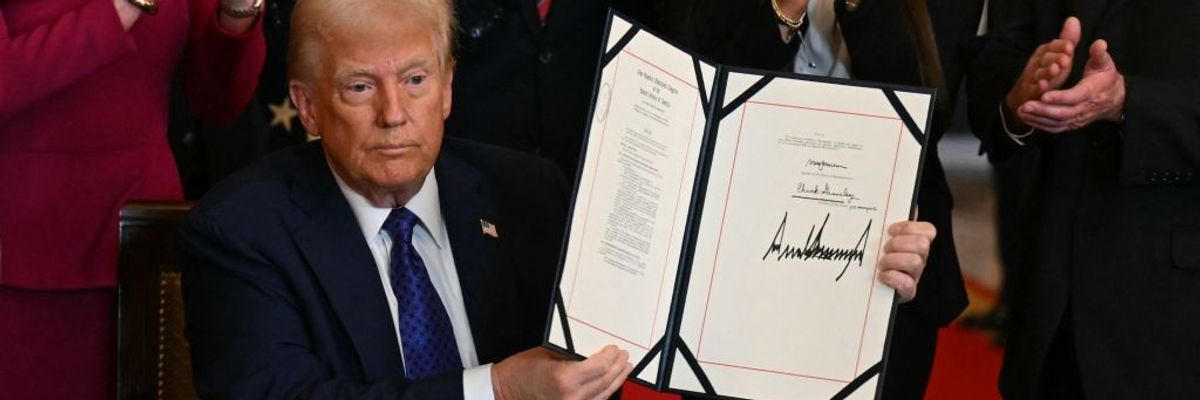
U.S. President Donald Trump holds up a signed copy of the Laken Riley Act in Washington, D.C. on January 29, 2025. (Photo: Pedro Ugarte/AFP via Getty Images)

“The Laken Riley Act capitalizes on a horrible tragedy in order to advance President Trump’s anti-immigrant agenda by scapegoating people seeking safety,” said one campaigner.

Human rights defenders decried U.S. President Donald Trump’s signing of legislation Wednesday that critics warn will strip due process rights from millions of people while harming some of the most vulnerable members of society, including migrant children, victims of sexual violence, and survivors of domestic abuse.

Trump signed the Laken Riley Act—named after a young woman murdered last year by a Venezuelan man who, according to U.S. Immigration and Customs Enforcement (ICE), entered the United States illegally—calling it a “landmark law” that “will save countless innocent American lives.”

“The Laken Riley Act is based upon false, xenophobic narratives that dehumanize and criminalize an entire group of people due to the actions of one person.”

However, Amy Fischer, director of the ACLU’s Refugee and Migrant Rights Program, said in a statement Wednesday that “the Laken Riley Act capitalizes on a horrible tragedy in order to advance President Trump’s anti-immigrant agenda by scapegoating people seeking safety and stripping away their right to due process.”

“This legislation mandates the arrest and detention of our undocumented neighbors for being convicted or charged of any theft, shoplifting, burglary, or larceny offense,” Fischer noted. “Mandatory detention solely for being accused of theft strips people of their right to due process and constitutes arbitrary detention under international human rights law.”

“The Laken Riley Act is based upon false, xenophobic narratives that dehumanize and criminalize an entire group of people due to the actions of one person,” Fischer added. “It will separate families and make our communities less safe. It is simply unconscionable for Congress to create a new mechanism that gives people the power to falsely accuse immigrants of theft knowing their detention is mandatory.”

As the Lawyers’ Committee for Civil Rights of the Bay Area, which called the law “shameful and unconstitutional,” noted Wednesday: “This bill does not require a conviction—simply being accused of a crime is enough to force individuals into mandatory detention without review by any judge. In doing so, the law strips due process protections and allows for discrimination against vulnerable immigrant communities.”

The group continued:

The federal government already has the power to detain and deport individuals who commit criminal acts. But in our legal system, judges act as a constitutionally required check on police actions. This new law removes that check. It is a direct attack on the constitutional rights of immigrants and communities of color, and it erodes the civil liberties of American society at large. It will incentivize racial profiling and divert law enforcement resources away from real threats, making our communities less safe.

“Lawyers’ Committee and our partners vow to challenge this unconstitutional law in court,” Bianca Sierra Wolff, the group’s executive director, said in a statement. “We will not stand by while the rights of immigrants and communities of color are trampled for political gain.”

Writing for Common Dreams Wednesday, National Center for Youth Law senior director Neha Desai and NCYL attorney Melissa Adamson lamented the Laken Riley Act’s passage and urged Congress, both chambers of which passed the law with bipartisan support, to “do the right thing” by introducing “new legislation to protect children from this draconian law.”

“Policymakers on both sides of the political aisle seem all too eager to support legislation that ignores that immigrant children are human beings, worthy of the same care and protections that their own children enjoy,” Desai and Adamson contended. “It is deeply disheartening to see lawmakers shift with the political winds rather than hold true to fundamental values. Congress must not acquiesce to a country in which the rejection of children’s rights is the norm.”

Shares in private prison companies have skyrocketed since Trump won last November’s election, partly in anticipation of a boom in business due to the Laken Riley Act and the broader campaign of mass deportations now underway.

On Wednesday, Trump also said he would instruct the Pentagon and Department of Homeland Security to prepare a detention facility—some critics called it a “concentration camp“—capable of holding 30,000 migrants at the notorious offshore Guantánamo Bay prison run by the U.S. military in Cuba.

Original article by Brett Wilkins republished from Common Dreams under Creative Commons (CC BY-NC-ND 3.0).

Continue ReadingTrump Signs Sweeping Xenophobic Bill, Rescinding Due Process for Millions

Trump 2.0: the rise of an ‘anti-elite’ elite in US politics

Spread the love
Elon Musk urges you to be a Fascist like him, says that you can ignore facts and reality then.

William Genieys, Sciences Po and Mohammad-Saïd Darviche, Université de Montpellier

US president Donald Trump is surrounded by a new cohort of politicians and officials. While one of his campaign promises was to overthrow the “corrupt elites” he accuses of flooding the American political arena, his second term in office has elevated elites chosen, above all, for their political loyalty to him.

The media’s focus on Trump’s comments on making Canada the 51st US state and annexing Greenland and billionaire Elon Musk’s support for some far-right parties in Europe has obscured the ambitious programme to transform the federal government that the new political elite intends to implement.

In the wake of Trump’s inauguration on January 20, the Republican elites most loyal to the MAGA (“Make America Great Again”) leader, who staunchly oppose Democratic elites and their policies, are operating amid their party’s control over the executive and legislative branches (at least until the midterm elections in 2026), a conservative-dominated Supreme Court that includes three Trump-appointed justices, and a federal judiciary that shifted right during his first term.

However, the political project of the Trumpist camp consists less of challenging elitism in general than attacking a specific elite: one particular to liberal democracies.

Castigating democratic elitism

Typical anti-elite political propaganda, along the lines of “I speak for you, the people, against the elites who betray and deceive you,” claims that a populist leader would be able to exercise power for and on behalf of the people without the mediation of an elite disconnected from their needs.

Political theorist John Higley sees behind this form of anti-elite discourse an association between so-called “forceful leaders” and “leonine elites” (who take advantage of the former and their political success): a phenomenon that threatens the future of Western democracies.

Since the Second World War, there has been a consensus in US politics on the idea of democratic elitism. According to this principle, elitist mediation is inevitable in mass democracies and must be based on two criteria: respect for the results of elections (which must be free and competitive); and the relative autonomy of political institutions.

The challenge to this consensus has been growing since the 1990s with the increased polarization of American politics. It gained new momentum during and after the 2016 presidential campaign, which was marked by anti-elite rhetoric from both Republicans and Democrats (such as senators Bernie Sanders and Elizabeth Warren). At the heart of some of their diatribes was an aversion to “the Establishment” on the east and west coasts of the United States, where many prestigious financial, political and academic institutions are based, and the conspiracy notion of the “deep state”.

The re-election of Trump, who has never admitted defeat in the 2020 presidential vote, growing political hostility and the direct involvement of tech tycoons in political communication –especially on the Republican side– further reinforce the denial of democratic elitism.

Trump’s populism from above: a revolt of the elites

The idea that democracy could be betrayed by “the revolt of the elites”, put forward by the US historian Christopher Lasch (1932-1994), is not new. For the anthropologist Arjun Appadurai, it is a particular feature of contemporary populism, which comes “from above.” Indeed, if the 20th century was the era of the “revolt of the masses”, the 21st century, according to Appadurai, “is characterized by the ‘revolt of the elites’.” This would explain the rise of populist autocracies (such as those currently led by Viktor Orban in Hungary, Recep Tayyip Erdogan in Turkey and Narendra Modi in India, and formerly led by Jair Bolsonaro in Brazil), but also the election successes of populist leaders in consolidated democracies (including those of Trump in the US, Giorgia Meloni in Italy, and Geert Wilders in the Netherlands, for example).

As Appadurai explains, the success of Trumpian populism, which represents a revolt by ordinary Americans against the elites, casts a veil over the fact that, following Trump’s victory in November, “it is a new elite that has ousted from power the despised Democratic elite that had occupied the White House for nearly four years.”

The aim of this “alter elite” is to replace the “regular” Democrat elites, but also the moderate Republicans, by deeply discrediting their values (such as liberalism and so-called “wokeism”) and their supposedly corrupt political practices. As a result, this populism “from above” carried out by the President’s supporters constitutes an alternative elite configuration, the effects of which on American democratic life could be more significant than those observed during Trump’s first term.

Beyond the idea of a ‘Muskoligarchy’

The idea that we are witnessing the formation of a “Muskoligarchy” –in other words, an economic elite (including tech barons such as Jeff Bezos, Mark Zuckerberg and Marc Andreessen) rallying around the figurehead of Elon Musk, whom Trump asked to lead what the president has called a “Department of Government Efficiency” (DOGE) –is seductive. It perfectly combines the vision of an alliance between a “conspiratorial, coherent, conscious” ruling class and an oligarchy made up of the “ultra-rich”. For the Financial Times columnist Martin Wolf, it is even a sign of the development of “pluto-populism”. (It is also worth noting that former president Joe Biden, in his farewell speech, referred to “an oligarchy… of extreme wealth” and “the potential rise of a tech-industrial complex.”)

However, some observers are cautious about the advent of a “Muskoligarchy.” They point to the sociological eclecticism of the new Trumpian elite, whose facade of unity is held together above all by a political loyalty, for the time being unfailing, to the MAGA leader. The fact remains, however, that the various factions of this new “anti-elite” elite are converging around a common agenda: to rid the federal government of the supposed stranglehold of Democratic “insiders.”

An ‘anti-elite’ elite against the ‘deep state’

In his presidential inauguration speech in 1981, Ronald Reagan said: “Government is not the solution to our problem; government is the problem.” The anti-elitism of the Trump elite is inspired by this diagnosis, and defends a simple political programme: rid democracy of the “deep state.”

Although the idea that the US is “beleaguered” by an “unelected and unaccountable elite” and “insiders” who subvert the general interest has been shown to be unfounded, it is nonetheless predominant in the new Trump Administration.

This conspiracy theory has been taken to the extreme by Kash Patel, the candidate being considered to head the FBI. In his book, Government Gangsters, a veritable manifesto against the federal administration, the former lawyer writes about the need to resort to “purges” in order to bring elite Democrats to justice. He lists around 60 people, including Biden, ex-secretary of state Hillary Clinton and ex-vice president Kamala Harris.

Government Gangsters, Kash Patel’s controversial book. Google Books

The appointment of Russell Vought as head of the Office of Management and Budget at the White House, a person who is known for having sought to obstruct the transition to the Biden Administration in 2021, also highlights the hard turn that the Trump administration is likely to take.

Reshaping the state around political loyalty

To “deconstruct the administrative state”, the “anti-elite” elites are relying on Project 2025, a 900-plus page programme report that the conservative think-tank The Heritage Foundation, which published it, says was produced by “more than 400 scholars and policy experts.” According to former Project 2025 director Paul Dans, “never before has the entire movement… banded together to construct a comprehensive plan” for this purpose. On this basis, the “anti-elite” elite want to impose loyalty to Project 2025 on federal civil servants.

But this idea is not new. At the end of his first term, Trump issued an executive order facilitating the dismissal of statutory federal civil servants occupying “policy-related positions” and considered to be “disloyal”. The decree was rescinded by president Biden, but Trump on his first day back in office signed an executive order that seeks to void Biden’s rescindment. As President, Trump is also able to allocate senior positions within the federal administration to his supporters.

The “anti-elite” elite not only want to reduce the size of the state, as was the case under Reagan’s “neoliberalism”, but to deconstruct and rebuild it in their own image. Their real aim is a more lasting victory: the transformation of democratic elitism into populist elitism.

William Genieys, Directeur de recherche CNRS au CEE, Sciences Po and Mohammad-Saïd Darviche, Maître de conférences, Université de Montpellier

This article is republished from The Conversation under a Creative Commons license. Read the original article.

Continue ReadingTrump 2.0: the rise of an ‘anti-elite’ elite in US politics

‘Sustainable’ aviation fuel and other myths about green airport expansion debunked

Spread the love
Taking off: emissions from the aviation sector. WildSnap/Shutterstock

Jack Marley, The Conversation

Environmentalists and locals have resisted a third runway at London’s Heathrow, Europe’s busiest airport, for more than two decades. Today, their efforts took a major setback.

The UK government has announced it will give the green light to airport expansion. This is not guaranteed to increase growth in the national economy as Chancellor Rachel Reeves hopes. More flights and more emissions are certain, however, at a time when experts are practically screaming at governments to rein them in.


This roundup of The Conversation’s climate coverage comes from our award-winning weekly climate action newsletter. Every Wednesday, The Conversation’s environment editor writes Imagine, a short email that goes a little deeper into just one climate issue. Join the 40,000+ readers who’ve subscribed.


“No airport expansions should proceed” without a UK-wide plan to annually assess and control the sector’s climate impact said the government’s watchdog, the Climate Change Committee, in 2023. Aeroplanes are 8% of UK emissions and 2% of the world’s, but they also release gases that seed heat-trapping clouds in the upper atmosphere, which triples air travel’s greenhouse effect.

While the government’s own advisers have effectively ruled out new runways for the sake of net zero, airport and airline bosses play a different tune. So what does the sector propose to manage its own pollution?

Not enough cooking oil to save us

Aviation is a notoriously difficult sector to decarbonise says Richard Sulley, a senior research fellow in sustainability policy at the University of Sheffield: “If electric or hydrogen-powered planes are possible, it won’t be for many years yet.”

To justify air travel emissions ballooning in the meantime, the aviation sector has promised a mix of “supply-side” measures, like replacing kerosene with so-called “sustainable aviation fuel” (SAF), which Reeves described as “a game changer”, and making planes lighter and more fuel-efficient.

Efficiency, in this context, is a slippery path to decarbonisation. When a high-emitting activity is reformed so that it consumes less energy, the efficiency savings are generally eclipsed by the increasing demand it drives.

“Indeed, the sector’s own plans for growth will outstrip efforts to decarbonise through synthetic fuel, delivering a neutral effect at best,” Sulley says.

Technicians refuel an aeroplane on the runway.
Fuel consumption is the biggest emissions source in aviation. Sergey Ginak/Shutterstock

“Demand-side” measures like fewer flights, taxes on frequent flying and domestic flight bans (see France) could cut emissions, he notes, but are seldom mentioned.

The UK has set a target for airline fuel to be 10% SAF by 2030. So far we’re at 1.2% – and Sulley reports that the industry has not said how it will scale up in time.

Even if airlines start taking their commitment to SAF seriously very soon, it’s a dubious solution to aviation’s climate impact according to political economists Gareth Dale (Brunel University) and Josh Moos (Leeds Beckett University).

Earlier SAF test flights burned coconut oil – 3 million coconuts to power a journey from London to Amsterdam, as Dale and Moos calculate it. At that rate, they argue Heathrow would exhaust the world’s entire crop in a few weeks (there are 18,000 commercial airports worldwide).

Modern SAF is blended with waste products from farms and kitchens. But the pair argue that the market for used cooking oil is “notoriously unregulated”. SAF may in fact be relabelled palm oil from plantations that are erasing orangutan habitat in the tropics. Again, Dale and Moos argue there is not enough used cooking oil to meet existing, let alone future, demand.

Transport for the rich, by the rich

At least the hype around SAF addresses the main problem, albeit misleadingly. Policy experts David Howarth (University of Essex) and Steven Griggs (De Montfort University) marvel at how often “carbon-neutral airports” in aviation sustainability strategies simply mean terminals powered by renewable energy.

“A terminal’s heating or lighting is, of course, largely irrelevant when its core business is as emissions-intensive as flying,” says Sulley.

Unfortunately for Rachel Reeves, a 2023 report by the New Economics Foundation found that any economic benefits of airport expansion will be largely confined to the airports themselves. Meanwhile, a wealthy subset of UK society can be expected to capture the biggest share of any new flight capacity. Each year, around half of British residents do not fly at all, Sulley points out.

At the stratospheric heights of that subset are the private jet passengers who are served by “more or less dedicated airports” that are more obscure to the general public, says Raymond Woessner, a geographer at Sorbonne Université. A study published in November found that emissions from these flights rose by 46% between 2019 and 2023. The lead author described wealthy passengers using jets “like taxis”.

“Discretion and anonymity” is what one airport nestled in the Oxfordshire countryside promises for “routine celebrity, head of state and royal visits”. Without state direction or regulation, it is these people who are setting the agenda for air travel.

Woessner notes that the world’s richest man, Elon Musk, successfully lobbied to derail a high-speed rail project in California in 2013. Instead of an option that has shown its ability to cut flight demand, the US will be offered intercontinental rocket travel.

Musk’s company SpaceX says that rockets could ferry passengers between New York and Shanghai in under an hour. Rockets would burn “vastly more fuel per trip than conventional aircraft”, says aerospace engineer Angadh Nanjangud of Queen Mary University of London, but this might “drive critical research into carbon-neutral” methane-based rocket fuel.

It would not be the first time an industry seeking to grow has used an as yet fantastical fuel to justify more carbon in Earth’s atmosphere.

“There is the potential to create a good life for all within planetary boundaries,” say Dale and Moos.

“But getting there requires clipping the wings of the aviation industry.”

Jack Marley, Environment + Energy Editor, The Conversation

This article is republished from The Conversation under a Creative Commons license. Read the original article.

Orcas comment on killer apes destroying the planet by continuing to burn fossil fuels.
Continue Reading‘Sustainable’ aviation fuel and other myths about green airport expansion debunked

New oil and gas field consent was unlawful – judge

Spread the love

https://www.bbc.com/news/articles/c3e1pw7npklo

A court has ruled that consent for two new Scottish oil and gas fields was granted unlawfully and their owners must seek fresh approval from the UK government before drilling can begin.

The written judgement on the Rosebank and Jackdaw fields came after a case brought by environmental campaigners, Uplift and Greenpeace, at the Court of Session in Edinburgh.

In his judgement, Lord Ericht said a more detailed assessment of the fields’ environmental impact was required, taking into account the effect on the climate of burning any fossil fuels extracted.

He said work on both fields could continue while the new information was gathered but no oil and gas could be extracted unless fresh approval was granted.

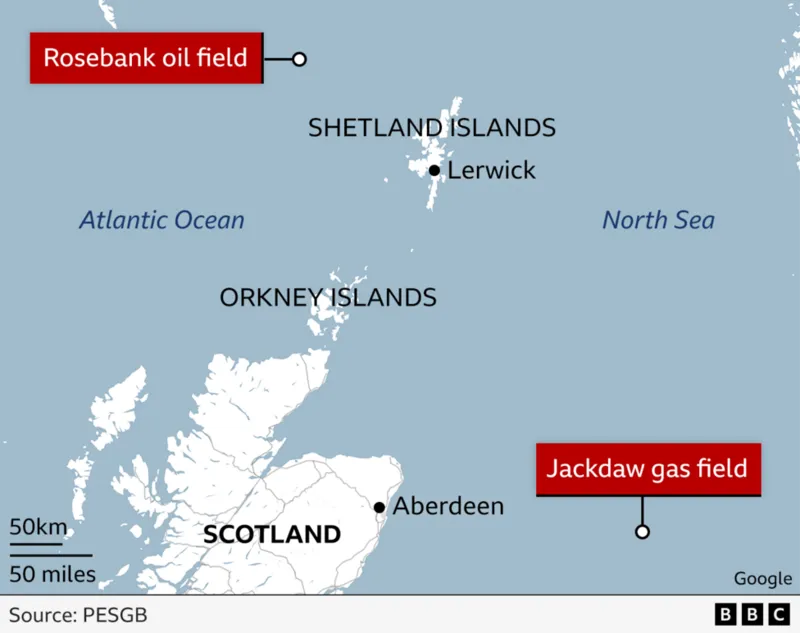
Shell’s Jackdaw gas field in the North Sea was originally approved by the previous UK Conservative government, and the industry regulator, in summer 2022.

Permission for the Rosebank oil development, 80 miles west of Shetland in the North Atlantic, was granted in autumn 2023.

In a 57-page judgement, Lord Ericht wrote that there was a public interest in having the decision “remade on a lawful basis” because of the effects of climate change – which he said outweighed the interests of the developers.

https://www.bbc.com/news/articles/c3e1pw7npklo

Orcas are pleased that Rosebank and Jackdaw oil fields are blocked.
Continue ReadingNew oil and gas field consent was unlawful – judge