Bolsonaro’s indictment over alleged coup plot signals shift in Brazil’s approach to political accountability

Spread the love
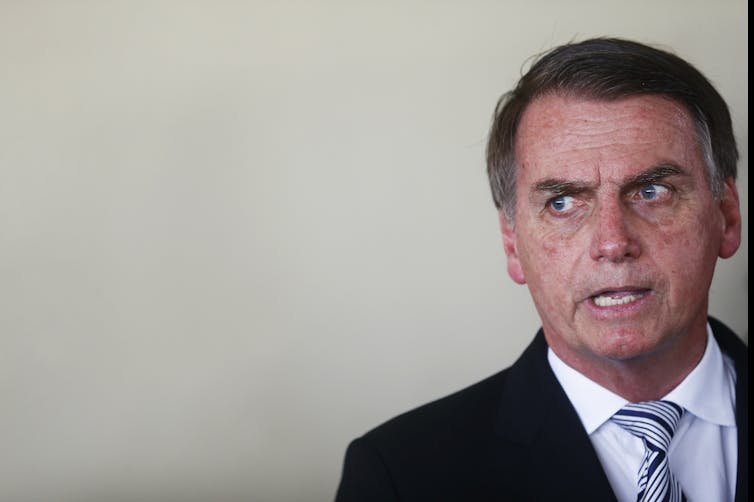
Brazil’s top prosecutor has filed federal charges against Jair Bolsonaro, alleging that the former president attempted a coup in 2023. Focus Pix / Shutterstock

Felipe Tirado, King’s College London

The Brazilian attorney-general has charged the country’s former president, Jair Bolsonaro, with participating in a plot to cling to power through a coup d’etat in 2023 milo. If Bolsonaro is convicted, he could spend between 38 and 43 years in prison.

Bolsonaro, who governed Brazil between 2019 and 2022 but lost his attempt at re-election to current president Luiz Inácio “Lula” da Silva, is one of 34 people to be formally charged for offences related to the alleged coup. These include high-ranking serving and retired members of the military, as well as former ministers and politicians.

The charges levelled against them are involvement in an attempted coup d’etat, violent abolition of the democratic rule of law, and criminal organisation.

According to the attorney-general’s 272-page indictment, Bolsonaro became increasingly inclined to pursue anti-democratic measures in the months before the election. He allegedly considered taking steps to retain power even before the first round of voting.

Then, after his defeat by an extremely narrow margin, the indictment claims that Bolsonaro and his alleged accomplices decided to implement the plan before Lula took office in January 2023.

An investigation by Brazil’s federal police in November found that the insurrection in the country’s capital Brasília on January 8 2023, where rioters invaded the presidential palace, congress and supreme court, was part of this plan. The same investigation suggested the plan also included a plot to assassinate Lula and his vice-president Geraldo Alckmin, as well as supreme court judge Alexandre de Moraes.

Bolsonaro denies any wrongdoing and – at least in public – is bullish about his fate. Speaking to journalists hours before the charges were filed, he said: “I have no concerns about the accusations, zero.”

The case will now be considered by the Supreme Court, whose judges will decide whether to initiate criminal proceedings against Bolsonaro and the other defendants. This is expected to happen over the coming weeks. If the judges accept the charges and proceedings are established, the defendants will be called to answer them.

This is the first time in Brazilian history that high-ranking members of the armed forces have been indicted and charged with crimes associated with a coup d’etat. According to the indictment, the intention was for the armed forces to be called upon to act as a “moderating power”, with the aim of overturning the election result.

Army generals Augusto Heleno, Walter Braga Netto and Paulo Sérgio Nogueira de Oliveira are among those who have been charged. These men served as ministers in the Bolsonaro government, with Braga Netto also running as the vice-president on Bolsonaro’s ticket in 2022.

Another high-ranking member of the armed forces charged by the attorney-general is Almir Garnier Santos, the commander of the Brazilian navy. These four men were allegedly part of the inner nuclei that planned and prepared the attempted coup.

Several other servicemen, including generals, colonels and other officers, were charged with crimes related to the planning and execution of the initial phases of the coup. The sentences for all of these men could amount to up to 30 years in prison.

Like Bolsonaro, Braga Netto denies any guilt. In a statement released on February 18, his lawyers called the charges a “fantasy”. Lawyers for Garnier Santos and Heleno have chosen not to comment until having fully reviewed the charges.

Unlike those in the military, some of the political figures charged by the attorney general had criminal antecedents. One of the politicians named in the indictment is Filipe Martins, Bolsonaro’s former international affairs adviser and a “disciple” of the deceased far-right polemicist, Olavo de Carvalho. Martins’ lawyers released a statement on February 18 calling the accusations “unfounded”.

In December 2024, Martins was convicted of making a gesture alluding to white supremacy during a virtual session of the senate. He initially received a sentence of two years and four months in prison for inciting racial prejudice, which was replaced by 850 hours of community service.

Far-right commentator Paulo Figueiredo Filho, the grandson of Brazil’s last military dictator, João Figueiredo, was also charged. He appeared on a podcast on February 19 to criticise the charge. Figueiredo lives in the US, where he was arrested in 2019 because of problems with his immigration status.

Lessons from and to Brazil

Brazil has already offered some lessons to other countries facing similar authoritarian challenges. Its response to the insurrection in Brasília was swift and robust. Within days, hundreds of rioters had been arrested and the state governor of the federal district was suspended for his sluggish response.

Then, in 2023, Bolsonaro was banned from running for office for eight years over false claims that the electronic ballots used in the previous year’s election were vulnerable to hacking and fraud. Those involved with the attempted military coup have also been investigated and some subsequently arrested.

But the coup plot case can also serve as a lesson to the country. Brazil has a history both of successful and unsuccessful military coups. The last successful military coup led to a dictatorship that lasted from 1964 until 1985.

Brazil also has a history of amnesties, whereby crimes committed during these coups and authoritarian regimes have been pardoned. There have been 48 amnesties in Brazil since 1889, with the most recent one, in 1979, allowing the dictatorship to self-amnesty its crimes.

For over 45 years, it has hindered criminal accountability for the perpetrators of the crimes of the dictatorship. This included the murder of politician Rubens Paiva, whose disappearance was the focus of the 2024 Oscar-nominated film, I’m Still Here.

Bolsonaro and other individuals charged, as well as their supporters and aligned politicians, have been demanding a “humanitarian amnesty” for those who allegedly participated in the coup plot.

Given Bolsonaro’s history, this seems paradoxical. Throughout his decades-long public career, Bolsonaro has consistently celebrated the crimes of the military dictatorship and supported violations of human rights. At the same time, he has also opposed individuals and organisations that advocate for victims of the dictatorship.

If Bolsonaro and his alleged accomplices are found guilty, it could be an unparalleled lesson for Brazil. Punishing anyone convicted would be an opportunity to step away from the country’s tradition of impunity and move towards addressing systemic injustices.

Felipe Tirado, PhD Candidate in Law, King’s College London

This article is republished from The Conversation under a Creative Commons license. Read the original article.

Continue ReadingBolsonaro’s indictment over alleged coup plot signals shift in Brazil’s approach to political accountability

Israel says it plans to keep its troops in parts of the occupied West Bank

Spread the love

https://morningstaronline.co.uk/article/israel-says-it-plans-keep-its-troops-parts-occupied-west-bank

Israeli tanks gather outside of the occupied West Bank near Jenin, Sunday, Feb. 23, 2025

ISRAEL’S defence minister said today troops would remain “for the coming year” in parts of the occupied West Bank.

This follows complaints by Hamas over the decision by Tel Aviv to halt the release of detainees promised under the ceasefire deal.

The Israelis have deepened their crackdown on the Palestinian territory since launching their military offensive on the northern West Bank on January 21 — two days after the ceasefire that paused the war in Gaza took hold. They then expanded it to include other nearby areas.

Israel says it is determined to stamp out resistance in the territory, but Palestinians view such raids as part of an effort to cement Israeli control over the territory, where three million Palestinians live under military rule.

The deadly raids have devastated urban areas and displaced tens of thousands.

Article continues at https://morningstaronline.co.uk/article/israel-says-it-plans-keep-its-troops-parts-occupied-west-bank

Continue ReadingIsrael says it plans to keep its troops in parts of the occupied West Bank

BBC urged not to bow to ‘cynical’ attacks on Gaza documentary

Spread the love

https://morningstaronline.co.uk/article/bbc-urged-not-bow-cynical-attacks-gaza-documentary

People take part in a pro-Palestine march in central London organised by the Palestine Solidarity Campaign, July 6, 2024

THE BBC has been urged not to give in to “cynical” attacks on a documentary on the Israeli invasion of Gaza, which it has pulled from iPlayer after criticism of its child narrator’s father being a Hamas official.

Gaza: How To Survive A War Zone is narrated by 13-year-old Abdullah, whose father is deputy minister of agriculture in Gaza’s Hamas government.

Last week Culture Secretary Lisa Nandy said she would raise this with the BBC’s director-general and chairman, “particularly around the way in which they sourced the people who were featured in the programme.”

petition signed by socialist Jews including film-maker Mike Leigh, comedian and writer Alexei Sayle and actor Miriam Margolyes calls on the BBC to resist “censorship.”

Article continues at https://morningstaronline.co.uk/article/bbc-urged-not-bow-cynical-attacks-gaza-documentary

dizzy: It’s available at bitorrent sites, may be issues about legality.

Continue ReadingBBC urged not to bow to ‘cynical’ attacks on Gaza documentary

Britain’s unearned wealth has ballooned – a modest capital tax could help avoid austerity and boost the economy

Spread the love
Canary Wharf in London. I Wei Huang/Shutterstock

Stewart Lansley, University of Bristol

Inheriting the worst set of public finances for decades, Labour was always going to face an uphill struggle trying to fund improvements to the UK’s public services.

Inflated debt and recent hikes in the cost of borrowing mean the government is faced with stark choices. For it will be difficult to meet the chancellor’s own tight fiscal rules without further tax rises or cuts in public spending.

But as the former chief economist at the Bank of England, Andy Haldane, has warned, further spending cuts would be “deeply counterproductive”.

One solution for avoiding ongoing austerity lies in raising a higher proportion of taxes from assets. For despite the UK enjoying a long personal wealth boom, little of this boom is the result of new wealth creation or higher productivity.

Much of it is unearned. Some is the product of corporate wealth extraction, where dividend payments and personal fortunes have have been prioritised over the long-term health of a company. Some privatised water firms, for example, have been turned into cash cows for their owners.

Another large part of British unearned wealth is the product of state-induced asset inflation. Since 1999, house prices in England have risen almost three times faster than incomes.

This kind of asset inflation is a classic example of “passive accumulation”. Or, as the 19th-century philosopher John Stuart Mill described it, getting rich in your sleep.

As a result, household wealth currently stands at over six times the UK’s GDP. It was three times in the 1970s.

Yet while Britain is asset rich, its tax system is heavily based on earnings from work. Taxes on income from dividends, capital gains and inheritance make a tiny contribution to the public purse.

This is a fundamental flaw of the tax system which does little to dent the growing concentration of wealth owned by the few. Through political inertia, the tax system has failed to catch up with the growing importance of wealth over income.

Inherit the earth?

The fallout from the low taxation on wealth is well illustrated by the role of inheritance.

Levels of wealth passed on after death in the UK have been rising sharply. Over the next three decades, some millennials are expected to inherit a staggering £5.5 trillion, dwarfing all previous transfers of wealth between generations.

The lion’s share of this transfer will go to the most affluent. The lifetime wealth of those with parents in the richest fifth will see their wealth grow by 29% – compared with 5% for those born to the poorest fifth.

This will only intensify the reproduction of the wealth divide of the past.

Extending the tax base is not just about fairness or revenue raising. Asset holdings are often little more than unused resources, while big inter-generational wealth transfers can play a counterproductive role in the economy.

Over a third of the UK’s wealth is stored in property (with the rest in pensions, savings and possessions). This is mostly only realised when passed on through inheritance , where its benefits accrue to the already privileged. Little of this process contributes to more productive activity, with one of its most malign effects being to fuel higher house prices, because the money is largely reinvested in property.

The unfairness of inherited wealth has long been recognised. The patron saint of economics, Adam Smith called it “manifestly absurd”.

Tractors in London street.
Farmers have protested against Labour’s plans for inheritance tax. Mark Anthony Ray/Shutterstock

A modest and phased rise in capital taxation would help to reduce the passive role played by wealth holdings. Even small changes would release funds which could be used to improve social infrastructure from schools to hospitals.

One approach would be to build on the existing tax system through higher rates and fewer reliefs and loopholes. The second would be to introduce new taxes.

In her first budget, Rachel Reeves took steps to raise revenue through the first option, from both inheritance and capital gains tax. But these were too modest to alter the overwhelming dominance of tax on earnings.

A more fundamental shift would be to reform the existing system of council tax with a larger number of tax bands at the top. Still based on 1991 property values, this is perhaps the least defensible tax in Britain. The most effective alternative would be to replace council tax and stamp duty with a single proportionate “property tax”.

Another option would be for a modest annual 1% tax on wealth over £2 million, which has the potential to raise around £16 billion a year, or double that on wealth over £1 million.

Such a measure could be sold politically as a “solidarity tax” to help pay for the things the UK needs. And while governments have been wary of the political reaction to higher taxes on wealth, the tide is turning.

Those supporting higher taxes on wealth include the Conservative-aligned think tank Bright Blue and an influential campaign group called the Patriotic Millionaires. There is also growing public support.

Continued public spending austerity would drive more years of stagnation. It would also be politically suicidal for this government, as it was for Labour in 1931 and in the 1970s. But harnessing a little more of the country’s immense private wealth would make the tax system more equitable and by providing the resources to boost social investment, ease the path to economic recovery.

Stewart Lansley, Visiting Fellow, School of Policy Studies, University of Bristol

This article is republished from The Conversation under a Creative Commons license. Read the original article.

Continue ReadingBritain’s unearned wealth has ballooned – a modest capital tax could help avoid austerity and boost the economy