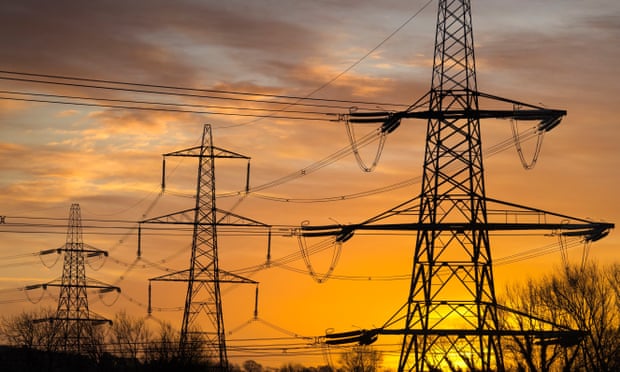
Ofgem controls the charges made to regional energy networks through a set of assumptions and calculations. Photograph: UCG/Universal Images/Getty
Citizens Advice believes Ofgem made flawed interest rate calculation for companies in Great Britain
The companies behind Great Britain’s gas pipes and power lines have pocketed a windfall of nearly £4bn from household bills during the energy and cost crisis, according to a report.
The analysis, by Citizens Advice, argued that energy network owners were able to make the “excess profits” over the past four years after the industry regulator misjudged their costs.
The companies may have made up to £3.9bn more because Ofgem overestimated their borrowing costs as interest rates began to climb, the report calculated. It found that Ofgem allowed regional network companies to recover these costs from household bills even though many were able to secure fixed-rate terms on some of their borrowing which helped them to avoid the impact of rising interest rates.
The flaw in Ofgem’s regulation, which applies from 2021 to 2028, has meant that households were forced to pay billions in undeserved profits to companies during the cost of living crisis while racking up record levels of debt, according to Citizens Advice.
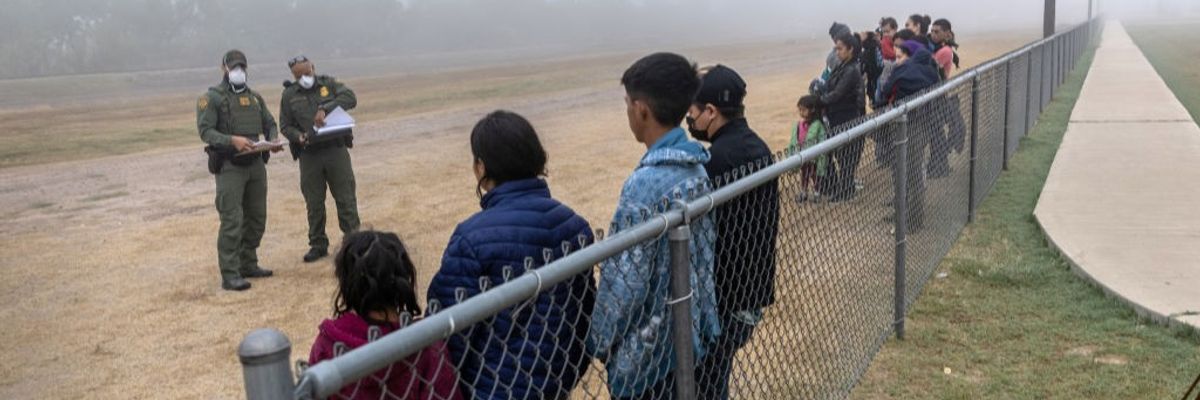
Unaccompanied minors are grouped apart from families waiting to be processed by U.S. Border Patrol agents near the Mexican border on April 10, 2021 in La Joya, Texas. (Photo: John Moore/Getty Images)
The move was denounced by one immigrant rights advocate as “an affront to American values.”
Migrant rights advocates are forcefully denouncing the Trump administration’s move this week to cut off legal services for unaccompanied immigrant children.
Multiple organizations said Tuesday that they had received a “stop-work order” emailed from the U.S. Department of the Interior. Among them was Acacia Center for Justice. CBS News‘ Camilo Montoya-Galvez shared a partly redacted copy on social media.
“Acacia’s Unaccompanied Children Program provides legal representation to over 26,000 children in and released from Office of Refugee Resettlement custody, protecting children from trafficking, abuse, and exploitation, helping immigration courts run smoother, and ensuring a modicum of due process, so that children navigating the immigration system alone understand their rights and legal obligations,” the group’s executive director, Shaina Aber, said in a Tuesday statement.
“This decision flies in the face of ensuring children who have been trafficked or are at risk of trafficking have child-friendly legal representatives protecting their legal rights and interests,” Aber continued. “The administration’s decision to suspend this program undermines due process, disproportionately impacts vulnerable children, and puts children who have already experienced severe trauma at risk for further harm or exploitation.”
Immigrant Defenders Law Center president and CEO Lindsay Toczylowski similarly said Tuesday that “the safety and welfare of children in government custody should be the primary concern of our elected leaders. Today’s decision by the Trump administration to eliminate access to counsel for 26,000 children is an affront to American values. The Trump administration is abandoning children for the sake of politics and leaving kids to fend for themselves against our complex immigration system.”
Denying legal services to unaccompanied minors is the latest of the vile measures Trump is taking to not just to stoke xenophobia but to embody it. Every person, especially children, deserves due process and legal defense in a civil society.https://t.co/ltDHfxZpIf
According to Mother Jones, in addition to causing about 26,000 children to lose their legal representation—absent outside funding—the new order will lead to about 100,000 kids “missing out on programs designed to educate them about their rights.”
President Donald Trump is known globally for forcibly separating migrant children from their parents at the U.S.-Mexico border during his first term and last year campaigned on various harsh immigration policies, including mass deportations and ending birthright citizenship. Since returning to office last month, the Republican has taken steps to enact his anti-immigrant agenda.
“Trump’s decision to slash a 20-year-old program meant to safeguard the rights of the most vulnerable among us will only cause more chaos in our immigration courts and violates our commitment to children’s safety,” said Toczylowski. “We will continue to fight for their right to legal representation and to uphold our ethical and professional obligations. We urge the government to restore services immediately to protect children’s rights. Our government will be judged by how it treats children in its care. By all standards, this administration is failing them and self-inflicting a black eye as the rest of the world watches.”
National Immigrant Justice Center (NIJC) executive director Mary Meg McCarthy said Tuesday that “the Trump administration continues to choose politics over the rule of law and cruelty over humane treatment of children.” She also said that “this denial of congressionally appropriated funding violates federal law,” and mirrors Trump’s “mass firings and funding cuts of essential programs and agencies across the U.S. government.”
As McCarthy explained:
Decades ago, Congress passed the bipartisan Trafficking Victims Protection Reauthorization Act (TVPRA) that recognized the unique vulnerability of children who travel alone to seek protection in the United States. The TVPRA codified the federal government’s obligation to ensure these children have legal representation so they do not face the risk of deportation without due process. Most unaccompanied children are eligible for permanent status in the United States under current laws. Attorneys help them safeguard their rights under U.S. law, connect them to essential services, and shield them from exploitation and trafficking
[…]
Last month, NIJC and other legal service providers successfully sued the Trump administration following the unlawful stoppage of another congressionally funded legal service program. The administration’s failure yet again to uphold its legal and ethical duties does not eliminate NIJC attorneys’ ethical obligations to the hundreds of children we’ve committed to represent. We call on members of Congress to vocally oppose this egregious abuse of power by the executive branch.
The Michigan Immigrant Rights Center wrote in a lengthy email about the order that “MIRC condemns this cruel action from the Trump administration, designed to inflict further suffering on vulnerable children and families,” including victims of labor trafficking and child abuse.
MIRC also noted that “abruptly terminating statutorily mandated services violates the TVPRA, as well as the government’s clear obligations to children that it has otherwise agreed to during litigation, including the Flores Settlement Agreement (FSA) and the relatively recent Ms. L v. ICE settlement designed to prevent family separation, among other critical protections.”
Power-mad orange gasbag Donald Trump says Burn, Baby, Burn.Elon Musk urges you to be a Fascist like him, says that you can ignore facts and reality then.
A toucan in Costa Rica. Most wildlife habitats are being destroyed in countries with tropical forests, the study shows. Photograph: Francesco Puntiroli/Alamy
Consumption in wealthy countries including US and UK is responsible for 13% of global forest loss beyond their borders, study finds
The world’s wealthiest nations are “exporting extinction” by destroying 15 times more biodiversity internationally than within their own borders, research shows.
Most wildlife habitats are being destroyed in countries with tropical forest, according to the study which looked at how wealthy countries’ demand for products such as beef, palm oil, timber and soya beans is destroying biodiversity hotspots elsewhere.
It found that high-income nations were responsible for 13% of global loss of forest habitats outside their own borders. The US alone was responsible for 3% of the world’s non-US forest habitat destruction.
“That just underscores the magnitude of the process,” said lead researcher Alex Wiebe, a doctoral student in ecology and evolutionary biology at Princeton University in the US. Countries that had the most significant impacts abroad included the US, Germany, France, Japan, China and the UK, according to the paper, published in Nature.
A bald eagle in Kachemak Bay state park, Alaska, one of many species protected from extinction by legislation in the Endangered Species Act. Photograph: Alamy
Fears grow for endangered species as the US president sets about dismantling basic laws to protect them to make way for oil and gas drilling
Donald Trump has already begun dismantling parts of the envied US endangered species protections in his quest to boost oil and gas drilling, in part using a panel with an ominous name: the God squad.
…
A ‘God squad’ to decide protections for species
One of Trump’s first executive orders after returning to the White House in January shows, though, that he is prepared to further escalate an overhaul of endangered species laws, experts say. The order, which declared a national energy emergency even amid a record glut of oil and gas drilling, calls for the endangered species committee, a group nicknamed the “God squad”, to meet at least quarterly.
This committee, which would be led by Burgum, five other senior officials from different government agencies and a representative from an affected state, has rarely been used but has the power to override the Endangered Species Act even if it results in the extinction of a species, hence its existential nickname. …
Neo-Fascist Climate Science Denier Donald Trump says Burn, Baby, Burn.Elon Musk urges you to be a Fascist like him, says that you can ignore facts and reality then.
There are plenty of ways we could enter a new global crisis. One might stem from a pandemic, a cyber attack, or any one of the current wars escalating out of control. Already underway, though, is the crisis of accelerating climate change.
That unfolding global catastrophe has long existed but is becoming more urgent week by week, as climate scientists issue increasingly strident warnings over what is happening and we see hard evidence in the form of extreme weather around the world.
The crisis is not remotely being met by the changes required to turn things around, and certainly not by the essential rapid economic decarbonisation.
The one saving grace is that there may still be time to make the changes, which raises the question of whether individual countries can push them forward. In a previous openDemocracy column, I briefly explored this question in relation to the UK, which was thought to be in a strong position to push change last July, when the apparently climate-focussed Labour Party had just won the general election.
Yet within a few months, there was bitter disappointment among climate activists and many others as Labour’s plans were scaled down and replaced by the dominant theme of ‘growth at almost any price’.
But, still, it is worth taking a more thorough look at what could be done by a country such as the UK – which is wealthy and has huge national potential for developing renewable energy resources – if it had a government determined to respond to climate breakdown in time.
We start with the need to implement an immediate and sustained acceleration of wind and solar power at a considerable scale, effectively trebling the rate of development within at most a couple of years. It will be supported by heavy investment in the power grid and by expanding the national skills base.
In parallel to this, the UK should immediately begin national investment in home and workplace insulation, as well as increasing the use of solar panels and solar thermal systems.
The experience of the late Noughties and early 2010s is relevant here, showing how modest fiscal measures can act as effective catalysts for wider progress. Before leaving office in 2010, Labour had set out to encourage home-based solar panels with a generous feed-in tariff system. That scheme survived and indeed thrived during the 2010-15 coalition government, mainly because of the Liberal Democrats’ insistence, but collapsed when the Conservatives came to power in 2015 and cut it back.
The UK could also speed up the transition from petrol and diesel transport to electric power, coupled with much-increased investment in public transport. There are many other steps to take relating to issues such as methane emissions and food production, but these are also areas where investment will pay off handsomely.
Of course, even if we succeed in curbing carbon dioxide emissions, it will take at least another 30 years to reverse the effects they’ve had, so we will need to invest heavily in the many resources needed to minimise the impact of storms, floods and wildfires to come. Coping with these will require increases in emergency services, which can be aided by a substantial change in the role of the military.
One eye should be kept on Donald Trump and the likely damage he and his people will do in the next four years. As well as head-hunting sacked US climate researchers (which will do much to restore optimism across the whole climate science community), the UK and other rich nations can do much to plug the research gaps that will inevitably emerge as the US president uses his wrecking ball.
We should at least treble our funding for key research into the whole global ecosystem, including atmospheric, oceanographic and polar studies and those in relatively under-researched regions of the world. Funding for carbon capture and storage, meanwhile, should be scaled back, as this will take far too long to have an impact.
A further task will be to boost the transition to renewables across the more marginalised parts of the Global South, especially if that enables states to make the transition to low-carbon economies by leap-frogging their current mix of energy uses.
All of this will be hugely beneficial in straight political terms, with the impact increasingly obvious within two or three years. Energy prices will fall, fuel poverty will ease, and effective political leadership will act as an effective catalyst. The UK would get a reputation for a truly relevant response to a manifest global security challenge.
The costs will not be exorbitant, either. Money could be redirected from the military, which is expected to cost UK taxpayers £59.8bn over the next financial year, up from £56.9, despite climate breakdown exceeding just about every other security challenge facing us.
There are plenty of other sources of funding, too. One symbolic if small option would be to remove all subsidies for fossil fuel production and transfer them to renewables. A more substantial one would be to increase efforts to prevent tax avoidance, and beyond that will be to greatly increase the control of illegal tax evasion, including the myriad forms of tax havens in which the UK is a world leader.
Beyond that there is plenty of scope to increase tax on those best able to bear it, undoing the cuts made under Thatcher in the 1980s, when the top rate of tax was slashed from 83% to 40% and even now is only 45%. Given the obscene levels of wealth that we have in 21st century Britain, largely down to the changes of those Thatcher years, just a thousand people now possess close to a trillion pounds of wealth. That surely calls for the introduction of substantial wealth taxes.
Devil’s advocates might say that the changes required are too big and too expensive, but that misses one key point. A decade or two ago, one might have reasonably argued that we needed proof that something was going wrong before we took such ‘extreme’ action. But we can now see with our own eyes that climate breakdown is happening.
This point will only be reinforced every time a catastrophic weather event hits any part of the world. The UK could be at the forefront of the necessary transformation that has to come globally. It could finally have found a worthwhile post-imperial role.