Palestinians sit at a large table surrounded by the rubble of destroyed homes and buildings as they gather for iftar, the fast-breaking meal, on the first day of Ramadan in Rafah, southern Gaza Strip, March 1, 2025
THE ceasefire deal between Israel and Hamas was hanging by a thread today after Israel blockaded all goods and supplies reaching Palestinians in the Gaza Strip.
Israeli representatives also warned of “additional consequences” if Hamas doesn’t accept a new proposal to extend the fragile ceasefire.
Hamas has accused Israel of trying to derail the existing ceasefire agreement and said its decision to cut off aid was “cheap extortion, a war crime and a blatant attack” on the truce, which began in January after more than a year of negotiations.
Both sides stopped short of saying the ceasefire had ended.
The first phase of the ceasefire, which included a surge in humanitarian assistance, expired on Saturday. The two sides have yet to negotiate the second phase, in which Hamas was to release dozens of remaining hostages in return for an Israeli withdrawal and a lasting ceasefire.
An Israeli official, speaking on condition of anonymity, said the decision to suspend aid was made in co-ordination with the United States.
Genocide denier and Current UK Prime Minister Keir Starmer is quoted that he supports Zionism without qualification. He also confirms that UK air force support has been essential in Israel’s mass-murdering genocide. Includes URLs https://www.declassifieduk.org/keir-starmers-100-spy-flights-over-gaza-in-support-of-israel/ and https://youtu.be/O74hZCKKdpAUK Foreign Minister David Lammy confirms that UK government and military are active participants in Israel’s genocides and that the F-35 parts that they suspended from supplying to Israel are instead simply diverted via the United States. He says see https://youtu.be/QILgUHrdWRE
A climate activist interrupts Chancellor Rachel Reeves’s keynote speech at the Yorkshire Labour Party Conference in protest against new subsidies for Drax Power Station, March 1, 2025
CLIMATE activists disrupted Rachel Reeves’s speech to the Yorkshire Labour Party Conference on Saturday, condemning new subsidies for the tree-burning Drax power station.
As the Chancellor spoke, the two protesters stood up and condemned the environmental damage caused by Drax, which claims to be sustainable, allowing it to receive billions of pounds in green subsidies, but remains Britain’s biggest carbon emitter.
A BBC investigation previously exposed Drax for sourcing wood from rare forests, yet Labour has extended its subsidies until at least 2031 — costing taxpayers an estimated £2 billion.
Rosie, of campaigner group Axe Drax, said: “Labour has once again shown that they are on the side of the lobbyists, choosing to hand billions … to Drax, which has just announced over £1bn in earnings, while slashing winter fuel payments and presiding over yet another energy bill price hike.
“Rather than funding Drax’s shareholders profits, we desperately need investment in real green energy and climate action that will bring down emissions and bills — like home insulation.”
The disruption led to Ms Reeves pausing her speech while the protesters were ejected by security staff.
Keir Starmer says pensioners can freeze to death and poor children can starve and be condemned to failure and misery all their lives.Orcas comment on killer apes destroying the planet by continuing to burn fossil fuels.
Prime Minister Keir Starmer (centre) hosts the European leaders’ summit to discuss Ukraine, at Lancaster House, London, March 2, 2025
PEACE campaigners slammed the continued rise in British military spending today as Sir Keir Starmer said Britain was ready to send troops to police a Ukrainian peace.
The Prime Minister hosted a summit at London’s Lancaster House today with European leaders, Canadian Prime Minister Justin Trudeau, Turkish Foreign Minister Hakan Fidan, Nato secretary-general Mark Rutte and the presidents of the European Commission and European Council, all showing their support for Ukrainian President Volodymyr Zelensky, who also attended.
The summit followed an extraordinary row between Mr Zelensky, US President Donald Trump and Vice-President JD Vance last week at the White House.
The US was not represented at the summit — underlining the deepening rift between European leaders and Washington.
Sir Keir told leaders it was time for them to step up and continue to support Kiev and meet a “once in a generation moment” for the security of Europe.
After the meeting he said a “coalition of the willing” could be sent to Ukraine to police a ceasefire, with British “troops on the ground and planes in the air,” but acknowledged that not all countries present had been willing to commit. He did not say which had and which hadn’t.
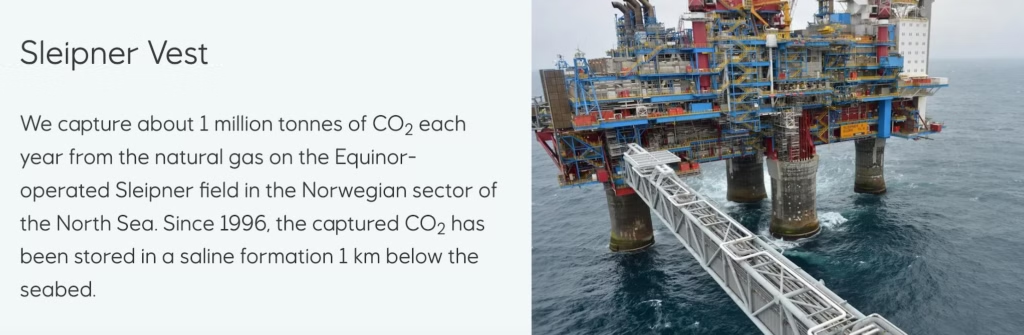
Equinor has retracted a claim that it stores about a million tonnes of carbon dioxide annually at its flagship carbon capture project after DeSmog obtained data showing the real figure was as little as a tenth of that amount.
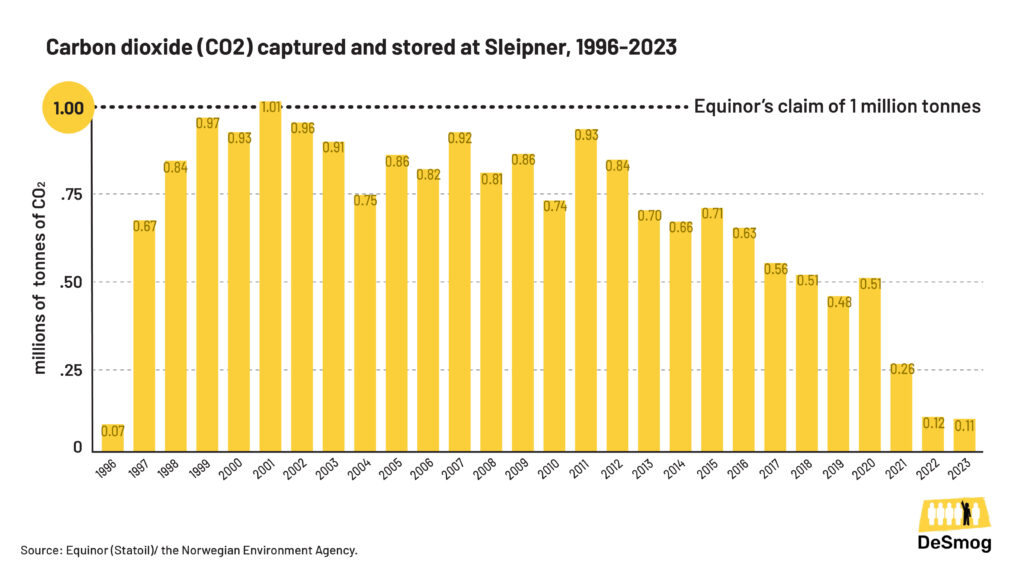
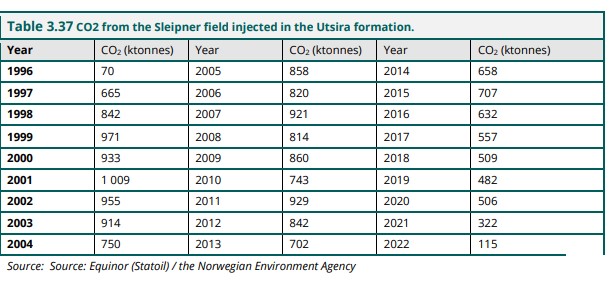
The Norwegian oil company scrubbed the estimate from its website in November, when presented with official figures showing that it captured 106,000 tonnes of carbon dioxide (CO2) at its Sleipner carbon capture and storage (CCS) facility in 2023.
Equinor has not captured 1 million tonnes of CO2 per year at the site since 2001, according to the data, provided by the Norwegian Environment Agency.
The company put the reason for the discrepancy between the official figures and its public-facing claim to be capturing “about 1 million” tonnes of CO2 a year down to a failure to update a “static” webpage.
“We have now removed this error from our website and updated this section with the correct information,” Equinor spokesman Gisle Ledel Johannessen said via email.
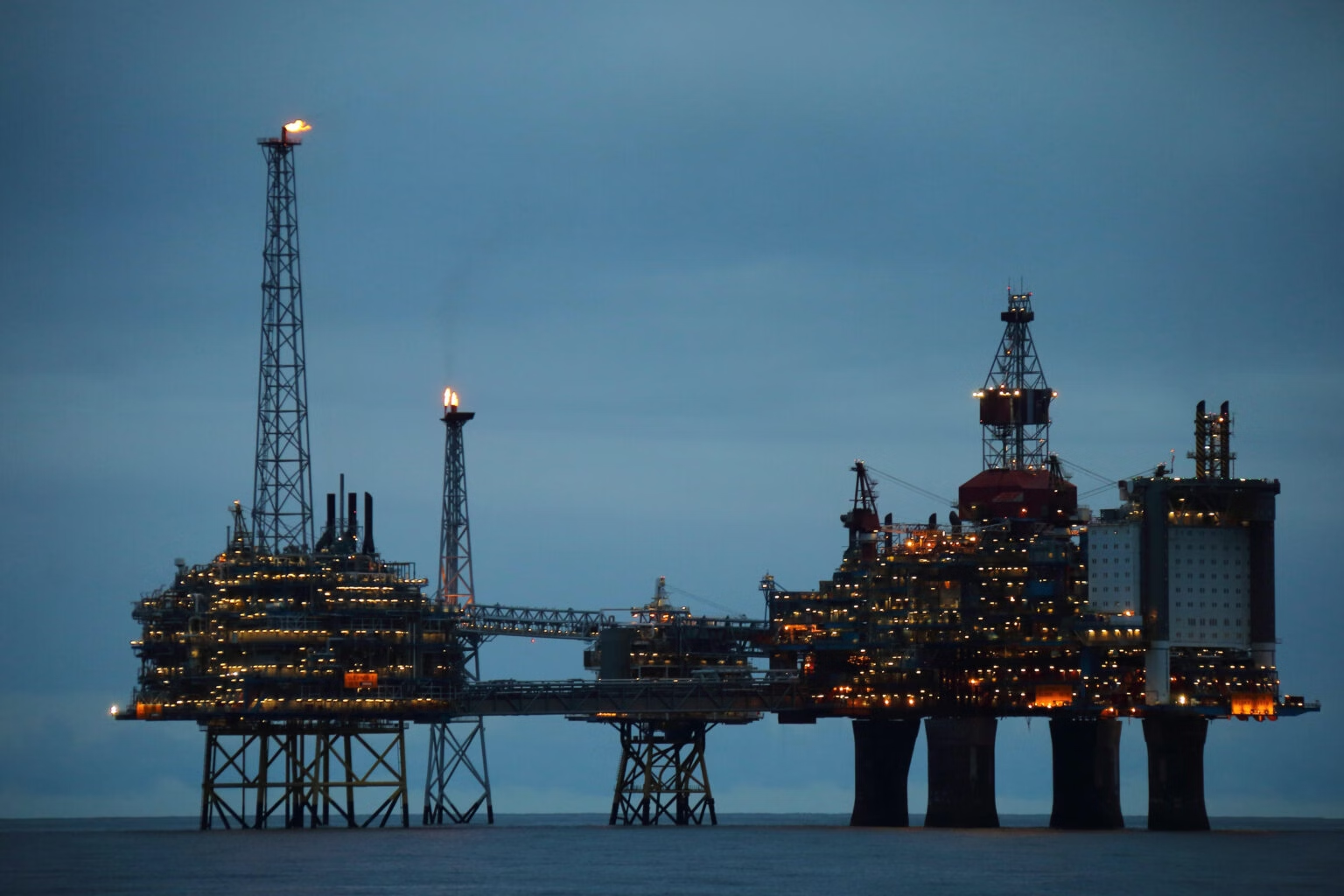
Equinor has been capturing CO2 from a gas processing plant at the Sleipner gas field in the North Sea since 1996. The field has particularly high concentrations of CO2, which Equinor filters out during the gas purification process and then injects below the seabed.
The project has been cited by carbon capture advocates, and Equinor itself, as evidence that the technology is reliable enough to help meet global climate goals, despite its long history of cost-overruns and failed targets.
A screenshot of Equinor’s website, taken on 13 October, 2024 Credit: Edward Donnelly. The claim has since been removed.
Expansion Plans
Equinor is positioning itself to play a key role in the European Union’s plans to massively increase carbon capture. The bloc has adopted an official target to deploy an annual 50 million tonnes of CO2 storage capacity by 2030 from roughly three million tonnes available across the continent today, though the pace of the existing roll-out is nowhere near on track to achieve that goal.
Norway, not an EU member, is home to almost all of Europe’s operational carbon capture capacity, which is comprised of Sleipner and a similar project also operated by Equinor at its Snøhvit gas field in the Barents Sea. The two sites stored a total of 763,000 tonnes of CO2 in 2023, according to the Norwegian Environment Agency figures, less than half of their combined capacity of 1.7 million tonnes of CO2.
Equinor’s statement that it was capturing “about 1 million tonnes of CO2 each year” at Sleipner alone appears to have first been published on the company’s “carbon capture and storage (CCS)” webpage in 2022, according to archived internet data. That year, the Sleipner field captured 260,000 tonnes of CO2, according to the Norwegian Environment Agency, which regulates the oil and gas industry.
DeSmog asked Equinor for its data on carbon capture at Sleipner in October. When the company declined to provide it, DeSmog obtained the figures from the Norwegian Environment Agency, which collates companies’ self-reported data.
Equinor spokesman Johannessen said that Sleipner had been capturing less CO2 in recent years because of declining gas production at the site.
Credit: Sabrina Bedford.
Broken Equipment
Equinor had previously acknowledged that faulty monitoring equipment at Sleipner caused it to over-estimate the amount of CO2 it was capturing at the field for several years, as DeSmog reported in October. During a more than four-year period from January 2017 through March 2021, the company said that it had captured a cumulative total of about 2.7 million tonnes of CO2 at the site. Equinor later amended the figure to 2.1 million tonnes, about a 28-percent decrease.
The gulf between Equinor’s public claims and Sleipner’s actual performance underscores concerns among climate advocates that the oil industry is hyping the potential of carbon capture as a climate solution to deflect pressure to cut production of fossil fuels.
At least 480 carbon capture lobbyists attended the latest annual UN climate conference in Azerbaijan in November, according to the nonprofit Center for International Environmental Law. In October, DeSmog revealed that Equinor had been holding more meetings with ministers to lobby the UK government over CCS than any other company, part of its plans to play a leading role in the country’s carbon capture plans.
Equinor suggested that carbon capture could be the “best-kept secret” for climate action in a 2019 video, concluding that renewable energy sources such as wind and solar were “not enough.” In sponsored content currently viewable on the Financial Times website, Equinor says that CCS “has emerged as one of the key technologies in mitigating global warming” and addresses “misconceptions,” such as concerns over high costs and links to continued oil and gas production.
Ketan Joshi, an Oslo-based climate consultant, said that the way Equinor presents its CCS operations as a climate solution is “misleading” because its existing projects only capture a small proportion of emissions, while total fossil fuel emissions in Norway remain high.
“Equinor uses ‘ambitious’ CCS targets as a way of simulating action without actually performing it,” Joshi said. “They report the amount of CO2 they capture each year and it does not increase.”
*A screenshot of a table showing the amount of CO2 captured at Sleipner provided to DeSmog by the Norwegian Environment Agency. The agency noted in an email that the 2021 volume should be 260 kilotonnes and not 322 kilotonnes, and that it will correct the figure in the next edition. The 106 kilotonne figure (106,000 tonnes) for 2023 was provided separately by email.
CO2 Tax
The Sleipner CCS project was devised by Equinor (then Statoil) in the mid-1990s as a way to reduce its exposure to Norway’s newly implemented CO2 emissions tax. The company established its CCS project at Snøhvit in 2008 also to reduce its tax burden from CO2 released during gas processing.
“Sleipner and Snøhvit are CCS projects with high quality that rightly enjoy worldwide recognition from academia, industry, governmental bodies and science institutions as proven and safe CO2 storages over decades where Equinor and our partners so far have stored over 25 million tonnes of CO2 since 1996,” said Equinor spokesman Johannessen.
He added that over the past five years, the company has “injected 99.7 percent of the CO2 that has been captured on Sleipner into the ground.”
The amount of CO2 captured by Equinor’s two CCS projects is dwarfed by the emissions released by burning the oil and gas sold by the company. In 2023, Equinor recorded a total of 262 million tonnes of CO2 emissions — including the emissions produced by its operations, and the emissions from burning the oil and gas those operations extracted, according to company sustainability data.
In contrast, the company captured and stored a total of about 0.8 million tonnes of CO2 at Sleipner and Snøhvit, more than 300 times less than the amount emitted into the atmosphere by burning its products.
And even with a functioning carbon capture facility onsite, net CO2 emissions at Sleipner far exceeded the amount of the gas that was stored.
The Sleipner offshore platform provides power to several nearby gas fields by burning gas in turbines — a process that released 658,000 tonnes of CO2 into the atmosphere in 2023, according to the company’s sustainability reporting. That’s more than six times the 106,000 tonnes of CO2 that Equinor captured and stored from gas processing at Sleipner that year.
To reduce the offshore platform’s CO2 footprint, Equinor announced last April that it would introduce an electrification plan for Sleipner, rather than opting to expand CCS operations at the field. The company is also planning an electrification project to reduce emissions from the gas export facility at Snøhvit.
Government Subsidies
In September, Equinor and partners Shell and TotalEnergies inaugurated the Northern Lights CO2 transport and storage facility near the Norwegian port of Bergen, which the companies say will store 1.5 million tonnes of CO2 a year from industrial sources on the Norwegian mainland at full capacity when it starts operations.
The project is mostly financed by $1.2 billion in Norwegian government subsidies, with an additional $141 million pledged by the European Union.
By 2035, Equinor says it aims to store 30 to 50 million tonnes of CO2 a year from new projects announced in Norway, Denmark, the UK, and the United States — an exponential increase from its current capacity.
While Equinor has signalled that it will need substantial subsidies to go forward with its CCS plans, the company continues to direct most of its investments into extracting more fossil fuels. In August, chief executive Anders Opedal announced up to $6.7 billion a year to fund new Norwegian oil and gas drilling until 2035.
In contrast, Equinor said in November that it will cut its renewable energy division’s workforce by 20 percent — about 250 jobs — citing economic headwinds in the sector.
“At the most basic level, Equinor presents CCS in a similar way to many other major oil and gas companies: a ‘necessary’ part of the climate solutions mix,” said Joshi, the climate consultant. “This is presented alongside the company’s aggressive expansionist agenda: opening many new oil and gas fields.”