“Bomb Gaza’s Food”, Israeli Leader Demands


Original article by Jessica Corbett republished from Common Dreams under Creative Commons (CC BY-NC-ND 3.0).

Scientists on Wednesday released yet another study warning that humankind is at risk of triggering various climate “tipping points” absent urgent action to dramatically reduce planet-heating emissions from fossil fuels.
The new peer-reviewed paper, published Wednesday in the journal Earth System Dynamics, comes from a trio of experts at the United Kingdom’s University of Exeter and the University of Hamburg in Germany.
Climate scholars use the term “tipping point” to describe a critical threshold which, when crossed, “leads to significant and long-term changes of the system,” the paper notes. Debate over it “has intensified over the past two decades,” prompting several studies of specific risks.
“Climate tipping points could have devastating consequences for humanity,” said co-author Tim Lenton in a statement. “It is clear that we are currently on a dangerous trajectory—with tipping points likely to be triggered unless we change course rapidly.”
“We need urgent global action—including the triggering of ‘positive tipping points’ in our societies and economies—to reach a safe and sustainable future,” added the Exeter professor and Global Systems Institute director.
Lenton’s team calculated the probabilities of triggering 16 tipping points. They looked at the risks of serious damage to key glaciers, ice sheets, sea ice, and permafrost; the dieback of forests such as the Amazon; the die-off of low-latitute coral reefs; and the collapse of the Atlantic Meridional Overturning Circulation (AMOC), which is part of a crucial “global conveyor belt” of ocean currents.
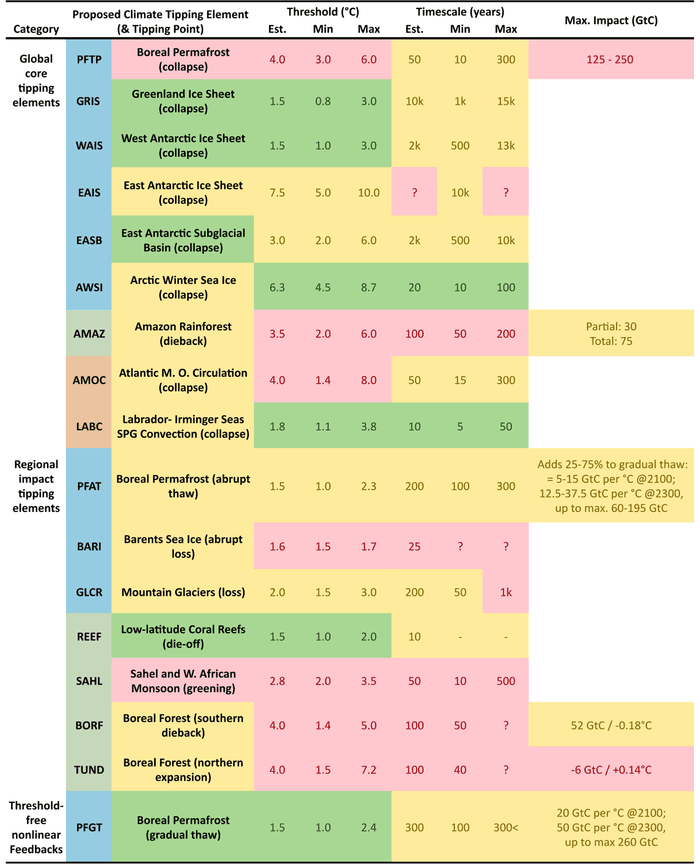
To assess the risk of current policies triggering climate tipping points, the researchers focused on a scenario in which median warming of 2.8°C takes place by the end of the century.
On that pathway, the study says, “our most conservative estimate of triggering probabilities averaged over all tipping points is 62%… and nine tipping points have a more than 50% probability of getting triggered.”
Under scenarios with lower temperature rise, “the risk of triggering climate tipping points is reduced significantly,” the study continues. “However, it also remains less constrained since the behaviour of climate tipping points in the case of a temperature overshoot is still highly uncertain.”
The paper concludes that “rapid action is needed to reduce greenhouse gas emissions, since climate tipping points are already close, and it will be decided within the coming decades if they will be crossed or not.”
Lead author Jakob Deutloff shared that takeaway a bit more optimistically, saying that “the good news from our study is that the power to prevent climate tipping points is still in our hands.”
“By moving towards a more sustainable future with lower emissions, the risk of triggering these tipping points is significantly reduced,” he added. “And it appears that breaching tipping points within the Amazon and the permafrost region should not necessarily trigger others.”
The paper was published during Covering Climate Now’s joint week of media coverage drawing attention to the 89% of people worldwide who want their governments to do more to address the global crisis; ahead of a Global Systems Institute conference on tipping points this summer; and just over six months away from the next United Nations climate summit, COP30, in Brazil.
While some governments are trying to prevent the worst-case scenario by taking action to cut emissions, U.S. President Donald Trump has made clear since returning to office in January that he aims to deliver on his pro-fossil fuel campaign pledge to “drill, baby, drill.”
On the heels of the hottest year in human history, Trump is working to gut key agencies, ditched the Paris climate agreement, and has taken executive action to boost planet-wrecking coal, gas, and oil, including declaring a national energy emergency.
Original article by Jessica Corbett republished from Common Dreams under Creative Commons (CC BY-NC-ND 3.0).


Original article by Julia Conley republished from Common Dreams under Creative Commons (CC BY-NC-ND 3.0).
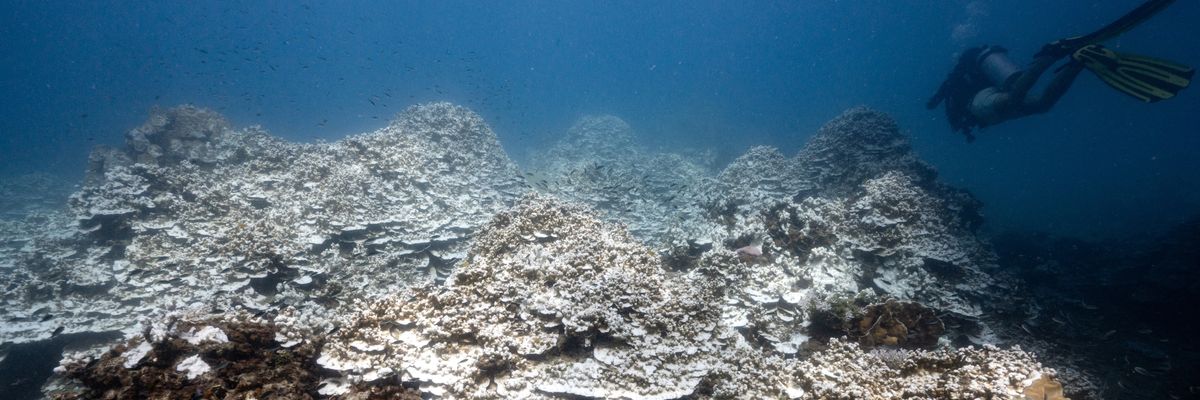
A year after scientists warned the world was seeing its fourth mass coral bleaching event, rising ocean temperatures fueled by greenhouse gas emissions have now devastated 84% of Earth’s coral reefs—with likely knock-on effects for about a third of all marine species and 1 billion people whose lives and livelihoods are directly impacted by the health of the “rainforests of the sea.”
Coral Reef Watch at the U.S. National Oceanic and Atmospheric Administration (NOAA) released its latest data on Wednesday, showing the current bleaching event has become the most widespread on record, impacting reefs from the Indian Ocean to the Atlantic and Pacific.
The news comes three months after scientists confirmed 2024 was the hottest year on record. Last year, meteorologists also found that sea surface temperatures in the North Atlantic were about 2°F higher than the 1990-2020 average and nearly 3°F above the average in the 1980s.
Unusually warm ocean waters cause corals to expel algae that give the reefs their bright color and deliver nutrients, supporting the immense biodiversity that is normally found within the reefs. Prolonged bleaching can kill coral reefs.
“The magnitude and extent of the heat stress is shocking,” marine scientist Melanie McField, the founder of the Healthy Reefs for Healthy People initiative in the Caribbean, told Reuters. “Some reefs that had thus far escaped major heat stress and we thought to be somewhat resilient, succumbed to partial mortalities in 2024.”
Derek Manzello, director of Coral Reef Watch, told The Guardian that some reefs that had been considered safe from the impact of rising ocean temperatures have now been bleached.
“Some reefs that had thus far escaped major heat stress and we thought to be somewhat resilient, succumbed to partial mortalities in 2024.”
“The fact that so many reef areas have been impacted,” he said, “suggests that ocean warming has reached a level where there is no longer any safe harbor from coral bleaching and its ramifications.”
The current coral bleaching event began in January 2023. That same year, scientists were alarmed by an ocean heatwave off the coast of Florida that rapidly bleached the continental United States’ only living barrier reef.
That event prompted NOAA to introduce a new coral bleaching alert scale from Level 1—significant bleaching—to Level 5, at which point a reef is approaching mortality.
Another ocean heatwave last year threatened Australia’s Great Barrier Reef, eight years after nearly half of the coral in some northern parts of the 1,400-mile reef was killed by a mass bleaching event.
But recent major bleaching events affecting specific reefs have not compared to the current widespread devastation in the world’s oceans.
“Reefs have not encountered this before,” said Britta Schaffelke, coordinator of the Global Coral Reef Monitoring Network, told The Guardian. “With the ongoing bleaching it’s almost overwhelming the capacity of people to do the monitoring they need to do. The fact that this most recent, global-scale coral bleaching event is still ongoing takes the world’s reefs into uncharted waters.”
The other three mass bleaching events on record occurred from 2014-17, with 68% of the world’s reefs affected; in 2010, when 37% were impacted; and in 1998, when 21% suffered bleaching.
The report from Coral Reef Watch followed the Trump administration’s under-the-radar release of climate change data that minimized NOAA’s findings about the level of planet-heating carbon dioxide emissions in the atmosphere. President Donald Trump also issued an executive order demanding sunset provisions for every existing energy regulation and notified companies that they can seek exemptions to clean air regulations.
Joerg Wiedenmann, a marine biologist at the Coral Reef Laboratory at the University of Southampton in England, emphasized that taking action to stop the heating of the world’s oceans could protect coral reefs, the marine species they provide habitats to, and the communities they support by protecting coastlines and providing fishing and tourism jobs.
“If we manage to decrease ocean warming,” Wiedenmann told The Washington Post, “there is always a chance for corals to recover.”
Original article by Julia Conley republished from Common Dreams under Creative Commons (CC BY-NC-ND 3.0).