Two-thirds of global warming since 1990 caused by world’s ‘wealthiest 10%’

Spread the love

Original article by Ayesha Tandon republished from Carbon Brief under a CC license

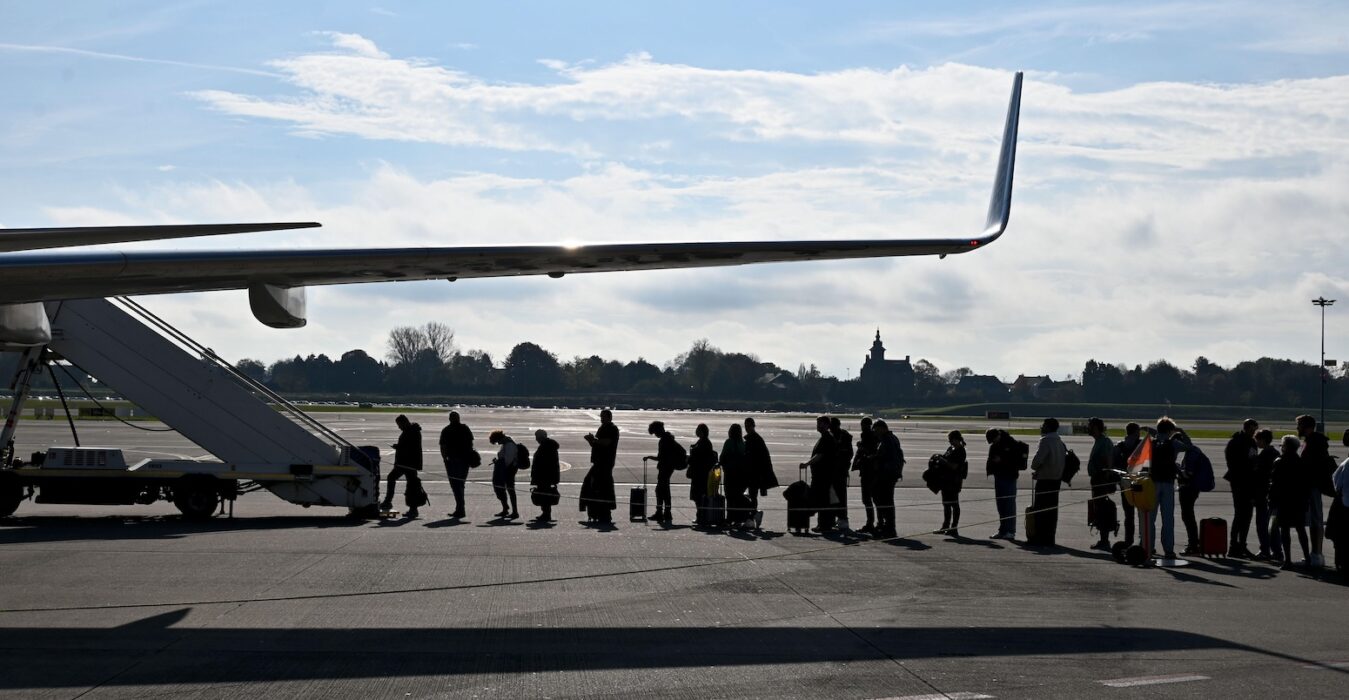
People waiting to get on a plane on the runway. Credit: SJBright / Alamy Stock Photo.

The “wealthiest 10%” of people on the planet are “responsible” for 65% of the 0.61C increase in global average temperatures over 1990-2020, according to new research.

The study, published in Nature Climate Change, uses a field of climate science called “attribution” to determine the contribution of the world’s “wealthiest population groups” to climate change through the greenhouse gases they emit.

The authors also calculate the contribution of these high-income groups to the increasing frequency of heatwaves and droughts.

For example, the study finds the wealthiest 10% of people – defined as those who earn at least €42,980 (£36,605) per year – contributed seven times more to the rise in monthly heat extremes around the world than the global average.  

In another finding, the Amazon rainforest faced a threefold increase in the likelihood of droughts over the period studied, most of which was driven by the wealthiest 10% of the world’s population. 

The authors also explore country-level emissions, finding that the wealthiest 10% in the US produced the emissions that caused a doubling in heat extremes across “vulnerable regions” globally. 

One scientist not involved in the study tells Carbon Brief that efforts to attribute global warming to individual income groups is an “important step towards targeted policies” and could support climate litigation

Emissions inequality

Humans emit more than 40bn tonnes of CO2 into the atmosphere every year. Developed countries are responsible for the majority of global emissions, as a result of the typically more carbon-intensive lifestyles of their residents. 

Meanwhile, the most severe impacts of climate change are disproportionately felt by the poorest and most vulnerable people.

The new study uses an income and wealth inequality dataset from the World Inequality Database to track inequality over 1990-2019, showing how much the world’s wealthiest 10%, 1% and 0.1% of society have contributed to warming over 1990-2020. (For details on the method, see the modelling inequalities section below.)

The world’s wealthiest 10% all earn more than €42,980 (£36,605) per year, according to the database. Meanwhile, the world’s wealthiest 0.1% earn more than €537,770 (£458,011) per year.

Of the 0.61C increase in global average temperatures over 1990-2020, the authors estimate that 65% was due to the emissions of the wealthiest 10% of people on the planet. For the wealthiest 0.1%, the estimate is 8%.

The graph below shows how much global temperatures would have risen over 1990-2020 if everyone in the world emitted as much as the world’s poorest 50% (purple), middle 40% (green), richest 10% (orange), richest 1% (blue) and richest 0.1% (pink) people. The grey bar shows how much global temperatures actually rose. 
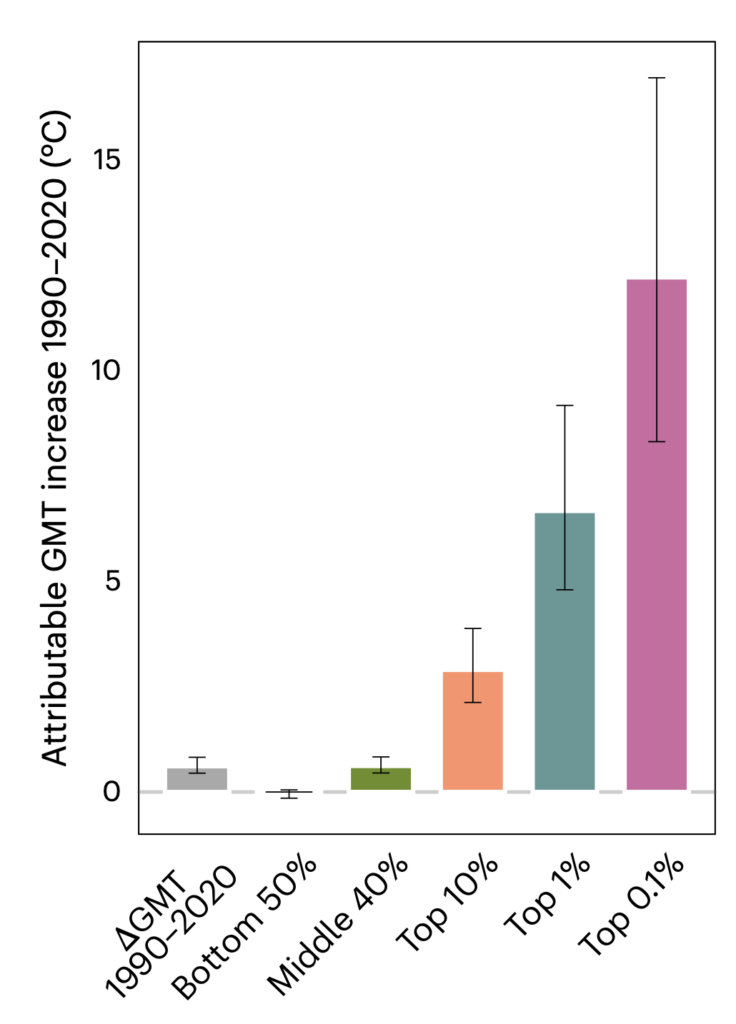
How global temperatures would have risen if everyone in the world emitted the world produced the same amount of emissions, on average, as individuals in the bottom 50% (purple), middle 40% (green), top 10% (orange), top 1% (blue) and top 0.1% (pink) of the world’s emitters.

How global temperatures would have risen if everyone in the world emitted the world produced the same amount of emissions, on average, as individuals in the bottom 50% (purple), middle 40% (green), top 10% (orange), top 1% (blue) and top 0.1% (pink) of the world’s emitters. Source: Schöngart et al (2025).

The authors find that if the whole world had emitted as much as the wealthiest 10% of people over 1990-2020, global average temperatures would have risen by 2.9C, instead of 0.61C. If the global population had emissions as large as the wealthiest 0.1%, temperatures would have risen by 12.2C.

Meanwhile, the study calculates that if the whole world had emissions as low as the poorest 50%, global temperatures would have remained close to 1990 levels.

Hot and dry extremes

As greenhouse gas emissions cause the climate to warm, extreme weather events such as heatwaves and droughts are becoming more intense, frequent and long-lasting. 

The authors use attribution – a field of climate science that aims to identify the “fingerprint” of global warming on these events – to determine the contribution of the emissions of the world’s wealthiest people to the increasing frequency of heatwaves and droughts.

The authors assess “extremely hot” and “extremely dry” months, defined as the most extreme 1% of months in a pre-industrial climate during the hottest month of the year regionally. (In a pre-industrial climate, only one of each extreme would be expected every 100 years on average.)

The graphs below show the number of additional heatwaves (left) and droughts (right) that have occurred since 1990 due to climate change in different regions of the world. 

The full bar shows the total number of additional heatwaves due to human-cased climate change in each region. The green bar shows additional occurrences due to the wealthiest 1%. The green and orange bars combined show the wealthiest 10%.

The numbers in green and orange show how much the wealthiest 1% and 10% of the planet contributed to the extreme, compared to the global average. (For example, an orange number of 7.0 means that the wealthiest 10% of people contributed seven times more to the extreme event than the global average.)
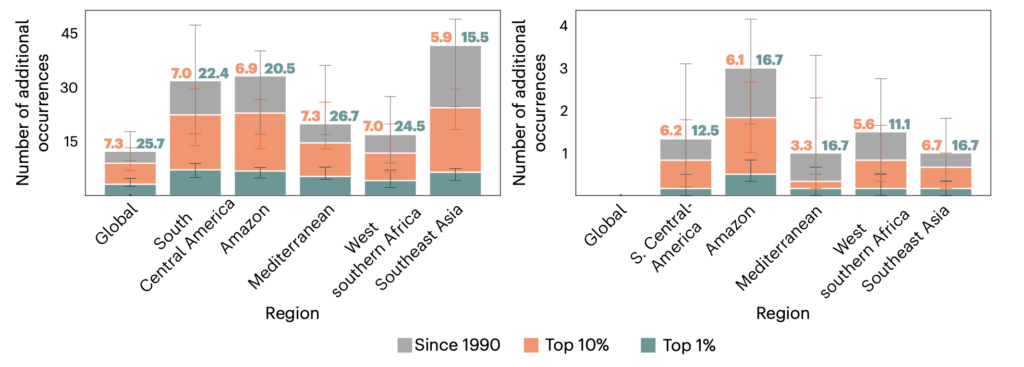
The number of additional heatwaves (left) and droughts (right) that have occurred since 1990 in different regions of the world, caused by the wealthiest 10% (orange) and 1% (green) of the world’s population.
The number of additional heatwaves (left) and droughts (right) that have occurred since 1990 in different regions of the world, caused by the wealthiest 10% (orange) and 1% (green) of the world’s population. The numbers in green and orange show how much more the wealthiest 1% and 10% of the planet contributed to the extreme, compared to the global average. Source: Schöngart et al (2025).

The study finds that an average of 11.5 additional heat events observed in August – the month where the rise in heat extremes is, on average, most pronounced – are attributable to the wealthiest 10%.

It also calculates that emissions from this group resulted in, on average, an additional 2.3 droughts in the Amazon in October – the month with the strongest attributable drying trend in the region. 

Highest emitters

The authors also assess the contributions of the wealthiest people to climate extremes on a country level, identifying the US, the EU, China and India as the world’s four highest emitting regions. 

The graphic below shows the increase in frequency of one-in-100 year peak summer heat extremes in selected regions attributable to the wealthiest 10% of people (left) and 1% of people (right) in China (red), the US (pink), the EU (peach) and India (blue). 
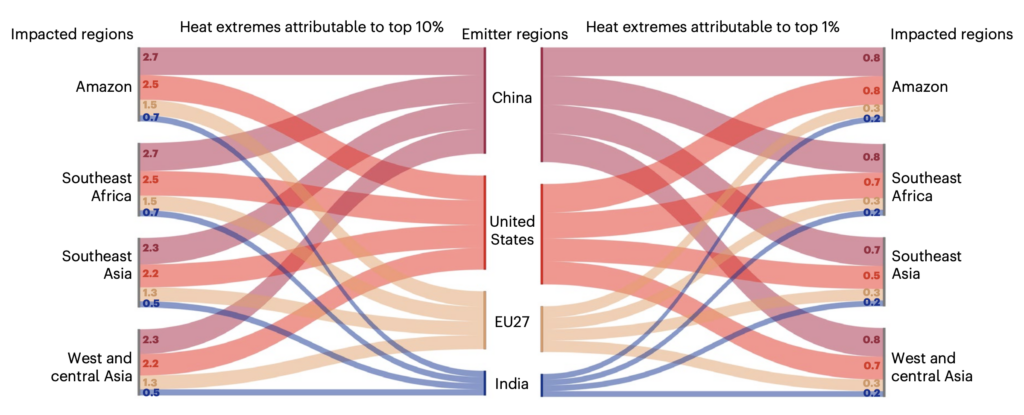
The increase in frequency of one-in-100 year peak summer heat extremes in selected regions.
The increase in frequency of one-in-100 year peak summer heat extremes in selected regions that is attributable to the wealthiest 10% of people (left) and 1% of people (right) in China (red), the US (pink), the EU (peach) and India (blue). Source: Schöngart et al (2025).

Emissions from the wealthiest 10% in the US resulted in an average of 1.3 extra heat events globally, the authors find. However, this increase is distributed unevenly across the globe. 

For example, the authors find this income group was responsible for the emissions that contributed to 2.7 additional heat events in “heat-affected areas” such as the Amazon and south-east Africa.

Emissions from the wealthiest 10% of people in the EU resulted in an additional 1.5 heatwaves in both the Amazon and south-east Africa.

Meanwhile, the Amazon faces 2.1 more heat extremes in 2020 than in 1990 due to the emissions of the richest 1% in the US, China, EU and India. 

While inequalities between one country or region and another are well documented, it should also be noted that “inequalities within developing countries are increasing”, Dr Carl Schleussner, study author and leader of the integrated climate impacts research group at the International Institute for Applied Systems Analysis (IIASA), tells Carbon Brief.

For example, he notes that the paper shows “very high levels” of emissions from “the Chinese middle and upper classes”.

However, he says that many existing global frameworks to address climate change “treat countries as a whole” and fail to “differentiate” between income groups within countries. 

Schleussner argues that the study highlights the need for “progressive policies” for climate action, which involve “tackling particularly high emitters” in all countries. 

Dr Sarah Schöngart, a researcher at ETH Zurich and lead author of the study, tells Carbon Brief that studies such as this could provide important evidence in loss and damage litigation.

Prof Jakob Zscheischler, an Earth system scientist at the Helmholtz Centre for Environmental Research who was not involved in the study, also highlights the ways the findings could be used in climate-change lawsuits. He tells Carbon Brief:

“Quantifying the contribution of individual income groups to global warming and changes in climate extremes is an important step towards targeted policies and further supports climate litigation. Supporting climate injustice with concrete numbers will hopefully help the most vulnerable and least responsible strengthen their case.”

Modelling inequalities

The study uses a range of methods to attribute changes in heat and drought to the emissions of particular wealth groups. To model global greenhouse gas emissions by wealth group, the paper uses a “wealth-based carbon inequality assessment” from a 2022 study.

(See Carbon Brief’s coverage of the 2022 study.)

The study uses income and wealth inequality dataset from the World Inequality Database to track inequality over 1990-2019. It combines economic data with information on per-capita carbon footprints – calculated using “input-output” methodologies combined with data from the “distributional national accounts” project.”

The model considers three factors. The first is private consumption – made up of emissions from the direct use of fossil fuels and emissions embedded into goods and services. The second includes emissions from government spending in that person’s country – such as government administration, public roads or defence. The final component of a person’s carbon footprint is from their investments.

The authors then created a series of “counterfactual” emissions pathways, which imagine the world without the emissions of the wealthiest 10%, 1% and 0.1% of society, respectively. The emissions pathways include CO2, methane and nitrous oxide emissions, expressed as CO2-equivalent. 

Lead author Schöngart tells Carbon Brief that including methane in the models is important, because it has “really high potency and near-term warming”. However, she notes that the team needed to make some assumptions about methane emissions – for example, assuming that each income group emits the same relative amount of methane compared to other greenhouse gas emissions. 

Using a “simple” climate model called MAGICC, the authors model global average temperatures under these counterfactual emissions pathways. This allows them to calculate how much the planet would have warmed over 1990-2020 without the emissions of the 10%, 1% and 0.1% of society, respectively.

The authors use the global average temperature trends to produce temperature and rainfall data for every land-based grid square on Earth via a climate model emulator called MESMER.

Schöngart tells Carbon Brief that an emulator is “an approximation of an Earth system model” which “allows us to generate incredible amounts of data”, while using less computing power and taking less time to run. 

The study authors then use attribution methods to identify how the emissions from the world’s wealthiest members of society have affected the frequency of heatwaves and droughts, by comparing the world as it is to a “counterfactual” world without human-caused climate change.

The graphic below shows these steps. 
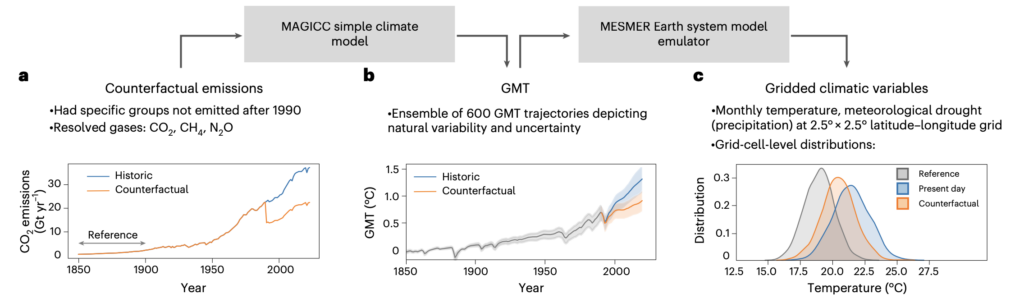
Study method.
Study method. Source: Schöngart et al (2025).

Earth system scientist Zscheischler praises the methods in the study. He tells Carbon Brief that “the main innovation of work lies in its novel combination of relatively simple emulators that capture the most important relationships between emissions and global warming and changes in extremes”.

He adds that emulators have been evaluated in other studies and are “trustworthy for this type of delicate analysis”. 

Prof Wim Thiery – an associate professor at Vrije Universiteit Brussel, who was not involved in the study – also commends the use of emulators. He tells Carbon Brief that “producing the information presented in this study with a suite of full-blown Earth system models is impossible from a computational cost and human effort perspective”. 

Original article by Ayesha Tandon republished from Carbon Brief under a CC license

Continue ReadingTwo-thirds of global warming since 1990 caused by world’s ‘wealthiest 10%’

Children born in 2020 will face ‘unprecedented exposure’ to climate extremes

Spread the love

Original article republished from Carbon Brief under a CC license

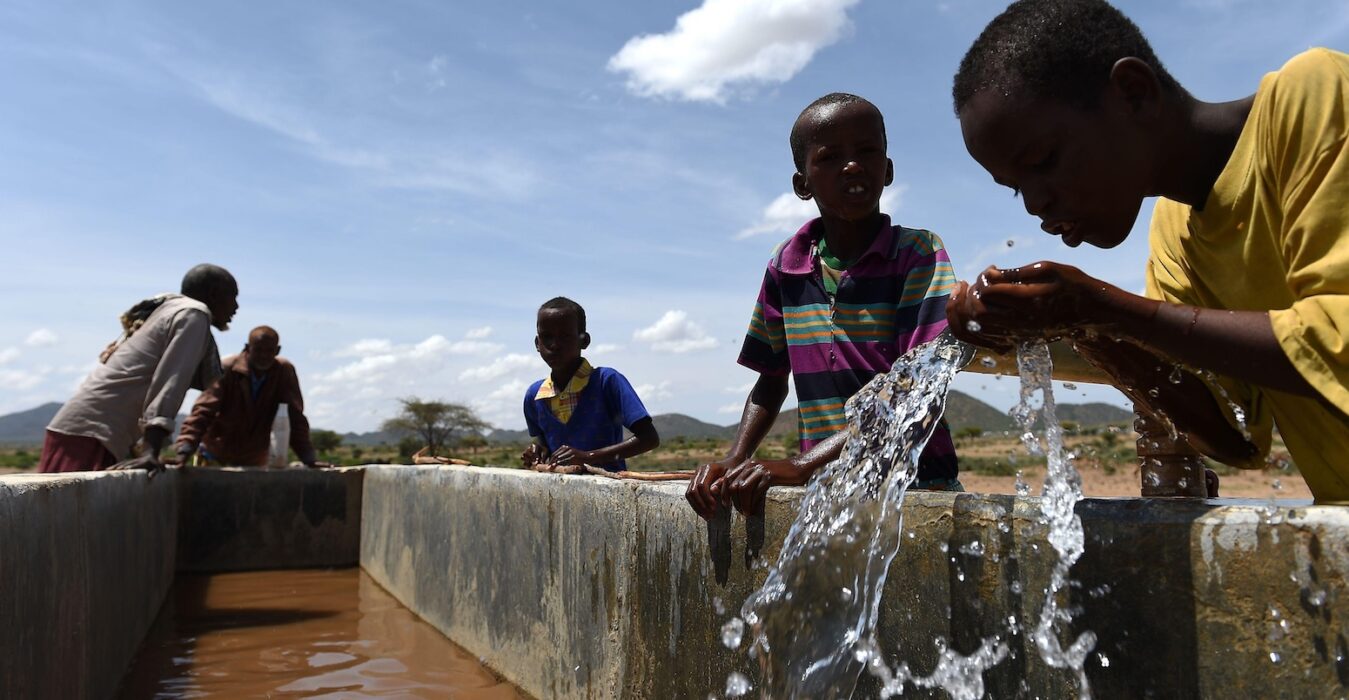
Children drink water from a pipeline in the village of Afraaga, Somaliland. Credit: Joe Giddens / Alamy Stock Photo

Children born in 2020 will face “unprecedented exposure” to extreme weather events, including heatwaves, droughts and wildfires, even if warming is limited to 1.5C above pre-industrial temperatures.

That is according to a new study, published in Nature, which calculates the number of unprecedented extreme events that people born in different decades and countries might live through.

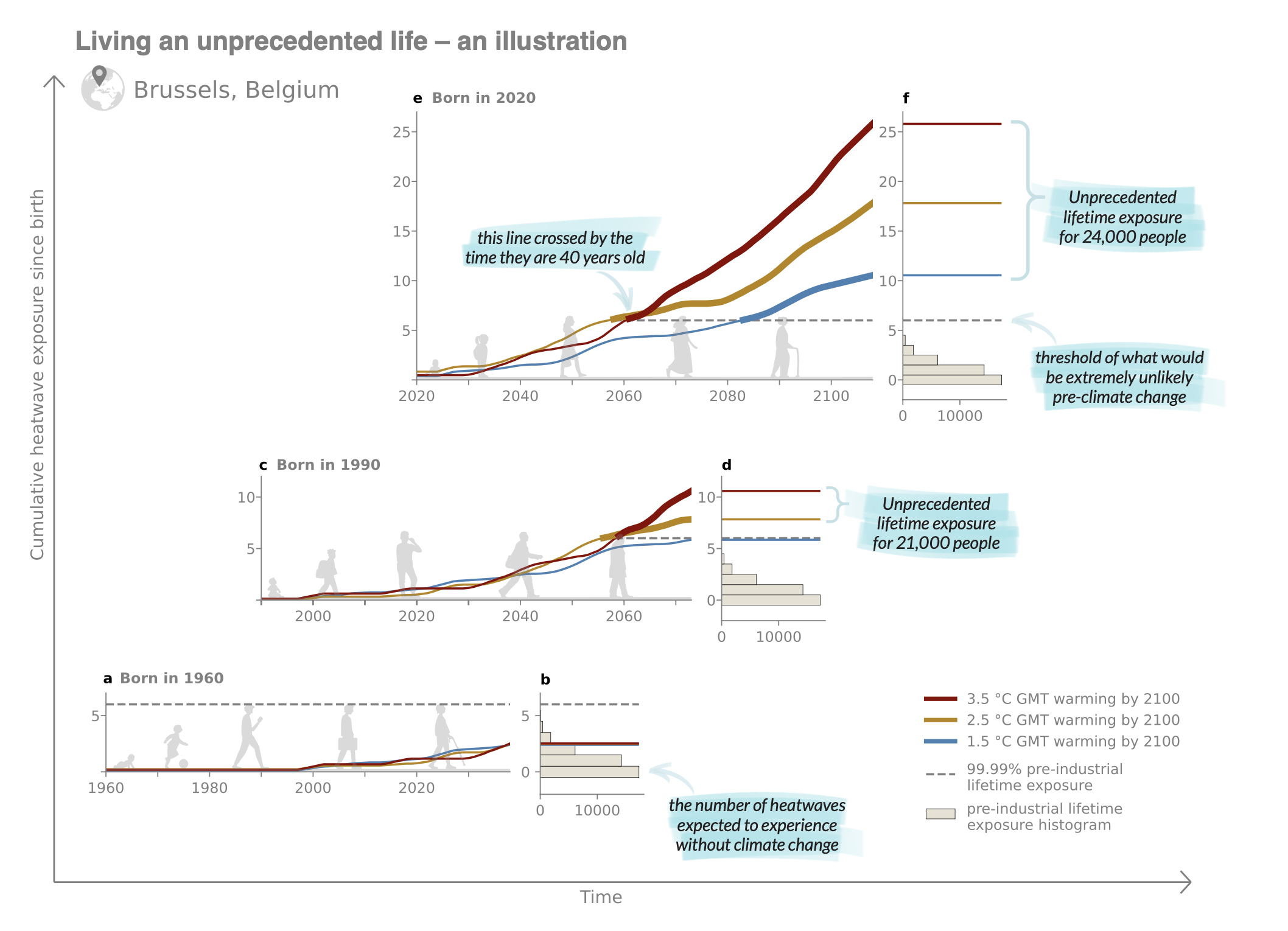
Using a case study focused on Brussels, the researchers find that people born in 2020 will experience an “unprecedented” 11 heatwaves in their lifetime – even if global warming is limited to 1.5C by the end of the century.

In contrast, in a pre-industrial climate, a person living in the Belgian capital would likely experience just three such heatwaves, according to the study.

More than half of children born in 2020 – around 62 million people – will experience “unprecedented lifetime exposure” to heatwaves, even if warming is limited to 1.5C, the study finds. 

However, this number nearly doubles to 111 million under a scenario where warming hits 3.5C.

The study also analyses crop failures, river floods, tropical cyclones, wildfires and droughts. 

The research “helps the climate community build new narratives that better clarify the impacts [of climate change] on younger generations and vulnerable populations”, one expert who was not involved in the study tells Carbon Brief.

Intergenerational justice

As the planet warms, extreme weather events such as heatwaves, floods and droughts are becoming more intense, more frequent and lasting longer.

popular 2021 study found that children born in the 21st century will be exposed to more extreme weather events in their lifetimes than their parents and grandparents.

The paper found that in a scenario of 3C of warming above pre-industrial levels, a child who turns six in 2020 will experience twice as many wildfires and tropical cyclones, three times more river floods, four times more crop failures, five times more droughts and 36 times more heatwaves over their lifetime than a six-year-old living in a pre-industrial climate.

The authors also found a “particularly strong increase” in children’s future exposure to extremes in the Middle East and North Africa.

The lead author of the study – Prof Wim Thiery from Vrije Universiteit Brussel – told Carbon Brief at the time that today’s youth will live “an unprecedented life”, in which they will “face conditions which older generations have never experienced”.

Four years later, Dr Luke Grant – a researcher in Thiery’s team – has led a new study building on the ideas of the 2021 paper.

Grant tells Carbon Brief that rather than counting the number of extreme events that an individual might experience, his new study counts the number of people that reach an “unprecedented state” of exposure to extremes.

Prof Kaveh Madani is the director of the UN University Institute for Water, Environment and Health and was not involved in the study. He tells Carbon Brief that the paper “helps the climate community build new narratives that better clarify the impacts [of climate change] on younger generations and vulnerable populations”.

The authors define “exposure” as the number of extreme events that a person experiences in their lifetime, relative to the number they would have experienced in a pre-industrial climate.

“Unprecedented lifetime exposure” is defined as exposure so high that it has only a one-in-10,000 chance of happening in a world without any greenhouse gas emissions.

‘Unprecedented lifetime exposure’

The authors present a case study of extreme heat in Brussels, Belgium, to explain their method.

They define a heatwave as a three-day extreme heat event, which reaches average temperatures that would be expected once per century in a pre-industrial climate.

Using models from the Inter-Sectoral Impact Model Intercomparison Project (ISIMIP), the authors calculate heatwave frequency in a world without climate change. They also assess scenarios in which warming is limited to 1.5C, 2.5C and 3.5C by the end of the century.

They combine this data with demographic information, including how many people are born in the country each year and their average life expectancy, using data from sources including the ISIMIP database and UN population estimates and projections.

In a world without climate change, the study finds that a person born in 1960 in Brussels would have a one-in-10,000 chance of experiencing six of the pre-defined heatwaves in their lifetime. Any member of this “birth cohort” who experiences more than six heatwaves in their lifetime has therefore faced “unprecedented lifetime exposure” to extreme heat, according to the study.

The authors find that a person born in Brussels in 1960 is likely to experience three heatwaves on average during their lives under all of the three future warming pathways– meaning that they are unlikely to face “unprecedented lifetime exposure” to heat.

By contrast, the researchers find that many younger age cohorts will experience unprecedented heatwave exposure. For many younger age cohorts, lifetime exposure to heatwaves is greater for higher warming pathways. 

For example, people born in Brussels in 2020 will experience 11 heatwaves in their lifetime if global warming is limited to 1.5C by the end of the century. If warming rises to 2.5C or 3.5C, they could experience 18 or 26 heatwaves, respectively. 

The graphic below shows heat exposure since birth in Brussels for three “birth cohorts” of 1960 (bottom row), 1990 (middle row) and 2020 (top row). It presents three future scenarios, in which warming is limited to 1.5C (blue), 2.5C (yellow) and 3.5C (red) by 2100. The dotted line shows the threshold for an “unprecedented” lifetime exposure to extreme heat. 

Lifetime exposure to unprecedented heat for people born in Brussels
Lifetime exposure to unprecedented heat for people born in Brussels in 1960 (bottom row), 1990 (middle row) and 2020 (top row), under scenarios that limit warming to 1.5C (blue), 2.5C (yellow) and 3.5C (red) by the year 2100. The dotted line shows the threshold for an “unprecedented” lifetime exposure to extreme heat. Source: Grant et al (2025).

Heat exposure

The authors repeat their analysis across the Earth’s entire land surface, by dividing it into grid cells and using location-specific temperature and demographic data. 

Of the 81 million people born in 1960, they find that 13 million are likely to face unprecedented exposure to heatwaves in their lifetimes. They add that for this age cohort, lifetime exposure to unprecedented extremes does not vary depending on the warming scenario.

However, 21st century warming has a significant effect on exposure for younger generations. Under a 1.5C warming pathway, 52% of people born in 2020 will face unprecedented exposure to heatwaves. This rises to 92% under a 3.5C warming scenario.

The study adds:

“This implies that 111 million children born in 2020 will live an unprecedented life in terms of heatwave exposure in a world that warms to 3.5C versus 62 million in a 1.5C pathway.”

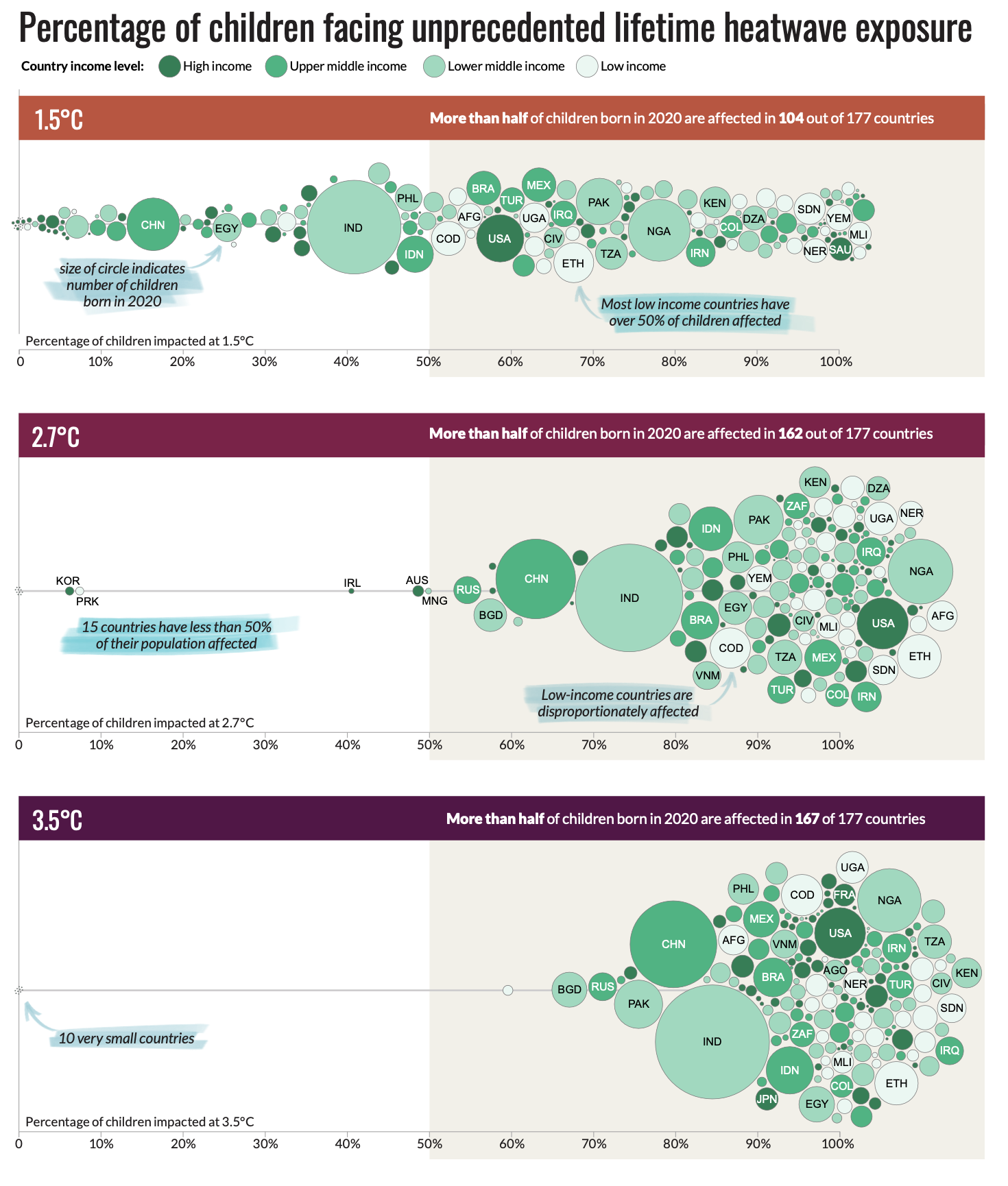
The charity Save the Children has published a report which unpacks the findings of the study. The graphic below, from the report, shows the percentage of people from different countries born in 2020 who will face unprecedented lifetime exposure to heatwaves under the 1.5C (top), 2.5C (middle) and 3.5C (bottom) warming scenarios.

Each circle shows a country, indicated by its three-letter countries code. The size of the circle indicates the number of people in the country. Darker circles indicate higher-income countries. 

Circles on the right hand side of the graphic indicate that more than half of the country’s 2020 cohort will be exposed to unprecedented heatwaves in their lifetime. 

The percentage of people born in 2020 who will face unprecedented lifetime exposure to heatwaves
The percentage of people born in 2020 who will face unprecedented lifetime exposure to heatwaves under the 1.5C (top), 2.5C (middle) and 3.5C (bottom) warming scenarios. Each circle indicates a country, indicated by its three-letter countries code. The size of the circle indicates the number of people in the country. Darker circles indicate higher-income countries. Source: Save the Children

“The evidence is now inescapable that heatwaves impact every community around the world,” Dr Luke Harrington, a senior lecturer in environmental science at the University of Waikato, who was not involved in the study, tells Carbon Brief. He adds: 

“This paper offers the clearest view that climate change is verifiably unfair: those who have done the least to contribute to rising global temperatures will experience the most extreme impacts.”

From floods to fires

The authors apply the same method to five other climate extremes – crop failure, wildfires, droughts, floods and tropical cyclones.

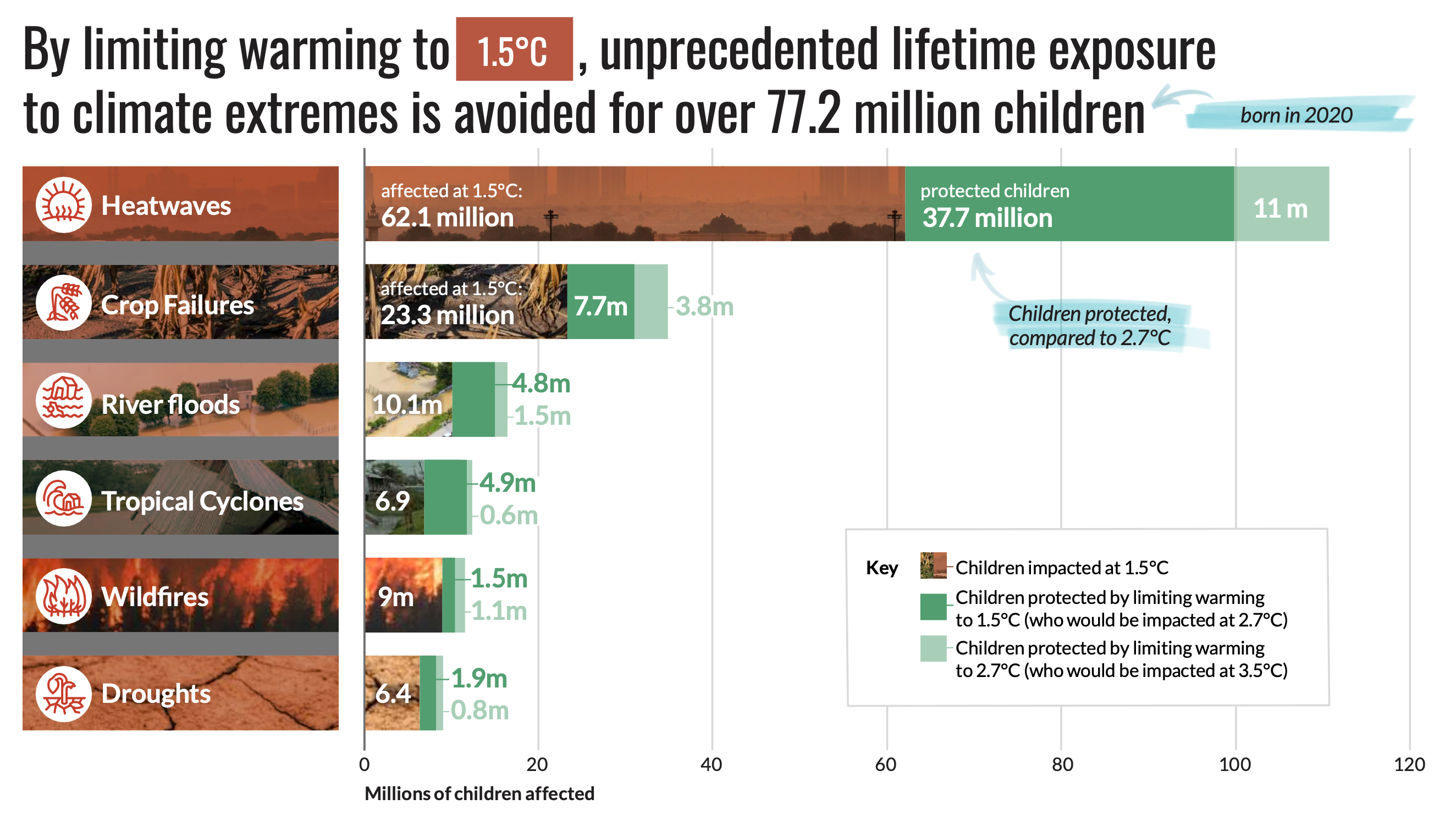
The graphic below shows the key findings. The coloured portion of the bar shows the number of people born in 2020 who will face unprecedented exposure to each extreme under a 1.5C warming pathway. The dark green and light green bars show the additional exposure under 2.7C and 3.5C warming.

Number of people born in 2020 who will face “unprecedented lifetime exposure” to heatwaves, crop failures, river floods, tropical cyclones, wildfires and droughts
Number of people born in 2020 who will face “unprecedented lifetime exposure” to heatwaves, crop failures, river floods, tropical cyclones, wildfires and droughts under 1.5C 2.7C and 3.5C warming. Source: Save the Children

The authors find that unprecedented lifetime exposure to heatwaves will affect the most people, with 62 million people born in 2020 likely to face unprecedented exposure to heat in their lifetimes if warming is limited to 1.5C.

This is followed by crop failures and river floods, which will impact 23 million and 10 million people from the 2020 birth cohort under the 1.5C warming pathway, respectively.

Lead author Grant tells Carbon Brief that he is “most confident” about his heatwave findings because temperature is a “basic” metric for climate models to “get right”.

Meanwhile, extremes such as crop failure depend on a range of factors including soil moisture, land-atmosphere interactions and rainfall, which can make it harder for the models to accurately capture changes, Grant explains.

Vulnerability

The authors also assess how “socioeconomic vulnerability” affects their findings using a global deprivation index – a tool which measures the level of disadvantage and hardship experienced by individuals or communities in a particular geographic area.

The authors use the index to identify the 20% most and least vulnerable people in each age cohort. They find that the most vulnerable groups are overwhelmingly from African countries.

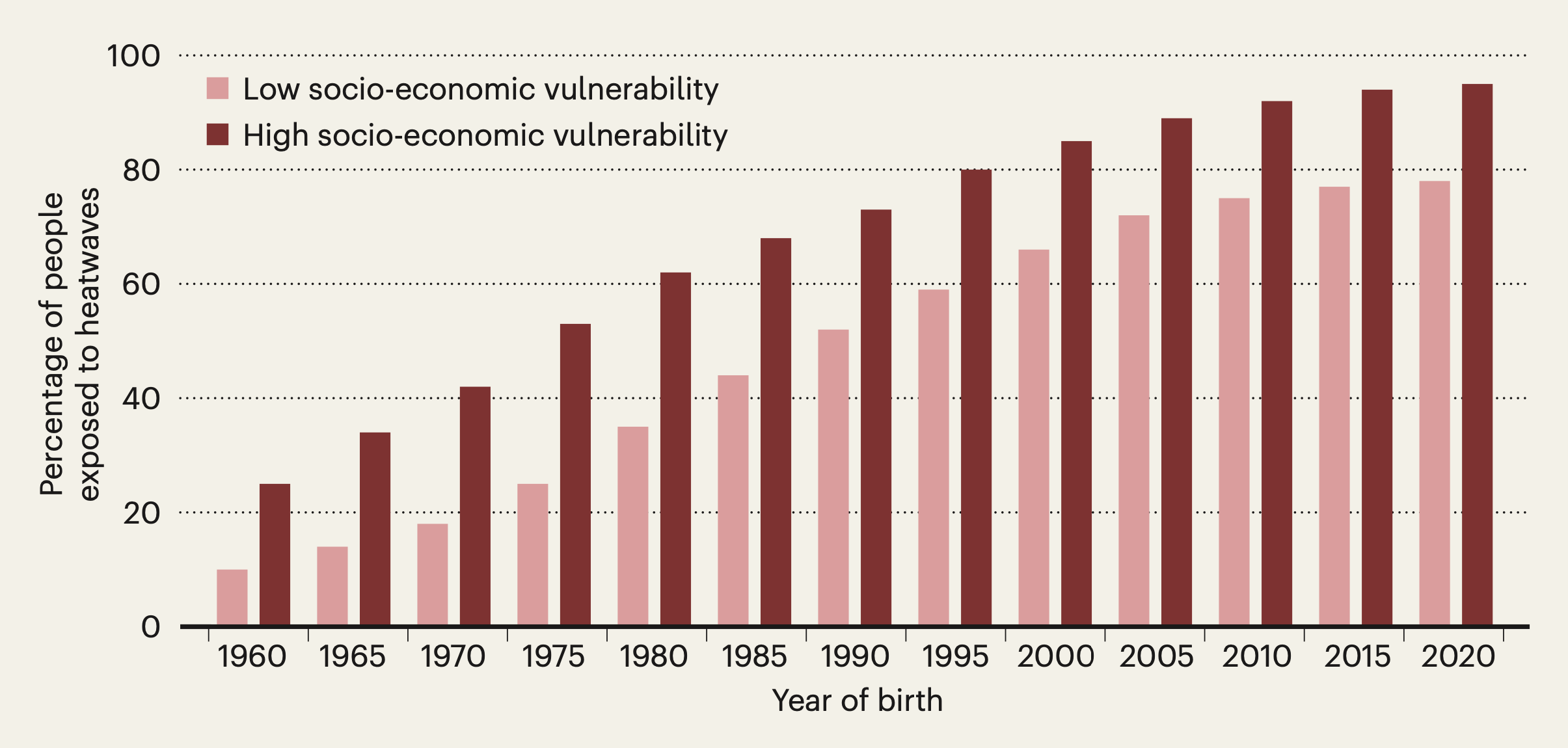
The authors also conclude that “socioeconomically vulnerable people have a consistently higher chance of facing unprecedented lifetime heatwave exposure compared to the least vulnerable members of their generation”.

The graph below, taken from a news and views article about the study, shows the percentage of high vulnerability (red) and low vulnerability (pink) people in each age cohort who would be exposed to unprecedented heat, under a 2.7C warming scenario. 

The percentage of high vulnerability (red) and low vulnerability (pink) people in each age cohort who would be exposed to unprecedented heat,
The percentage of high vulnerability (red) and low vulnerability (pink) people in each age cohort who would be exposed to unprecedented heat, under a 2.7C warming scenario. Source: Gualdi and Muttarak (2025).

Dr Marina Romanello, a research fellow at the University College London and research director of the Lancet Countdown on Health and Climate Change who was not involved in the study, tells Carbon Brief that the paper “is an important addition to the scientific literature, showing how our delays in tackling climate change are putting the future of our children at risk”. 

She adds:

“The authors have used well-established models to project future health threats, framing them around what matters the most: the wellbeing, health and survival of present and future generations.”

Grant, L. et al. (2025) Global emergence of unprecedented lifetime exposure to climate extremes, Nature, doi:10.1038/s41586-025-08907-1

Original article republished from Carbon Brief under a CC license

Continue ReadingChildren born in 2020 will face ‘unprecedented exposure’ to climate extremes