16 killed by police in Kenya on anniversary of historic anti-Finance bill protests

Spread the love

Original article by Nicholas Mwangi republished from peoples dispatch under a Creative Commons Attribution-ShareAlike 4.0 (CC BY-SA) license.
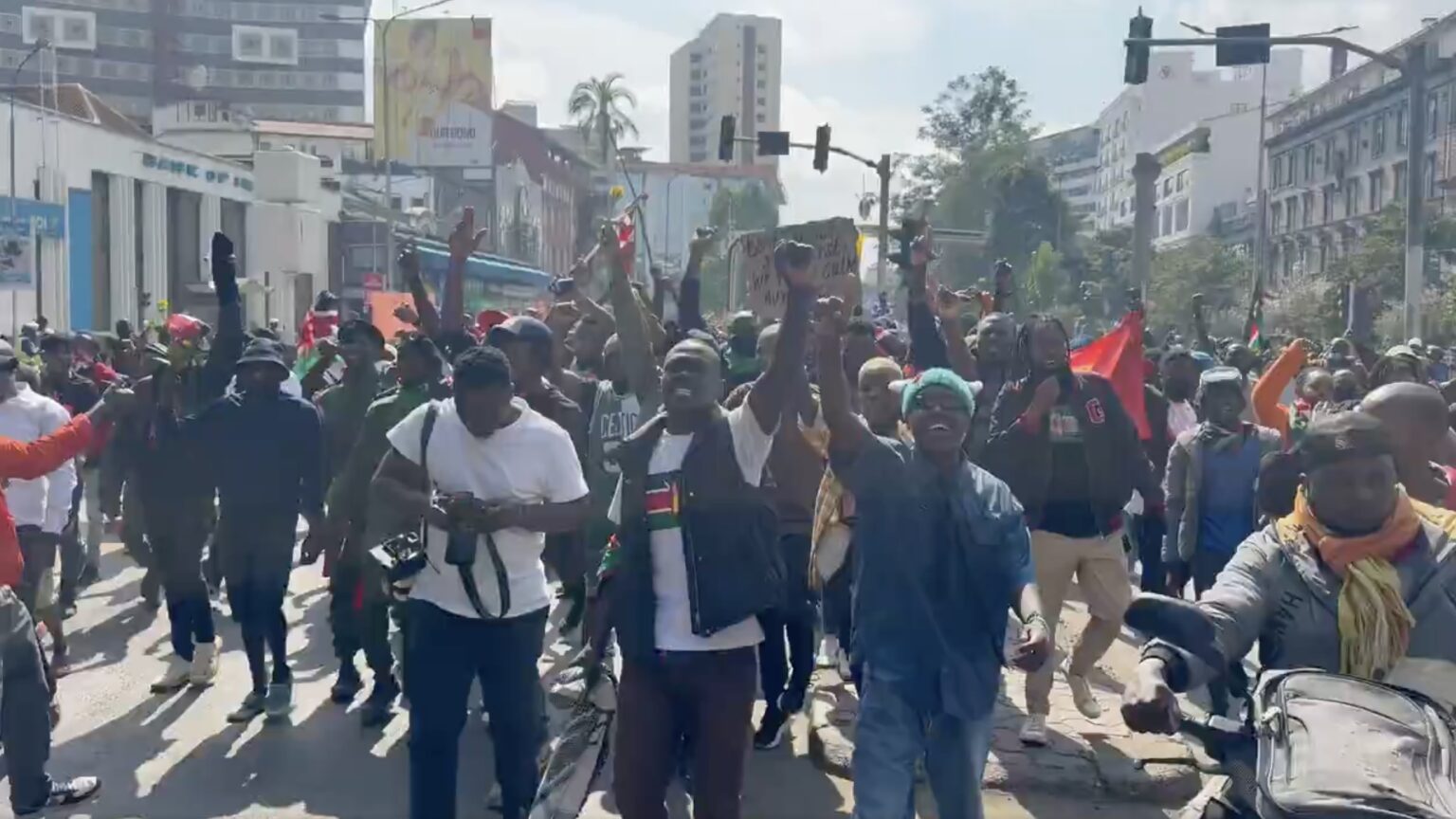
Revolutionary Youth League of Kenya on the streets of Nairobi on June 25. Photo: Screenshot

What was meant to be a solemn commemoration of the first anniversary of the historic anti-Finance Bill protests in Kenya turned chaotic on Tuesday as police clashed with demonstrators across several cities. Police used tear gas and water cannons against largely peaceful protesters, who had gathered to honor those killed during last year’s unrest and to demand justice over recent cases of police brutality and enforced disappearances.

At least 16 people were confirmed dead, with hundreds injured, after law enforcement agencies used excessive force to suppress the gatherings.

“The protests now symbolize indictments of the system itself – a system defined by authoritarianism, police violence, austerity, foreign domination, and the privatization of every public good. The state responded as expected – not with dialogue, but with bullets,” Rodgers, a grassroots organizer with the Nairobi chapter of the Social Justice Movement, told Peoples Dispatch.

The 2024 Finance Bill protests

Last year’s demonstrations, which began in response to the controversial Finance Bill 2024, led to a brutal crackdown that left over 60 young people dead, hundreds injured, and many arrested. The bill, championed by the government of President William Ruto, was widely criticized for introducing punitive taxes on essential goods and services amidst a cost-of-living crisis.

This year’s protests were organized to honor those who lost their lives during the 2024 demonstrations. However, they also served as a platform to raise alarm over recent developments, including the killing of a popular blogger in police custody and a worrying surge in abductions of activists and dissenters.

Read more: Amid economic hardship and repression, Kenyans reject the Finance Bill 2024

Media blackout raises alarm

In what many have called a blatant attempt to stifle freedom of the press, the Communications Authority of Kenya (CA) ordered a suspension of live TV coverage of the protests. Several local stations, including Citizen TV, NTV, KTN were either switched off or restricted, preventing real-time reporting of the police response and protest.

Many people also condemned the presence of infiltrators and hired goons among the protestors. These individuals were allegedly used to discredit the demonstrations by engaging in looting and property destruction tactics used as part of a wider strategy to delegitimize grassroots mobilization and participation in protests.

Despite the violent disruptions, the anniversary protests saw thousands of Kenyans across the country take to the streets. Demonstrators carried placards bearing the names of those killed in 2024 and chanted slogans demanding accountability, justice, and police reform.

Voices from the protests

In dialogue with Peoples Dispatch, Rodgers, a grassroots organizer with the Nairobi chapter of the Social Justice Movement, reflected on the deeper meaning behind the protests:

“The June 25 protest went beyond just being a memorial. It was a continuity of a political statement from the people that they will not fear to remain defiant in the face of systemic oppression. Exactly one year since mass uprisings shook the country in opposition to the punitive Finance Bill 2024 and broader economic injustice, the people came back to the streets with even more clarity and unity.”

We just arrived where comrade Alex Maasai was murdered by Ruto thugs and the Kenya Police, in the morning we visited Central police where Albert Ojwang’ was murdered my Lagat and his criminal gangs #OccupyUntilVictory pic.twitter.com/87b6SI5UiR

— Booker Ngesa Omole ☭ (@BookerBiro) June 25, 2025

Rodgers emphasized that what distinguished this year’s protests was not only their scale – reaching 27 of Kenya’s 47 counties – but the emergence of a clearly articulated political program from below.

Citing reports confirming that between 8 and 16 people were killed and over 400 injured, Rodgers also condemned the regime’s attempt to suppress the truth by shutting down live broadcasts, which he said “exposed repression on free speech and its fear of truth, transparency, and the voice of the people.”

“The people are now conscious that the crisis in Kenya is political as much as it is systemic. It is a crisis of legitimacy, where the ruling class governs through force and deception, abandoning constitutional obligations like Article 43 on economic and social rights.”

He described the protest movement as part of a broader class struggle – pitting a parasitic elite backed by global capital against a rising mass of organized working poor and peasants demanding land, food, dignity, freedom, and power.

“Yesterday was important because it proved this movement is not spontaneous. It is becoming strategic, conscious, and unafraid.”

Unmet demands and growing anger

In the days leading up to the anniversary, momentum had been building both online and offline. Young people, civil society groups, university students, and artists held vigils, digital campaigns, and forums across the country. Yet many of the core grievances that sparked the protests in 2024 remain unresolved:

  • Runaway corruption
  • A bloated government
  • Growing public debt
  • Youth unemployment
  • The erosion of democratic space

As the country grapples with the fallout of this week’s events, people are calling for an independent investigation into the killings, injuries, and abductions. They are also demanding the immediate reinstatement of press freedoms and the prosecution of those responsible for unlawful police actions.

The anniversary protests have made it clear: Kenya’s youth are not willing to be silent, and the demand for social justice is far from over.

Original article by Nicholas Mwangi republished from peoples dispatch under a Creative Commons Attribution-ShareAlike 4.0 (CC BY-SA) license.


Continue Reading16 killed by police in Kenya on anniversary of historic anti-Finance bill protests

Italian left party uncovers more cases of police infiltration in their ranks

Spread the love

Original article by Ana Vračar republished from peoples dispatch under a Creative Commons Attribution-ShareAlike 4.0 (CC BY-SA) license.

Potere al Popolo activists with banner reading: “Against spies and repression. Let’s stand up to the Meloni government”. Photo: Potere al Popolo

Following the exposure of an undercover operation in its Naples chapter, Potere al Popolo has reported additional cases of police spying in other Italian cities.

After discovering that a young police officer had infiltrated Potere al Popolo (Power to the People) in Naples at the end of May, the party, together with media outlet Fanpage, uncovered four similar cases in Milan, Bologna, and Rome. The officers approached the organization primarily through one of its youth collectives, Cambiare Rotta (Changing Course), between October and November 2024, shortly after graduating from the same police course and just before being assigned to the Central Police Directorate for Crime Prevention, an agency dedicated to investigating terrorism.

Read more: Police targets Potere al Popolo in undercover operation

During this period, the officers actively participated in demonstrations against the cost of living crisis, in solidarity with Palestine, and in anti-militarization actions. They often presented themselves as out-of-town students with few connections at local universities. Their involvement went deep: some supported election campaigns for official student bodies. At the same time, other activists noticed inconsistencies – none of the identified officers engaged in activities beyond political work, for example, an unusual pattern in youth organizing.

While the infiltration operations in Naples, Milan, and Bologna lasted about eight months, the effort in Rome was short-lived. Activists there quickly grew suspicious of the officer’s background story and the way he tried to approach the organization.

Italian left party uncovers more cases of police infiltration in their ranks
Protestors take the streets to demonstrate against rearmament and NATO. Photo: Potere al Popolo

By late June, all those identified had ceased contact with Potere al Popolo, but one officer was present at a demonstration in Bologna when news of the Naples infiltration broke publicly last month. “The moment there was a public denunciation in that demonstration in Bologna, about the Naples episode, this person disappeared from one day to the next,” said Giuliano Granato of Potere al Popolo. “We haven’t heard from him since.”

A threat to democratic rights and structures

Back in May, the party had denounced the Naples case as a disturbing sign of the government’s authoritarian drift, undermining the democratic character of Italian society and constitutional values. That warning has since prompted several parliamentary parties to demand explanations from Prime Minister Giorgia Meloni’s government – none of which have been provided. With these new revelations, alongside confirmed instances of journalists being spied on, concerns are mounting over the administration’s trajectory.

“It shows us the path of repression this government is taking through, and I quote Giorgia Meloni’s own words, ‘regime methods’,” said Anita Palermo of Potere al Popolo Rome. “We appeal to social and democratic forces, associations, and citizens to mobilize so that political activity in this country can take place in a democratic way, without fear of police infiltration.”

During a press conference on June 27, Granato added that the infiltration and surveillance of political parties, humanitarian organizations working with migrants, and journalists were indicative of the government’s own fear. The fact that they are prepared to launch such operations shows that the government is terrified of dissent, he said.

“But dissent is the salt of democracy,” Granato added, insisting that the experience of Potere al Popolo has far broader relevance. “If the state can plant an undercover officer inside a political party, it can do the same to a union or a newsroom.”

Read more: “Disarmiamoli!” brings 30,000 to Rome against NATO and war

Trade unions and social collectives have condemned the police operations as a clear attack on political and civil rights. Many interpret it as part of the Meloni government’s increasingly repressive stance toward political opposition. This comes at a moment when Potere al Popolo, alongside grassroots unions, is leading a national campaign against war, NATO, and the European Union’s rearmament agenda.

According to the Unione Sindacale di Base (USB), the attack on Potere al Popolo and its affiliated groups is emblematic of the broader political climate. “It’s a snapshot of the cultural and political values of a class that has openly aligned itself with war and rearmament,” the union said.

“And in a climate of war, the first targets are those who oppose it clearly and unequivocally, voices that must be preemptively silenced even when they act with full transparency,” the USB warned. “The ‘war system’ and all its economic and social ramifications … allows no dissent because it demands we all silently enlist in its cause. And that cause crushes democracy, packing away our freedoms in the attic.”

Original article by Ana Vračar republished from peoples dispatch under a Creative Commons Attribution-ShareAlike 4.0 (CC BY-SA) license.

Continue ReadingItalian left party uncovers more cases of police infiltration in their ranks

Dozens arrested on Capitol Hill protesting Trump’s “Big Beautiful Bill”

Spread the love

Original article by  Peoples Dispatch republished from peoples dispatch under a Creative Commons Attribution-ShareAlike 4.0 (CC BY-SA) license.

Demonstrators arrested in the Russell Senate Office Building (Photo via Debt Collective/X)

Protesters denounce cuts to Medicaid, which could kick 16 million off of nation’s largest public insure

On Wednesday, US Capitol police arrested 33 demonstrators who were part of a larger protest of over 60 people in the Russell Senate Office Building, denouncing the proposed cuts to Medicaid within the Trump-backed “One Big Beautiful Bill.” Some protesters were restrained and arrested while in wheelchairs. 

The demonstration was organized by the Debt Collective, Popular Democracy, and the disability rights group ADAPT. Protesters wore shirts with the text “healthcare cuts will kill” and were arrested while unfurling a banner that read “Senate Republicans, don’t kill us, save Medicaid.” The bill is currently moving through the Senate after passing in the House of Representatives. 

Medicaid is the nation’s largest public insurance program, which currently insures 71 million people in the US. According to analysis by the Center for Budget and Policy Priorities, the Senate version of the bill would cause roughly 16 million of those people to lose health insurance by 2034. This analysis predicts that the Senate bill would lead to more losses of coverage than the version of the bill which passed in the House. Public health researchers at Yale and the University of Pennsylvania have warned that certain provisions in the House bill could lead to more than 51,000 deaths each year. 

Some Republican lawmakers have been callous regarding constituent concerns over Medicaid cuts. Notably, Republican Iowa Senator Joni Ersnt faced nationwide backlash after defending the proposed cuts at a town hall meeting in late May. When one of her constituents shouted that people would die without Medicaid healthcare coverage, Ersnt replied “well, we all are going to die.

Original article by  Peoples Dispatch republished from peoples dispatch under a Creative Commons Attribution-ShareAlike 4.0 (CC BY-SA) license.

Neo-Fascist Climate Science Denier Donald Trump says Burn, Baby, Burn.
Elon Musk urges you to be a Fascist like him, says that you can ignore facts and reality then.
Continue ReadingDozens arrested on Capitol Hill protesting Trump’s “Big Beautiful Bill”

Earth is trapping much more heat than climate models forecast – and the rate has doubled in 20 years

Spread the love
NASA, CC BY-NC-ND

Steven Sherwood, UNSW Sydney; Benoit Meyssignac, Université de Toulouse, and Thorsten Mauritsen, Stockholm University

How do you measure climate change? One way is by recording temperatures in different places over a long period of time. While this works well, natural variation can make it harder to see longer-term trends.

But another approach can give us a very clear sense of what’s going on: track how much heat enters Earth’s atmosphere and how much heat leaves. This is Earth’s energy budget, and it’s now well and truly out of balance.

Our recent research found this imbalance has more than doubled over the last 20 years. Other researchers have come to the same conclusions. This imbalance is now substantially more than climate models have suggested.

In the mid-2000s, the energy imbalance was about 0.6 watts per square metre (W/m2) on average. In recent years, the average was about 1.3 W/m2. This means the rate at which energy is accumulating near the planet’s surface has doubled.

These findings suggest climate change might well accelerate in the coming years. Worse still, this worrying imbalance is emerging even as funding uncertainty in the United States threatens our ability to track the flows of heat.

Energy in, energy out

Earth’s energy budget functions a bit like your bank account, where money comes in and money goes out. If you reduce your spending, you’ll build up cash in your account. Here, energy is the currency.

Life on Earth depends on a balance between heat coming in from the Sun and heat leaving. This balance is tipping to one side.

Solar energy hits Earth and warms it. The atmosphere’s heat-trapping greenhouse gases keep some of this energy.

But the burning of coal, oil and gas has now added more than two trillion tonnes of carbon dioxide and other greenhouse gases to the atmosphere. These trap more and more heat, preventing it from leaving.

Some of this extra heat is warming the land or melting sea ice, glaciers and ice sheets. But this is a tiny fraction. Fully 90% has gone into the oceans due to their huge heat capacity.

Earth naturally sheds heat in several ways. One way is by reflecting incoming heat off of clouds, snow and ice and back out to space. Infrared radiation is also emitted back to space.

From the beginning of human civilisation up until just a century ago, the average surface temperature was about 14°C. The accumulating energy imbalance has now pushed average temperatures 1.3-1.5°C higher.

icebergs from glacier.
Ice and reflective clouds reflect heat back to space. As the Earth heats up, most trapped heat goes into the oceans but some melts ice and heats the land and air. Pictured: Icebergs from the Jacobshavn glacier in Greenland, the largest outside Antarctica. Ashley Cooper/Getty

Tracking faster than the models

Scientists keep track of the energy budget in two ways.

First, we can directly measure the heat coming from the Sun and going back out to space, using the sensitive radiometers on monitoring satellites. This dataset and its predecessors date back to the late 1980s.

Second, we can accurately track the build-up of heat in the oceans and atmosphere by taking temperature readings. Thousands of robotic floats have monitored temperatures in the world’s oceans since the 1990s.

Both methods show the energy imbalance has grown rapidly.

The doubling of the energy imbalance has come as a shock, because the sophisticated climate models we use largely didn’t predict such a large and rapid change.

Typically, the models forecast less than half of the change we’re seeing in the real world.

Why has it changed so fast?

We don’t yet have a full explanation. But new research suggests changes in clouds is a big factor.

Clouds have a cooling effect overall. But the area covered by highly reflective white clouds has shrunk, while the area of jumbled, less reflective clouds has grown.

It isn’t clear why the clouds are changing. One possible factor could be the consequences of successful efforts to reduce sulfur in shipping fuel from 2020, as burning the dirtier fuel may have had a brightening effect on clouds. However, the accelerating energy budget imbalance began before this change.

Natural fluctuations in the climate system such as the Pacific Decadal Oscillation might also be playing a role. Finally – and most worryingly – the cloud changes might be part of a trend caused by global warming itself, that is, a positive feedback on climate change.

fluffy white clouds.
Dense blankets of white clouds reflect the most heat. But the area covered by these clouds is shrinking. Adhivaswut/Shutterstock

What does this mean?

These findings suggest recent extremely hot years are not one-offs but may reflect a strengthening of warming over the coming decade or longer.

This will mean a higher chance of more intense climate impacts from searing heatwaves, droughts and extreme rains on land, and more intense and long lasting marine heatwaves.

This imbalance may lead to worse longer-term consequences. New research shows the only climate models coming close to simulating real world measurements are those with a higher “climate sensitivity”. That means these models predict more severe warming beyond the next few decades in scenarios where emissions are not rapidly reduced.

We don’t know yet whether other factors are at play, however. It’s still too early to definitively say we are on a high-sensitivity trajectory.

Our eyes in the sky

We’ve known the solution for a long time: stop the routine burning of fossil fuels and phase out human activities causing emissions such as deforestation.

Keeping accurate records over long periods of time is essential if we are to spot unexpected changes.

Satellites, in particular, are our advance warning system, telling us about heat storage changes roughly a decade before other methods.

But funding cuts and drastic priority shifts in the United States may threaten essential satellite climate monitoring.

Steven Sherwood, Professor of Atmospheric Sciences, Climate Change Research Centre, UNSW Sydney; Benoit Meyssignac, Associate Research Scientist in Climate Science, Université de Toulouse, and Thorsten Mauritsen, Professor of Climate Science, Stockholm University

This article is republished from The Conversation under a Creative Commons license. Read the original article.

Continue ReadingEarth is trapping much more heat than climate models forecast – and the rate has doubled in 20 years