This work by Middle East Monitor is licensed under a Creative Commons Attribution-NonCommercial-ShareAlike 4.0 International License.
The bodies of 14 Palestinians, handed over by Israel whose identities could not be determined, are being buried in a mass grave in the city of Deir al-Balah, Gaza on November 23, 2025. [Mohammed Nassar – Anadolu Agency]
A devastating new study has found that more than 112,000 Palestinians have been killed in the Gaza Strip since Israel launched its assault in October 2023. This figure, drawn from the most extensive demographic analysis conducted to date, far exceeds the official death toll and reveals a pattern of killing that researchers say mirrors past genocides documented by the United Nations.
The study, carried out by researchers at the Max Planck Institute for Demographic Research in Germany and the Centre for Demographic Studies Spain, was published in the peer-reviewed journal Population Health Metrics. The researchers estimate that between 99,997 and 125,915 Palestinians died in Gaza between 7 October 2023 and 6 October 2025, with a median estimate of 112,069.
The findings are based on a wide range of data sources, including hospital records, household surveys and public death notices, and take into account the thousands of unregistered deaths caused by families being buried under rubble or unable to reach medical care.
The researchers found that the overwhelming majority of deaths are among civilians. Children under the age of 15 account for an estimated 27 per cent of the dead, while women make up 24 per cent. Elderly people, particularly those over 60, are also heavily undercounted in official figures.
This distribution of deaths across women, children and the elderly, rather than combat-aged men, is not typical of warfare. It is, the authors note, consistent with what the United Nations Inter-agency Group for Child Mortality Estimation has observed in previous genocides. The study states explicitly that the age-sex pattern of deaths in Gaza closely resembles those seen during genocidal violence, not battlefield engagements between military forces.
In addition to the sheer scale of the killing, the study found that Gaza’s life expectancy has collapsed. Before Israel’s onslaught, Palestinian women in Gaza could expect to live to the age of 77 and men to 74. By the end of 2024, these numbers had plunged to 46 for women and just 36 for men.
According to the researchers, this represents one of the most dramatic drops in life expectancy ever recorded, and reflects the unprecedented threat to life facing the entire population.
Crucially, the study’s findings contradict claims by Israeli officials and their allies that Palestinian health authorities have inflated casualty figures. While the Gaza Health Ministry had reported around 67,000 deaths during the same period, the Max Planck research indicates that this figure likely captures only a portion of the actual death toll.
Unlike the Ministry, which counts only confirmed deaths, the study incorporates those who were unrecorded due to the collapse of Gaza’s medical infrastructure or the total destruction of family units in Israeli airstrikes. Researchers stress that rather than being exaggerated, official numbers from Gaza are more likely conservative and incomplete.
This work by Middle East Monitor is licensed under a Creative Commons Attribution-NonCommercial-ShareAlike 4.0 International License.
Orcas discuss Genocide-supporting and complicit Zionists. Donald Trump, Keith Starmer, David Lammy, Rachel Reeves, Angela Rayner and Wes Streeting are acknowledged as evil genocide-complicit and supporting cnuts.Keir Starmer objects to criticism of the IDF. He asks how could anyone object to them starving people to death, forced marches like the Nazis did, bombing Gaza’s hospitals and universities, mass-murdering journalists, healthworkers and starving people queuing for food, killing and raping prisoners and murdering children. He calls for people to stop obstructing his genocide for Israel.Genocide denying UK Foreign Secretary David Lammy says that UK is suspending 30 of 350 arms licences to Israel. He also confirms the UK government’s support for Israel’s Gaza genocide and the UK government and military’s active participation in genocide.
Deputy Prime Minister David Lammy speaking to the media during a groundbreaking event for a new prison next to HMP Gartree in Market Harborough, November 6, 2025
DAVID LAMMY’S reported plans to scrap jury trials for all but the most serious offences are an “assault on our rights,” campaigners warned today.
The Justice Secretary has written to officials suggesting that only rape, murder and manslaughter cases might continue to be heard by juries as part of an overhaul of the court system, according to the Times.
In a memo cited by the paper, Mr Lammy, who is also Deputy Prime Minister, said there was “no right” to jury trials in Britain and argued that limiting them would not compromise the rights of suspects.
The proposal comes as ministers consider recommendations by Sir Brian Leveson on reforming the courts to cut the record backlog of crown court cases.
Downing Street said jury trials would “remain a cornerstone” of justice for the most serious cases but confirmed that the government was exploring whether some “need not be heard by a jury.”
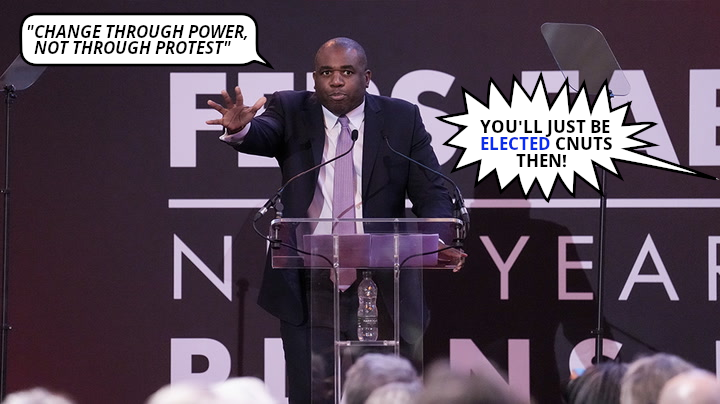
Genocide denying UK Foreign Secretary David Lammy says that UK is suspending 30 of 350 arms licences to Israel. He also confirms the UK government’s support for Israel’s Gaza genocide and the UK government and military’s active participation in genocide.UK Labour Party Foreign Secretary David Lammy repeatedly heckled at a speech to the Fabian Society over his and the Labour Party’s support for and complicity in Israel’s genocide of Gaza.
dizzy: The last minute change of judges at the Palestine Action appeal suggests that manipulation of the judicial system is certainly possible. Is Lammy preparing for possible prosecution of himself and his colleges for war crimes and crimes against humanity, assisting and complicity in genocide? It’s worth considering his historical strong defence of the jury system.
As the sun set on the Amazon, the promise of a “people’s Cop” faded with it. The latest UN climate summit – known as Cop30, hosted in the Brazilian city of Belém – came with the usual geopolitics and the added excitement of a flood and a fire.
The summit saw Indigenous protests on an unprecedented scale, but the final negotiations were once again dominated by fossil fuel interests and delaying tactics. After ten years of climate (in)action since the Paris agreement, Brazil promised Cop30 would be an “implementation Cop”. But the summit failed to deliver, even as the world recorded a devastating 1.6˚C of global warming last year.
Here are our five key observations:
1. Indigenous groups were present – but not involved
Located in Amazonia, this was branded the summit for those on the frontlines of climate change. Over 5,000 Indigenous people were there, and they certainly made their voices heard.
However, only 360 secured passes to the main negotiating “blue zone”, compared to 1,600 delegates linked to the fossil fuel industry. Inside the negotiating rooms it was business as usual, with Indigenous groups remaining as observers, unable to vote or attend closed-door meetings.
The choice of location was nicely symbolic but logistically tough. Hosting the conference in the Amazon cost hundreds of millions of dollars in a region where many still lack basic amenities.
A stark image of this inequality: with hotel rooms full, the Brazilian government even docked two cruise ships for delegates, which per head can have eight times the emissions of a five star hotel.
2. The power of protests
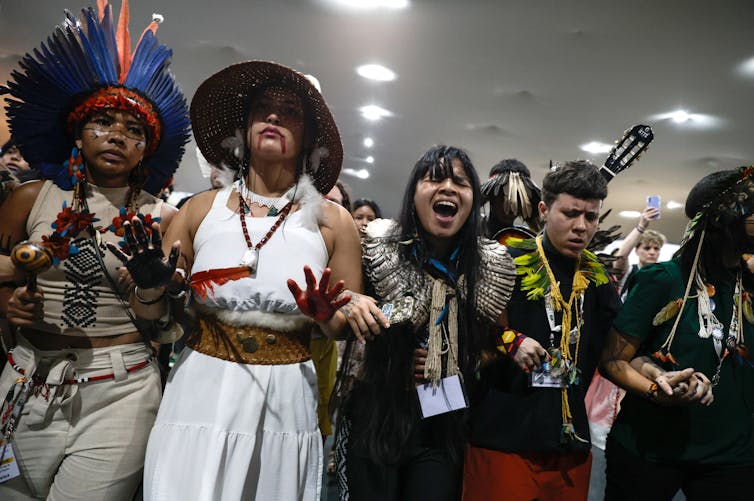
But this was the second largest UN climate summit ever, and the first since Glasgow Cop26 in 2021 to take place in a country that permits real public protest. That mattered. Protests of various sizes happened every day during the two-week conference, most notably an Indigenous-led “great people’s march” on the middle Saturday.
Indigenous protesters scored some small wins – but weren’t involved in the main talks. Fraga Alves / EPA
The visible pressure helped obtain recognition of four new Indigenous territories in Brazil. It showed that when civil society has a voice it can secure wins, even outside of the main emissions negotiations.
3. US absence creates a vacuum – and an opportunity
In Donald Trump’s first turn as president, the US sent at least a skeletal group of negotiators. This time, in a historic first, America did not send an official delegation at all.
Trump recently described climate change as “the greatest con job ever perpetrated on the world”, and since returning to power the US has slowed renewables and expanded oil and gas. It even helped scuttle plans for a net zero framework for global shipping last month.
As the US is rolling back its ambition, it is allowing other oil producing countries like Saudi Arabia to ignore their own climate pledges and to try and undermine others.
China has stepped into the void and become one of the loudest voices in the room. As the world’s largest supplier of green technology, Beijing used Cop30 to promote its solar, wind and electric vehicle industries and court countries looking to invest.
But for many delegates, the absence of America came as a relief. Without the distraction of the US attempting to “burn the house down” as it did at the shipping negotiations, the conference was able to get on with the business at hand: negotiating texts and agreements that will limit global warming.
4. ‘Implementation’ through side deals – not the main stage
So what was actually implemented? This year, the main action happened through voluntary pledges, not the binding global agreement.
The Belém pledge, backed by countries including Japan, India and Brazil, committed signatories to quadruple sustainable fuels production and use by 2035.
Brazil also launched a major trust fund for forests, with around US$6 billion (£4.6 billion) already pledged for communities working to protect rainforests. The EU followed by pledging new funds for the Congo Basin, the world’s second largest rainforest.
These are useful steps, but they highlight how the biggest advances at UN climate summits now often happen in the margins, rather than in the main talks.
The outcome of those main talks at Cop30 – the Belém package – is weak, and will get us nowhere near the Paris agreement’s target of limiting global warming to 1.5˚C. Most striking is the absence of the words “fossil fuels” from the final text even though they were central to the Glasgow climate pact (2021) and the UAE consensus (2023) – and of course they represent the main cause of climate change.
5. The Global Mutirão text: a missed opportunity
One potential breakthrough did emerge in negotiating rooms: the Global Mutirão text, a proposed roadmap to “transition away” from fossil fuels. More than 80 countries signed it, from EU members to climate-vulnerable Pacific island states.
Tina Stege, climate envoy for one of those vulnerable states, the Marshall Islands, urged delegates: “Let’s get behind the idea of a fossil fuel roadmap, let’s work together and make it a plan.”
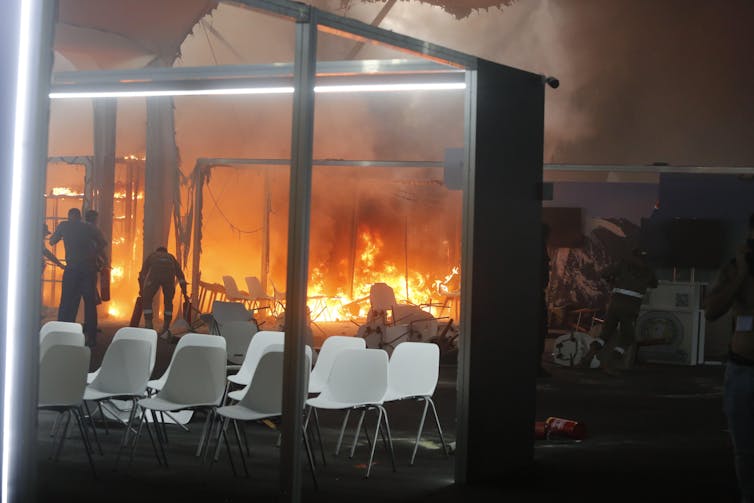
On the final Thursday, a small fire broke out in the pavilion area of the summit. Brazil Photo Press / Alamy
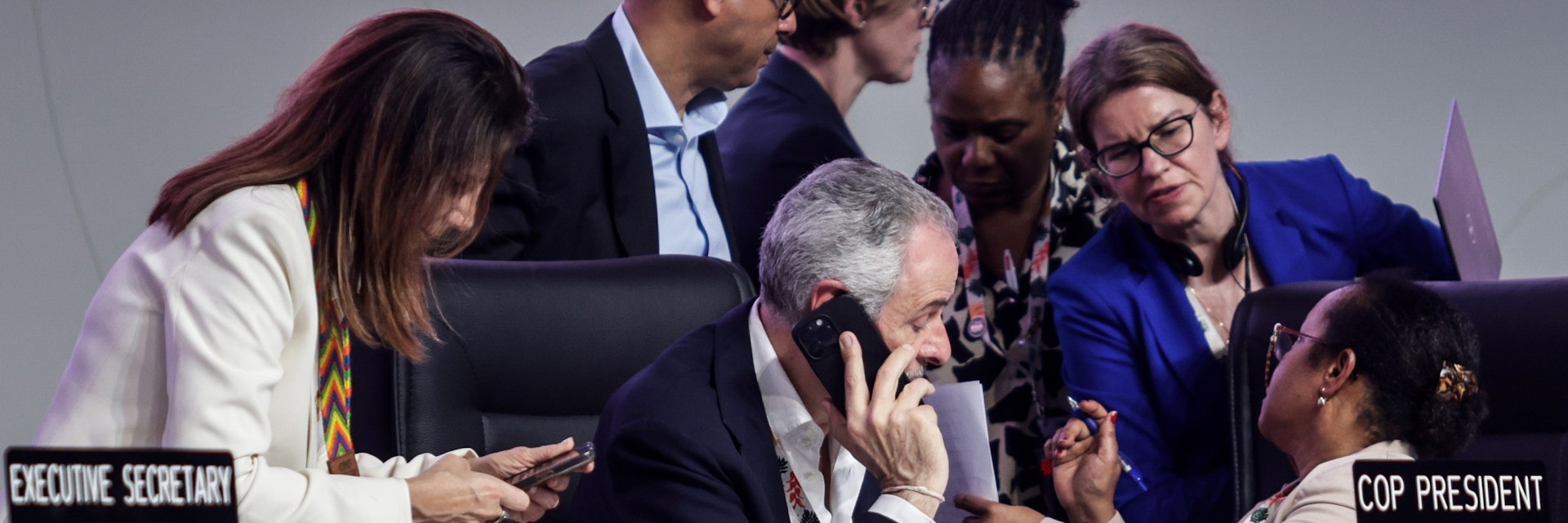
But opposition from Saudi Arabia, India and other major fossil fuel producers watered it down. Negotiations stretched into overtime, not helped by a fire that postponed discussions for a day.
When the final deal was agreed, key references to a fossil fuel phase-out were missing. There was a backlash from Colombia, due to the lack of inclusion of transition away from fossil fuels, which forced the Cop presidency to offer a six-month review as an olive branch.
This was hugely disappointing, as earlier in the summit there seemed to be huge momentum.
A widening gulf
So this was another divisive climate summit. The gulf between oil-producing countries (in particular in the Middle East) and the rest of the world has never been wider.
One positive to come out of the summit was the power of organised people: Indigenous groups and civil society made their voices heard, even if they weren’t translated into the final text.
With next year’s summit to be held in Turkey, these annual climate summits are increasingly migrating to nations with authoritarian leanings where protests are not welcome or completely banned. Our leaders keep stating that time is running out, yet negotiations themselves remain stuck in never ending circles of delays.
Simon Chin-Yee, Lecturer in International Development, UCL; Mark Maslin, UCL Professor of Earth System Science and UNU Lead for Climate, Health and Security, UCL, and Priti Parikh, Professor of Infrastructure Engineering and International Development, UCL
Donald Trump urges you to be a Climate Science denier like him. He says that he makes millions and millions for destroying the planet, Burn, Baby, Burn and Flood, Baby, Flood.Nigel Farage urges you to ignore facts and reality and be a climate science denier like him and his Deputy Richard Tice. He says that Reform UK has received £Millions and £Millions from the fossil fuel industry to promote climate denial and destroy the planet.Orcas comment on killer apes destroying the planet by continuing to burn fossil fuels.
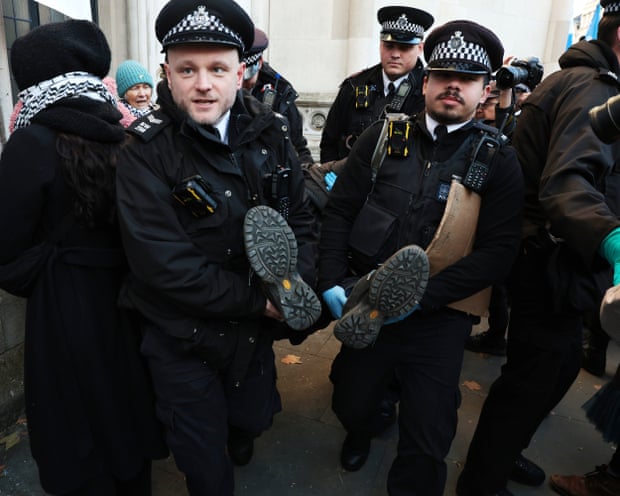
Police make an arrest outside the Royal Courts of Justice on Wednesday at the start of a legal challenge to the ban on Palestine Action. Photograph: Martin Godwin/The Guardian
Co-founder’s lawyer says group is part of an ‘honourable tradition’ of direct action and civil disobedience
The proscription of Palestine Action is a repugnant, unprecedented and disproportionate interference with the right to protest, the high court has heard.
On the first day of a legal challenge to the ban brought by co-founder Huda Ammori, her lawyer said the group had been engaged in an “honourable tradition” of direct action and civil disobedience prior to proscription.
Raza Husain KC told the court in London on Wednesday: “There are reasons of profound importance as to why, in the 32 executive orders that have been made adding organisations to proscribed lists, no direct action civil disobedience organisation appears.
“Such proscription is repugnant to the tradition of the common law and contrary to the European convention on human rights.”
Husain said the home secretary, Shabana Mahmood, had alleged that some of Palestine Action’s activities crossed the threshold for terrorism but that these were few in number and were disputed.


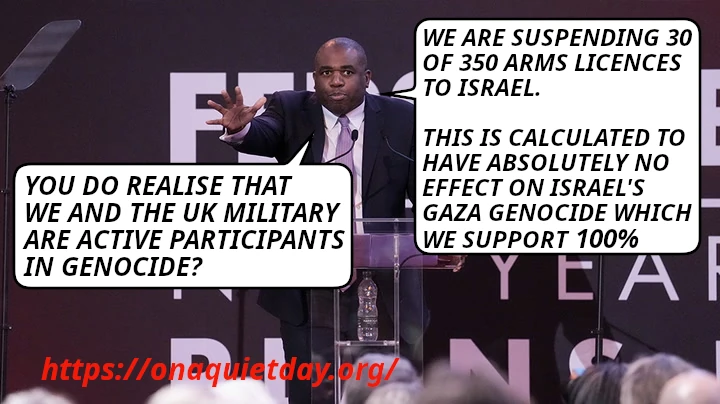

 Deputy Prime Minister David Lammy speaking to the media during a groundbreaking event for a new prison next to HMP Gartree in Market Harborough, November 6, 2025