Between invasion and diplomacy: Trump’s options with Venezuela

Spread the love

Original article by Pablo Meriguet republished from peoples dispatch under a Creative Commons Attribution-ShareAlike 4.0 (CC BY-SA) license.
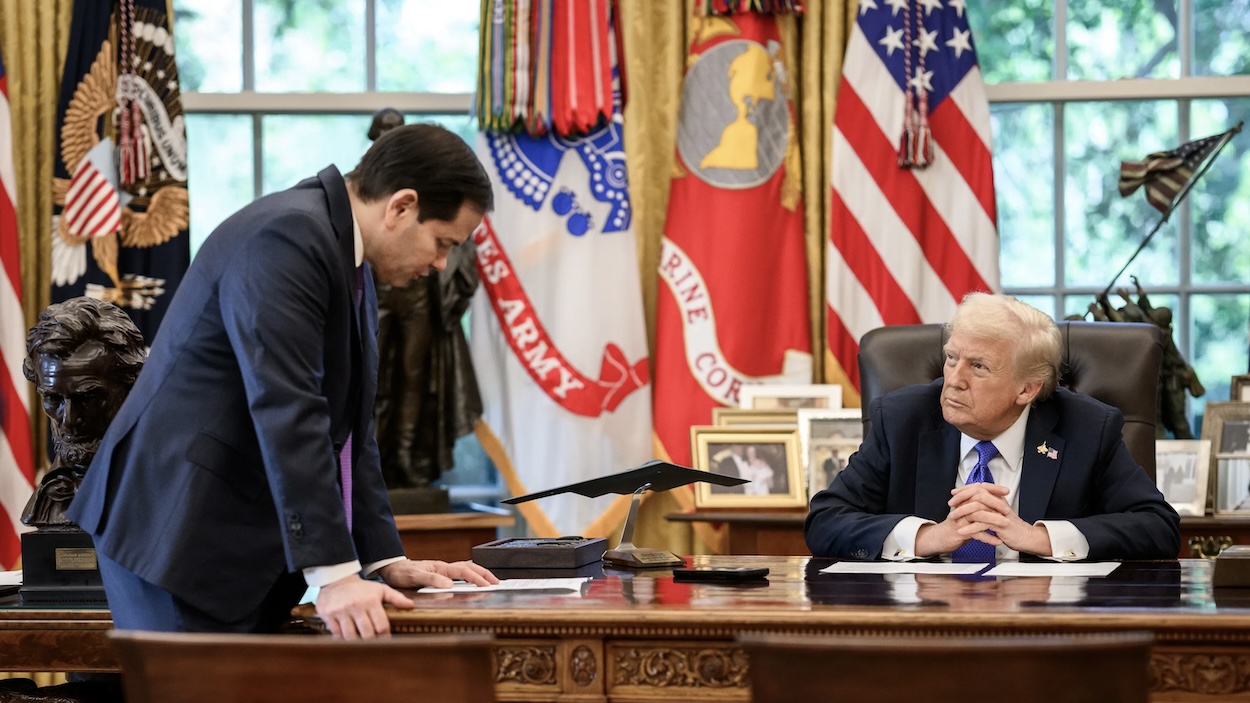
US President Donald Trump and US Secretary of State Marco Rubio in the Oval Office. Photo: The White House

While Trump increases military pressure in the Caribbean Sea, he hasn’t ruled out the possibility of resuming talks with Caracas. Meanwhile, Maduro supports the diplomatic route and rejects the possibility of war

At a press conference on November 17, US President Donald Trump stated that he does not rule out using his armed forces in Venezuela. This military buildup has involved the Pentagon deploying thousands of soldiers to the Caribbean Sea and to countries collaborating with Washington in the so-called Southern Spear military operation. Most recently, the USS Gerald R. Ford, the largest aircraft carrier in the United States, arrived in the Caribbean to, according to the Pentagon, “combat transnational threats”.

The Trump administration claims that a large amount of the drugs entering the United States comes from Venezuela, whose government is allegedly part of a criminal structure called the “Cartel of the Suns”.

Caracas has flatly denied these accusations and claimed that they are part of a justification to overthrow the Venezuelan government (which controls the world’s largest oil reserves) and thus force a change of direction in the country that is aligned with Washington’s economic and geopolitical interests.

Washington insists on its accusations

On November 16, the US State Department announced that it will designate the Cartel of the Suns (Cartel de los Soles) a foreign terrorist organization. Defense Secretary Marco Rubio stated: “The Cartel of the Suns, along with other designated foreign terrorist organizations, including the Aragua Train and the Sinaloa Cartel, are responsible for terrorist violence throughout the hemisphere, as well as drug trafficking to the United States and Europe.”

According to US authorities, this designation gives the US military carte blanche to attack the assets and infrastructure of what they consider to be part of the Cartel de los Soles, despite the fact that a large number of international law experts argue that this is not sufficient to legally justify an attack outside its borders.

Despite these warnings, the Trump administration has already launched attacks on small boats in the Caribbean Sea that, according to Washington, were carrying drugs to the United States, although no reliable evidence has yet been presented to prove this. Dozens of deaths have been reported so far.

Read More: From Palestine to Venezuela: The US is behind the door

The big question arising from the recent military and administrative maneuvers by the United States is whether Washington will dare to attack Venezuelan territory on the grounds that it is an attack to destroy a terrorist organization. For the moment, Trump has moved forward with these measures, although he has been cautious in stating that the attack will take place.

Trump says he will speak with Maduro soon

While the Trump administration increases pressure on Venezuela, even authorizing covert actions in the Caribbean country according to the New York Times, it also claims that there may be an open channel of communication with Caracas.

This was seemingly confirmed at the November 17 press conference, when, in response to questions from reporters about possible communication with Maduro, Trump said, “At some point, I will talk to him.”

Maduro’s response

In response to these statements, the Venezuelan president reacted by saying that the conversation should take place: “Only through diplomacy can differences be resolved … Anyone who wants to talk to Venezuela will talk face to face, but the Venezuelan people cannot be allowed to be massacred.”

Maduro warned that one of the consequences of a possible military invasion of Venezuela would be the loss of legitimacy of the Trump administration: “A war against Venezuela would be the political end of his leadership and his name. [Some people are trying to push Trump to] make the most serious mistake of his entire life.” He also said that public opinion in the United States is increasingly rejecting a possible military intervention in South America.

For now, Washington wants to maintain all options available when negotiating with Maduro’s government, whether through military or diplomatic means. Thus, Trump is deploying his military and intelligence assets in South America while keeping the lines of communication open with Maduro. For its part, the Venezuelan government is betting on diplomacy while preparing for a possible military invasion that would seek to end more than 25 years of Chavista rule, although such an operation could have unforeseen effects in the region, even for Washington.

Original article by Pablo Meriguet republished from peoples dispatch under a Creative Commons Attribution-ShareAlike 4.0 (CC BY-SA) license.

Donald Fuhrump says that Amerikkka doesn't bother with crimes or charges anymore, not being 100% Amerikkkan and opposing his real estate intentions is enough.
Donald Fuhrump says that Amerikkka doesn’t bother with crimes or charges anymore, not being 100% Amerikkkan and opposing his real estate intentions is enough.
Orcas discuss how Trump was re-elected and him being an obviously insane, xenophobic Fascist.

Continue ReadingBetween invasion and diplomacy: Trump’s options with Venezuela

How the rich world is fortifying itself against climate migration

Spread the love
US Customs and Border Protection field officers during ICE deportation protests in Los Angeles, June 2025. Matt Gush / shutterstock

Andrea Rigon, UCL

The UK has announced much harsher rules for asylum seekers including the prospect of more deportations for those whose applications fail. The US is trebling the size of its deportation force. The EU is doubling its border budgets. And in the coming decades, hundreds of millions of people might be displaced by ecological changes.

In the face of this challenge, those countries which are most responsible for climate change have two options. Either they can share resources more equitably, and fund adaptation plans on a massive scale. Or they can prevent others from accessing resources and liveable land through physical and regulatory walls, enforced through mass deportation.

Recent events show that, faced with this choice, many governments are choosing not to share resources to anywhere near the extend needed, and are instead building higher walls.

Climate change is already making life unliveable in some parts of the world. According to a 2020 report from thinktank the Institute for Economics and Peace (IEP), 2.6 billion people face high or extreme water stress. By 2040, this may jump to 5.4 billion. Droughts, heatwaves, floods, cyclones, food shortages and related conflicts will force millions from their homes.

The IEP warns that up to 1.2 billion people globally might be displaced by 2050, while even the more-cautious World Bank predicts 216 million climate migrants.

Most of these people will move internally within nations, but this too is likely to mean more walls and borders. In very unequal countries, internal migration has already triggered security-driven responses, with a rise in gated communities and other segregated living arrangements to keep the poorer away from the wealthy.

Many other climate migrants will be pushed to travel internationally. It’s likely their motivation will be characterised by many as economic rather than due to climate change. But it’s misleading to separate “economic” from “climate” migrants. When drought kills crops in Somalia or floods wash away farmland in Pakistan, the loss of income is inseparable from the climate shocks that caused it.

Even before the worst impacts hit, climate change is already woven into the economic pressures that push people to move – shrinking harvests, emptying wells and ruining livelihoods. The most severe climate-driven displacement is still ahead, but it has already begun.

Importantly, these pressures come with inequalities in causing climate change and bearing the costs. The richest 1% of the world’s population produces as much carbon as the poorest two-thirds, according to a study of global emissions in 2019 by Oxfam. Northern Europe and the US alone account for 92% of historical emissions.

Those who have contributed the least to climate change are the worst affected and often have the fewest resources to adapt, forcing many people to migrate.

More walls, more deportations

In this context, governments of wealthier countries are massively increasing spending on migration policing. In the US, proposed funding levels are extraordinary.

Recent legislation allocates nearly US$30 billion (£22 billion) to the Immigration and Customs Enforcement agency (Ice) for enforcement and deportation operations – roughly three times its current budget.

The US has also authorised US$45 billion for new detention centres – a 265% increase, more than the entire defence budget of Italy – and US$46.6 billion for additional border walls. Under this plan, Ice would become the largest US law enforcement agency, three times the size of the FBI.

Donald Trump’s policies can be easily labelled as the excess of one would-be autocrat, but this is a global trend across the political spectrum, albeit implemented with more acceptable language by the centre-left.

Introducing the UK Labour government’s new asylum and returns policy, Prime Minister Keir Starmer said: “We need an approach with a stronger deterrent effect and rules that are robustly enforced.” But previously-supportive MPs from his own party have warned this will mean “Ice-style raids” to deport asylum seekers.

The European Commission’s 2028–34 budget proposal earmarks €25.2 billion (£21.7 billion) for border management and €12 billion for migration, plus €11.9 billion for the Frontex border agency – more than double its current resources.

All this effectively triples current migration and border spending. In 2024, the EU ordered 453,000 non-EU nationals to leave, and actually deported 110,000 of them.

This is part of a much wider pattern, with borders today being far more militarised than at the end of the cold war. After decades of globalisation, states are now reterritorialising, building armoured fortifications against unwanted flows.

In the past two decades, more than 70 new international barriers have gone up, including Poland’s barbed-wire fence with Belarus, Greece’s steel wall on the Turkish border, Turkey’s stone wall on its Iranian border, and the new sections of the infamous wall between the US and Mexico.

Israel has built an “iron wall” around Gaza and border fences through much of the West Bank. Supposedly built to prevent Palestinians moving into Israel, these barriers have become a clear example of migration control tied to power grabs for land and resources.

A crossroads for human rights

Resource-driven migration pressures are rising just as the world is hardening its borders. In July 2025, the International Court of Justice declared that countries have a legal responsibility to address and compensate for climate change – and can be held accountable for their emissions. It is another signal that as humanity, we are at a crossroads.

The world can either prioritise universal human rights by sharing resources. Or it can attempt to protect a small, wealthy minority through walls, mass deportations and border violence on an unprecedented scale.

Andrea Rigon, Professor, Politecnico di Milano, and, UCL

This article is republished from The Conversation under a Creative Commons license. Read the original article.

Keir Starmer refuses to be outcnuted by Nigel Farage's chasing the racist bigot vote.
Keir Starmer refuses to be outcnuted by Nigel Farage’s chasing the racist bigot vote.
Climate science denier Nigel Farage explains that it's simple to blame asylum-seekers or Muslims for everything.
Climate science denier Nigel Farage explains that it’s simple to blame asylum-seekers or Muslims for everything.
Continue ReadingHow the rich world is fortifying itself against climate migration

Asylum is not illegal migration – why the UK government shouldn’t conflate the two

Spread the love
Ajdin Kamber/Shutterstock

Nando Sigona, University of Birmingham

The UK government’s latest proposals on asylum rest on an incorrect premise. In announcing them, home secretary Shabana Mahmood argued that “illegal migration is tearing our country apart”. But asylum-seeking is not illegal migration.

Asylum is a form of protection granted by a country to a non-citizen who faces persecution in their home country. The right to seek asylum is enshrined in international law, and applies irrespective of how the person travelled to the place where they are seeking protection.

Yet the policies being rolled out collapse two distinct categories into a single threat, to be addressed through deterrence and control. In effect, the category of the asylum seeker is equated to that of “illegal migrant”. Both are discussed as “abusing the system”, “flouting the rules” and “undermining communities”.

The underlying implication is that all asylum seekers are “illegal migrants”. Any system that follows will therefore be built on a distortion. Its consequences will fall not on the minority who try to game the system, but on the overwhelming majority who have legitimate claims for protection.

In 2024, 84,200 applications for asylum were made in the UK, relating to 108,100 individuals. More than 36,500 asylum appeals were lodged against negative decisions, with 48% of them allowed. Recent data show that in the months to March 2025, 47% of initial decisions resulted in the applicant being granted refugee status.

The new asylum measures promise faster decisions on asylum applications, tougher thresholds to be granted status, and expanded detention and removals. In continuity with the previous Conservative government, the rhetoric of “restoring control” makes the direction clear: restrict access to protection, harden the conditions for claiming it, and speed up refusals.

Labour is not hiding its reasoning for this approach. The government explicitly argues that firmer control is needed to prevent “darker forces” from coming into power. This is presented not as a concession to the far right, but as a public rationale for tightening the system. The message is clear: these policies are needed to keep politics steady, not because they improve the asylum system.

The issue is not simply that the proposals are harsh, unethical or likely to be ineffective. They represent a deeper shift: redefining protection as a discretionary favour rather than a legal obligation. Control becomes the primary focus, leaving less space for discussing refugee rights, protection and international obligations.

If asylum is framed as illegality, and settlement is reshaped into a privilege that must be endlessly earned, then our understanding of equal membership – the idea that those lawfully in the UK should enjoy stability and a clear path to full inclusion – is fundamentally altered.

A lifetime review

One of the key proposals is to extend the length of time it takes for a refugee to achieve settlement from five to 20 years. Until recently, settlement – the immigration status that allows a non-UK citizen to live, work and study in the UK without time restrictions – was the expected outcome for anyone granted refugee status. It is also a prerequisite for applying for British citizenship.

The new proposals transform settlement into something that must be continually earned. The path has become longer, more conditional and far more easily disrupted.

This aligns closely with other recent announcements on policies relating to migrants more generally. Higher salary thresholds, more enforcement, extended probationary periods and more complex routes to settlement have all been tabled.

These changes would build a structural disadvantage into the migration system. Non-citizens can live, work and contribute, but their belonging remains conditional. They become long-term residents on a form of probation, their status always open to review. This is more than an administrative change. It creates a hierarchy of membership that shapes lives, futures and families.

For a refugee family, this can mean years of uncertainty: parents unable to plan long-term careers or mortgages; partners and children living with the fear that a change in income, a missed renewal deadline or a shift in political priorities could jeopardise their right to remain.

It can also mean delays or barriers to family reunification, with spouses or children abroad left in limbo while the principal applicant waits to demonstrate continuous compliance. In practice, what should be a path to stability becomes a prolonged period of vulnerability, in which everyday life is overshadowed by the possibility of losing one’s status.

Nando Sigona, Professor of International Migration and Forced Displacement and Director of the Institute for Research into International Migration and Superdiversity, University of Birmingham

This article is republished from The Conversation under a Creative Commons license. Read the original article.

Keir Starmer refuses to be outcnuted by Nigel Farage's chasing the racist bigot vote.
Keir Starmer refuses to be outcnuted by Nigel Farage’s chasing the racist bigot vote.
Continue ReadingAsylum is not illegal migration – why the UK government shouldn’t conflate the two

Green Party leader Zack Polanski says: our message to Rachel Reeves is simple: cut bills, tax billionaires

Spread the love
Green party leader Zack Polanski (Green Party of England and Wales). Image: Bristol Green Party Creative Commons CC0 1.0 Universal Public Domain Dedication.

Greens call for the introduction of immediate and long term cost of living measures to cut bills by hundreds of pounds, and a package of fair wealth taxation measures to raise over £30 billion a year.

Green Party leader Zack Polanski said: 

“It is a political choice to keep children in poverty whilst billionaires and multimillionaires get richer, that’s just a fact, and any politician who says otherwise doesn’t have the public’s interests at heart. 

“Our country is and has been for a long time now at breaking point. Life has become literally unaffordable for millions of people. People are angry, and I get it, our communities deserve so much better. It is time for bold policies and bold choices that make a real difference to ordinary people 

“But instead of facing this reality head-on, this Labour government, like the Conservatives before it, has stood by whilst the 1% get ever richer at the expense of ordinary people.”

The Green Party leadership team, together with Green MPs, Peers, and 20 Green Council Leaders and Deputy Leaders – have joined forces to urge the Chancellor to tax wealth fairly, end the cost-of-living crisis and deliver real change.

In a letter sent to the Chancellor today [Wednesday 19th November] the Green Party is calling on the government to commit to immediate and long term measures to address the cost-of-living crisis and bring children out of poverty. 

 Senior Green figures are urging Reeves to tax wealth by:

  • Implementing a 1% tax on wealth over £10 million and 2% over £1 billion, raising £14.8 billion per year. 
  • Aligning rates of Capital Gains Tax – currently the lowest in the G7 – with income tax so income from work is not taxed more than income from wealth, raising an additional at least £12 billion per year.
  • Introducing National Insurance on investment income, in line with employment income, to raise at least £6.1 billion per year.

Senior Green figures are urging Reeves to tackle the cost-of-living by:

  • Moving policy costs off bills, cutting typical household energy bills by £156 per year.
  • Stopping gas prices inflating the price of electricity, cutting bills by at least £65 per year.
  • Scaling up nationwide retrofit.
  • Ending profiteering off essentials: bringing energy retail companies and water into public ownership.
  • Giving Local Authorities the power to control rents, similar to Scotland.
  • Scrapping the two child benefit cap in full.
  • Extending free school meals to all primary and secondary school children.

Greens say the package of measures would raise over £30 billion a year to spend on tackling the cost-of-living crisis and bringing down household energy bills, which have risen by 42% since 2021.

Last year, billionaires saw their collective wealth increase by £35 million a day and Britain’s 50 richest families now hold more wealth than half the population combined.

The Greens argue that taxes on the super-rich should be used to move policy costs away from electricity bills, saving a typical household around £156 a year from their electricity bill. The government should pay for these policy measures through wealth taxation instead. In addition to this, they call for decoupling the price of electricity from expensive gas, which they say could cut bills by at least £65 per year for the average household.

In light of rumoured cuts to the government’s flagship Warm Homes Plan, they are also calling on the government to ‘scale up’ investment in home insulation, to reduce bills in the long-term.

As well as scrapping the two-child benefit cap in full, the Greens are also pushing the Chancellor to extend free school meals to every child to help families with soaring food prices, which have risen by over a third since 2020. 

Green Party Treasury Spokesperson Adrian Ramsay MP said: 

“The Chancellor has spent the past 16 months claiming that there isn’t enough money to lift children out of poverty, ensure warm homes for pensioners, or provide vital support for people with disabilities.

“But the truth is Starmer and Reeves are choosing to make life harder for ordinary people while refusing to even consider taxing wealth fairly to unlock billions of pounds for the public purse. 

“We’re making clear that there are common-sense steps this government could and should take to raise revenue and deliver the change people are crying out for.”

Keir Starmer says pensioners can freeze to death and poor children can starve and be condemned to failure and misery all their lives.
Continue ReadingGreen Party leader Zack Polanski says: our message to Rachel Reeves is simple: cut bills, tax billionaires

Young Greens become largest youth and student wing of any British political party 

Spread the love
Ciara Alleyne, Co-Chair Young Greens

The Young Greens of England and Wales is now officially the largest youth and student wing of any British political party. 

Following on from the Green Surge, with Green Party membership now at over 150,000, the Young Greens have over 40,000 members – making them larger than Young Labour.

The Green Party is also polling at over 40% with young people aged 18-24, and is now the most popular party with under-50s.

Zack Polanski, leader of The Green Party, said:

“We meant it when we said we’re here to replace Labour – and I could not be happier that our incredible Young Greens are yet again leading the way.

“Young people have been let down by successive Conservative and Labour governments, so it’s no surprise that they are desperate for an alternative. 

“I said the Green Party wants to make hope normal again, and up and down the country our Young Greens are engaging in bold politics – whether they are members, activists or elected representatives – and doing that each and every day.

“It’s become a media commonplace to say that young people are going to Reform, so let’s set the record straight. The Young Greens are the biggest youth and student wing of any political party in the UK. They are the biggest Green youth movement in Europe, and recent polling shows the Green Party is now the most popular party among young people.

“Britain’s young people are going Green.”

The Young Greens includes all party members who are under the age of 30, or full time students; over 20 universities have Young Green societies, with more campuses organising every day. They also have independent leadership, internal decision-making structures, and policies that are distinct from the main party.

Ciara Alleyne, Co-Chair of the Young Greens, said: 

“Our generation knows that Labour won’t stand up for them or their future. They are looking for an alternative and despite what the media says, it is not Reform they are flocking to.

“Young people know what matters to them, and they are willing to fight for it by becoming part of a movement that spreads hope, not hatred and fear.

“We are ecstatic to have the largest youth and student wing in the UK, but it is only the start. We are organising across the country to take on politicians across the spectrum who are scapegoating the vulnerable and deferring to the wishes of the 1%.

“It’s our future more than anyone else’s, and we’re making sure it’s a bright one.”

Continue ReadingYoung Greens become largest youth and student wing of any British political party