Bill Gates Gave $3.5M to Think Tank Run by Climate Crisis Denier Bjorn Lomborg 

Spread the love

Original article by Rei Takver republished from DeSmog.

Left, Bjorn Lomborg speaks at the Alliance for Responsible Citizenship Conference in 2023. Credit: ARC Forum, C0 Right, billionaire Microsoft founder and philanthropist Bill Gates. Credit: DOE/Ken Shipp, C0

Tax records reveal that the billionaire’s foundation has donated for years to Lomborg’s Copenhagen Consensus Center.

Bill Gates’ charity has donated more than $3.5 million to a think tank run by the Danish academic and climate crisis denier Bjørn Lomborg, according to U.S. tax records reviewed by DeSmog.

The donations, which were made between 2017 and 2022, were listed on IRS 990 Forms filed by the Gates Foundation. Those donations went to the Copenhagen Consensus Center, which describes itself as a “think tank that researches the smartest solutions for the world’s biggest problems, advising policy-makers and philanthropists how to spend their money most effectively.”

The center was created by Lomborg, who for years has argued in op-eds, lectures, and broadcast media that there are more important global issues to prioritize than climate change, writing in April that “it is not the existential threat that some would have us believe.”

Those views align closely with a controversial memo Gates recently published during the lead-up to the United Nations COP30 climate summit in Belém, Brazil, in which the philanthropist, who is worth an estimated $118 billion, argued that climate change “will not lead to humanity’s demise.”

The Microsoft founder and longtime public health philanthropist claimed that a “doomsday outlook” about the future of the climate is “causing much of the climate community to focus too much on near-term emissions goals” and that is “diverting resources from the most effective things we should be doing to improve life in a warming world.”

Gates’ “tough truths” post came on the heels of the United Nations Secretary General António Guterres noting that it is now “inevitable” that the world is on track to at least temporarily burst past the 1.5 degrees C (2.7 degrees F) warming target of the Paris Agreement, with “dramatic consequences.”

Gates’ arguments have drawn outcries of dismay from some of the world’s top climate scientists, who have pointed out that “this memo is already being championed by those seeking to misinform and sow doubt about climate change and delay climate progress–up to and including the executive branch of the United States government.”

But Lomborg is full of praise for the billionaire who has frequently donated to his think tank.

“Revolutionary climate truth: @BillGates nails it,” he posted on X.
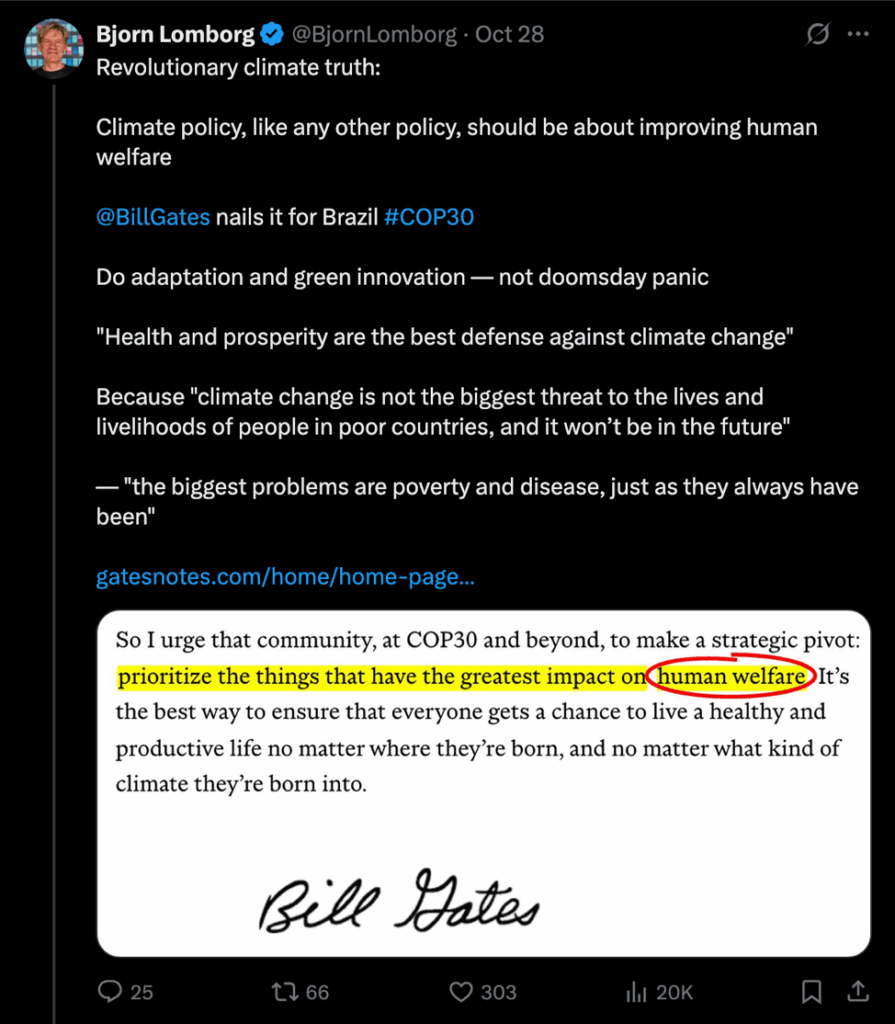
Bjorn Lomborg praises Bill Gates' climate memo in a tweet on X:"Revolutionary climate truth: "@BillGates nails it for Brazil #COP30"
Bjorn Lomborg praises Bill Gates’ climate memo in a tweet: “Revolutionary climate truth: @BillGates nails it for Brazil #COP30”

The Gates Foundation and the Copenhagen Consensus Center didn’t respond to a request for comment.

“He’s read some of my stuff”

In total, the Gates Foundation (formerly known as the The Bill & Melinda Gates Foundation) has donated $3,519,491 to Lomborg’s think tank. The most recent tax filing on record includes a 2022 donation to the Copenhagen Consensus Center worth $1.25 million, which went to support “community engagement grantmaking.”

Lomborg’s center credits the Gates Foundation with providing “financial support” for a 2021 report identifying development priorities for Africa. That report ranked climate solutions such as “resilience to drought” and “solar energy for unreliable grids” in the bottom third of a list of investment opportunities for the continent.

The report ranked objectives such as “family planning,” “R&D for agricultural yield increase,” and “tobacco control” at the top of the list. “All other things equal, the policies producing high returns should be funded before the ones with low return,” it noted.

Africa faces unfairly high costs to adapt to climate extremes, such as droughts, heatwaves, and floods, according to a 2024 World Meteorological Organization report.

The relationship between Lomborg and Gates goes back at least as far as 2014.

That year, DeSmog reported that Gates had published a blog post promoting Lomborg’s views. In the post, Gates argued that as rich countries “push to get serious about confronting climate change,” telling poorer countries not to rely on fossil fuels is wrong.

“For one thing, poor countries represent a small part of the carbon-emissions problem. And they desperately need cheap sources of energy now to fuel the economic growth that lifts families out of poverty. They can’t afford today’s expensive clean energy solutions, and we can’t expect them wait for the technology to get cheaper,” Gates wrote.

Alongside Gates’ 2014 post was a “GatesNotes”-branded video where Lomborg said it was “hypocritical” for the developed world to deny poor countries access to fossil fuels when so much of the developed world is still fueled on them. 

In the video, Lomborg can be seen climbing a staircase with the words “Fighting poverty with fossil fuels” painted behind him.

This GatesNotes video shows Lomborg climbing a rusty outdoor staircase against a brick and metal backdrop with the words "Fighting poverty with fossil fuels."
Bill Gates was featuring the work of climate crisis denier Bjorn Lomborg at least as far back as 2014. This GatesNotes video shows Lomborg against a backdrop with the words “Fighting poverty with fossil fuels.”

As recently as 2023, Lomborg co-authored a GatesNotes post with Gates arguing that the UN Sustainable Development Goals are “too much of a good thing” because they say the world is not “stepping up to fund all of them.”

In response to the October 28 Gates climate memo, Lomborg told Newsweek that “I’ve met with Mr. Gates himself several times. He’s read some of my stuff.” However, Lomborg did not directly take credit with influencing Gates’ views in the “Three Tough Truths about Climate” memo.

Deniers Celebrate Gates

Shortly after the memo’s release, U.S. President Donald Trump declared on his social media platform Truth Social: “I (WE!) just won the War on the Climate Change Hoax. Bill Gates has finally admitted that he was completely WRONG on the issue. It took courage to do so, and for that we are all grateful. MAGA!!!”

Trump is not alone in his celebration. Several long-time climate crisis deniers are cheering the statement from Gates, including Robert Bradley of the Institute for Energy Research, a nonprofit that attacks renewables and criticizes decarbonization plans.

Alex Epstein, who himself has cited Lomborg as an influence, said last week that “we should celebrate that Bill Gates has seen the light.” Epstein, the “fossil fuel philosopher” who helped shape the clean energy cuts in Trump’s domestic policy bill, claimed that Gates’ memo is in part a response to a Trump administration that “that is pro-fossil fuel and very anti-climate catastrophist.”

Gates’ backsliding on climate is not just words, it’s money and resources. For instance, in March, he made deep cuts to the climate policy staff of Breakthrough Energy, the “clean energy” organization he founded in 2015 and whose work he touted in his October 28 memo.

Explaining his “pivot” on climate change during an interview on CNBC, Gates said, “I’ll let the temperature go up 0.1 degree to get rid of malaria. People don’t understand the suffering that exists today.” Afterwards, Lomborg took to X to praise Gates, writing, “Exactly right!”
 
 Arguments like this have garnered sharp criticism from climate leaders.
 
Gates is wrong to frame climate change and human well-being as disconnected, zero-sum issues, argues climate scientist Katharine Hayhoe. “We are nowhere near maxing out investment in & implementation of [solutions] that benefit people, health, climate and nature at the same time,” the Texas Tech professor and chief scientist at The Nature Conservancy posted on Bluesky. “[The climate, pollution, and nature crises] are already actively amplifying poverty, hunger, and division.”

“There is no greater threat to developing nations than the climate crisis,” Michael Mann, University of Pennsylvania climate scientist, told CNN in response to the Gates memo. “He’s got this all backwards.” 


Original article by Rei Takver republished from DeSmog.

Elon Musk urges you to be a Fascist like him, says that you can ignore facts and reality then.
Donald Trump urges you to be a Climate Science denier like him. He says that he makes millions and millions for destroying the planet, Burn, Baby, Burn and Flood, Baby, Flood.
Nigel Farage urges you to ignore facts and reality and be a climate science denier like him and his Deputy Richard Tice. He says that Reform UK has received £Millions and £Millions from the fossil fuel industry to promote climate denial and destroy the planet.
Continue ReadingBill Gates Gave $3.5M to Think Tank Run by Climate Crisis Denier Bjorn Lomborg 

Nvidia Flogged AI for Brazilian Oil and Gas on Eve of COP30

Spread the love

Original article by Rei Takver republished from DeSmog.

Jensen Huang, CEO of Nvidia. A DeSmog collage. Credit: Simon Liu / Office of the President (Huang, CC-BY-2.0); Wikimedia Commons (Petrobas, CC-BY-SA-4.0); Wikimedia Commons (Nvidia, CC-Zero); Ivan Mlinaric (Amazon rainforest, CC-BY-2.0)

The tech giant was in Rio de Janeiro hawking AI software to fossil fuel firms just days before crucial climate crisis negotiations in the Amazon.

As world leaders prepared to descend on the small city of Belém in the Brazilian Amazon for the COP30 climate summit, artificial intelligence (AI) chip-manufacturer Nvidia was instead peddling its energy-guzzling AI tools to Brazilian oil and gas companies, DeSmog can reveal.

During the Offshore Technology Conference (OTC) in Rio de Janeiro last week, a gathering of over 23,000 oil and gas representatives, Nvidia sent a senior energy staffer to sell bespoke AI software to help oil giants dredge up ever-vaster troves of fossil fuels. Nvidia did so even though the tech giant markets itself as a creator of AI-driven climate crisis solutions, and has made the (contestedclaim that 100 percent of its prodigious electricity consumption comes from renewable sources.

The company’s Global Head of Subsurface Energy Solutions, Nefeli Moridis, who is on the board of the Society of Petroleum Engineers International, joined an OTC Conference panel on 29 October which discussed how to use AI to tackle the “biggest challenges” in offshore oil and gas operations – including “optimizing production.”

A promotional banner for an event at the 2025 Offshore Technology Conference (OTC) in Rio de Janeiro.

Credit: OTC Brasil / Linkedin

The panel also featured representatives from the tech giant Amazon Web Services (AWS), who talked about “why Brazil is uniquely positioned to lead the global offshore AI transformation”, alongside a senior figure from one of the conference’s “master sponsors” – Brazilian state-owned oil and gas company Petrobras.
 
Petrobras, which has already garnered criticism for accelerating its exploration of new oil and gas reserves ahead of COP30, was granted a new license in late October from the Brazilian government (also a master sponsor) to drill on the Amazon coast.

“What a great discussion! Robotics can – and will – be leveraged in offshore environments to push the boundaries of what’s possible,” Moridis promised on social media platform LinkedIn after speaking on the panel.

An event at the 2025 Offshore Technology Conference (OTC) in Rio de Janeiro.

Speakers included Otávio Ciriblli from Petrobras (far-right); Nefeli Moridis from Nvidia (third from left); Arno Van Den Haak, Amazon Web Services (second from right).

Credit: OTC Brasil / Linkedin

Nvidia’s decision to flog its technology to fossil fuel firms at the OTC Conference was not a one-off. The tech giant, which was recently crowned the world’s largest public company and donated $1 million to Donald Trump’s inauguration ceremony, has a long history of selling its wares to oil and gas companies.
 
On the “oil and gas operations powered by AI” page of its website, Nvidia celebrates its recent work developing an AI assistant for Saudi Aramco, a custom AI chatbot with expertise about chemicals for Shell, and an AI tool for Petrobras to “speedup… reservoir simulations”.

The contradiction between Nvidia’s climate claims and its courtship to oil and gas giants, particularly in the shadow of the upcoming COP30 negotiations, has sparked outrage among campaigners.
 
“This kind of hypocrisy undermines the credibility of tech companies heading into COP – they can’t present themselves as climate leaders while marketing AI to expand fossil fuel production,” said Holly Alpine, a former Microsoft employee turned campaigner for Enabled Emissions, which fights to stop big tech from enabling fossil fuel industry expansion.

Tech companies have been selling their services to the fossil fuel industry for a long time. A 2023 survey by consulting firm EY reported that 92 percent of fossil fuel companies are already using AI for their operations.

Nvidia’s Climate Contradictions

It is still unclear whether Nvidia will be attending COP30 – especially given the company’s increasing closeness to the administration of U.S. President Donald Trump, which has reversed American climate policy so dramatically that some experts are now calling the U.S. a “petrostate”.

The Trump administration has pulled out of attending COP in Brazil this year.

Nvidia, regardless of the company’s closeness to Trump, continues to trumpet its climate credentials.

Just a month ago at New York Climate Week, the world’s largest discussion of climate crisis solutions outside COP, Nvidia’s Head of Sustainability Joshua Parker spoke on a panel that celebrated the company’s “innovative climate technologies”, which Parker argued will “advance sustainability solutions at an unprecedented pace”.
 
The company has previously boasted that its products make “every day about Earth Day” by monitoring wildfires and extreme weather, on top of the energy efficiency of its chips.
 
Nvidia also had a presence at past COP summits. At COP29 in Baku, Azerbaijan, Nvidia sent its senior sustainability leader to sell the idea that “AI has the potential to make other sectors much more energy efficient”.
 
The previous year, at COP28 in Dubai, United Arab Emirates, Nvidia joined up with the Commonwealth Secretariat for a panel about using AI to support climate action in nations vulnerable to climate change, including to track sea level rise in countries like Tonga.
 
Its climate pledges are not without controversy. Nvidia’s claim that 100 percent of its electricity consumption in 2025 is powered by renewable energy was challenged by a report from Greenpeace in October that ranked Nvidia last among tech giants on the decarbonisation of its supply chain.

The Greenpeace report said that Nvidia relies on suppliers that use fossil fuels to power their operations, and criticised the company for failing to release data on how much electricity those suppliers use. In the 2025 fiscal year, Nvidia suppliers produced 6 million tonnes of CO2, according to Greenpeace – double what they produced just two years earlier.

Alpine goes further. “A company cannot claim to lead on climate while its technology drives the very emissions it vows to eliminate – or claim transparency while concealing those risks from shareholders,” she told DeSmog.

Nvidia was approached for comment.

Beyond Nvidia

This phenomenon goes well beyond Nvidia and COP30.

AWS and Microsoft, which fielded two of the OTC Conference’s AI panel speakers (the Microsoft representative did not ultimately attend), reportedly make vast sums from the fossil fuel industry.
 
A 2024 report by the group Amazon Employees for Climate Justice goes so far as to claim that by this year, AWS “could be making $9.6 billion annually from the oil and gas industry alone – about 10 percent of AWS revenue.”

Amazon is not hiding its work with these companies. In response to DeSmog, Amazon stated: “The energy industry should have access to the same technologies as other industries. We will continue to provide cloud services to companies in the energy industry to make their legacy businesses less carbon intensive and help them accelerate development of renewable energy businesses.”

As for Microsoft, documents viewed by The Atlantic last year suggest that oil and gas revenues may account for a market opportunity of $35 billion to $75 billion each year for the firm. Alpine told the Financial Times this may constitute up to half of the company’s cloud revenue.

Alpine’s campaign group, Enabled Emissions, argues that tech companies selling AI for fossil fuel expansion are causing “staggering emissions” by enabling increased oil and gas drilling with their software.

“AI isn’t neutral – it’s shaping the pace and scale of fossil fuel expansion,” Alpine told DeSmog.

AI at COP30

As the energy-intensity of the AI boom skyrockets, and big tech firms water down or even completely rescind their climate commitments, they are also reportedly shrinking from visibility at climate events.
 
Last year, the Financial Times reported that big tech firms had already begun stepping back from participation at COP29 compared to previous years.

On 28 October, Microsoft’s founder Bill Gates, a philanthropist worth an estimated $118 billion, wrote a memo addressed to COP30 attendees saying climate change won’t cause “humanity’s demise.”
 
Gates’s arguments in the memo have drawn outcries of dismay from some of the world’s top climate scientists, who have pointed out that “this memo is already being championed by those seeking to misinform and sow doubt about climate change and delay climate progress – up to and including the executive branch of the United States government.”
 
Whether big tech firms attend or not, COP30 is expected to involve discussions of the threats to climate change posed by the immense amounts of energy needed to fuel the global AI energy boom, as well as efforts to address the climate crisis using AI – an effort critics say is misguided.
 
“The fact is that the climate crisis is not primarily a technological problem: we have most if not all of the tech we need to fix it,” Adam Becker, science journalist and author, previously told DeSmog.
  
“Tech oligarchs think that they can burn fossil fuels with impunity and clean it up later with a magic wand given to them by a machine god. But that isn’t going to happen. The reality is that we need to save ourselves from the machinations of these cruelly myopic billionaires.”
 

Original article by Rei Takver republished from DeSmog.

Continue ReadingNvidia Flogged AI for Brazilian Oil and Gas on Eve of COP30

‘Inviting the Fox Into the Henhouse’: Canada Delegation to COP30 Loaded with Fossil Fuel Representatives

Spread the love

Original article by Taylor Noakes republished from DeSmog.

Fossil fuel lobbyists in the Canadian delegation include representatives of the Canadian Association of Petroleum Producers (CAPP), a lobby group that represents Canada’s oil and natural gas producers. Credit: C2C Journal

Delegation’s composition consistent with new KBPO report revealing this year’s U.N. climate talks have the largest number of fossil fuel lobbyists to date.

Lobbyists and representatives of Canada’s oil and gas industry are part of Canada’s official delegation to this year’s U.N. climate talks in Brazil, in keeping with the high number of fossil fuel representatives in attendance at the summit. 

About a dozen individuals representing fossil fuel interests were part of the 240-person Canadian delegation, according to documents reviewed by DeSmog as well as a Nov. 12 Canadian Press article.  

“Fossil fuel lobbyists have no place at the U.N. climate negotiations,” Emilia Belliveau, program manager of energy transition with Environmental Defence, said in a statement to DeSmog.

“Their presence here with official badges from Canada undermines the work of Canadians attending COP30 who are genuinely working to advance climate action,” she said. 

This year’s U.N. climate talks have the single largest share of fossil fuel lobbyists in attendance to date. Some 1,600 people — or one out of every 25 attendees — are fossil industry or related lobbyists, according to an analysis by Kick Big Polluters Out (KBPO), an alliance of climate and justice organizations that push to remove fossil fuel companies and their lobbyists from influencing climate negotiations and policymaking.

The presence of so many Canadian fossil fuel sector representatives exemplifies the report’s findings.
 
“It demonstrates the extent by which the current government is aligned with oil industry interests,” Patrick Bonin, the Bloc Québécois’ environment and climate change critic, said in a statement to DeSmog. 

“The oil and gas industry is the biggest lobby in Canada,” Bonin continued, “so it’s like inviting the fox into the henhouse … Giving them access to the delegation gives them far greater influence than regular participants.” 

Fossil fuel lobbyists in the Canadian delegation include representatives of the Canadian Association of Petroleum Producers (CAPP), a lobby group that represents Canada’s oil and natural gas producers; Tourmaline Oil, Canada’s largest natural gas producer; CarbonAi; the International Emissions Trading Association (IETA), the Global CCS Institute; and the gas industry advocacy group Energy for a Secure Future.

Huge Industry Presence

KBPO’s analysis reveals that fossil fuel lobbyists at COP30 outnumber every national delegation except for Brazil, the host country. The number of lobbyists also represents a 12 percent increase over last year’s COP conference held in Baku, Azerbaijan.

Fossil fuel lobbyists received two-thirds more passes to COP30 than the total number of delegates from the 10 most climate-affected nations on Earth, the KBPO report said. This highlights “how industry presence continues to dwarf that of those on the frontlines of the climate crisis,” KBPO said in a statement that accompanied the report’s release.

The influence of major trade associations at COP30 is palpable, with the IETA bringing 60 representatives, including delegates from oil and gas giants ExxonMobil, BP, and TotalEnergies. These associations are “a primary vehicle for fossil fuel influence, according to a KBPO statement.  

Kathleen Sullivan, global managing director with IETA, is in the COP30 Canadian delegation. It also includes Jay Averill, assistant vice president of communications with CAPP; Scott Volk and Tim Shaw of Tourmaline Oil; and Todd Smith, Ontario’s former energy minister who advocated for an expansion of nuclear power. Smith left office in August 2024 to become vice president of marketing and business development with CANDU Energy Inc., a manufacturer of nuclear reactors.

The Canadian delegation also includes several representatives from Energy for a Secure Future, a lobby group that advocates for continued fossil fuel use to ensure “energy affordability.” The group states on their website that “our gas energy can respond to the needs of our friends around the world who are facing punishing energy costs and are left with options that drive up global emissions.”

Canadian “Carbon Bombs”

However, Canada’s natural gas industry is a major contributor of rising global emissions. The nation’s natural gas resources have been described as “carbon bombs” for their potential to release billions of tonnes of CO2 into the atmosphere, according to a 2024 DeSmog article.

“The spectacle of Canada’s COP delegation [serving as] a Trojan horse for fossil fuel interests like Tourmaline and the CAPP is shocking,” said James Browning, executive director of F Minus, a climate accountability group. F Minus recently issued a report detailing numerous conflicts of interest that have resulted from Canadian environmental organization sharing lobbyists who also serve major polluters.
 
 “Lobbying decisionmakers in secret is really just another day at the office for these climate denialists, given the failure of Canada’s lobbyist disclosure system to fully capture the extent of their dealings with Canadian officials,” Browning said in a statement to DeSmog. 

“COP may be 5,000 kilometres away, but the deeper scandal here is that Tourmaline’s and CAPP’s lobbyists enjoy a similar, extraordinary level of secrecy in their meetings with government officials every day in Ottawa,” he said.

CAPP has misled the public about emissions from Canada’s oil and gas sector, and has  campaigned against anti-greenwashing laws. Heather Feldbusch, one of Pierre Poilievre’s campaign’s inner circle, was formerly a lobbyist with Alberta Counsel Inc., which represents Tourmaline.

“At the COP negotiations two years ago, governments took a historic step by committing to transition away from fossil fuels in energy systems in a just, orderly, and equitable manner,” Keith Stewart, senior energy strategist with Greenpeace Canada, said in a statement to DeSmog. “By including fossil fuel lobbyists in our official delegation, Canada is undermining that global effort and risks being seen as negotiating in bad faith.” 

“CAPP has been fighting against effective climate action for decades and should be shown the door, not the red carpet,” he added.

Another organization with a stake in fossil fuels included in the Canadian delegation is the Global CCS Institute, a carbon capture advocacy group based in Australia. Critics have long argued that carbon capture is an expensive false solution designed to give fossil fuel production an air of social acceptability. Canadian Prime Minister Mark Carney has used the term “low carbon oil” in reference to carbon capture, despite experts arguing that the term is nonsense.

“Inviting fossil fuel lobbyists into global climate negotiations is as misguided as letting the tobacco industry write health policy, and Canada is compounding the problem by weakening its own greenwashing rules” Sabaa Khan, director general, Quebec and Atlantic Canada, with the David Suzuki Foundation, said in a statement to DeSmog.

DeSmog reached out to Keean Nembhard, press secretary for Canadian environment minister Julie Dabrusin, but did not receive a statement by press time.

Original article by Taylor Noakes republished from DeSmog.

Continue Reading‘Inviting the Fox Into the Henhouse’: Canada Delegation to COP30 Loaded with Fossil Fuel Representatives

50,000 March in Brazil to Celebrate Death of Fossil Fuel Industry at COP30

Spread the love

Original article by Jon Queally republished from Common Dreams under Creative Commons (CC BY-NC-ND 3.0).

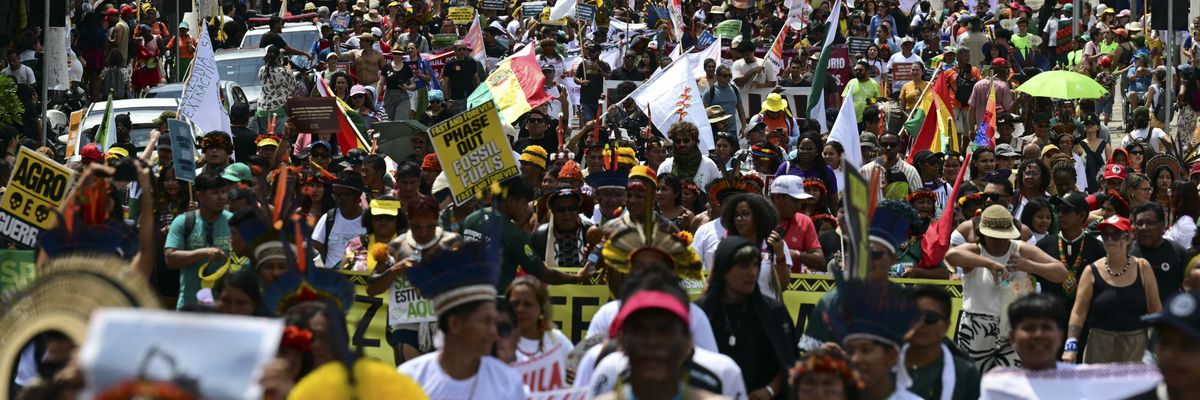
Thousands of people take part in the so-called “Great People’s March” in the sidelines of the COP30 UN Climate Change Conference in Belem, Para State, Brazil on November 15, 2025. Tens of thousands of people attended the march to demand “real solutions” to human-caused global warming , and which comes at the halfway point of contentious COP30 negotiations following two Indigenous-led protests that disrupted proceedings earlier in the week. (Photo by Pablo Porciuncula / AFP via Getty Images)

“It is time to put these old fuels where they belong—in the ground of history.”

An estimated 50,000 people took to the streets of Belém do Pará, Brazil, on Saturday to demonstrate outside the halls of the United Nations annual climate summit, holding a “Great People’s March” and makeshift “Funeral for Fossil Fuels” as they demanded a just transition toward a more renewable energy system and egalitarian economy.

Organized by civil society organizations and Indigenous Peoples groups from Brazil and beyond, the tens of thousands who marched outside the thirtieth Conference of the Parties (COP30) summit called for an end to the rapacious greed of the oil, gas, and coal companies as they advocated for big polluters to pay for the large-scale damage their businesses have caused worldwide over the last century.

“We are tens of thousands here today, on the streets of Belém, to show negotiators at COP30 that this is what people power looks like,” said Carolina Pasquali, executive director of Greenpeace Brazil, said as the march took hold. “Yesterday we found out that one in every 25 COP30 participants is a fossil fuel lobbyist, proportionally a 12% increase from last year’s COP. How can the climate crisis be solved while those creating it are influencing the talks and delaying decisions? The people are getting fed up–enough talking, we need action and we need it now.”

The report by the Kick Big Polluters Out coalition last week showed that at least 1,600 lobbyists from the fossil fuel industry are present at the conference, making it the second-largest delegation overall, second only to Brazil’s, the host nation.

“It’s common sense that you cannot solve a problem by giving power to those who caused it,” said Jax Bongon from the Philippines-based IBON International, a member of the coalition, in a Friday statement. “Yet three decades and 30 COPs later, more than 1,500 fossil fuel lobbyists are roaming the climate talks as if they belong here. It is infuriating to watch their influence deepen year after year, making a mockery of the process and of the communities suffering its consequences.”

While the overwhelming presence of fossil fuel lobbyists has once again diminished hopes that anything worthwhile will emerge from the conference, the tens of thousands in the streets on Saturday represented the ongoing determination of the global climate movement.

João Talocchi, co-founder of Alianza Potência Energética Latin America, one of the key groups behind the “Funeral for Fossil Fuels” portion of the day’s action—which included mock caskets for the oil, gas, and coal companies alongside parades of jungle animals, wind turbines, and solar panels representing what’s at stake and the better path forward—noted the key leadership of Indigenous groups from across the Global South.

“From the Global South to the world, we are showing what a fair and courageous energy transition must look like,” said Talochhi.

Ilan Zugman, director of 350.org in Latin America and the Caribbean, noted the significance of the demonstration, including the symbolism of the funeral procession.

“We march symbolically burying fossil fuels because they are the root of the crisis threatening our lives,” explained Zugman. “Humanity already knows the way forward: clean energy, climate justice, and respect for the peoples who protect life. What is missing is political courage to break once and for all with oil, gas, and coal. It is time to put these old fuels where they belong—in the ground of history.”

With the COP30 at its midway point, climate activists warn that not nearly enough progress is being made, with the outsized influence of the fossil fuel industry one of the key reasons that governments, year after year and decade after decade, continue to drag their feet when it comes to taking the kind of aggressive actions to stem the climate crisis that scientists and experts say is necessary.

“We are taking to the streets because, while governments are not acting fast enough to make polluters pay for their climate damages at COP30, extreme weather events continue to wreak havoc across the globe,” said Abdoulaye Diallo, co-head of Greenpeace International’s “Make Polluters Pay” campaign. “That is why we are here, carrying the climate polluters bill, showing the projected economic damages of more than $5 trillion from the emissions of just five oil and gas companies over the last decade.”

“Fossil fuel companies are destroying our planet, and people are paying the price,” said Diallo. “Negotiators must wake up to the growing public and political pressure to make polluters pay, and agree to new polluter taxes in the final COP30 outcome.”

Original article by Jon Queally republished from Common Dreams under Creative Commons (CC BY-NC-ND 3.0).

Continue Reading50,000 March in Brazil to Celebrate Death of Fossil Fuel Industry at COP30

With US ‘Paying the Price for Trump’s Mistakes,’ He Ends Tariffs for Bananas, Beef, Coffee, and More

Spread the love

Original article by Jessica Corbett republished from Common Dreams under Creative Commons (CC BY-NC-ND 3.0).

Shoppers browse produce at Sabor Tropical Supermarket in Miami Beach, Florida on July 23, 2022. Photo by: Jeffrey Greenberg/Universal Images Group via Getty Images

Although President Donald Trump didn’t actually confess that his global trade war is driving up the cost of groceries for Americans, he did finally drop his dubiously named “reciprocal” tariffs on key imports on Friday.

According to a White House fact sheet, Trump’s new executive order ends his tariffs on beef; cocoa and spices; coffee and tea; bananas, oranges, and tomatoes; other tropical fruits and fruit juices; and fertilizers.

The New York Times had reported Thursday that “the Trump administration is preparing broad exemptions to certain tariffs in an effort to ease elevated food prices that have provoked anxiety for American consumers.”

The reporting drew critiques of the administration’s economic policies, including from members of Congress such as Senate Finance Committee Ranking Member Ron Wyden (D-Ore.), who said that “Trump just admitted it: Americans are footing the bill for his disastrous tariffs.”

“While this move may alleviate some of the cost increases Trump caused, it will not stop the larger problems of rising inflation, business uncertainty, and economic damage done by Trump’s crazy tariff scheme.”

Also responding to the Times reporting, Sen. Elizabeth Warren (D-Mass.) wrote on social media Friday: “After months of increasing grocery prices, Donald Trump is finally admitting he was wrong. Americans are literally paying the price for Trump’s mistakes.”

More lawmakers and other critics piled on after Trump issued the order. CNN‘s Jim Sciutto said: “Trump administration now acknowledging what economists and business leaders have told us from the beginning: that tariffs are driving up prices.”

MeidasTouch and its editor in chief, Ron Filipkowski, also called out the president on social media, with the outlet sarcastically noting, “But Trump said his tariffs don’t raise prices.”

https://embed.bsky.app/embed/did:plc:t6ubj2wlhc34awzcymh3qpur/app.bsky.feed.post/3m5mrgzllz22t?id=8128174723413667&ref_url=https%253A%252F%252Fwww.commondreams.org%252Fnews%252Ftrump-food-tariff&colorMode=system

OR, Trump Admits His Tariffs Caused Grocery Prices to Rise.

Ron Filipkowski (@ronfilipkowski.bsky.social) 2025-11-14T22:52:26.406Z

Congressman Don Beyer (D-Va), who serves on the House Ways and Means Subcommittee on Trade, said in a Friday statement that “President Trump is finally admitting what we always knew: His tariffs are raising prices for the American people.”

“After getting drubbed in recent elections because of voters’ fury that Trump has broken his promises to fix inflation, the White House is trying to cast this tariff retreat as a ‘pivot to affordability,’” Beyer said, referencing Democrats who won key races last week, from more moderate Mikie Sherrill and Abigail Spanberger, the incoming governors of New Jersey and Virginia, to democratic socialist Mayors-elect Zohran Mamdani of New York City and Katie Wilson of Seattle.

In addition to those electoral victories for Democrats, last week featured a debate over Trump’s trade war at the US Supreme Court. According to Beyer: “The simple truth is that Republicans want credit for something they think the Supreme Court will force them to do anyway, after oral arguments before the court on Trump’s illegal abuses of trade authorities went badly for the administration. Trump is still keeping the vast majority of his tariffs in place, and his administration is also planning new tariffs in anticipation of a Supreme Court loss.”

“The same logic—that Trump’s tariffs are driving up prices on coffee, fruit, and other comestibles—is equally true for the thousands of other goods on which his tariffs remain,” he continued. “While this move may alleviate some of the cost increases Trump caused, it will not stop the larger problems of rising inflation, business uncertainty, and economic damage done by Trump’s crazy tariff scheme.”

“Only Congress can do that, by reclaiming its legal responsibility under the Constitution to regulate trade, and permanently ending Trump’s trade war chaos,” he stressed. “All but a handful of Republicans in Congress are still refusing to stand up to Trump, stop his tariffs, and lower costs for the American people, and unless they find a backbone, our economy will continue to suffer.”

https://embed.bsky.app/embed/did:plc:qxudeqrdbv6676vzjssrhllo/app.bsky.feed.post/3m5mrcrvkp22m?id=3415354401869237&ref_url=https%253A%252F%252Fwww.commondreams.org%252Fnews%252Ftrump-food-tariff&colorMode=system

Huh. Trump dropped the tariffs on coffee, beef, and tropical fruit to LOWER PRICES. I thought other countries paid for those?

Angry (@angrystaffer.bsky.social) 2025-11-14T22:50:04.132Z

As the Associated Press noted Friday, “The president signed the executive order after announcing that the U.S. had reached framework agreements with EcuadorGuatemalaEl Salvador, and Argentina designed to ease import levies on agricultural products produced in those countries.”

Trump’s order also came just a day after Democrats on the congressional Joint Economic Committee released a report showing that US families are paying roughly $700 more each month for basic items since Trump returned to office in January—with households in some states, such as Alaska and California, facing an average of over $1,000 monthly.

The president has floated sending Americans a $2,000 check, purportedly funded by revenue collected from his tariffs, but as Common Dreams reported Wednesday, economist Dean Baker of the Center for Economic and Policy Research crunched the numbers and found that the proposed “dividend” doesn’t add up.

Original article by Jessica Corbett republished from Common Dreams under Creative Commons (CC BY-NC-ND 3.0).

Orcas discuss how Trump was re-elected and him being an obviously insane, xenophobic Fascist.
Continue ReadingWith US ‘Paying the Price for Trump’s Mistakes,’ He Ends Tariffs for Bananas, Beef, Coffee, and More