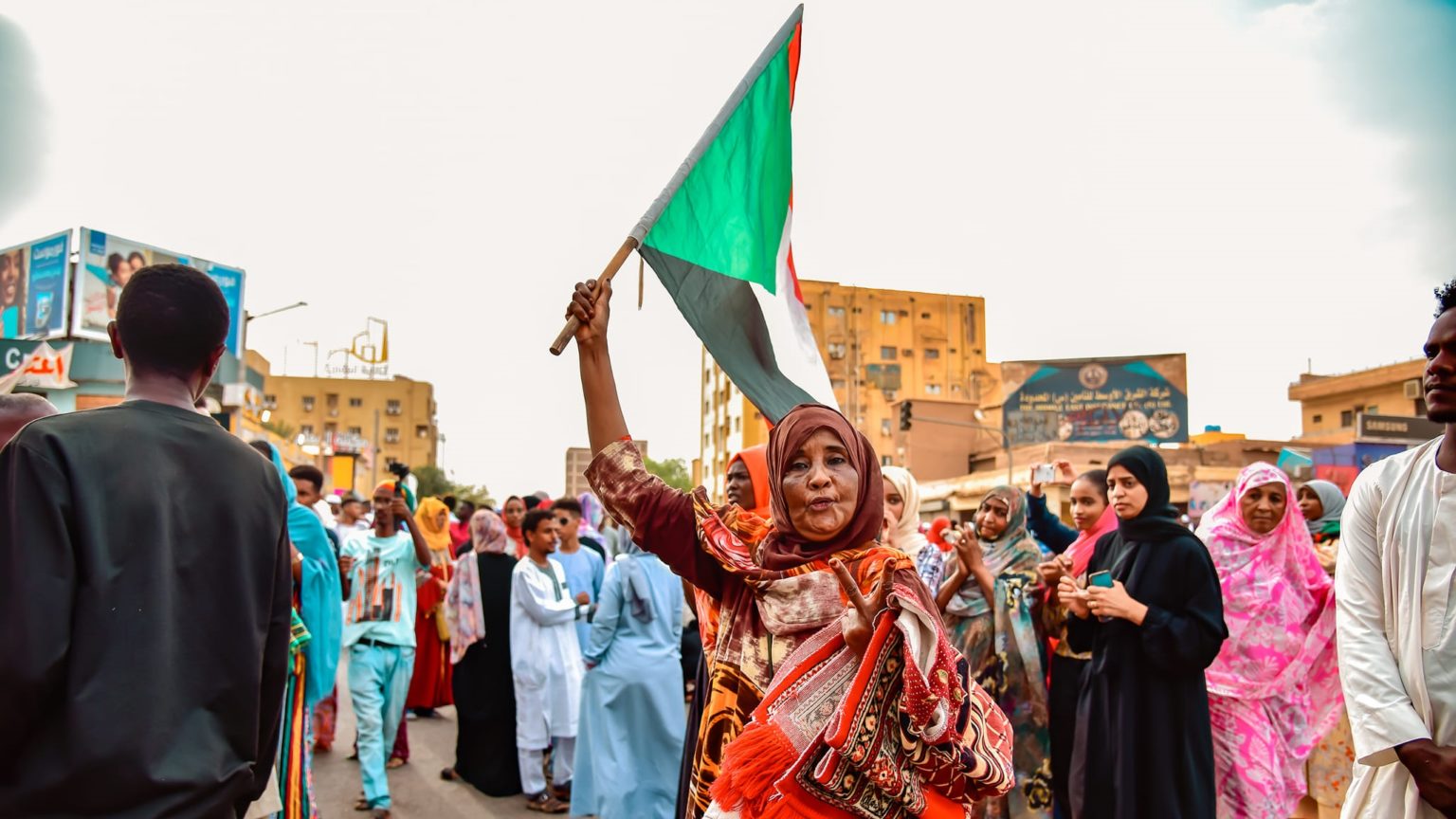
Popular organizations and movements across Africa and beyond have condemned the ongoing massacre of the Sudanese people by the Rapid Support Forces (RSF), calling for an immediate end to the violence. Urging support for the Sudanese people’s struggle for peace, justice, and democratic self-determination.
Across Africa and the world, progressive and popular organizations are raising their voices in solidarity with the people of Sudan, as they face one of the most brutal and protracted conflicts in the world today. From Ghana to South Africa, from international networks to grassroots movements, the message is unified in a call to end the massacres, open humanitarian corridors, and uphold the Sudanese people’s struggle for justice, peace, and sovereignty.
Amid mounting international condemnation for its war crimes, especially over the last several weeks, the Rapid Support Forces (RSF) have reportedly agreed to a three-month pause in the fighting. However, analysts and activists argue that the “humanitarian ceasefire” is far from a solution to the two-and-a-half-year war.
The Socialist Movement of Ghana (SMG) condemned the “genocidal conflict between factions of the militarized elite” that has terrorized the people of Sudan since 2023. In their statement, the movement expressed solidarity with the Sudanese people and their popular organizations, including the Sudanese Communist Party (SCP), lauding their courage and political clarity in the face of devastation.
The SMG statement described the war between the Sudanese Armed Forces (SAF) and the RSF as a tragic consequence of elite rivalries and foreign interference. It denounced the “murky transnational corporate and resource-grabbing agenda of the United States, Western powers, and some Arab and East African countries” fueling the conflict.
“The people of Sudan clearly reject both warring factions and any national ‘solution’ based on military force or elite interests,” SMG declared, reaffirming that Sudan’s revolution, born out of the people’s 2018 uprising, continues to embody the demand for democracy, justice, and full sovereignty over national resources.
The International Peoples’ Assembly (IPA) and Pan Africanism Today (PAT) also issued a joint statement condemning the “brutal massacres currently unfolding in Sudan,” particularly in El-Fasher, Bara, Darfur, and Kordofan, describing the atrocities as genocide. They called for immediate international mobilization, demanding a ceasefire, protection of civilians, and independent investigations into war crimes.
“The Sudanese people face a destructive war machine, defending their dignity, communities, and right to live,” the statement read. It called upon trade unions, women’s movements, youth, and social movements worldwide to stand with Sudan through coordinated actions, educational events, and artistic expressions of solidarity.
Joining this call, South Africa’s Abahlali baseMjondolo Movement, representing shack dwellers and grassroots activists, issued a solidarity statement denouncing the ongoing massacres in El-Fasher and Darfur. The movement condemned the RSF’s atrocities; executions, mass killings, and the starvation of entire communities, financed by the United Arab Emirates and sustained by European complicity in migration control.
“The uprising that began in December 2018 was a democratic revolt of workers, women, students and the urban poor,” Abahlali’s statement reminded. “That uprising gave rise to new grass-roots forms of democracy through the resistance committees, which continue to provide food, medicine, and mutual aid amid war.”
Sudan’s struggle is our struggle. As the Socialist Movement of Ghana declared:
“Let us stand for unity, sovereignty, and development. Sudan’s struggle is Africa’s struggle.”
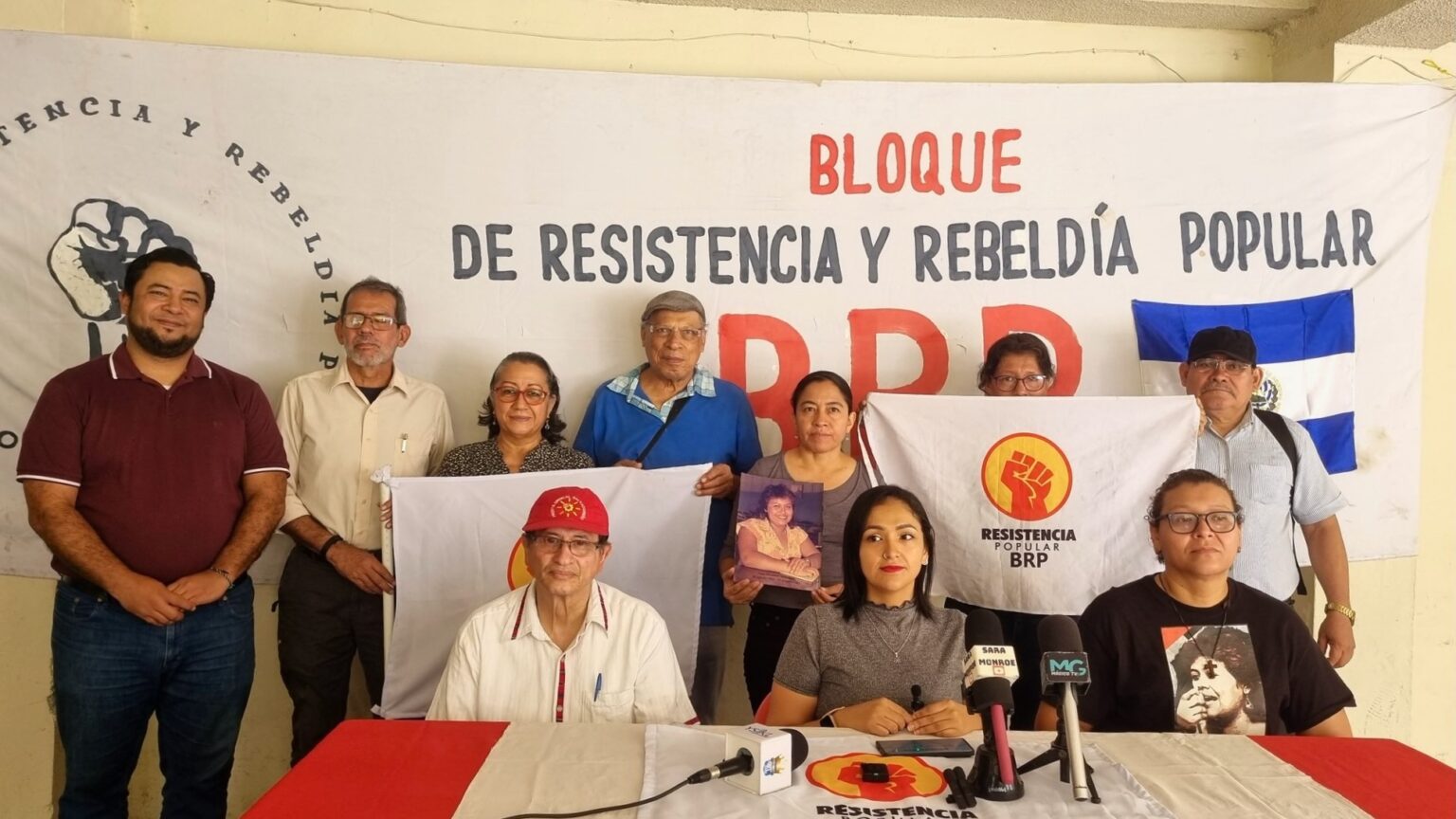
Organizers hold flags and a photo of labor martyr Febe Elizabeth Velasquéz during a press conference on the commemoration of the Day of the Salvadoran Trade Unionist. Photo: BRRP/X
The October 31 commemoration links past revolutionary struggles with today’s fight for labor rights and democracy
October 31 in El Salvador is recognized as the Day of the Salvadoran Trade Unionist.
This year’s commemoration event brought together veteran organizers and a new generation of grassroots leaders, bridging past and present struggles for workers’ rights and social change.
“This date brings us back to the origin of labor organizing in our country,” asserted Marisela Ramírez, a leader of the Popular Resistance and Rebellion Bloc, at the rally at Cuscatlán Park in San Salvador, organized by the group.
“We remember with dignity, the history of struggle, resistance, and sacrifice, of the labor movement in El Salvador.”
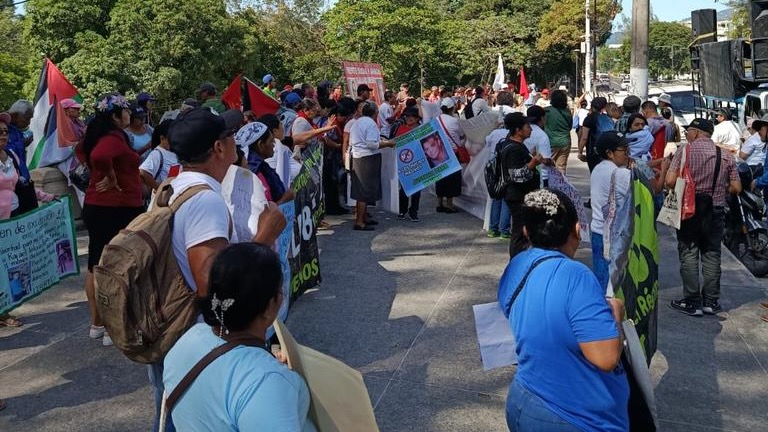
A few hundred people gathered with placards, flags, and banners representing various organizations, like the Salvadoran Social and Labor Front (FSS), the Permanent Roundtable for Labor Justice, the Movement of Victims of the Regime (MOVIR), and others.
Ramírez outlined the legacy that the day is tied to: the historic strikes of the 40s and 50s, the struggles for the 8-hour workday, for fair wages, and for the right to unionize. The event also paid tribute to “the thousands of women and men who, during the repression of the 70s and 80s, sacrificed their lives to defend justice and the dignity of the working class” against the US-backed Salvadoran government.
The Day of the Salvadoran Trade Unionist was established by Legislative Decree 589 (1990). It specifically honors the leaders of the National Union Federation of Salvadoran Workers (FENASTRAS) that were bombed by government forces on October 31, 1989.
Friday’s commemoration paid homage to prominent labor figure Febe Elizabeth Velasquéz and the nine other leaders martyred in the attack on the country’s principal organized labor front at the time.
A legacy of revolutionary struggle
The country’s trade groups have a long history of tying labor organizing to social change. These connections can be traced back to the formation of the Communist Party in 1930. Similarly, many of the 1989 FENASTRAS martyrs were affiliated with the National Unity of Salvadoran Workers (UNTS), the main federation tied to the popular movement aligned with the left guerilla force, the Farabundo Martí National Liberation Front (FMLN).
Legislative Decree 589 (1990) came two years before the 1992 Peace Accords, which officially ended the 12-year war between the FMLN (Farabundo Martí National Liberation Front) and the US-backed Salvadoran state.
By 1990, faced with continued armed opposition and a popular movement (made up of unions, student groups, and peasant associations) that had endured heavy repression, the Salvadoran government was under tremendous pressure to negotiate and recognize the legitimacy of the country’s social movements.
The deadly attack on FENASTRAS’ headquarters was a major factor in this outcome. Less than two weeks after the massacre, the FMLN would launch their historic final offensive, named in honor of the martyred union leader: “To the Limit, Period. Febe Elizabeth Lives”.
The Salvadoran military responded with intense fighting and indiscriminate aerial bombardment of residential neighborhoods, allegedly to dislodge the guerilla fighters. One US-trained Atlacatl Battalion unit stormed the Central American University (UCA) campus and murdered six Jesuit priests. The priests were known to advocate for a negotiated settlement to the conflict and spoke out against the military’s human rights abuses. The government and military claimed they were the “brain of the guerilla”.
International condemnation of the Salvadoran government grew louder than ever.
The FMLN was ultimately forced to retreat from the cities, but not before making it clear that a decisive military victory for the government was impossible. Negotiations became inevitable.
Decree 589 (1990) represented one of the first concessions by the state. It opened democratic space and acknowledged the sacrifices of trade unionists persecuted, imprisoned, or killed over the previous decade for their association with the revolutionary left. The FENASTRAS bombing and the martyrdom of Febe Elizabeth Velásquez was etched in history as the Day of the Salvadoran Trade Unionist.
Following these events, the power of the revolutionary movement and organized labor in El Salvador would completely restructure politics in the country through key democratic reforms signed into law in the 1992 Peace Accords.
Historical continuity and labor setbacks under Bukele
At the rally at Cuscatlán Park, the Bloc emphasized that this day is not only about remembrance, but also historical continuity: “the defense of labor rights today is part of the same battle for social justice that those martyrs defended with their lives,” Marisela Ramírez proclaimed.
The event’s organizers asserted that today, the Salvadoran trade unionist faces a new wave of “persecution and criminalization” by the “authoritarian regime of Nayib Bukele”.
“This regime has imposed a neoliberal and anti-union model that intends to eliminate all forms of independent organizing that defends labor rights,” says the Bloc leader.
The group has consistently denounced a systematic weakening of union structures by the Bukele regime. They claim that recently, dozens of union members have suffered arbitrary arrests, threats, and terminations without justification. Over 200 unions have been denied credentials.
Despite the increasing attacks, Ramírez tells Peoples Dispatch that the historic spirit of resistance in the Salvadoran labor movement is still alive.
“Just as before, today we see unionism as a collective and solidarity-based struggle, not only for economic improvements, but also for social transformation and justice,” she says.
Several Palestine flags were visible throughout the crowd, as well as placards that read “Respect our rights!” and “Freedom for political prisoners!” Some had photos of young men imprisoned or disappeared, asserting their innocence. Several placards displayed the image of Febe Elizabeth Velasquéz. Others, the image of Óscar Romero, the Archbishop of San Salvador, assassinated by government forces in 1980 after calling on the soldiers to disobey their orders amid escalating violence and massacres of civilians.
Commemoration event for the Day of the Salvadoran Trade Unionist. Photo: BRRP
“The impunity of yesterday is the impunity of today,” she declared.
“The only way to resist the impunity, the social injustice that we’re living under is through social struggle. We have to continue taking the streets and raising our voices.”
Rebuilding the labor movement in Bukele’s El Salvador
Ramírez says that what is lacking in the Salvadoran left is a political instrument that can “capture the discontent of the popular sectors and channel their demands towards a strategic commitment to social transformation.”
Amid Bukele’s “state of exception”, the challenge the new generation faces, she argues, is that of rebuilding and revitalizing Salvadoran trade unionism. Not just the infrastructure itself but the values and culture of historic movements. The new generation must promote “the active participation of women and young people in a process of organizational and ethical renewal that can re-articulate the labor struggles with broader social causes,” Ramírez says.
The Popular Resistance and Rebellion Bloc recently held a mass march on September 15, El Salvador’s Independence Day. It mobilized its various affiliated organizations, trade unions, civil society groups, and the general public against the human rights violations of the Bukele government.
September 15 mass march in El Salvador. Photo: BRRP
A new generation may be doing just that: revitalizing the historic struggles of the Central American country.
As resistance grows once again, organizers across generations maintain that commemorations like the Day of the Salvadoran Trade Unionist are crucial in giving shape, identity, and historical memory to the social movements of today.
The labor leaders targeted in the October 31, 1989 FRENASTRAS bombing are the following:
Febe Elizabeth Velásquez – General Secretary of FENASTRAS and member of the National Unity of Workers (UNTS); killed.
Ricardo Humberto Cestoni – Recording Secretary of the ANDA Workers’ Company Union (SETA); killed.
Rosa Hilda Saravia de Elías – Member of the Union of Workers of the Cotton, Synthetic, Textile Finishing and Related Industries (STITAS); killed.
Julia Tatiana Mendoza Aguirre – Member of the Gastronomic Union (STITGASC); killed.
Vicente Melgar – Secretary of Social Assistance of SETA; killed.
José Daniel López Meléndez – Member of SETA and Secretary of Conflicts of FENASTRAS; killed.
Luis Gerardo Vásquez – Member of the General Union of Bank Employees (SIGEBAN); killed.
María Magdalena Sánchez – FENASTRAS member; killed.
Carmen Hernández – FENASTRAS member; killed
Unidentified male worker – Died later from injuries sustained in the explosion
Zohran Mamdani votes on November 4 with his wife, Rama Duwaji (Photo via @ZohranKMamdani)
Cuomo concedes and conservatives lash out in fury; A rattled right-wing political class confronts a new era in New York, and the United States
Socialist Zohran Mamdani became the mayor-elect of New York City on November 4, winning with just over 50% of the vote (at the time of this writing, 93% of votes have been counted). Former governor Andrew Cuomo, who had already lost to Mamdani in the June Democratic Party primary, received 41.6% of the vote. Republican Party candidate Curtis Sliwa received just over 7% of the vote. Mamdani’s win was called by the Associated Press less than an hour after polls closed in New York City on November 4.
Thanking billionaire ex-mayor and campaign donor Michael Bloomberg, disgraced former governor Andrew Cuomo conceded defeat to upstart socialist Zohran Mamdani.
“This campaign was to contest the philosophies that are shaping the Democratic Party, the future of this city, and the future of this country,” Cuomo outlined at his election-night party in Midtown Manhattan. Cuomo warned that “we are heading down a dangerous, dangerous road,” preaching against divisiveness, despite being attacked by progressives for running racist advertisements against his opponent.
In Mamdani’s own victory speech, the socialist mayor-elect was not shy to call out Cuomo directly. “I wish Andrew Cuomo only the best in private life. But let tonight be the final time I utter his name, as we turn the page on a politics that abandons the many and answers only to the few,” Mamdani said, addressing the crowd at his watch party at the Brooklyn Paramount Theatre in downtown Brooklyn.
Mamdani also addressed Trump in his speech: “Donald Trump, since I know you’re watching, I have four words for you: Turn the volume up.”
Right-wing racism in full swing
Reactions from notorious right-wing figures poured in immediately. Former New York mayor Rudy Giuliani, a conservative embroiled in scandal alongside Trump for alleged attempts to overturn the 2020 presidential election, said live on NEWSMAX that Mamdani’s win “breaks my heart.”
“Forget that he’s a communist,” Giuliani asserted. “He’s also a supporter of extremist Islamic terrorism.”
The Trump administration reacted with similar levels of malice and racism. Top Trump advisor Stephen Miller, and architect of Trump’s immigration policy, tweeted out a photo with no context at 10:08 pm on election night. The photo was a screenshot of a page on the official New York City government website, describing how “almost 50 percent of New Yorkers live in family households with at least one immigrant” – a post which could be seen to imply that immigration, legal or otherwise, are contributing to the problems that conservatives like Miller see with the recent election outcome. Such an assertion comes only weeks after a high-profile ICE raid in New York City’s Chinatown generated outrage nationwide.
Trump issued a slew of posts on his social media platform, Truth Social, leading up to Mamdani’s victory, condemning the socialist candidate and issuing a reluctant endorsement to former political rival Andrew Cuomo. The following day, however, Trump’s only possible reference to Mamdani was an anniversary post celebrating his own electoral win last year, in which he referenced that “Affordability is our goal.” Mamdani had made the sky-high cost of living in New York City the centerpiece of his platform.
Democratic establishment issues lukewarm response
Some establishment Democrats have thus far issued no statement on Mamdani’s victory at all. Senate minority leader Chuck Schumer, a Brooklyn resident and the Senator from Mamdani’s own state of New York put out a short statement congratulating Mamdani on his win and saying he looks forward to working with the new mayor-elect. Notably, he did not state who he voted for and never formally endorsed Mamdani during the race.
House minority leader Hakeem Jeffries issued a last-minute endorsement of Mamdani on October 24 after repeatedlydodging press questions on the issue. Following Mamdani’s victory, Jeffries issued no direct congratulations, only a vague statement that “Donald Trump and Republicans haven’t done a damn thing to lower the high cost of living” and that “working class Americans know it.”
In this photo illustration, the age-restriction warning screen of the website PornHub is displayed on two digital screens, in London, England [Leon Neal/Getty Images]
The Online Safety Act, sold as child protection, now hides Gaza’s suffering, silences dissent and exports censorship to the world.
The United Kingdom’s Online Safety Act was meant to keep children safe. Instead, it is keeping the public uninformed. Within days of the law taking effect in late July 2025, X (formerly Twitter) started hiding videos of Israel’s atrocities in Gaza from UK timelines behind content warnings and age barriers. A law sold as safeguarding has become one of the most effective censorship tools Britain has ever built. What is unfolding is no accident. It is the result of legislation that weaponises child-protection rhetoric to normalise censorship, identity verification and online surveillance.
The roots of Britain’s online censorship crisis go back almost a decade, to MindGeek, now rebranded as Aylo, the scandal-ridden company behind Pornhub. This tax-dodging, exploitative porn empire worked closely with the UK government to develop an age-verification system called AgeID, a plan that would have effectively handed Aylo a monopoly over legal adult content by making smaller competitors pay or perish. Public backlash killed AgeID in 2019, but the idea survived. Once one democracy entertained the notion that access to online content should be gated by identity checks, the precedent was set. The Digital Economy Act 2017 laid the groundwork, and the Online Safety Act 2023 made it law. Today, several European Union states, including France and Germany, are exploring similar legislation, each cloaked in the same rhetoric of “protecting children”. This is not conspiracy; it is the natural convergence of corporate capture and state control, wrapped in the moral language of child safety.
The Online Safety Act empowers Ofcom to police almost every corner of the internet, from social media and search engines to adult content platforms, under threat of fines of up to 18 million pounds ($24m) or 10 percent of global revenue. Platforms can be designated as “Category 1” services, triggering the harshest rules, including mandatory age verification, identity checks for contributors and the removal of vaguely defined “harmful” material. Wikipedia now faces this exact threat. In August 2025, the High Court dismissed the Wikimedia Foundation’s challenge to the categorisation rules, clearing the way for Ofcom to treat it as a high-risk platform. The foundation has warned that compliance would force it to censor vital information and endanger volunteer editors by linking their real identities to their writing. If it refuses, the UK could, in theory, be legally empowered to block access altogether, a breathtaking example of how “child protection” becomes a tool for information control. Already, Ofcom has opened multiple investigations into major porn sites and social networks over alleged non-compliance. The law’s chilling effect is no longer hypothetical; it is operational.
Age-verification systems are fundamentally incompatible with privacy and security, in fact, any id-verification system should immediately raise suspicion. The July 25 breach of the Tea dating app, with thousands of photos and over 13,000 sensitive ID documents leaked and circulated on 4chan, or the even more recent Discord data breach exposing over 70 thousand government ID documents after a third-part service was hacked, proved the point.
…
Strip away the child-protection rhetoric, and the Online Safety Act’s true function becomes clear: it builds the infrastructure for mass content control and population surveillance. Once these systems exist, expanding them is easy. We have seen this logic before. Anti-terror laws morphed into instruments for policing dissent; now “child safety” provides cover for the same authoritarian creep. The EU is already entertaining proposals that would mandate chat-scanning and weaken encryption, promising such measures will be used only against abusers, until, inevitably, they are not. The immediate consequences in the UK – restricted Gaza footage, threatened access to Wikipedia, censored protest videos- are not glitches. They are previews of a digital order built on control. What is at stake is not just privacy but democracy itself, the right to speak, to know and to dissent without being verified first.
A humpback whale jumps out of the waters of the Pacific Ocean near Cabo San Lucas, Mexico. Credit: Alfredo Martinez/Getty Images
Rising ocean temperatures, heatwaves and dwindling prey are forcing marine mammals into new and more dangerous waters, scientists warn.
For millennia, some of the world’s largest filter-feeding whales, including humpbacks, fin whales and blue whales, have undertaken some of the longest migrations on earth to travel between their warm breeding grounds in the tropics to nutrient-rich feeding destinations in the poles each year.
“Nature has finely tuned these journeys, guided by memory and environmental cues that tell whales when to move and where to go,” said Trisha Atwood, an ecologist and associate professor at Utah State University’s Quinney College of Agriculture and Natural Resources. But, she said, climate change is “scrambling these signals,” forcing the marine mammals to veer off course. And they’re not alone.
Earlier this year, Atwood joined more than 70 other scientists to discuss the global impacts of climate change on migratory species in a workshop convened by the United Nations Convention on the Conservation of Migratory Species of Wild Animals. The organization monitors and protects more than 1,000 species that cross borders in search of food, mates and favorable conditions to nurture their offspring.
More than 20 percent of these species are on the brink of extinction. It was the first time the convention had gathered for such a purpose, and their findings, published this month in a report, were alarming.
“Almost no migratory species is untouched by climate change,” Atwood said in an email to Inside Climate News.
From whales and dolphins, to arctic shorebirds and elephants, all are affected by rising temperatures, extreme weather and shifting ecosystems, which are disrupting migratory routes and reshaping critical habitats across the planet.
Asian elephants, for instance, are being driven to higher ground and closer to human settlements as they search for food and water amidst intensifying droughts, fueling more frequent human-elephant conflicts, the report found. Shorebirds are reaching their Arctic breeding grounds out of sync with the insect blooms their chicks depend on to survive.
The seagrass meadows that migrating sea turtles and dugongs feed on are disappearing due to warmer waters, cyclones and sea level rise, according to the report. To date, around 30 percent of the world’s known seagrass beds have been lost, threatening not only the animals that depend on them, but also humans. These vital ecosystems store around 20 percent of the world’s oceanic carbon, in addition to supporting fisheries and protecting coastlines.
A view of seagrass meadows found in the depths of Izmit Bay off the coast of Karamursel, Turkey. Credit: Tahsin Ceylan/Anadolu via Getty Images
Together, these examples reveal how climate change is tipping the delicate balance migratory species have long relied on to survive.
“Climate change is disrupting this balance by altering when and where resources appear, how abundant they are, the environmental conditions species must endure, and the other organisms they interact with, reshaping entire networks of predators and competitors,” Atwood said.
Especially amongst marine life.
On the United States’ West Coast, for instance, Atwood said, warming waters are pushing juvenile great white sharks out of their traditional southern habitats. This shift has led to a sharp rise in sea otter deaths in Monterey Bay, California, where they are increasingly getting bitten by the sharks.
Whales and dolphins are particularly vulnerable species as rising temperatures threaten both their prey and their habitat, according to the report.
Heatwaves in the Mediterranean are projected to reduce suitable habitat for endangered fin whales by up to 70 percent by mid-century as their prey dwindles or moves due to rising temperatures. In some places, such as the Northern Adriatic Sea, hotter temperatures may eventually prove intolerable for bottlenose dolphins. “Rising water temperatures could exceed the species’ physiological tolerance,” the report says, which also acknowledges that this is already happening in other parts of the world, such as the Amazon River.
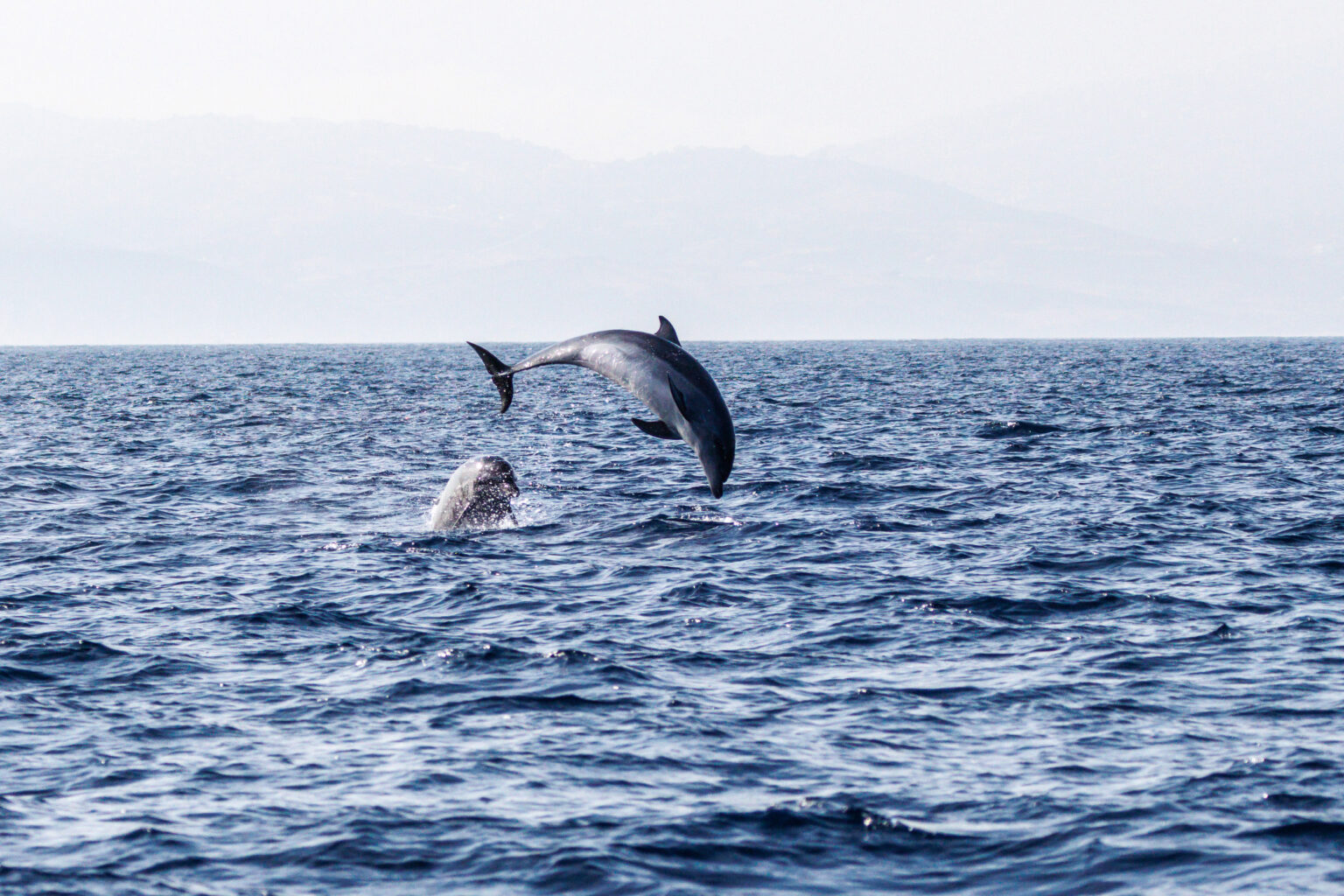
Two bottlenose dolphins play in the Mediterranean Sea off the coast of Tarifa, Spain on Sept. 21. Credit: Matthias Balk/picture alliance via Getty Images
In 2023, more than 200 river dolphins, which migrate seasonally between tributaries and lagoons in the Amazon, died due to record-high temperatures, along with much of their prey. In some areas, their shallow aquatic habitats exceeded 100 degrees Fahrenheit. “The river systems were unusually empty and dry and the animals got isolated,” said Mark Simmonds, scientific councilor for marine pollution for the U.N. convention, who led some of the discussions around climate change impacts on cetaceans at the workshop in February. “They lost the water that they would have been living in.”
Loss of prey in traditional habitats is of particular concern for migrating marine mammals that are forced to follow their prey into new, and sometimes more perilous, waters.
This is particularly evident in the case of critically endangered North Atlantic Right whales, which the report says are especially prone to ship strikes and entanglement in fishing gear as they pursue their prey—tiny crustaceans called copepods—which are moving towards cooler waters. There are fewer than 400 of the whales left.
The North Pacific humpback whales that feed off the coast of California are also at risk.
Orcas comment on killer apes destroying the planet by continuing to burn fossil fuels.Donald Trump urges you to be a Climate Science denier like him. He says that he makes millions and millions for destroying the planet, Burn, Baby, Burn and Flood, Baby, Flood.Nigel Farage urges you to ignore facts and reality and be a climate science denier like him and his Deputy Richard Tice. He says that Reform UK has received £Millions and £Millions from the fossil fuel industry to promote climate denial and destroy the planet.