Original article by Aseel Saleh republished from peoples dispatch under a Creative Commons Attribution-ShareAlike 4.0 (CC BY-SA) license.
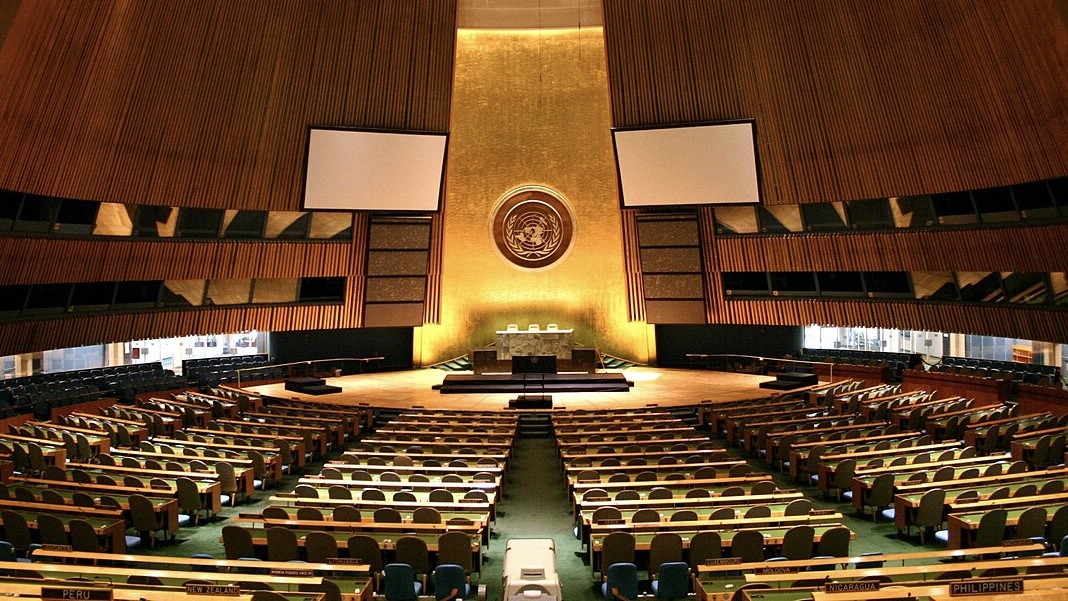
The move came more than six decades after Israel occupied the concerned territories, and over two years after it started its all-out aggression across West Asia.
The United Nations General Assembly (UNGA) adopted two resolutions on Tuesday, December 2, demanding Israel withdraw from Palestinian and Syrian territories that it occupied in 1967. These territories include the West Bank (including East Jerusalem), the besieged Gaza Strip, and Syria’s Golan Heights.
It is worth noting that the first resolution, which called for ending the Israeli occupation of the Palestinian territories passed with 151 votes in favor, 11 against, and 11 abstentions. Meanwhile, the second resolution on ending the occupation of the Syrian Golan Heights passed with 123 votes in favor, 7 against and 41 abstentions.
Annalena Baerbock: self-determination is “not a privilege to be earned, but a right to be upheld”
“For 78 years the Palestinian people have been denied their inalienable rights – in particular, their right to self-determination. Now, it is high time that we take decisive action to end this decades-long stalemate,” the President of the UNGA, Annalena Baerbock, stated at the 80th session, during which the resolutions were adopted.
Referring to Israel’s all-out multi-front war across West Asia, Baerbock pointed out that what happened during the last couple of years underscores the importance of the two-state solution to achieve “lasting peace”. A solution, which according to the UN senior official, should have been reached decades ago.
Baerbock emphasised that “self-determination, and the right to live in one’s own state in peace, security, and dignity, free from war, occupation and violence, is not a privilege to be earned, but a right to be upheld.”
UN considers Israel’s annexation of Syria’s Golan Heights as “null and void”
Regarding the Syrian Golan Heights, the resolution adopted by the UNGA considered the decision which Israel made on December 14, 1981 “to impose its laws, jurisdiction and administration on the occupied Syrian Golan” as “null and void”, calling for its withdrawal.
The resolution demanded Israel “withdraw from all the occupied Syrian Golan to the line of 4 June 1967 in implementation of the relevant Security Council resolutions.”
The UNGA further resolved that Israel’s continued occupation and de facto annexation of the Syrian Golan constitute “a stumbling block in the way of achieving a just, comprehensive and lasting peace in the region.”
The United Nations Security Council had already unanimously adopted resolution 497 on December 17, 1981, deciding that the Israeli Golan Heights Law, based on which Israel effectively annexed the Golan Heights, was “null and void and without international legal effect”. The resolution had also called on Israel to rescind its action.
UN resolutions are nominal when Israel is the aggressor
While the UNGA’s resolutions were welcomed by many states including the Palestinian Authority and Syria’s interim government, critics deemed the efforts as nominal, performative, and with a low likelihood of being implemented as long as the United States continues to support Israel unconditionally.
The multiple US vetoes of UN Security Council resolutions calling for a ceasefire during Israel’s genocidal aggression on Gaza, proves this particular argument.
Furthermore, many Palestinians still view the two-state solution as unfeasible and insufficient to address the inalienable Palestinian rights and demands, above all the right of return, and another way to recognize and cover the occupation.
This is reminiscent of late Palestinian writer and revolutionary leader Ghassan Kanafani when he said:
“They steal your bread, then give you a crumb of it. Then they demand you thank them for their generosity. O their audacity!”
Original article by Aseel Saleh republished from peoples dispatch under a Creative Commons Attribution-ShareAlike 4.0 (CC BY-SA) license.
Leave a Reply