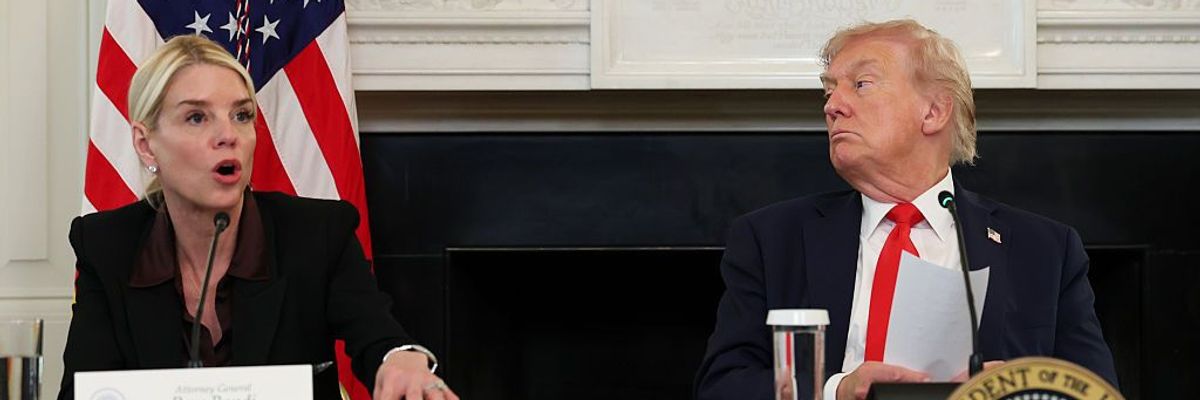
US President Donald Trump reads a note as Attorney General Pam Bondi speaks during a roundtable discussion at the White House in Washington, DC on October 8, 2025. (Photo by Anna Moneymaker/Getty Images)
US Attorney General Pam Bondi generated alarm on Wednesday when she said the Trump administration is going to take the “same approach” to Antifa as it has to drug cartels—as the military bombs boats in the Caribbean it claims are smuggling drugs.
Antifa encompasses autonomous anti-fascist individuals and loosely affiliated groups who lack a national organizational structure or leadership. Still, as the increasingly authoritarian administration works to quash dissent on all fronts, President Donald Trump last month signed an executive order designating the Antifa movement as a domestic terrorist organization.
During a related roundtable on Wednesday—held as the administration worked to deploy the National Guard in Democrat-led cities—Bondi said that “we’re not gonna stop at just arresting the violent criminals we can see in the streets. Fighting crime is more than just getting the bad guy off the streets; it’s breaking down the organization brick by brick, just like we did with cartels.”
Glancing toward Trump, she continued: “We’re going to take the same approach, President Trump, with Antifa: Destroy the entire organization from top to bottom. We’re going to take them apart. Thanks to your bold leadership, and the designation of Antifa as a terrorist organization—which is exactly what they are—Americans will no longer tolerate their unhinged violence.”
Lawyer and radio host Dean Obeidallah warned: “Please understand that this is Trump regime explaining how they will use the government to prosecute Democrats. Page 1 of the fascist playbook is imprison political opponents so that the fascist has one-party rule.”
Others noted the violence the administration has already taken. Zeteo reporter Prem Thakker said: “My gosh. After the US bombed multiple boats in the middle of the ocean, murdering people on grounds that they were allegedly ‘carrying drugs,’ the US attorney general says, ‘Just like we did with cartels, we’re going to take the same approach…with Antifa.’”
Zeteo founder Mehdi Hasan said, “So he is going to drone strike American citizens?”
HuffPost‘s SV Dáte similarly asked, “So the US military will be summarily killing them from above now?”
Trump has recently announced four bombings of boats he claimed were running drugs, without releasing any evidence. Those US military attacks have killed at least 21 people. Critics in Congress and beyond argue the strikes are illegal under federal and international law.
On Tuesday, top Democrats from key committees in the US House of Representatives demanded further information about the bombings and reminded Trump: “Congress has the sole constitutional responsibility to declare war and to authorize the use of force. You have failed to secure such authorization for these strikes.”
Also on Tuesday, Bondi appeared before the Senate Judiciary Committee, where lawmakers grilled her on a range of topics. Asked about legal justification for the boat bombings by Sen. Chris Coons (D-Del.), she declined to comment.
COONS: How did you conclude that these strikes on boats in the open ocean are legal?
BONDI: I'm not going to discuss any legal advice that my department may or may not have issued pic.twitter.com/Lg1FNPBpk7
Ahead of Bondi’s Senate testimony, watchdog groups and hundreds of former employees of the US Department of Justice expressed alarm about her leadership of the DOJ.
“We’re seeing the erosion of the Justice Department’s fabric and integrity at an alarming pace,“ says a letter signed by 282 former DOJ officials. ”Our democratic system cannot survive without the primary institution that enforces the law.”
Donald Fuhrump says that Amerikkka doesn’t bother with crimes or charges anymore, not being 100% Amerikkkan and opposing his real estate intentions is enough.Orcas discuss how Trump was re-elected and him being an obviously insane, xenophobic Fascist.
Pro-Palestine protesters in NYC (Photo: Wyatt Souers)
Pro-Palestine organizers credit “how the movement for Palestine has intervened,” for seismic shift in public opinion
US popular discontent over Israel’s war on Gaza has grown over the past two years, a Pew Research poll finds. Currently, 39% of those polled said that Israel’s military action against Hamas has gone too far – up from 31% a year ago and just 27% in late 2023. Six in 10 have an unfavorable view of Israel’s government. This survey was conducted before Trump and Netanyahu announced their so-called “peace plan”.
The Pew Research poll revealed that the percentage of those who believe President Donald Trump favors Israel too much has risen by five points since March, from 31% to 36%. Republicans remain far more likely than Democrats to back Trump’s handling of the conflict and view him as balanced between Israelis and Palestinians. Yet among voters of both parties, more people now believe he’s siding too heavily with Israel since previous polling in March.
Polling conducted by the New York Times and Siena University revealed a dramatic decline in support for Israel among US voters. Following October 7, 47% of US voters said their sympathies lay with Israelis, while just 20% sided with Palestinians. Today, that gap has vanished: 34% now say they back Israel, 35% back Palestinians, and 31% say they’re uncertain or support both equally. A majority of voters now oppose sending additional aid to Israel, at 51%.
Although the claims of antisemitism have been levied against the pro-Palestine movement, especially by the US government, Jewish people in the US have vastly shifted their stance against Israeli action in Palestine. According to a poll conducted by the Washington Post, 61% of surveyed Jewish people in the US believe Israel has committed war crimes in Gaza, and 39% said Israel is guilty of genocide.
“The movement for Palestine has intervened”
According to Miriam Osman, an organizer with the Palestinian Youth Movement, these drastic shifts in public opinion reveal “the massive gap between the policies of the ruling class and the vast majority of people who are not represented by them.” Osman says that the cause of this change is “first and foremost the result of Israel’s brutal genocide, live-streamed to our phones daily unlike any other atrocity we have seen,” but also credits “how the movement for Palestine has intervened, expanded, and kept Palestine front and center, building mass protests and organizing infrastructure over the last two years.”
Groups like the Palestinian Youth Movement have been active in organizing mass mobilizations since the beginning of Israel’s war on Gaza on October 7 – including taking part in a march of half a million in Washington, DC on November 4, 2023, which to date is the largest demonstration in support of Palestine in US history.
Since then, the movement for Palestine has taken a constant array of diverse forms, engaging potentially millions of people in the US. These include the wave of Gaza solidarity encampments protests, started by students at Columbia University and quickly spread across the country and around the world. Visits to the United States by Israeli Prime Minister Benjamin Netanyahu have seen mass demonstrations in July of 2024 in Washington, DC, and September during UNGA week in both 2024 and 2025.
The waves of pro-Palestine organizing in the United States have been sustained by a variety of organizations and coalitions, some in existence prior to October 2023 and some coming on the scene after. While the Palestinian Youth Movement has been active for decades, two years ago the Palestinian diaspora organization joined forces with other groups including the ANSWER Coalition and the People’s Forum to form “Shut it Down for Palestine”, a coalition which holds public meetings in New York City each week.
List of US citizens killed by Israel grows
The victims of Israel’s genocide and occupation includes US citizens, but the Israeli government has faced not accountability from the US for these killings. These include Ayşenur Ezgi Eygi, an activist shot by Israeli forces while at a protest in the West Bank, and Sayfollah Musallet, a Palestinian-American beaten to death by Israeli settlers while visiting family, also in the West Bank.
The US Department of Justice launched investigations against the alleged killings of US citizens by Hamas during October 7, and charged Hamas leaders with terrorism. However, when it comes to Israeli killings of US citizens, the US government has deferred to Israel to conduct its own internal investigations.
Establishment digs heels in
Demonstrations have also targeted members of the political establishment who have refused to respond to the sea change in constituent opinion and shift their stance in support of Israel. These include those in the liberal wing of politics, such as Senate Minority Leader Chuck Schumer – who has faced waves of activist pickets both outside his office and his home in New York City.
Some activists, notably, members of the anti-war group CODEPINK have taken to filming direct confrontations with politicians in the halls of Congress over their support for Israel – including those in the Democratic Party. When campaigning as Kamala Harris’ running mate last year, Tim Walz was called out by CODEPINK activists while at a DNC women’s caucus event for his support for Israel.
After 2 years of Israel’s genocide and war on Gaza, the US government shows no sign of changing its unwavering financial and political support for Israel. Although the Trump administration has been especially staunch in its support, establishment leaders of the Democratic Party have also remained, in many ways, just as supportive as two years ago. As recently as April of this year, establishment Senators including Schumer, fellow New York Senator Kirsten Gillibrand, and Cory Booker of New Jersey, voted down a Bernie Sanders-led effort to limit US arms sales to Israel.
Orcas discuss Genocide-supporting and complicit Zionists. Donald Trump, Keith Starmer, David Lammy, Rachel Reeves, Angela Rayner and Wes Streeting are acknowledged as evil genocide-complicit and supporting cnuts.
Larry Ellison speaking at a conference. Photo: Wikimedia Commons
The pending purchase of TikTok, blessed by the Trump-Netanyahu duo, once again sets off alarm bells regarding the marriage of economic, geopolitical, and military interests.
Launched in 2017 by the private Chinese company ByteDance, TikTok quickly became one of the most important social networks on the planet. By early 2025, it had 1.6 billion active users, more than half of them outside China, of whom an estimated 170 million are North American; 1 in 5 people in the US get their news from this network, 4 in 10 among the 18-29 age group. Today, it is the fastest-growing platform among the younger segments of the global population.
The US government has waged a long battle to force ByteDance to sell the US branch of TikTok to a group of “domestic” capitalists, citing national security concerns and threatening to ban the platform in the US if the deal did not go through. On September 25, the White House announced through an Executive Order signed by Trump, “Save TikTok by Protecting National Security”, the terms under which the transaction would take place. According to the document, the app in the US “will be majority-owned and controlled by US persons and will no longer be controlled by any foreign adversary, as ByteDance Ltd. and its affiliates will own less than 20% of the entity, with the remainder held by certain investors.” Who are these mysterious “certain investors” that the Executive Order does not directly mention?
None other than a consortium led by the giant Texas-based company Oracle, which already stored TikTok data in the US. Its main shareholder is an 81-year-old American tycoon who, unlike Elon Musk, is relatively unknown to the public: Larry Ellison. Ellison, in addition to being the new owner, would also take on key roles in managing security, data, and algorithm auditing. In a nutshell, he will be the new boss of the vertical video platform in the United States, a company valued at USD 14 billion. But perhaps the most relevant aspect of the case is not the amount of the transaction, but its long-term implications for power. As a BBC article states, “Investors will control the algorithm that powers the US version of TikTok, and Americans will occupy six of the seven seats on the board of directors that will oversee it.”
Why is Larry Ellison’s role (geo)politically relevant, and what does Israel have to do with it?
What is admitted need not be proved, as the old adage goes. The day after the announcement, before an audience of podcasters and TikTokers at the Israeli consulate in New York, a blunt Benjamin Netanyahu declared: “Weapons change over time; the most important ones are social media,” adding that the purchase of TikTok “is the most important purchase being made right now.” A purchase that, incidentally, had been preceded a month earlier by the appointment of Erica Mindel, a US citizen and former Israeli military instructor, as the company’s new Director of Public Policy for Hate Speech. So did Israel buy TikTok? It depends on how you look at it. The key lies with Larry Ellison and his ties to the genocidal state. So who is this Ellison?
The owner of Oracle – cloud applications, databases, and servers, with 160,000 employees around the globe – is currently the second richest person on the planet (behind only Musk), with a fortune valued at USD 350 billion, according to Forbes. He lives on the Hawaiian island of Lanai, which he bought in 2012 for USD 300 million; he is a shareholder in X and Tesla; he owns almost 50% of the media giant Paramount-Skydance (including CBS), valued at USD 28 billion. An interesting fact provided by Forbes: “Ellison never finished college. He started out creating databases for the CIA.” His trusted business partner: Safra Catz, Oracle’s CEO since 2014, born in Israel and, like Ellison, a personal friend of … Netanyahu. According to a press release, “a few months before the start of the genocidal war in Gaza, Catz met with Netanyahu to discuss the expansion of Oracle’s projects in the Israeli-occupied territories.” But this is not an isolated incident. The close relationship between the new owner of TikTok and Israel goes back a long way, so much so that on one occasion Ellison even offered Netanyahu a seat on Oracle’s board of directors.
According to data provided by the BDS Movement, in 2019, Oracle leased an underground data center in Har Hotzvim, Jerusalem, to provide Israeli banks, health funds, and military forces with AI processing and information storage services; in 2021, it became the first multinational technology company to sell cloud services to Israel within the occupied territories; in 2022, it hosted soldiers and software developers from the Israeli army’s C41 Corp. to learn how to use Oracle’s cloud for military purposes…
It is no coincidence that Catz, Oracle’s all-powerful CEO, states that “for employees, it’s clear: if you’re not pro-US or pro-Israel, don’t work here”; nor is it surprising that some of her employees commented to The Intercept that “the atmosphere is horrible, people are terrified to even mention Palestine.” According to the same source, as soon as Israel’s military retaliation in Gaza began in October 2023, Catz demanded that the inscription “Oracle Stands with Israel” appear on all company screens in more than 180 countries. In the same context of the aggression against Palestinians in Gaza, Oracle developed the “Words of Iron” project, in collaboration with Israeli ministries, “to help the country elevate pro-Israel content and counter critical narratives on TikTok, Instagram, and Twitter.” In other words, a weapon at the service of propaganda, in that theater of operations that has now become fundamental, as Netanyahu himself knows: cognitive warfare. The Intercept also reports that a year ago, Oracle partnered with one of Israel’s largest defense companies, Rafael Advanced Defense Systems, on an AI project to provide “fighters with rapid, actionable information on the battlefield.” In other words, war on the ground.
The relationship with Trump and his consolidation as media emperor
However close Ellison’s relations with the State of Israel and its army may be (he has also been a major donor to the US organization Friends of the Israel Defense Forces (FIDF), which channels millions of dollars to the soldiers of that country) it would have been very difficult for his company to win the approval of the Trump administration if its owner were not close to the president of the United States himself. After many years of donating to both parties but closer to the Democrats – an admirer of Clinton, disenchanted with Obama – Ellison’s balance began to shift toward the Republican side, especially its more radical wing. In 2016, he donated a significant sum to Marco Rubio in the Republican primaries and, according to Wired, later became a “reliable donor and fundraiser for the Republican Party during the 2020 and 2024 cycles,” which allowed him to become very close to Donald Trump. Although perhaps somewhat exaggerated, one of Trump’s advisers interviewed by that website referred to the Oracle owner as “the shadow president of the United States.”
In any case, what is certain is that Netanyahu and Trump’s personal friend will not be satisfied with his latest acquisition from the Chinese. The US media has been reporting in recent weeks that the Ellisons, Larry and his son/heir David, are going for more. They now have their sights set on the acquisition of Warner Brothers Discovery – which includes CNN. According to the national media watchdog organization FAIR, if the sale goes through, it would “create an unprecedented level of media consolidation” in the history of global media, including powerful news channels, film production companies, cable television … to which must be added control over TikTok. The danger of hyper-concentration of media power has been pointed out by various groups. Massachusetts Senator Elizabeth Warren warned that regulatory agencies should block the potential merger “because it is a dangerous concentration of power.” Or, as professor of digital sociology Steven Buckley points out: “It is not a sign of a healthy democracy when billionaires buy up all the cultural consumption media.” For now, regardless of whether this latest move by the Ellison clan comes to fruition, his purchase of TikTok, blessed by the Trump-Netanyahu duo, once again sets off alarm bells regarding the marriage of economic, geopolitical, and military interests; just at a time when global awareness seems to be awakening to the urgent need to stop the war machines of Israel and the United States.
Miguel Ruíz is a Mexican-Ecuadorian sociologist. He holds a PhD in Latin American Studies (UNAM). He has been a professor and researcher at various universities in Mexico and Ecuador. He currently teaches at the Faculty of Social and Human Sciences and is a member of the Institute of Economic Research, both at the Central University of Ecuador.
Orcas discuss Genocide-supporting and complicit Zionists. Donald Trump, Keith Starmer, David Lammy, Rachel Reeves, Angela Rayner and Wes Streeting are acknowledged as evil genocide-complicit and supporting cnuts.
Mexican President Claudia Sheinbaum greets supporters in the Zócalo on October 5, marking one year of her administration. Photo: MORENA / X
In her speech to a full Zócalo, Sheinbaum reviewed her government’s major accomplishments in a year of global turbulence largely amid a US tariff war and military threats
Mass mobilizations have been a feature of Claudia Sheinbaum’s first year presiding over Mexico, and to finish her first “accountability” tour of Mexico and mark one year of governance, she had her biggest yet. More than 400,000 people came out to watch her speak for nearly an hour on Sunday, October 5, reflecting on her and the party’s achievements in the first year of her term, and the continued “fourth transformation” of Mexico.
In recent weeks, Sheinbaum has visited all 31 states of Mexico, outlining her administration’s current projects, plans and results in each state.
The communication strategy of MORENA, the governing party, is very front-facing, with both Sheinbaum and her predecessor Andrés Manuel López Obrador hosting daily press conferences from Monday to Friday, and then generally traveling to one or two parts of Mexico over the weekend. This has proven extremely effective in countering the narratives from the large press corporations that own and operate the majority of Mexican media outlets, as well as of course maintaining closer communication and accountability with the people of Mexico.
Sheinbaum has faced significant challenges in her first year, most notably due to relations with the administration of US President Donald Trump, with problems ranging from tariff threats even to members of his administration suggesting unilateral military intervention against Mexico. While Trump has threatened Mexico with tariffs at every turn, Sheinbaum’s firm but open stance has proved effective in negotiations with Trump and today the country has managed to achieve important exceptions to the aggressive tariff regime.
Sheinbaum arrives at one year in charge with historic levels of approval, depending on the poll you choose your approval rate is somewhere between 72% and 79%. While other countries around the world aren’t as comprehensive in approval polls as Mexico, this likely makes Sheinbaum the most popular leader in the world.
So, how did she get to that level of popularity and what are her challenges in maintaining or growing it? Here are some of the points mentioned by Sheinbaum in her speech and the highlights from her first year governing Mexico.
Reiterating economic achievements
Sheinbaum began by reiterating some of the economic achievements, both that MORENA has accomplished since 2018, and some of the present moment.
Between 2018 and 2014, 13.5 million Mexican, Mexico is now the second least unequal country in the Americas, behind only Canada, and the income gap between the richest and poorest was reduced from 27 to 14 times over.
Annual inflation has settled at 3.7% percent, unemployment is at 2.7%, a record level of foreign direct investment was reached and annual economic growth is expected at 1.2%.
Sheinbaum’s initiatives from her first 12 months.
Sheinbaum created three new social programs. One is Salud Casa por Casa, a door-to-door free healthcare system for the elderly, where healthcare professionals come into their home for regular check ups. Another is Pensión Mujeres Bienestar, which gives women their pension from 60 years of age, rather than 65, to recognize unpaid work in the home. The final is Beca “Rita Cetina”, which is a universal scholarship for all secondary students in public schools, this is a payment every two months of 1900 pesos (USD 103) to cover schooling costs.
The constitutional recognition of several rights, such as the right for women to live lives free from violence, the right of access to the internet, the right of access to housing, the right to social programs and more.
Mexico has served more than 86,000 deported Mexicans who have been deported from the US in special comprehensive care centers, under a program called ‘Mexico embraces you”. This includes registering them into Mexicans social security systems to assist them with access to housing, employment and transportation to their area of origin, as well as food and shelter in the meantime.
Sheinbaum said the “4T is bringing back the trains”, with many rail projects underway, after they were previously privatized in the late 90s. These make up more than 3000kms of railway across the country, including two trains from Mexico City, to Pacucha and Queretaro respectively, and further expansion of the Interoceanic train, which is a key part of Mexico’s attempt to create an alternative trade corridor to the Panama Canal.
Sheinbaum emphasized the administration’s goal to “promote equality and the recognition and just development of women in Mexico.” The current government has created The Secretariat for Women as an official government ministry, opened a national support line for women, has opened the first 678 free centers for women that focus on comprehensive care for women, but the administration is aiming to build 2,500 in total. The government is also aiming to build 1,000 early education and childcare centers, which will provide free childcare to children from 40 to 1,000 days old.
Sheinbaum has also made access to water a key feature of her first year in charge. About four billion cubic meters of water have been de-privatized, a new agricultural irrigation technology program is being developed across 13 states, and there are 20 new strategic drinking water and sanitation projects.
The Sheinbaum administration will build 1.7 million homes, 400,000 of those for Mexicans without social security, and the rest with accessible loan offers for those who earn less than two minimum wages.
Another key feature of her first year in charge has been more scientific investment and projects, with funding for scientific research projects increasing by 193%. These include the production of an electric car, a project for Mexico to make its own semiconductors, the production of observation satellites and more.
Security
A challenge moving forward for Sheinbaum will be continuing to manage the security situations, although her early strategies have proved effective.
52% of Mexicans rank insecurity and drug trafficking as the most important issue affecting the country, and 63% of Mexicans living in urban areas consider it unsafe to live in their city. This figure rose from the previous year, but in fairness, levels were historically low before.
Sheinbaum and Omar Garcia Harfuch, her secretary of security, have taken a different approach to security than AMLO had. Sheinbaum and Garcia Harfuch also worked together when Sheinbaum was the mayor of Mexico City, and homicides dropped 50% in the six years they worked together.
The results have been swift, with Sheinbaum reporting a 32% reduction in homicides over her first year. Between September 2024 and July 2025, there was an average of 64.9 homicides per day. While these numbers are stark, it is a marked improvement from the 98.5 per day that Mexico was experiencing in 2018, when MORENA first came to power.
In 2007, before Felipe Calderon’s aggressive, US-backed security strategy, Mexico was experiencing 24.3 daily homicides.
Mexico also recently managed to get the United States to sign an agreement to attempt to limit the inflow of weapons from the US into Mexico. This is a huge point for Mexican security as even the US itself has recognized that 74% of weapons used by organized crime groups in Mexico arrive illegally from the United States.
However, Mexican political commentator and editor of Mexico Decoded, Viri Rios makes the point that this agreement focuses only on increased border surveillance and inspection, and misses the core problem of dangerous weapons being too easily acquired and severely unregulated in the US.
In theory, the US agreeing to this new policy will give them more accountability for the guns that continue to arrive in Mexico.
Early results are extremely promising, but Sheinbaum’s grapple with security and US relations will be critical moving forward.
Tallis Boerne Marcus is an Australian journalist currently based in Mexico City.
Graffiti in Lima condemning police repression of protests. Photo via Joxe Carlos / X
Protesters are demanding an end to the government with the highest disapproval rating on the entire continent. Boluarte, however, says she will not resign.
Another massive mobilization took place on October 4 in Lima, Peru’s capital, against the government of Dina Boluarte. With this mobilization, it has now been three weeks in a row that thousands of Peruvians have taken to the streets to demand an end to the proposed pension reform, corruption, insecurity, and police abuse.
But, as several analysts have pointed out, the protests are no longer focused solely on specific issues, but on raising the demand for an end to the Boluarte government. Boluarte took office after the overthrow of then-President Pedro Castillo, and led to the deaths of more than 60 Peruvians following massive protests between 2022 and 2023.
Protests in Lima
On Saturday, October 4, the streets of downtown Lima were once again filled with cries against the government and the national congress. The demonstrations were attended by young people, university students, workers, transport workers, and various collectives who denounced the Peruvian state structure as corrupt due to the presence of political and economic mafias. The General Confederation of Workers of Peru (CGTP) also joined the demonstration.
However, journalist Ricardo Rodríguez argues that perhaps the most important aspect of the protests is not the repression, but rather the ability of Peruvians to mobilize in the face of a government that refuses to step aside: “It’s not just about bullets, tear gas, or arrests. What those in power fear – and are already beginning to feel – is that these young people are not just taking to the streets: they know, they understand, they articulate. They organize in a decentralized manner; they mobilize without waiting for permission; they use social media not as a showcase but as a tool for coordination; they demand not crumbs, but real change.
Rodríguez also pointed out that there is a spirit of rejection not only of the current government, but of a system that offers no opportunities for growth for Peruvians, felt most strongly among young people: “Many reject the economic model that offers them precariousness, miserable wages, and old age without decent pensions. The proposed reform is not the only cause: it is the trigger for accumulated resentment against decades of broken promises and state neglect.”
Transport workers’ strike
In addition to the demonstrations on Saturday, October 4, several dozen transport companies in Peru staged protests against the government of Dina Boluarte on October 7.
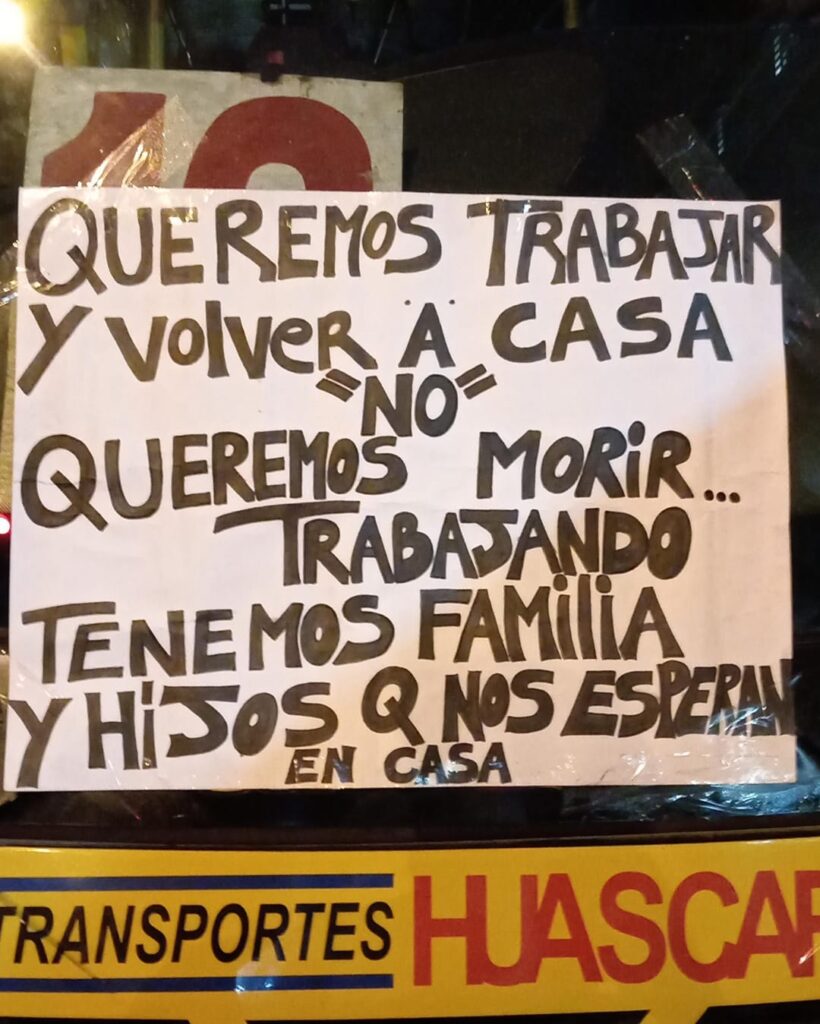
Their main demand is that the government take action to stop the growing wave of insecurity and extortion suffered by transport workers at the hands of organized crime groups. Attacks on transport workers have caused the deaths of 47 drivers.
At various points in Lima, transport workers stopped work and gathered in the streets to demand a change in the state’s security policy, even blocking roads to make themselves heard.
France 24 correspondent Francisco Zacarías reported that there were clashes between protesters and police. He also stated that President Boluarte “downplayed” the transport strike and said that the protests “will not solve the problem,” which has further provoked the transport unions.
Sign on a bus reads “We want to work and return home. We do NOT want to die working. We have family and children that wait for us at home.” Photo via X
Almost total rejection of the Boluarte government and Congress
Currently, Peru’s Congress has one of the lowest approval ratings among the country’s various state institutions, reaching almost total rejection. Not far behind, President Boluarte has a 96% disapproval rating, according to an IPSOS poll.
In this regard, IPSOS CEO Alfredo Torres stated: “This is something that has never been seen before in history, nor has it been seen in other countries. A poor approval rating for any president is 20% in favor and 80% against, but a 96% disapproval rating is extremely high. It is absolute rejection, absolute distrust. People no longer expect anything. It is also outrageous that scandals continue to emerge and nothing happens.”
“I will not resign,” says Boluarte
Faced with periodic protests and a huge crisis of legitimacy, President Boluarte stated that she has no intention of leaving power before the 2026 elections. According to Boluarte, Peru has become a prime destination for foreign investment, so her administration is more than justified.
“If those small-time leaders believe that with riots, violence, hatred, and the desire to impose an anarchic world, they are going to change the history of Peru … We are seeing other countries that have done the same and have failed governments,” Boluarte said.
However, Boluarte will still have to endure protests that seem to be increasing in frequency in line with the disapproval of her mandate.