Spring barley is harvested. The ECIU said the evidence suggests climate impacts were driving issues of profitability in the arable sector. Photograph: Diane Randell/Alamy
Many now concerned about ability to make living in fast-changing climate after one of worst grain harvests recorded
Record heat and drought cost Britain’s arable farmers more than £800m in lost production in 2025 in one of the worst harvests recorded, analysis has estimated.
Three of the five worst harvests on record have now occurred since 2020, leaving some farmers asking whether the growing impacts of the climate crisis are making it too financially risky to sow their crops. Farmers are already facing heavy financial pressure as the costs of fertilisers and other inputs have risen faster than prices.
This year Britain had the hottest and driest spring on record, and the hottest summer, with drought conditions widespread. As a result, the production of the five staple arable crops – wheat, oats, spring and winter barley, and oilseed rape – fell by 20% compared with the 10-year average, according to the analysis by the Energy and Climate Intelligence Unit (ECIU). The harvest in England was the second-worst in records going back to 1984.
Supercharged by global heating, extreme rainfall in the winters of 2019-20 and 2023-24 also led to very poor harvests, as farmers were unable to access waterlogged and flooded fields to drill their crops.
“This has been another torrid year for many farmers in the UK, with the pendulum swinging from too wet to too hot and dry,” said Tom Lancaster at the ECIU. “British farmers have once again been left counting the costs of climate change, with four-fifths now concerned about their ability to make a living due to the fast-changing climate.”
Donald Trump urges you to be a Climate Science denier like him. He says that he makes millions and millions for destroying the planet, Burn, Baby, Burn and Flood, Baby, Flood.Nigel Farage urges you to ignore facts and reality and be a climate science denier like him and his Deputy Richard Tice. He says that Reform UK has received £Millions and £Millions from the fossil fuel industry to promote climate denial and destroy the planet.
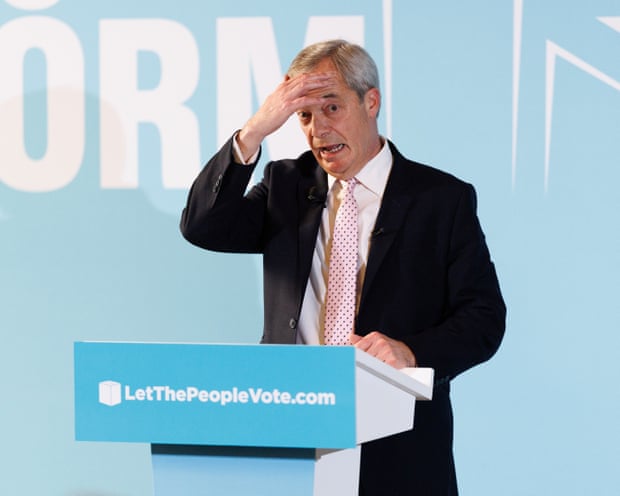
Nigel Farage gave an angry performance at a press conference in London. Photograph: Dan Kitwood/Getty Images
Reform leader suggests he would boycott BBC, saying he has had letter from Dulwich pupils defending him
Nigel Farage has turned on broadcasters for questioning him about his alleged teenage racism and antisemitism as the number of school contemporaries who recalled such behaviour to the Guardian reached 28.
In an angry performance at a press conference in London, the Reform leader suggested he would boycott the BBC and said ITV had its own case to answer, as he repeatedly shouted “Bernard Manning”.
Manning, a comedian from Manchester who died in 2007, was a regular face on British television in the 1970s but he drifted from the public eye after claims that his material was racist and misogynistic.
The intemperate performance by Farage, whose party has slipped in the national polls in recent weeks, came as a further five school contemporaries came forward to the Guardian with allegations that they had witnessed deeply offensive racist or antisemitic behaviour by him.
dizzy: Is Farage’s current flavour of argument that there were other blatant racists and misogynists at that time so that it’s fine?
He’s said that he wants an apology “for everything”. I can try, might take a few goes.
I’m so sorry that everyone is not as perfect as you Nigel. You’ve obviously been taught all your life that you’re so special and it’s so unfortunate that there are so many inferior people and races affecting your absolutely perfect being and experience. I’m so sorry that you’re so obviously always in distress, I can see you shouting it at every opportunity.
… I’ll have to work on it.
Nigel Farage blames the Muzzies.Nigel Farage explains the politics of Reform UK: Racism, Fake anti-establishmentism, Deregulation, Corporatism, Climate Change Denial, Mysogyny and Transphobia.
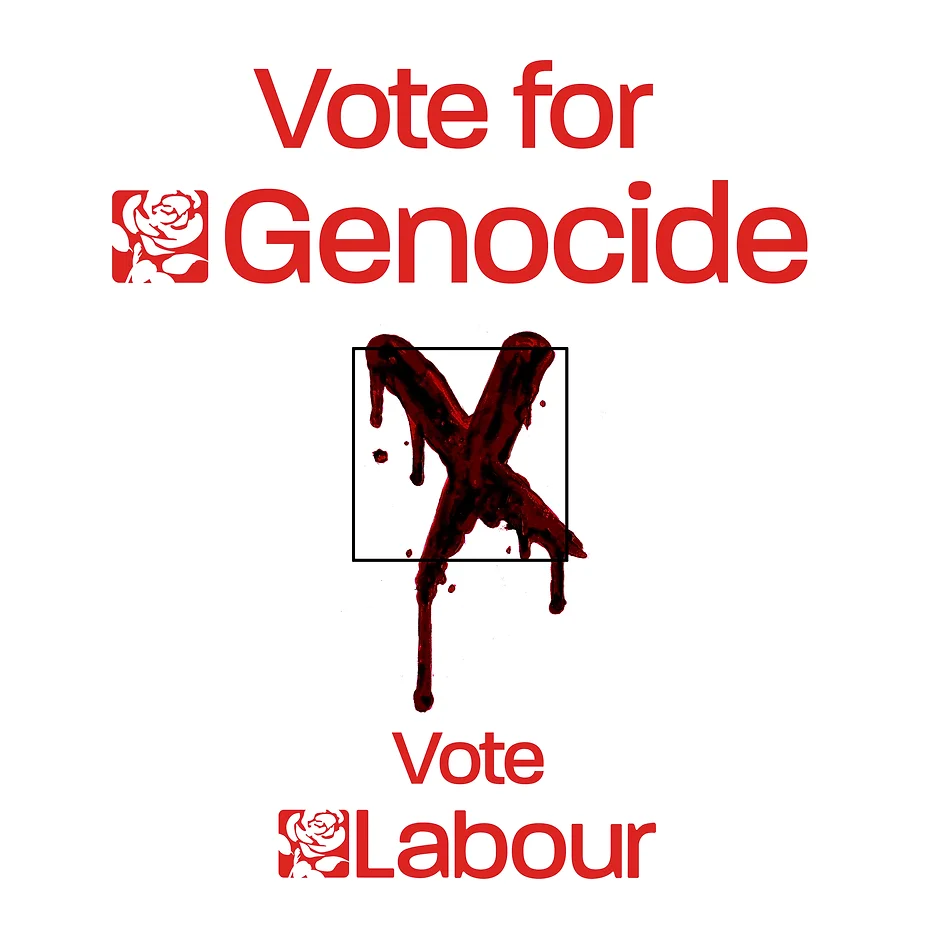
Keir Starmer objects to criticism of the IDF. He asks how could anyone object to them starving people to death, forced marches like the Nazis did, bombing Gaza’s hospitals and universities, mass-murdering journalists, healthworkers and starving people queuing for food, killing and raping prisoners and murdering children. He calls for people to stop obstructing his genocide for Israel.Orcas discuss Genocide-supporting and complicit Zionists. Donald Trump, Keith Starmer, David Lammy, Rachel Reeves, Angela Rayner and Wes Streeting are acknowledged as evil genocide-complicit and supporting cnuts.Vote Labour for Genocide.
CLAMPDOWN: People take part in a demonstration at Parliament Square
THE Palestine Action hunger strike is on track to become the largest since the 1981 Irish republican protest led by Bobby Sands, yet campaigners say it has faced a “mainstream media blackout.”
So far, seven prisoners have refused food — some for as long as four weeks — with more expected to join.
They are among 33 prisoners who are locked away without trial, over alleged involvement in non-violent actions aimed at blockading arms supply to Israel.
The hunger strikers’ demands are clear. They want Israel’s largest weapons company, Elbit Systems, to cease operating in Britain for good.
They want the ban on Palestine Action, currently designated a terror group, to be lifted. And they are demanding immediate bail and a fair trial — basic democratic rights that should already be guaranteed.
Francesca Nadin, a spokesperson for Prisoners for Palestine, spoke to the Morning Star about their struggle.
Nadin herself was in prison on remand last year, over actions at a Teledyne weapons factory and a Barclays branch in Leeds.
“The fact is that for the charges that they have, which is property damage, people are never usually kept on remand,” she says.
“It’s clear to me that the process is the punishment.”
Four of the strikers — Qesser Zuhrah, Heba Muraisi, Teuta Hoxha and Kamran Ahmed — have been held on remand since last November, far exceeding the six-month pre-trial custody limit.
They are part of the “Filton 24” — inmates held in connection to an action in which activists reportedly drove a repurposed prison van into an Elbit manufacturing hub and dismantled equipment inside.
Qesser, who hasn’t eaten for over four weeks, now feels close to collapse, campaigners report, while Heba, who has also gone more than a month without food is severely fatigued and is finding it increasingly difficult to hold water down.
Teuta and Kamran, who haven’t eaten for 26 and 25 days, were both recently hospitalised.
“As you can imagine now, they’re all very weak”, Nadin says.
“It’s getting to the point of serious deterioration. We are just prepared for something very serious to happen any moment now.”
Keir Starmer objects to criticism of the IDF. He asks how could anyone object to them starving people to death, forced marches like the Nazis did, bombing Gaza’s hospitals and universities, mass-murdering journalists, healthworkers and starving people queuing for food, killing and raping prisoners and murdering children. He calls for people to stop obstructing his genocide for Israel.Orcas discuss Genocide-supporting and complicit Zionists. Donald Trump, Keith Starmer, David Lammy, Rachel Reeves, Angela Rayner and Wes Streeting are acknowledged as evil genocide-complicit and supporting cnuts.Palestine Action joke that appeared in the UK satirical magazine ‘Private Eye’.
Justice secretary David Lammy has announced one of the most significant changes to criminal justice in England and Wales in decades, by scrapping the use of jury trials for most offences that carry a likely jail sentence of less than three years.
Under the proposals, only the most serious offences such as murder, robbery and rape would continue to be tried by a jury. Most other cases would be heard by a judge alone. The reforms will also include creating new “swift courts” within the crown court division.
The government says judge-alone trials will take 20% less time than jury trials. Currently, cases can take an average of 332 days from charge to completion.
Yet the right to be tried by one’s peers has deep roots in the legal tradition of England and Wales. Its origins trace back to Magna Carta in 1215, which promised that no one would lose their liberty or property without “the lawful judgement of his peers and the law of the land”.
The judge and legal philosopher Lord Devlin described trial by jury as “the lamp that shows that freedom lives”. It is a symbolic cornerstone of justice in England and Wales.
These proposals go far beyond the recommendations put forward in Brian Leveson’s independent review of the criminal courts, published in July 2025. Leveson proposed trial by judge alone where the defendant requested it, or in particularly lengthy and complex trials. But Lammy’s proposals appear to be a watering down of leaked MoJ plans to restrict the use of jury trials to only “public interest” cases with sentences of over five years.
In practical terms, jury trials already form only a small part of the system, accounting for around 2% of all criminal cases. Ministry of Justice data shows that most criminal cases are resolved in the magistrates’ courts, in which three magistrates (who are volunteer lay people rather than professional judges), determine guilt as well as sentence.
Although magistrates deal with less serious offending, they currently have the power to imprison offenders for up to 12 months for a single offence, a power which, Lammy announced, would be increased to 18 months. Of those cases which are dealt with by the crown court, around 60% of defendants plead guilty, removing the need for a trial.
Some might therefore regard juries as symbolically important, but an unnecessary burden on a struggling court system. While there are valid concerns about aspects of jury decision making, research has found that juries do generally make fair decisions.
There is limited research on judge-only trials, in part because they are relatively rare. Even in jurisdictions where juries are not used, judges more often sit in panels of three or more. There are concerns that judge-only trials risk exacerbating judicial bias.
Perhaps just as importantly, juries provide a form of lay participation that helps ensure public confidence in the fairness of verdicts.
Juries can act as a democratic check on official power. There have been cases, for example in protest-related trials, where juries have interpreted the law in ways that reflect broader community standards. Such instances are a reminder that the legitimacy of criminal justice depends on public consent.
The court backlog
The evidence suggests that jury trials are not the primary cause of the current backlog. Crown court backlogs began rising sharply in 2017, driven by years of budget reductions, court closures, maintenance backlogs and limits on the number of days courts were permitted to sit. However, the backlog has not fallen below 35,000 since 2000.
The pandemic brought unprecedented disruption into an already fragile system as many hearings were postponed and the transition to remote hearings caused delays. By late 2023, there were around 68,000 outstanding crown court cases, already the highest on record, and experts consistently identified lack of capacity as the central issue.
Given that jury trials make up such a small proportion of criminal cases, reducing them cannot, on basic numerical grounds, meaningfully reduce a backlog of this scale. The government has stated that restricting jury trials would save £31 million, just 0.2% of the MoJ budget.
It could, however, create new problems, including increased appeals, challenges on grounds of judicial bias and reduced public confidence in the outcome of trials.
The Institute for Government has warned that such changes could increase the risk of wrongful convictions and further erode trust in the justice system.
There is no doubt that long waits can be profoundly distressing for victims as well as defendants and witnesses. But victims’ interests also include trust in the process and confidence that decisions about guilt reflect a broad social judgement, not just the view of a single official.
This does not mean that the jury system is perfect or that reform is unnecessary. Leveson’s review of the courts suggested targeted changes, such as judge-only trials in highly complex fraud cases, or hybrid panels of judges and magistrates for certain intermediate offences. It also called for significant improvements in digital case management and infrastructure – investments that could address underlying inefficiencies more directly.
Restricting jury trials might appear to offer a fast route to clearing backlogs, but the data suggests that delays stem from wider capacity constraints, not the workings of juries themselves. England and Wales already rely overwhelmingly on magistrates’ courts and guilty pleas to handle most cases.
If the government is serious about improving outcomes for both victims and defendants, it should invest in the capacity of the courts, rather than remove one of the few remaining avenues for public participation in the criminal justice system.






 CLAMPDOWN: People take part in a demonstration at Parliament Square