Palestinian Envoy to ICJ: Israel Using Starvation as ‘Weapon of War’ in ‘Genocidal Campaign’

Spread the love

Original article by Julia Conley republished from Common Dreams under Creative Commons (CC BY-NC-ND 3.0). 
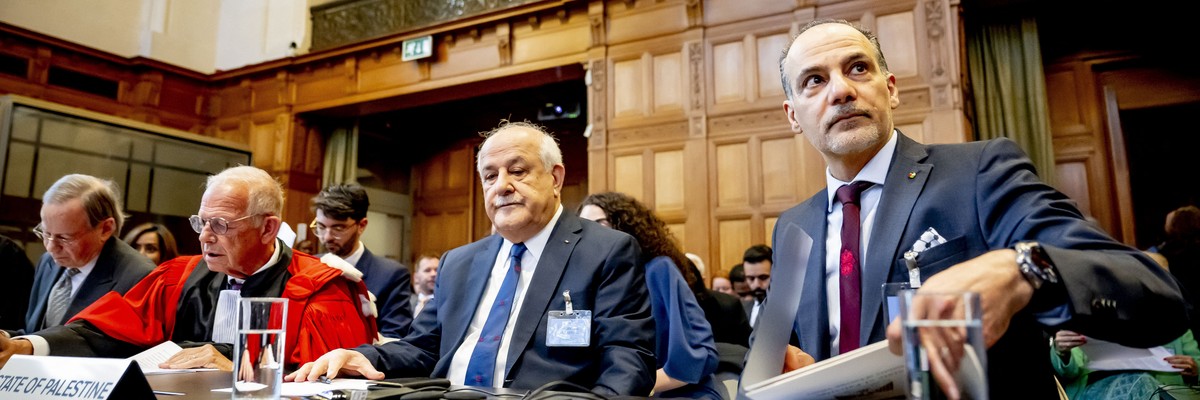
Palestinian ambassador Ammar Hijazi (R) looks on as he attends an interrogation on Israel’s humanitarian obligations towards Palestinians at the International Court of Justice in The Hague, Netherlands on April 28, 2025. (Photo: Robin Utrecht/ANP/AFP via Getty Images)

“Israel is starving, killing and displacing Palestinians while also targeting and blocking humanitarian organizations trying to save their lives,” said Palestinian envoy Ammar Hijazi.

With Israel’s “total and complete blockade” leaving people across Gaza “slowly dying” if they aren’t being “killed with bombs and bullets,” according to one United Nations official, Palestinian envoy Ammar Hijazi was among those who described the reality on the ground to the U.N.’s top court on Monday as the body considered Israel’s legal obligations in Palestine.

Ammar Hijazi, Palestinian ambassador to the Netherlands, warned the International Court of Justice (ICJ) that since October 2023, Israel’s blockade on humanitarian aid “has progressively turned into a total siege.”

“Israel is starving, killing, and displacing Palestinians, while also targeting and blocking humanitarian organizations trying to save their lives,” he said, accusing the Israeli military of waging a “genocidal campaign” in Gaza.

On March 2, for the second time since the Israel Defense Forces (IDF) began bombarding Gaza in retaliation for a Hamas-led attack in October 2023, Israel halted all humanitarian aid into the enclave. The total blockade was followed by Israel’s decision to end a cease-fire that has begun in January, conducting a bombing campaign that killed hundreds of Palestinians in its first day.

For nearly two months, food supplies have dwindled in Gaza, and the World Food Program announced last week that it had delivered its last remaining stocks of hot meals to food kitchens.

The siege has created conditions that are “incompatible with sustaining life or the continued existence of Palestinians in Gaza,” Hijazi said.

The ambassador noted that the ICJ hearing was taking place to consider whether Israel is violating international law.

“It is not about the number of aid trucks Israel is or is not allowing into the Occupied Palestinian Territories, especially Gaza,” said Hijazi. “It is about Israel destroying the fundamentals of life in Palestine while it blocks U.N. and other humanitarians from providing lifesaving aid to the population. It is about Israel unraveling fundamental principles of international law, including their obligations under the U.N. Charter.”

“Starvation is here,” Hijazi added. “Humanitarian aid is being used as a weapon of war.”

The hearing on Monday was the first of several that will take place at the ICJ over the next five days, following a resolution passed by the U.N. General Assembly last year calling on the court to consider Israel’s legal responsibilities after the government blocked the U.N. Relief and Works Agency for Palestine Refugees in the Near East (UNRWA) from operating in the Palestinian territories—cutting Palestinians off from the agency that has for years provided crucial food aid, cash assistance, and health services, among other necessities.

Elinor Hammarskjold, U.N. undersecretary-general for legal affairs, argued during the hearing that Israel’s ban on UNRWA is “inconsistent with Israel’s obligation under international law” and warned that Israel has an “overarching obligation to administer the territory for the benefit of the local population” and must “agree to and facilitate relief schemes.”

As the hearing was underway, medical sources in Gaza toldAl Jazeera that at least 36 people had been killed in Israeli attacks since dawn while eight out of 12 ambulances in southern Gaza were no longer operating due to a lack of fuel.

The Palestinian Civil Defense said its capacity to respond to residents in need will be increasingly reduced by the blockade, “threatening the lives of hundreds of thousands of citizens and displaced persons in shelters.”

“We hold the Israeli occupation responsible for the worsening suffering of our people in the Gaza Strip due to the ongoing war and the continued imposition of the blockade,” said the civil defense.

In addition to describing to the court the impact of Israel’s blockade, Hijazi spoke about the IDF’s attacks that have killed hundreds of aid workers, including nearly 300 UNRWA staff members and dozens of paramedics.

“These killings are deliberate, not accidental,” he said of the killing earlier this month of 15 paramedics who were found with bullet wounds in a mass grave, and whose vehicles were shown to be clearly marked in cellphone footage that was later released—despite Israeli claims that they had provoked suspicion by driving in the dark without headlights on.

One of the attorneys representing Palestine at the ICJ, Paul Reichler, said that “the inhumanity of this Israeli policy is compounded by its unlawful objective: to forever extinguish the right of the Palestinian people to self-determination.”

“In these circumstances, there can be no doubt that Israel is violating its obligations under international humanitarian law, including obligations under the Fourth Geneva Convention and customary international law,” said Reichler.

Blinne Ní Ghrálaigh, another of the international human rights lawyers who represented Palestine at the ICJ on Monday, cataloged just some of Israel’s recent displays of hostility to the rule of law, noting that Defense Minister Israel Katz said earlier this month that “Israel’s policy is clear: No humanitarian aid will enter Gaza,” and that the Israeli government is planning to annex 75 square kilometers of the southern Gaza city of Rafah as part of a so-called “buffer zone.”

Ní Ghrálaigh emphasized that “despite the extraordinary efforts of Palestinian journalists, who are themselves repeatedly targeted and killed, so much remains undocumented.”

“As stated by UNRWA’s commissioner-general, I quote, ‘I shudder to think of what will still be revealed about the horrors that have taken place in this narrow strip of land,'” she said.

Forty states and four international groups are scheduled to present in the upcoming ICJ hearings, which are separate from the genocide case filed at the court by South Africa. The ICJ said in January 2024 that Israel was required to take steps to protect Palestinians in Gaza from the risk of genocide and to provide humanitarian aid.

A ruling in the case that began Monday is expected to take several months to be announced.

Original article by Julia Conley republished from Common Dreams under Creative Commons (CC BY-NC-ND 3.0). 

Experiencing issues with this image not appearing. I suspect because it's so critical of Zionist Keir Starmer's support of and complicity in Israel's genocides.
Genocide denier and Current UK Prime Minister Keir Starmer is quoted that he supports Zionism without qualification. He also confirms that UK air force support has been essential in Israel’s mass-murdering genocide. Includes URLs https://www.declassifieduk.org/keir-starmers-100-spy-flights-over-gaza-in-support-of-israel/ and https://youtu.be/O74hZCKKdpA
UK Labour Party government Keir Starmer, Angela Rayner and Rachel Reeves explain that they are participants and complicit in Israel's Gaza genocide providing Israel with army and air force support. They explain that they don't do gas chambers but do do forced marches, starvation, destroy hospitals, mass-murders of journalists and healthcare workers.
UK Labour Party government Keir Starmer, Angela Rayner and Rachel Reeves explain that they are participants and complicit in Israel’s Gaza genocide providing Israel with army and air force support.
Continue ReadingPalestinian Envoy to ICJ: Israel Using Starvation as ‘Weapon of War’ in ‘Genocidal Campaign’

Thoughts of the day 28 April 2025

Spread the love

Instead of allowing business as usual it should be disrupted – Neo-Fascist genocide supported by stronger Western nations including our own UK and continuing destruction of our climate and planet so that the uber-rich get uber-richer. In a sense you have to permit these activities without objecting. [7.40pm ed: I mean In a sense you permit these activities unless you object.] This is why I have respect and admiration for activists from groups like Just Stop Oil and Youth Demand!, that they’re not willing to permit the Fascism to continue without obstruction, without saying “I object!”.

Experiencing issues with this image not appearing. I suspect because it's so critical of Zionist Keir Starmer's support of and complicity in Israel's genocides.
Genocide denier and Current UK Prime Minister Keir Starmer is quoted that he supports Zionism without qualification. He also confirms that UK air force support has been essential in Israel’s mass-murdering genocide. Includes URLs https://www.declassifieduk.org/keir-starmers-100-spy-flights-over-gaza-in-support-of-israel/ and https://youtu.be/O74hZCKKdpA
Keir Starmer says that the Labour Party under his leadership all feel a small part of Scunthorpe.

Years ago I mused about using traffic to disrupt traffic. One of the worst places for cars to break down on the way to work on Mayday Thursday would be at junctions to and from motorways so don’t do that. Breakdowns are often ignition issues. Owners can often make breakdowns worse trying to fix them e.g. by undoing ignition or electrical connections and not remaking the connection properly after investigation. You could try this outside your home …

There is huge support for climate action – people have children of course who’s futures will be totally destroyed although it’s now really, not in the future. One of the best groups to oppose climate destruction by the rich may be school students. They have power if they acted collectively and opposed any attacks on any individuals. They’re also the ones most attacked by people destroying our planet and futures of course.

Neo-Fascist Climate Science Denier Donald Trump says Burn, Baby, Burn.
Elon Musk urges you to be a Fascist like him, says that you can ignore facts and reality then.
Continue ReadingThoughts of the day 28 April 2025

Guest post: Exploring the risks of ‘cascading’ tipping points in a warming world

Spread the love

Original article by Dr Nico Wunderling and Thilo Körkel republished from Carbon Brief under a CC license

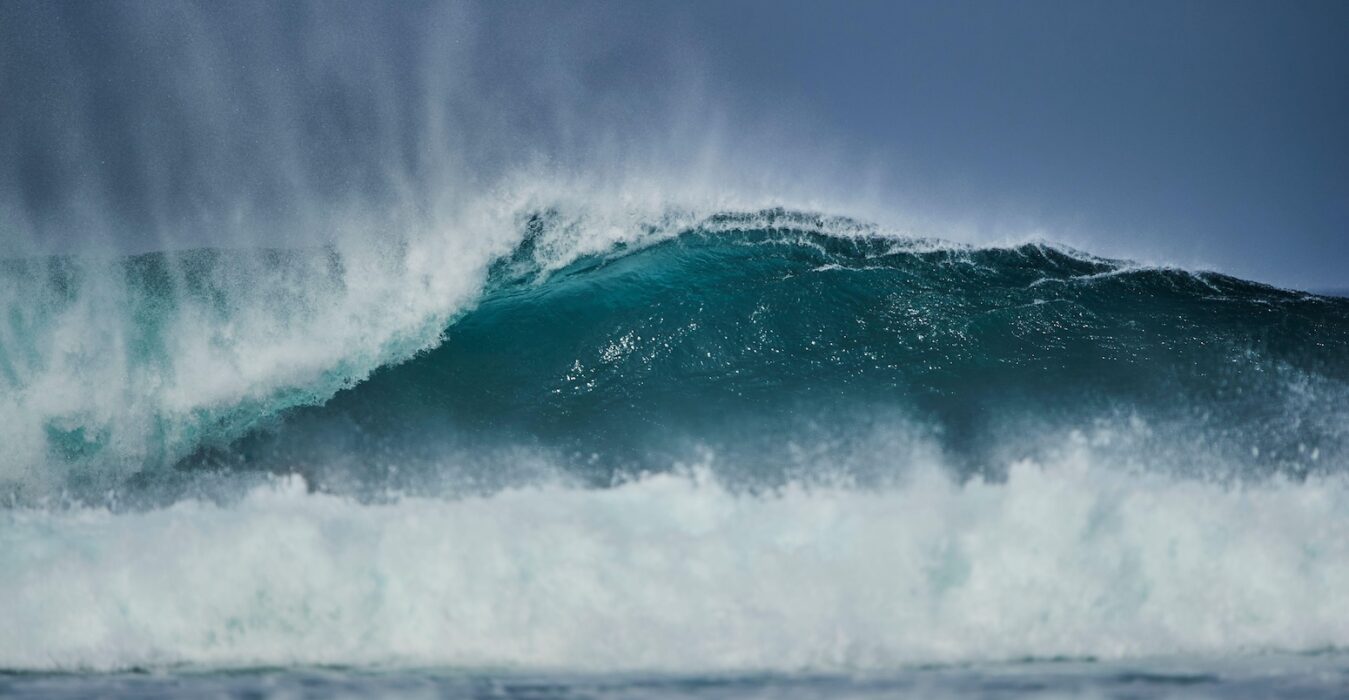
Huge wave in the Atlantic Ocean. Credit: mauritius images GmbH / Alamy Stock Photo

Tipping elements within the Earth system are increasingly well understood

Scientists have identified more than 25 parts of the Earth’s climate system that are likely to have “tipping points” – thresholds where a small additional change in global warming will cause them to irreversibly shift into a new state.

The “tipping” of these systems – which include the Atlantic Meridional Overturning Circulation (AMOC), the Amazon rainforest and the Greenland ice sheet – would have profound consequences for both the biosphere and people. 

More recent research suggests that triggering one tipping element could cause subsequent changes in other tipping elements, potentially leading to a “tipping cascade”.

For example, a collapsed AMOC could lead to dieback of the Amazon rainforest and hasten the melt of the Greenland ice sheet.

However, the interactions between individual tipping elements – and the ways they might trigger each other – remain largely underexplored.

In a review study, published last year in Earth System Dynamics, we unpack the current state of scientific understanding of the interactions between individual tipping elements. 

We find that scientific literature suggests the majority of interactions between tipping elements will lead to further destabilisation of the climate system. 

Existing research also indicates that “tipping cascades” could occur even under current global warming projections.

Scientific understanding of individual tipping elements is continuously improving, but more research on their interactions is needed.

An emerging field 

The history of tipping elements as an object of investigation is relatively short. As a result, they are only partially accounted for in current climate models

For the Intergovernmental Panel on Climate Change (IPCC), the possibility of abrupt changes in the Earth system was first mentioned in its third assessment report in 2001. At the time, climate scientists expected these changes only in scenarios where temperatures rose to 4-5C above pre-industrial levels

The term “tipping elements” was first used in the context of the climate system in 2008, in a foundational paper in the journal Proceedings of the National Academy of Sciences (PNAS).

Since then, significant progress has been made on tipping element research. 

For instance, the 2023 global tipping points report – co-authored by more than 200 researchers from 90 organisations in 26 countries – recognised that five “major” tipping elements –  the Greenland and West Antarctic ice sheets, the warm-water coral reefs, the North Atlantic Subpolar Gyre and global permafrost regions – are already “at risk of being crossed due to warming”. 

However, tipping elements have so far largely been studied in isolation. Most research has neglected the interactions between different tipping elements which could further destabilise the climate system – and eventually even lead to tipping cascades. 

Tipping cascades

Interactions between tipping elements clearly exist. 

For example, we find robust evidence that an influx of freshwater into the North Atlantic caused by the disintegration of the Greenland ice sheet would destabilise the AMOC and could trigger its slowdown. (This, in turn, could result in the ocean currents moving less heat from equatorial regions to higher latitudes, leading to significant cooling in Europe.)

In worst-case cascading scenarios, the tipping of one system directly leads to the tipping of another. In less dramatic cases, it only reinforces destabilisation of other systems.

So, what additional effects are to be expected from these interactions?

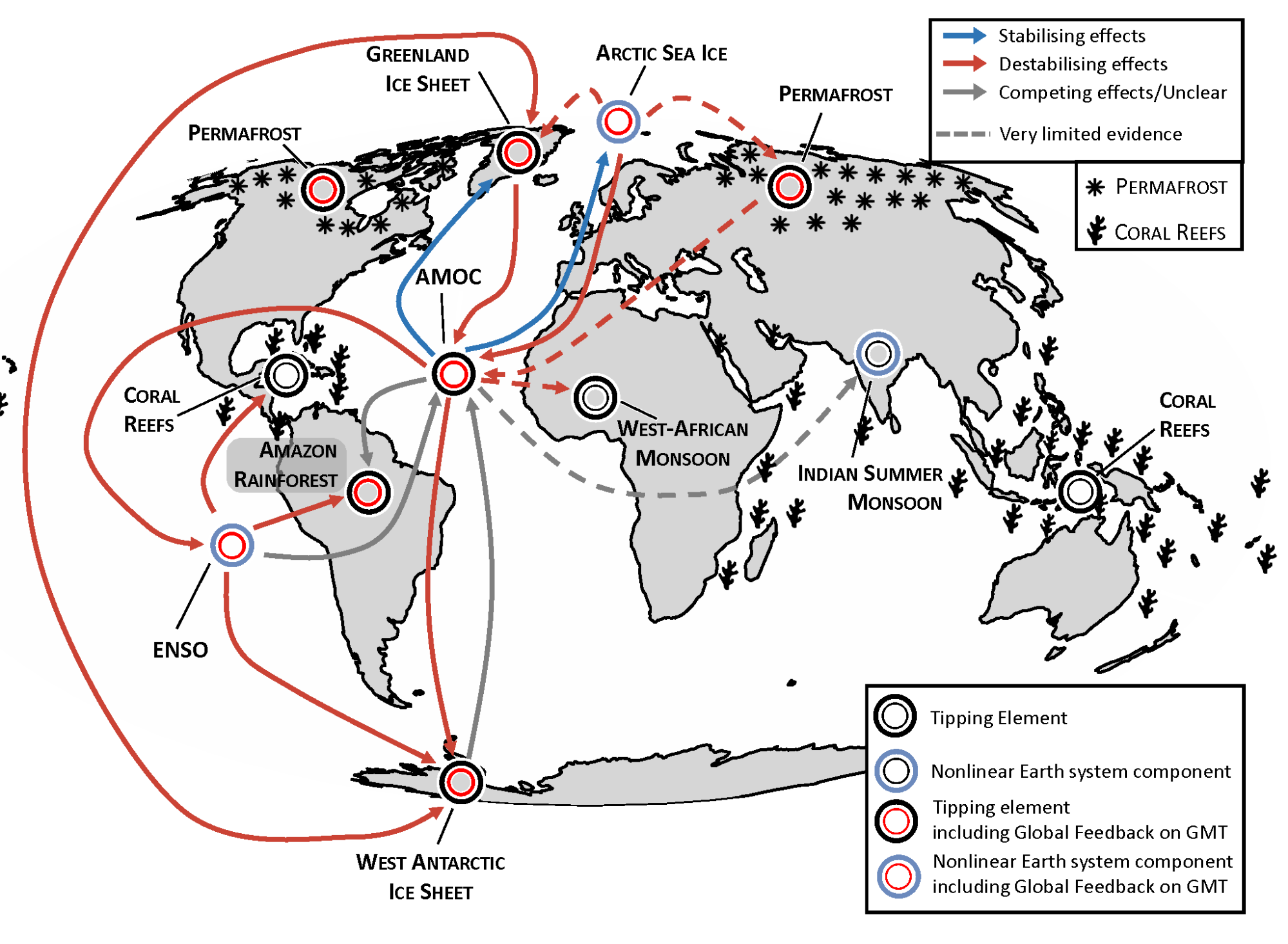
The map below shows how 13 out of 19 tipping element interactions analysed in our review study are expected to lead to further destabilisation. The arrows indicate destabilising (red), stabilising (blue) or competing (grey) effects, while the dashed lines show where there is only limited evidence for a connection.

A prominent example of a tipping point that leads to further destabilisation is the impact of changes to the AMOC. The weakening or collapse of the system of ocean currents may lead to accumulation of warm ocean water in the Southern Ocean, which could, in turn, contribute to a destabilisation of the West Antarctic ice sheet. 

It has also been suggested that a weaker AMOC could promote El Niño events by increasing the temperature difference between the equator and the poles, which would strengthen trade winds. (While the El Niño-Southern Oscillation, or ENSO, is not a tipping element, it may play an important role as a propagator of disturbances.)

There are also a few examples – two out of 19 interactions – where a tipping point can help stabilise another system. For example, the weakening of AMOC could lead to an interrupted flow of warm water from equatorial to the polar Atlantic regions. This would drastically cool large parts of the polar region and could therefore stabilise the Greenland ice sheet. 

Map of interactions between tipping elements.
Map of interactions between tipping elements. Stabilising effects are shown in blue, destabilising effects in red, and unclear effects in grey. Effects with very limited evidence are denoted by dashed lines. Credit: Wunderling et al. (2024)

A conceptual model

While scientists have gathered evidence for tipping points from observations, models and proxy data from the distant past, we still need more research to study interactions.

Our ongoing research aims to quantify the risk of tipping cascades using a conceptual computational model. 

The model is “conceptual” in the sense that it is not grounded in physical or chemical processes, such as heat transfer or circulation patterns. Instead, a range of measurements  – such as global average temperature, tipping temperature and temperature overshoot trajectory – serve as “modelling parameters” that can be varied to study a large range of possible scenarios. 

To date, the model is limited to simulating the Amazon rainforest, the AMOC and the West Antarctic and Greenland ice sheets – tipping elements whose respective interactions are relatively well established. 

However, using this model we can investigate – among other things – tipping risks under different so-called temperature “overshoot” scenarios. 

This is where global warming peaks at a certain temperature level – for example, 2C – before declining to a lower long-term stabilisation temperature. (The subsequent decline is assumed to be the consequence of a global roll-out of negative-emission technologies, as assessed in several recent publications.). The difference between the peak temperature and the long-term stabilisation temperature is the overshoot.

Evaluating millions of scenarios, our model calculates “tipping risks” for fixed combinations of a particular overshoot and stabilisation temperature.

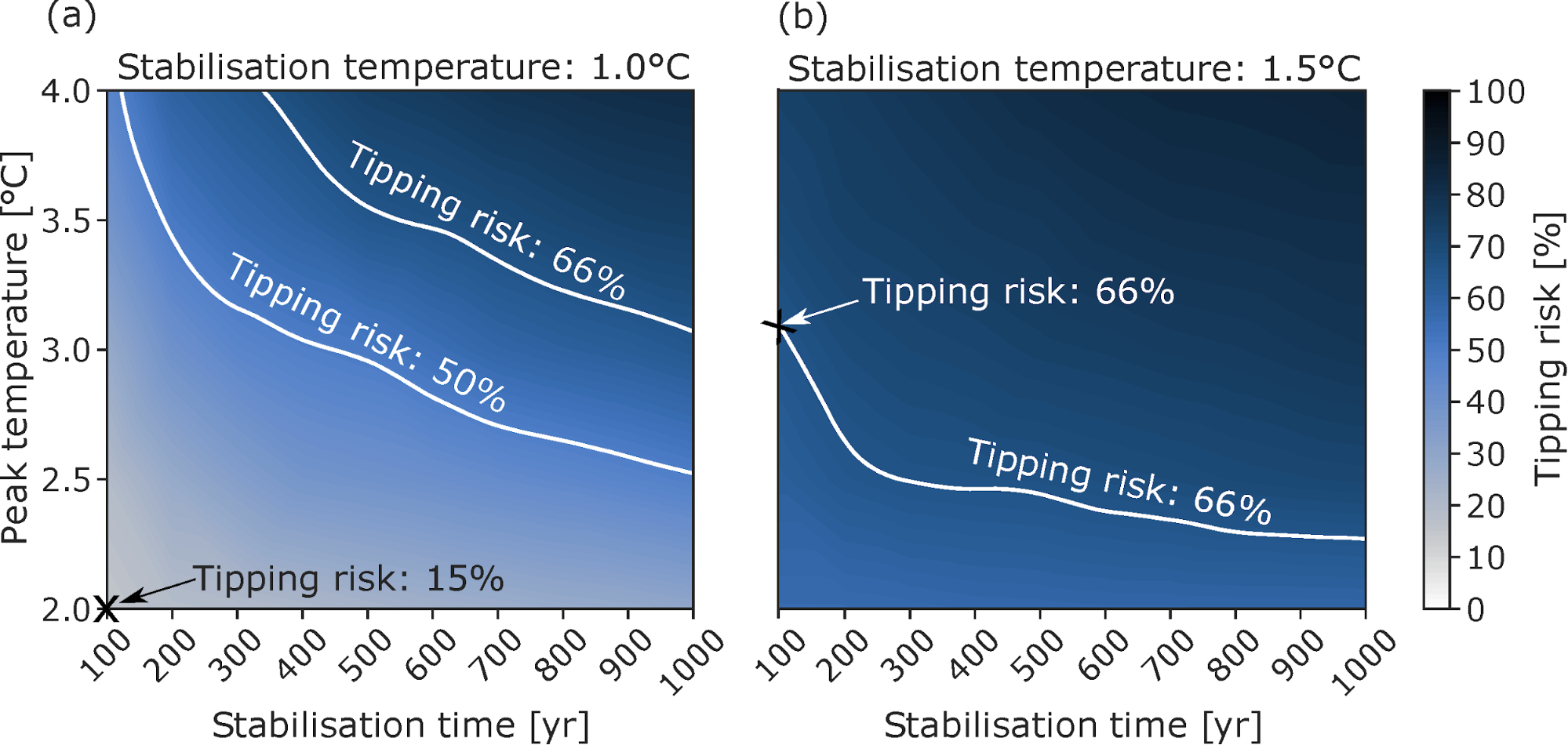
The main finding of the research is that long-term tipping risks are in the order of 15% if warming peaks at 2C and then stabilises at 1C. 

In contrast, in a scenario where the peak warming reaches 3C and stabilises at 1.5C in the 22nd century, there is a 66% probability that at least one of the four modelled tipping elements would lose stability.

The figure below shows tipping risks where warming peaks at between 2C and 4C (“peak temperature” on y-axis) and takes 100-1,000 years to stabilise (“stabilisation time” on x-axis). 

The figure on the left shows tipping probabilities where temperatures eventually stabilise at 1C and the figure on the right where temperatures settle at 1.5C. Darker colours represent higher tipping risks.

The figure shows how tipping risks increase with higher peak and stabilisation temperatures, as well as with longer stabilisation times.

Tipping risks under global warming overshoots for peak temperatures
Tipping risks under global warming overshoots for peak temperatures (between 2C and 4C) and overshoot durations (stabilisation time of 100 to 1,000 years) for stabilisation temperatures of 1C (left), and 1.5C (right). Credit: Adapted by the authors from figure 3 in Wunderling et al. (2023)

While solidly calculated and based on recent scientific literature, our results can not count as projections of future climate due to the conceptual nature of our underlying model. 

Nevertheless, the findings are useful and complement findings from traditional climate models, known as General Circulation Models (GCMs). 

GCMs have only started to fully address the dynamics of tipping elements and their interactions. For example, most do not yet feature fully interactive ice-sheet dynamics, nor their interactions with global oceans. 

In a paper published last November, we used our conceptual model to show that neglecting interactions between the Greenland ice sheet and the AMOC can alter the expected number of tipped elements by more than a factor of two.

In addition, the high cost of running GCMs means researchers cannot run large “ensembles” of multiple model simulations to account for uncertainties in knowledge of key parameters. Our simplified conceptual model, on the other hand, can account for this uncertainty.

By drastically reducing physical complexity, we are able to compute several million – and up to a billion – ensemble members in large-scale Monte Carlo simulations.

Historical tipping events

While our results need to be confirmed by more complex Earth system models, such as GCMs, they hint at the need for scientists to examine interactions between tipping elements and potential tipping cascades more closely. 

The study of abrupt climate changes of the distant and not-so-distant past is critical to convince researchers of the existence and significant impact of tipping cascades. 

A potential candidate for investigation is the Eocene–Oligocene transition. This took place roughly 34m years ago and led to the formation of a continent-scale ice sheet on Antarctica which buried the region’s forests. 

The transition likely involved the interaction of several tipping elements, including global deep-water formation, the Antarctic ice sheet, polar sea ice, monsoon systems and tropical forests. The monsoon-like climate of the Antarctic content at the end of the Eocene would have had to change drastically – or tip – to allow for glaciation during the transition to the Oligocene. 

Since the events at that time were also linked to a major loss of mammal species, mostly in Europe, the Eocene–Oligocene transition might even have involved a climate-ecology tipping cascade. 

Heinrich events, which took place in the last ice age – around 120,000 to 11,500 years ago – as well as the mid-Holocene, could also be especially revealing around what we can expect in the near future.

These events, which involved the release of icebergs into the North Atlantic, resulted in a fresh water inflow that substantially weakened the AMOC. This, in turn, led to the drying of northern Amazonia and the retreat of the rainforest. Today’s melting of the Greenland ice sheet could have similar consequences for the AMOC. 

While these climate changes in the past happened through natural drivers, humans are potentially forcing these rapid changes now in the modern era through emissions of carbon dioxide, possibly on a much faster timescale. 

Updated climate models

The science of interacting tipping elements and tipping cascades is in its early stages – and there is significant debate within the scientific community on the topic. 

Some consider a global reorganisation of the climate system induced by tipping elements and cascades to be speculative, given that recent observations are not available and proxy data is scarce. 

Additionally, there is scientific uncertainty of how tipping processes may play out across different spatial scales, as well as how to increase the resilience of tipping elements against perturbations.

Therefore, significant work is underway to investigate tipping processes in complex Earth system models. The Tipping Points Model Intercomparison Project (TIPMIP) and European Union-funded projects ClimTIP or TipESM are among a raft of such initiatives.

Although these initiatives are largely looking at tipping elements in isolation, they will also shed more light on the interactions between these important parameters of the Earth’s climate system stability.

Original article by Dr Nico Wunderling and Thilo Körkel republished from Carbon Brief under a CC license

Neo-Fascist Climate Science Denier Donald Trump says Burn, Baby, Burn.
Elon Musk urges you to be a Fascist like him, says that you can ignore facts and reality then.

Wunderling, N. et al. (2024): Climate tipping point interactions and cascades: a review, Earth System Dynamics, doi:10.5194/esd-15-41-2024.

Continue ReadingGuest post: Exploring the risks of ‘cascading’ tipping points in a warming world