Trump Claims Venezuelan Airspace Is Closed in Latest Illegal, ‘Dangerous Escalation’
Original article by Julia Conley republished from Common Dreams under Creative Commons (CC BY-NC-ND 3.0).
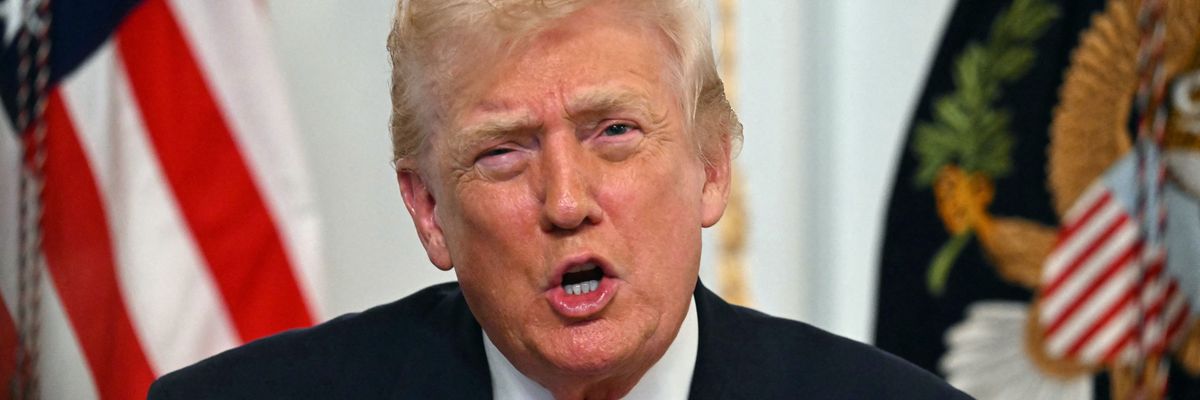
“Even if unenforced, Trump’s declaration functions as an improvised, extralegal no-fly zone created through fear, FAA warnings, and military pressure,” said the anti-war group CodePink.
Policy experts and advocates on Saturday denounced President Donald Trump’s claim that he had ordered the airspace above and around Venezuela “to be closed in its entirety”—an authority the US president does not have but that one analyst said signaled a “scorched earth” policy in the South American country and that others warned could portend imminent airstrikes.
Francisco Rodriguez, a senior research fellow at the Center for Economic and Policy Research, said that after months of escalating tensions driven by Trump’s strikes on boats in the Caribbean and other aggressive actions, the US government was treating the Venezuelan people as “chess pieces.”
“A country subject to air isolation is a country where medicine and essential supplies cannot enter, and whose citizens cannot travel even for emergency reasons,” Rodriguez told Al Jazeera.
US strikes on vessels in the Caribbean and the eastern Pacific have killed at least 83 people since early September, with Defense Secretary Pete Hegseth reportedly ordering US military officers to “kill everybody” on board when he directed the first strike. The administration claims it is conducting the strikes to stop drug trafficking from Venezuela, though US and international intelligence has shown the South American country is not involved in trafficking fentanyl to the US and serves as only a transit hub—but not a major production center—of cocaine.
The Trump administration has claimed it is engaged in an “armed conflict” with Venezuela, though Congress has not authorized any such conflict. Lawmakers from both sides of the aisle have introduced war powers resolutions to stop Trump from conducting more attacks on boats and inside Venezuela, where the president has also authorized covert CIA operations and has threatened to launch strikes.
On Thursday, Trump said in a statement to US service members that the military could begin targeting suspected drug traffickers on land “very soon,” before claiming the country’s airspace was closed Saturday morning.
The US has also sent an aircraft carrier and 10,000 troops to the region in the largest US deployment to Latin America in decades.
The Federal Aviation Administration (FAA) last week urged civilian aircraft to “exercise caution” when flying over Venezuela due to the “worsening security situation and heightened military activity in or around” the country.
That warning led six airlines to suspend flights to Venezuela, which in turn prompted President Nicolás Maduro’s government to ban the companies, including Turkish Airlines, Spain’s Iberia, Portugal’s TAP, Colombia’s Avianca, Chile and Brazil’s LATAM, and Brazil’s GOL. Maduro accused the airlines of “joining the actions of state terrorism promoted by the United States government.”
The anti-war group CodePink said Trump’s claim about Venezuelan airspace represented “a dangerous escalation with no legal basis and enormous regional consequences.”
“The United States has no authority to close another country’s airspace,” said the group. “Under international law, only Venezuela can determine the status of its skies and enforcing a foreign no-fly zone without UN authorization or host-state consent would constitute an act of war. Even if unenforced, Trump’s declaration functions as an improvised, extralegal no-fly zone created through fear, FAA warnings, and military pressure.”
Trump’s actions in Venezuela in recent weeks—which come two years after the president explicitly said he wanted to take control of the country’s vast oil reserves—“form a familiar pattern,” said CodePink.
“Manufacture a crisis, then paint a sovereign government as a danger to US interests, and finally use the manufactured urgency to justify military measures that would otherwise be politically impossible,” said the group. “Trying to ‘close’ the airspace of another country is an act of aggression. It risks flight disruptions, economic panic, and aviation accidents. It is also an attempt to isolate Venezuela without admitting that the US is imposing a de facto blockade. The people of Venezuela have lived with the consequences of Washington’s reckless interventions. They deserve peace, not another manufactured war.”
“Diplomacy, not domination, remains the only path that respects international law and regional sovereignty,” added CodePink. “Hands off Venezuela. Hands off Latin America.”
Charles Samuel Shapiro, a former US ambassador to Venezuela, emphasized that Trump’s latest move in what he claims is a battle against drug trafficking came a day after he announced a pardon for right-wing former Honduran President Juan Orlando Hernández, who was convicted of working with drug traffickers.
“The whole drug trafficking thing is simply a pretext,” Shapiro told Al Jazeera. “If you look at the US government’s own reports, drugs coming into the United States from Venezuela are minimal, so declaring these people to be ‘narcoterrorists’—it makes no sense.”
Original article by Julia Conley republished from Common Dreams under Creative Commons (CC BY-NC-ND 3.0).

- As Trump Issues New Threats to Mexico and Colombia, Democrats Push to End Unauthorized Aggression
- US Troops Near Venezuela Reportedly Denied Holiday Leave as Fears Grow of Unpopular and Lengthy Trump War
- Former Caribbean Leaders Denounce Trump’s Military Escalation in the Region ›
- Trump says airspace above and surrounding Venezuela to be … ›
Italy holds third general strike in three months, against war budget and for Palestine
Original article by Ana Vračar republished from peoples dispatch under a Creative Commons Attribution-ShareAlike 4.0 (CC BY-SA) license.
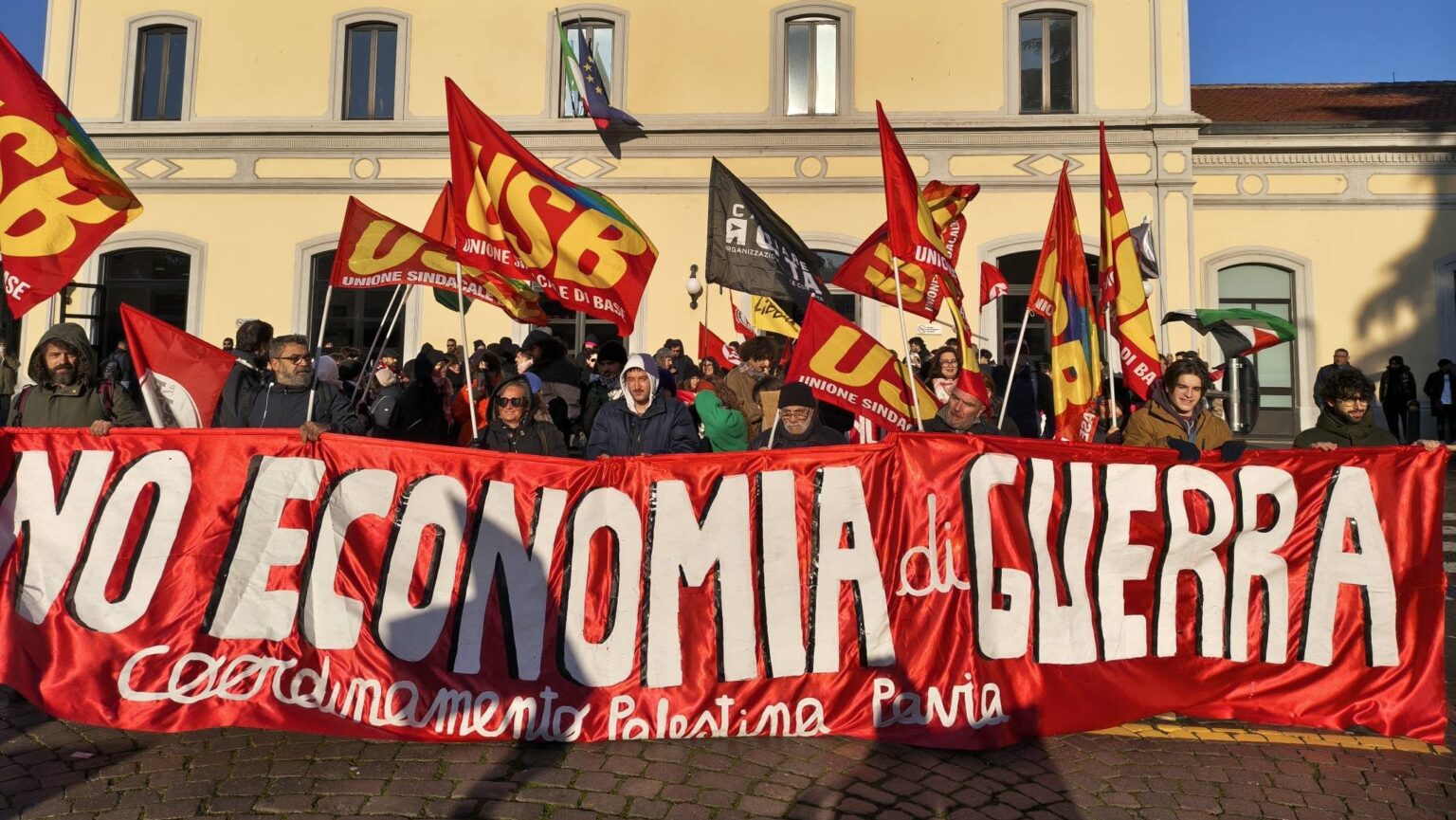
Workers in Italy have launched their third general strike in under three months, demanding an end to Meloni’s war agenda and budget.
Italy is on general strike for the third time in less than three months, following a call by the grassroots union Unione Sindacale di Base (USB). Pickets, industrial actions, and demonstrations were organized in over 40 cities, with massive rallies demanding an end to rearmament plans and the war budget shaped by Giorgia Meloni’s government.
On Friday, workers stressed that their mobilization is tied both to worsening material conditions at home and to international events, specifically the struggle of the Palestinian people – whose fate, they insist, is inseparable from Europe’s expanding war economy. As a result, those striking today reiterated their commitment to join the national march for Palestine in Rome, taking place on Saturday, November 29.
“The Meloni government’s rearmament budget is in line with the warmongering policies pursued in recent years, but it also represents a further leap in quality, with public services being sacrificed on the altar of the war economy, all while inflation continues to rise and wages have been stagnant for decades,” USB and the dockworkers’ collective CALP wrote in one of the strike calls.
“We want at least €2,000 in base pay, retirement no later than 62, an end to subcontracting, reduced working hours with no loss of pay, guaranteed housing rights, new public-sector hiring, and free, universal public health care,” USB added. “These are urgent needs in an exhausted country, needs that are incompatible with the government’s warmongering.”
Italy’s social situation is “a political choice,” workers say
Like other European governments, Meloni’s administration has aligned itself with the European Union’s armament agenda. According to trade unions, this will mean billions for the military and related industries while essential public services fall apart. CALP described the new budget as one that freezes wages, ignores inflation, and prioritizes banks and capital gains. “While prices keep rising, salaries stay stagnant and pensions are cut every year,” the collective stated. “We work more, earn less, and live worse. This isn’t a crisis: it’s a political choice, and workers are the ones paying for it.”
Read more: Belgian workers reject Arizona’s austerity in three-day strike wave
Calls for the government’s dismissal could be heard across today’s actions, together with refusals to accept the shift toward militarization and military enrollment. Groups including left party Potere al Popolo and student collectives CAU and Cambiare Rotta marched with striking workers, blocking roads and picketing companies set to profit from military budgets while healthcare and education are left underfunded.
Messages of support arrived from abroad as well. UN Special Rapporteur Francesca Albanese and Freedom Flotilla participants Greta Thunberg and Thiago Ávila announced they would join the 28-29 November mobilizations in person. Artists including Roger Waters, as well as international trade unions and Palestine solidarity coalitions, expressed solidarity with the strike. “USB’s strikes have shed a bright light on the shameful complicity of the Italian government and Italian corporations in enabling Israel’s genocide, illegal occupation and apartheid against Palestinians,” the BDS National Committee wrote. “They have shown the power of the people and inspired many across the globe.”
In a letter to USB, the Galician Unions Confederacy (CIG) emphasized the strike’s relevance in the context of the EU’s ReArm Europe strategy and the rise of the far right. “We reject the policies promoted by the EU and its member states, which fuel a warmongering escalation and commit to increasing military budgets at the expense of public services and social support,” CIG stated. “And we are concerned about the fascist drift toward which Europe is heading, of which the Meloni government is a clear example.”
Read more: Is fascism back in Europe? A conversation with the Zetkin Forum
Unlike the general strike in October, in which the confederation CGIL joined USB’s call in a rare moment of unity, the call for today’s action came from grassroots unions alone, with CGIL planning its own strike in mid-December. This, however, did not diminish USB’s determination. “Calling the third general strike in just over two months is not a decision to be taken lightly or symbolically,” they wrote.
Instead, they reiterated that today’s strike was intended to table concrete demands and alternatives. The strike, USB added, should not be perceived as a one-off protest but as “an event that represents not only a stage of mobilization, but also a decisive political step to give a voice to those who can’t make ends meet, those working for starvation wages, and those watching their futures crushed by wars, inequality, and the choices of a government hostile to workers.”
Original article by Ana Vračar republished from peoples dispatch under a Creative Commons Attribution-ShareAlike 4.0 (CC BY-SA) license.
After the “Iron Wall”: Israel launches another large-scale operation in northern West Bank
Original article by Aseel Saleh republished from peoples dispatch under a Creative Commons Attribution-ShareAlike 4.0 (CC BY-SA) license.
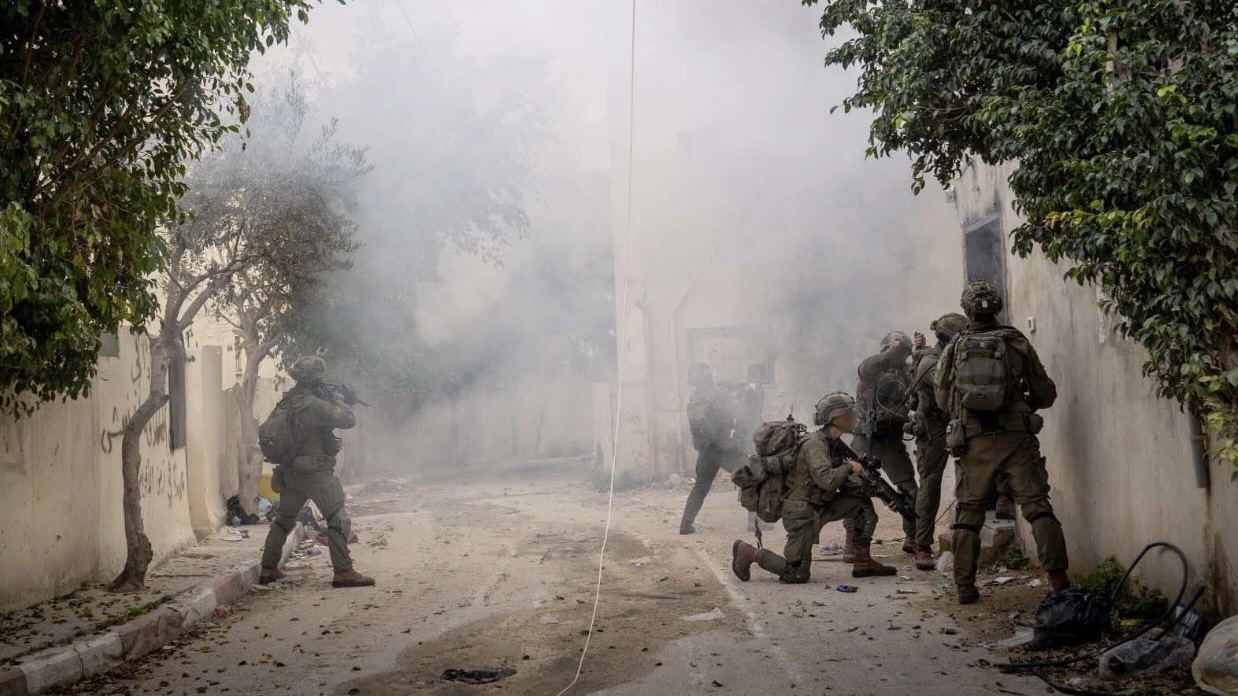
The IOF claims that the extensive military campaign aims to crackdown on new Palestinian armed resistance groups in the making.
After Israel’s 10-month “Iron Wall” operation in the northern governorates of the occupied West Bank had failed to eradicate Palestinian resistance, the Israeli Occupation Forces (IOF) launched yet another extensive military campaign on Wednesday, November 26, targeting the same areas.
The IOF and the Israel Security Agency (known as Shin Bet) said in a joint statement on Wednesday morning, that the new operation aims to prevent emergent Palestinian resistance groups from being established in several areas in the northeast of the West Bank, including Tubas, Tammun, and Aqaba.
According to Israeli newspaper Yedioth Ahronoth, the intensive military action involves three IOF brigades, forces from the Commando Brigade, Samaria and Menashe regional brigades, Shin Bet agents and Border Police officers.
The Israeli Air Force is also taking part in the operation by carrying out strikes “to isolate and seal off” the targeted areas.
The broad assault expanded to the northern governorate of Jenin on Wednesday night, resulting in the killing of Osama Kameel (20) in Qabatia town.
On Thursday, November 27, the IOF announced that the Israeli Air Force targeted seven sites allegedly used as hideouts by resistance groups in different parts of the West Bank with airstrikes.
Furthermore, over 220 sites were searched, dozens of Palestinians were interrogated and several others were detained.
Citing the Israeli Army Radio, Palestinian Ma’an news agency reported that the Israeli forces assassinated three Palestinian resistance fighters during a raid in the neighborhood of Jabal Abu Dhuhair, in the outskirts of Jenin refugee camp on Thursday. However, the identities of the slain Palestinian men have not been revealed yet.
The operation was preceded by bloody days across the West Bank
Israel’s new wide-scale offensive followed some of the bloodiest days across the West Bank, during which the IOF had murdered a number of Palestinian youths.
On Friday, November 21, Israeli soldiers shot dead Amr Al-Marboua (18), and Sami Mashaikha (16) during a military incursion in the town of Kafr Aqab, north of occupied Jerusalem.
Palestinian police officer Younis Shtayyeh (24) was also killed by the IOF on Friday, in the town of Tell near the northern West Bank city of Nablus.
On Sunday, November 23, Adel Qazzaz (26) succumbed to injuries he sustained after being shot by Israeli troops days earlier in Dura town, in the West Bank southern governorate of Hebron.
That same day saw the killing of Baraa Maali (20) at the hands of the IOF, while he was confronting an attack by illegal Israeli settlers on the village of Deir Jarir northeast of the Ramallah and Al-Bireh governorate, in the central occupied West Bank.
“Resistance is a viable and continuous effort”
The current Israeli military campaign in the northern West Bank marks a crucial development, because it has once again confirmed the determination of the Palestinian people to continue resisting Israel as a fascist occupying power.
Analysts claim that while Netanyahu’s government has relentlessly sought to resolve the Arab-Israeli conflict by waging a brutal indefinite multi-front war across West Asia, its goal seems to be far from attainable, as facts on the ground show that the peoples of the region continue to support the path of resistance.
This approach brings to mind the legacy of late Palestinian resistance icon and writer, Basel Al-Araj, who once said: “Resistance is a viable and continuous effort”.
Original article by Aseel Saleh republished from peoples dispatch under a Creative Commons Attribution-ShareAlike 4.0 (CC BY-SA) license.


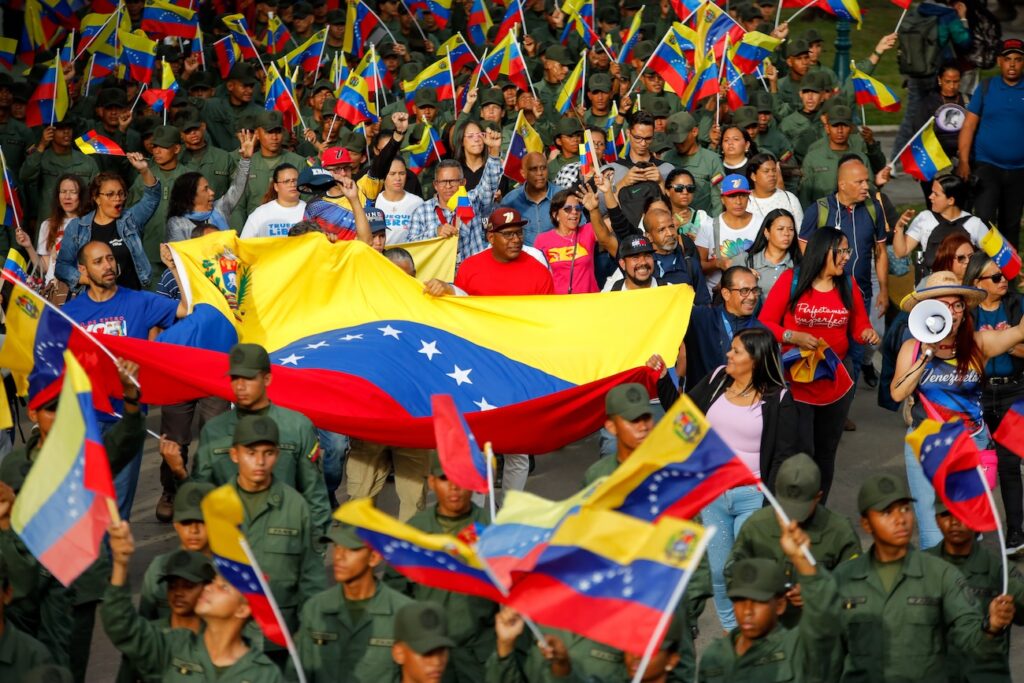
Mass mobilization in Caracas rejects US threats of intervention
Original article by Pablo Meriguet republished from peoples dispatch under a Creative Commons Attribution-ShareAlike 4.0 (CC BY-SA) license.
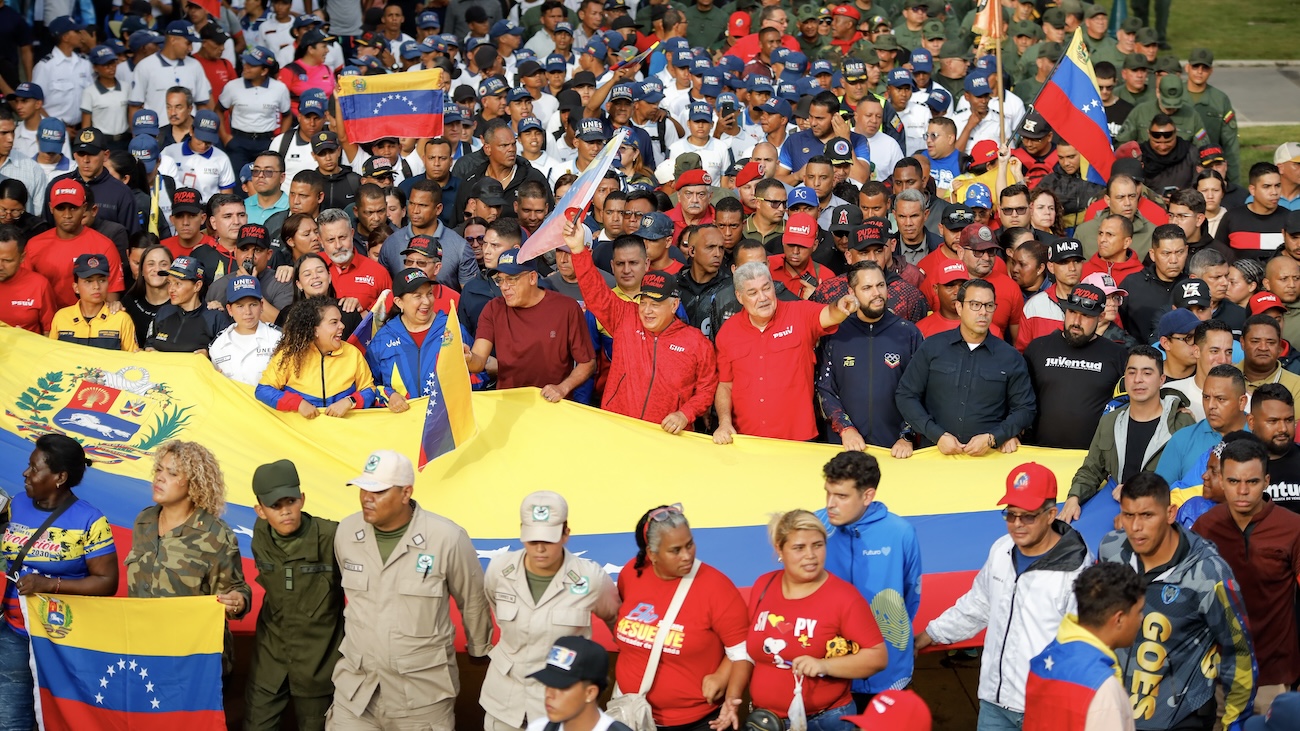
Demonstrators marched through central Caracas and demanded an end to military threats against Venezuela. For his part, Trump is keeping the lines of communication open with Caracas while increasing pressure on Chavista leaders.
On November 25, tens of thousands of Venezuelans marched to defend national sovereignty. The event, dubbed the “Great Civic-Military, Police March for our National Flag and the Sword of Bolívar”, brought together various groups of military personnel, police, and civilians who demanded an end to Washington’s pressure on the Caribbean country.
Since August, the Pentagon has deployed its troops in the Caribbean Sea to, according to the Trump administration, stop the entry of drugs which allegedly come out of Venezuela. At the same time, they have declared the Cartel de los Soles an international terrorist organization and identified the Venezuelan government leadership as part of that organization.
Read more: US deploys aircraft carrier and threatens invasion of Venezuela, while expanding “drug” war to Colombia
However, Caracas has categorically rejected the accusations, which, according to Chavismo, are a crude and false attempt to pave the way for the overthrow of President Nicolás Maduro and establish a puppet government allied with the demands and needs of the United States, which would be after Venezuela’s mineral and oil reserves, the largest in the world.
Tuesday’s demonstration took place in the center of Caracas, the country’s capital, and sought to showcase and strengthen the mass popular defense of Venezuela’s sovereignty in the face of possible US military intervention. “Bolívar is more alive than ever among us, the anti-imperialist Bolívar, the genius Bolívar…” said PSUV secretary and Interior Minister Diosdado Cabello.
For several weeks, Chavismo has been preparing for a possible scenario in which it must face an invasion by the world’s largest military power. To this end, it has carried out coordination exercises between the organized bases of Chavismo, the National Bolivarian Militia, and the army and police.
In this regard, Defense Minister Vladimir Padrino emphasized that Washington’s recent actions are intended to cause fear and intimidate the Venezuelan people: “Bombers, ships, destroyers, submarines, all equipped with guided missiles; fighter planes approaching the coast, trying to intimidate a people.” Despite this, he affirmed that Venezuelan forces are ready to respond to any scenario.
During the mobilization, Maduro told attendees: “Venezuela faces a decisive moment for its existence… There is no excuse for anyone, whether civilian, politician, military, or police, to make excuses. Failure is not an option! Our homeland demands our utmost effort and sacrifice.”
Trump’s ambiguity
For its part, the Trump administration continues to maintain an ambiguous stance on the situation in Venezuela. On the one hand, it has ordered the Cartel de los Soles to be declared a terrorist organization, which, according to Washington’s official line, makes Maduro the leader of a terrorist group.
However, Trump is aware of the enormous political damage that an attack on Venezuela could cause his administration. Perhaps that is why he is not ruling out the possibility of forcing Maduro out through hard diplomacy, namely through the pressure his troops are exerting on Venezuela’s borders in the Caribbean Sea.
On November 25, Trump said: “If we can save lives, if we can do things the nice way, that’s fine… [But] if we have to do it the hard way, that’s fine too.”
Many have seen the upcoming visit to the Dominican Republic by Pete Hegseth, the US Secretary of War, as a new maneuver to strengthen their military positions. Dominican President Luis Abinader, an ally of Washington, reported that the purpose of the visit is to strengthen the joint fight against drug trafficking in the region, which can be interpreted as an alliance in preparation for a war scenario in the Caribbean Sea.
Similarly, the Chief of Staff of the United States, Dan Caine, has been touring the Caribbean. Caine is one of the architects of Operation Southern Spear, the US Southern Command (SOUTHCOM) mission launched on November 13, 2025 by US Secretary of War Pete Hegseth to “removes narco-terrorists from our Hemisphere, and secures our Homeland from the drugs that are killing our people.” Presumably, though it is not clarified, the operation is a continuation of the military deployment and pressure campaign that began in August which has seen 15,000 soldiers stationed in the Caribbean and the launching of attacks on dozens of boats, resulting in the extrajudicial killings of over 80 people in international waters who, according to Washington, were carrying drugs in their boats, although several human rights organizations have strongly questioned these claims.
For his part, Albert Ramdin, the Secretary General of the Organization of American States, has called for a halt to a possible attack on Venezuela, despite his critical stance against the Chavista government: “We do not want any war in our hemisphere. Peace is, ultimately, what everyone in this hemisphere wants. No one wins in a war.”
Original article by Pablo Meriguet republished from peoples dispatch under a Creative Commons Attribution-ShareAlike 4.0 (CC BY-SA) license.
