Fidel Castro’s final reflections

Spread the love

Original article by Pablo Meriguet republished from peoples dispatch under a Creative Commons Attribution-ShareAlike 4.0 (CC BY-SA) license.
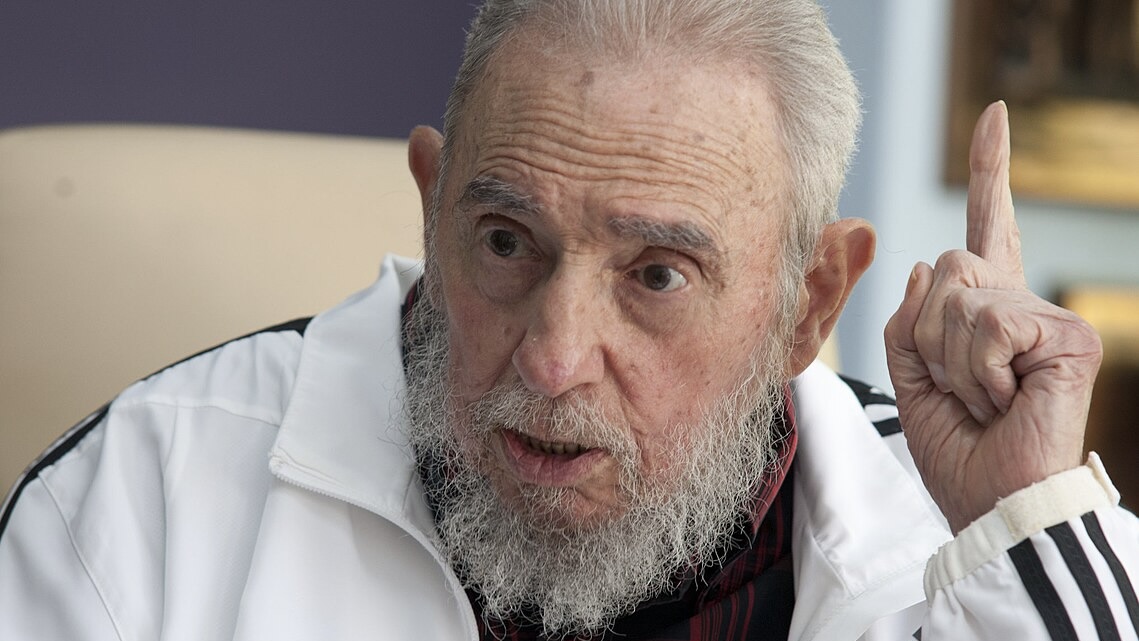
Cuban revolutionary leader Fidel Castro in 2014. Photo: Wikimedia Commons

Nine years after his death, we look back at some of the most relevant themes in Fidel Castro’s final writings after stepping down as President of Cuba.

Fidel Castro is often remembered as one of the most iconic leaders of the 20th century. Despite Washington’s unrelenting attempts to overthrow and even assassinate him, Fidel continued his rule and the development of the Cuban Revolution, which began in 1959 after the overthrow of Fulgencio Batista.

Much is written on his reflections on the development of the revolutionary struggle in the second half of the 20th century, his emblematic speeches, and his universal vision that combined the best of Leninist pragmatism with the sharpness of anti-colonial critical thinking. But Fidel’s vision of the future of humanity during his last years of life, an activity that demanded many hours of reading and writing, is often overlooked.

Read more: Fidel

In fact, Fidel resigned as President of Cuba in 2008, with the aim of ensuring that the transition to another leader would not jeopardize the existence of the Cuban Revolution; many believed that after his death, the Communist Party of Cuba’s government would collapse.

And while many said that Fidel continued to lead the country after his resignation, the truth is that his production of essays and articles increased exponentially. Foreign policy, ecology, coups d’état, and even reflections on baseball and sports were all topics that Castro covered in his copious written work, generally published in Cuban and international newspapers.

The right to live

Fidel insisted that if human beings continued down the path of savage capitalism, they would bring about the end of their own existence. For Fidel, climate change was not only a transformation of certain environmental aspects, but also the destruction of human existence: “Continuing the battle and demanding at all meetings, particularly those in Bonn and Mexico, the right of humanity to exist… is, in our opinion, the only way forward.”

Here Fidel took a stance far removed from any short- or medium-term ideological dispute to adopt a long-term vision, according to which human beings have been incapable of properly managing a legacy of billions of years once they appeared on Earth: “[Human beings] benefit from a fabulous legacy of 4 billion years provided by the Earth… They are only 200,000 years old, but they have already changed the face of the world.”

Furthermore, he found any kind of military spending deeply inappropriate in the face of the inexorable arrival of the end of humanity. “The world is suffering the consequences of climate change at the same time;… A war was the most inappropriate thing that could happen at this time.”

The nuclear danger

Few people knew more about an almost imminent nuclear war than Fidel Castro. During the Cuban Missile Crisis, the world was on the brink of self-destruction. This concern never left Castro, when he warned of the massacre that would take place years later in Palestine: “As soon as the warships of the United States and Israel take their positions… the terrible war will begin.”

Furthermore, he clearly understood that a large-scale war, especially a nuclear one, would not transform the balance of power between social classes. Thus, he warned that after such a war, only “the administration of goods and services” would remain, and it would be carried out by the same elites that currently exist.

Imperialism as a method of domination

Fidel never abandoned the idea that imperialism continued to be the capitalist system’s most refined method for extracting value and subjugating the peoples of the Third World. Militaristic policy, the essence of imperialism, could never abandon its development, even at the expense of other more pressing needs.

He emphasized that in 2008, 42% of global spending was on military expenses: “While USD 1.5 trillion is spent on defense, the number of hungry people in the world reaches 1 billion.” This disparity was no accident, but rather a strategy executed by the great powers, under the pretext of defense cooperation, to impose economic programs and projects that further dispossess Third World countries. Thus, he openly criticized Obama’s foreign policy for Latin America as a ploy to control the Amazon

Science and technology

Fidel’s Marxism could not ignore the impressive technological transformation that took place during the first decades of the 21st century. In this sense, his reflections often focused on the use that transnational companies were making, and could make, in the field of production.

“If robots in the hands of transnational corporations can replace imperial soldiers in wars of conquest… (they can) flood it with robots that displace millions of workers.” Thus, Fidel announced a new process of dispossession of labor, as carried out by the merchant bourgeoisie at the dawn of the Modern Age.

Thus, technology, climate change, imperialism, and so on, could give the impression of rampant pessimism. However, thinking that could be a mistake. It is true that there was a great deal of caution and concern in Fidel’s final reflections, but this should not be confused with a renunciation of collective struggle.

Castro’s final texts always called for organization, for not giving up the strength of will, for continuing to think and work toward another future, one that is not at the mercy of the designs of a few. In short, as Romain Rolland stated and Gramsci popularized, Fidel’s thinking perfectly executed the maxim “Pessimism of the intellect, optimism of the will.”

Original article by Pablo Meriguet republished from peoples dispatch under a Creative Commons Attribution-ShareAlike 4.0 (CC BY-SA) license.
Continue ReadingFidel Castro’s final reflections

The Caribbean faces two choices: join the US attempt to intimidate Venezuela or build its own sovereignty

Spread the love

Original article by Vijay Prashad republished from peoples dispatch under a Creative Commons Attribution-ShareAlike 4.0 (CC BY-SA) license.

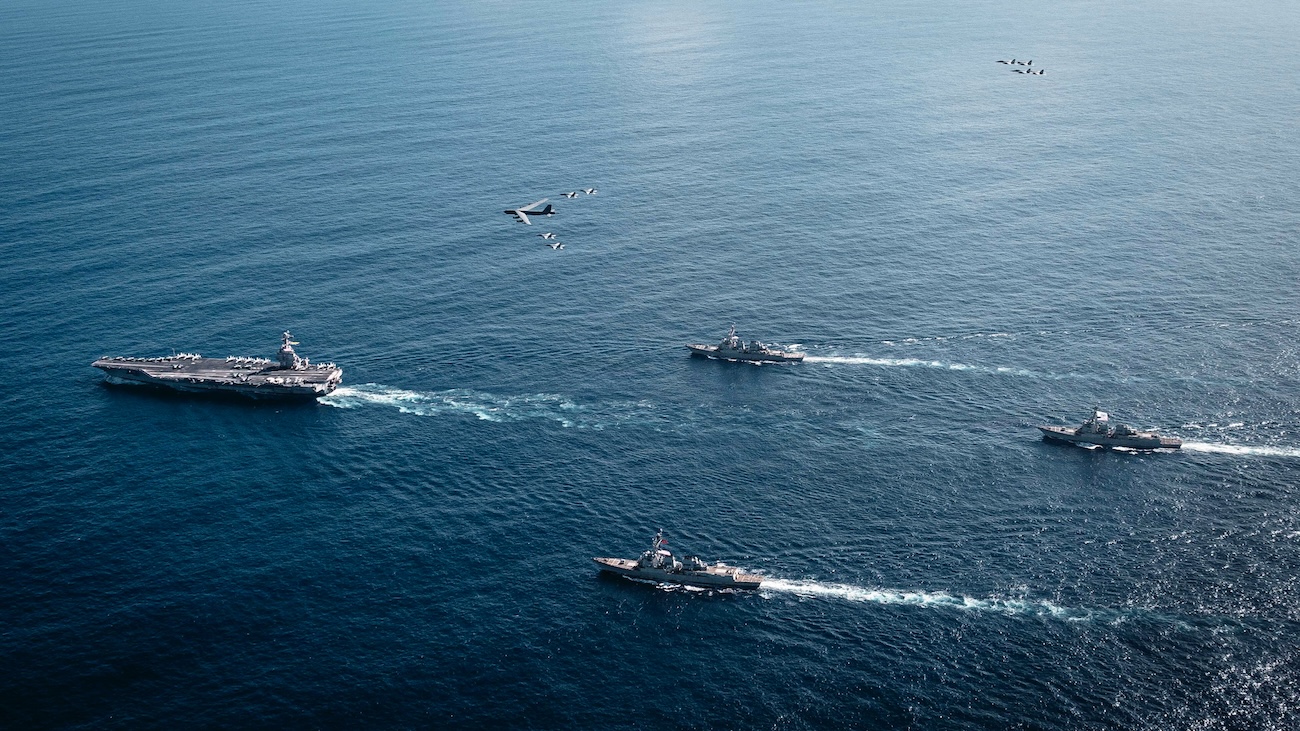
US war ships in the Caribbean. Photo: US Secretary of Defense/War

The US aggression against Venezuela has fomented divisions within the Caribbean, with many calling on countries like Trinidad and Tobago to refuse cooperation with the US in its military endeavors against the peoples of the region

US President Donald Trump has authorized the USS Gerald R. Ford to enter the Caribbean. It now floats north of Puerto Rico, joining the USS Iwo Jima and other US navy assets to threaten Venezuela with an attack. Tensions are high in the Caribbean, with various theories floating about regarding the possibility of what seems to be an inevitable assault by the US and regarding the social catastrophe that such an attack will occasion. CARICOM, the regional body of the Caribbean countries, released a statement affirming its view that the region must be a “zone of peace” and that disputes must be resolved peacefully. Ten former heads of government from Caribbean states published a letter demanding that “our region must never become a pawn in the rivalries of others”.

Former Trinidad and Tobago Prime Minister Stuart Young said on August 21, “CARICOM and our region is a recognized zone of peace, and it is critical that this be maintained”. Trinidad and Tobago, he said, has “respected and upheld the principles of non-intervention and non-interference in the internal affairs of other countries and for good reason”. On the surface, it appears as if no one in the Caribbean wants the United States to attack Venezuela.

However, the current Prime Minister of Trinidad and Tobago, Kamla Persad-Bissessar (known by her initials as KPB), has openly said that she supports the US actions in the Caribbean. This includes the illegal murder of eighty-three people in twenty-one strikes since September 2, 2025. In fact, when CARICOM released its declaration on the region being a zone of peace, Trinidad and Tobago withdrew from the statement. Why has the Prime Minister of Trinidad and Tobago gone against the entire CARICOM leadership and supported the Trump administration’s military adventure in the Caribbean?

Backyard

Since the Monroe Doctrine (1823), the United States has treated all Latin America and the Caribbean as its “backyard”. The United States has intervened in at least thirty of the thirty-three countries in Latin America and the Caribbean (90 percent of the countries, in other words) – from the US attack on Argentina’s Malvinas Islands (1831-32) to the current threats against Venezuela.

The idea of the “zone of peace” emerged in 1971 when the UN General Assembly voted for the Indian Ocean to be a “zone of peace”. In the next two decades, when CARICOM debated this concept for the Caribbean, the United States intervened in, at least, the Dominican Republic (after 1965), Jamaica (1972-1976), Guyana (1974-1976), Barbados (1976-1978), Grenada (1979-1983), Nicaragua (1981-1988), Suriname (1982-1988), and Haiti (1986).

In 1986, at the CARICOM summit in Guyana, the Prime Minister of Barbados, Errol Barrow, said “My position remains clear that the Caribbean must be recognized and respected as a zone of peace… I have said, and I repeat, that while I am prime minister of Barbados, our territory will not be used to intimidate any of our neighbors be that neighbor Cuba or the USA.” Since Barrow made that comment, Caribbean leaders have punctually affirmed, against the United States, that they are nobody’s backyard and that their waters are a zone of peace. In 2014, in Havana, all members of the Community of Latin American and Caribbean States (CELAC) approved a “zone of peace” proclamation with the aim “of uprooting forever [the] threat or use of force” in the region.

Persad-Bissessar or KPB has rejected this important consensus across political traditions in the Caribbean. Why is this so?

Betrayals

In 1989, trade union leader Basdeo Panday formed the United National Congress (UNC), a centre-left formation (whose former name was the Caucus for Love, Unity, and Brotherhood). KPB joined Panday’s party and has remained in the UNC since then. Throughout her career till recently, KPB stayed at the center of the UNC, arguing for social democratic and pro-welfare policies whether as opposition leader or in her first term as Prime Minister (2010-2015). But even in her first term, KPB showed that she would not remain within the bounds of the centre-left but would tack Far-Right on one issue: crime.

In 2011, KPB declared a State of Emergency for a “war on crime”. At her home in Phillipine, San Fernando, KPB told the press, “The nation must not be held to ransom by groups of thugs bent on creating havoc in our society”, “We have to take very strong action”, she said, “very decisive action”. The government arrested seven thousand people, most of them released for lack of evidence against them, and the government’s Anti-Gang Law could not be passed: this was a policy that mimicked the anti-poor campaigns in the Global North. Already, in this State of Emergency, KPB betrayed the legacy of the UNC, which she dragged further to the Right.

When KPB returned to power in 2025, she began to mimic Trump with “Trinidad and Tobago First” rhetoric and with even harsher language against suspected drug dealers. After the first US strike on a small boat, KPB made a strong statement in support of it: “I have no sympathy for traffickers, the US military should kill them all violently”. Pennelope Beckles, who is the opposition leader in Trinidad and Tobago, said that while her party (the People’s National Movement) supports strong action against drug trafficking, such action must be “lawful” and that KPB’s “reckless statement” must be retracted. Instead, KPB has furthered her support of the US militarization of the Caribbean.

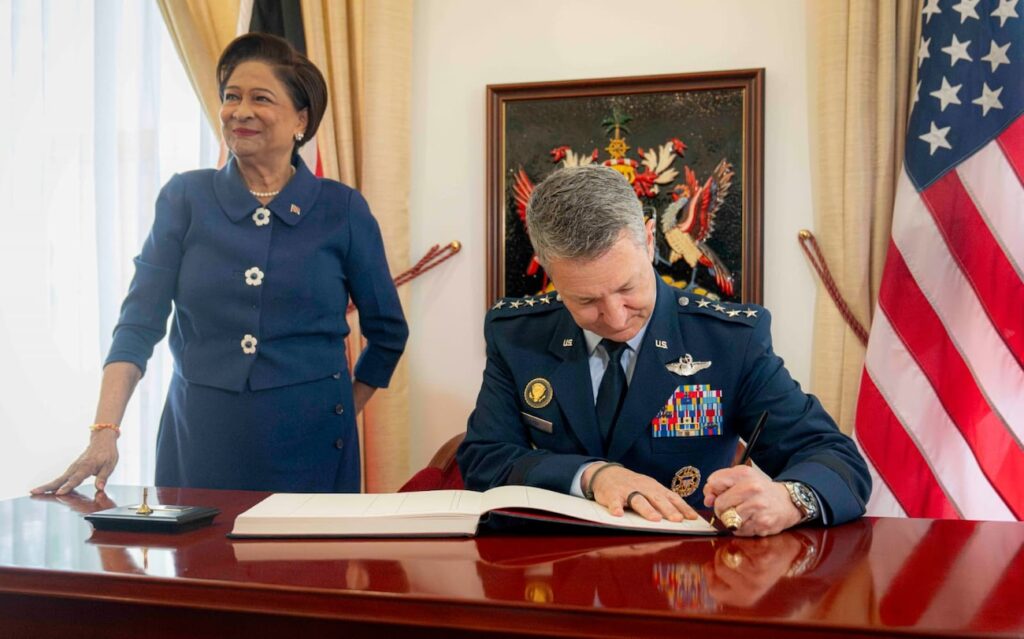
Kamla Persad-Bissessar Dan Caine
Trinidad and Tobago PM Kamla Persad-Bissessar with US Joint Chief of Staff General Dan Caine on November 25, 2025. Photo: US Embassy / X

Problems

Certainly, Trinidad and Tobago faces a tight knot of economic vulnerability (oil and gas dependence, foreign exchange shortages, slow diversification) and social crises (crime, inequality, migration, youth exclusion). All of this is compounded by the weakness of State institutions to help overcome these challenges. The weakness of regionalism further isolates small countries such as Trinidad and Tobago, which are vulnerable to pressure from powerful countries. But KPB is not only acting due to pressure from Trump; she has made a political decision to use US force to try and solve her country’s problems.

What could be her strategy? First, get the United States to bomb small boats that are perhaps involved in the centuries-old Caribbean smuggling operations. If the US bombs enough of these little boats, then the small smugglers would rethink their transit of drugs, weapons, and basic consumer commodities. Second, use the goodwill generated with Trump to encourage investment into Trinidad and Tobago’s essential but stagnant oil industry. There might be short-term gain for KPB. Trinidad and Tobago requires at least USD 300 million if not USD 700 million a year for maintenance and for upgrading its petrochemical and Liquified Natural Gas plants (and then it needs USD 5 billion for offshore field development and building new infrastructure). ExxonMobil’s massive investment in Guyana (rumored to be over USD 10 billion) has attracted attention across the Caribbean, where other countries would like to bring in this kind of money. Would companies such as ExxonMobil invest in Trinidad and Tobago? If Trump wanted to reward KPB for her unctuousness, he would tell ExxonMobil CEO Darren Woods to expand on the deepwater blocks investment his company has already made in Trinidad and Tobago. Perhaps KPB’s calculation to set aside the zone of peace ideas will get her some more money from the oil giants.

But what does this betrayal break? It certainly disrupts further any attempt to build Caribbean unity, and it isolates Trinidad and Tobago from the broader Caribbean sensibility against the use of the waters for US military confrontations. There are real problems in Trinidad and Tobago: rising gun-related violence, transnational trafficking, and irregular migration across the Gulf of Paria. These problems require real solutions, not the fantasies of US military intervention. US military interventions do not resolve problems, but deepen dependency, escalate tensions, and erode every country’s sovereignty. An attack on Venezuela is not going to solve Trinidad and Tobago’s problems but might indeed amplify them.

The Caribbean has a choice between two futures. One path leads toward deeper militarization, dependency, and incorporation into the US security apparatus. The other leads toward the revitalization of regional autonomy, South-South cooperation, and the anti-imperialist traditions that have long sustained the Caribbean’s political imagination.

Vijay Prashad is an Indian historian, editor, and journalist. He is a writing fellow and chief correspondent at Globetrotter. He is an editor of LeftWord Books and the director of Tricontinental: Institute for Social Research. He has written more than 20 books, including The Darker Nations and The Poorer Nations. His latest books are On Cuba: Reflections on 70 Years of Revolution and Struggle (with Noam Chomsky), Struggle Makes Us Human: Learning from Movements for Socialism, and (also with Noam Chomsky) The Withdrawal: Iraq, Libya, Afghanistan, and the Fragility of US Power.

Original article by Vijay Prashad republished from peoples dispatch under a Creative Commons Attribution-ShareAlike 4.0 (CC BY-SA) license.

Donald Fuhrump says that Amerikkka doesn't bother with crimes or charges anymore, not being 100% Amerikkkan and opposing his real estate intentions is enough.
Donald Fuhrump says that Amerikkka doesn’t bother with crimes or charges anymore, not being 100% Amerikkkan and opposing his real estate intentions is enough.
Elon Musk urges you to be a Fascist like him, says that you can ignore facts and reality then.
Continue ReadingThe Caribbean faces two choices: join the US attempt to intimidate Venezuela or build its own sovereignty

Palestine Action protests come to an end with 636 arrests over 12 days in over 20 towns and cities

Spread the love
defendourjuries

Over 250 people took action today (Saturday 29 November) against our government’s complicity in genocide and against the ban on Palestine Action in ten towns and cities across the UK. They were all peacefully holding signs saying “I oppose genocide. I support Palestine Action”.

Yet police only arrested 164 of them as police forces in Edinburgh and Exeter decided not to make arrests of the 55 and 35 sitters there respectively.

Today’s action brings the total of arrests to 636 in the ‘most widespread wave of civil disobedience in modern UK history’ with many more people sitting with signs that police failed to arrest. This brings the total number of Lift The Ban sign-holding arrests since the proscription to 2717.

The day of action come in the middle of the Judicial Review – which is now due to end on Tuesday 2 December – and which has been plagued by allegations of a last minute ‘stitch up’. It also comes as a second hunger striker is hospitalised and as the genocide continues in Gaza with Isreal killing at least 345 Palestinians and wounding 889 since the “ceasefire”.

The Lift The Ban actions started at 1pm and the number of sitters and arrests in each town were as follows according to on the ground observers:

📍31 – Bristol
📍25 – Birmingham
📍0 of 35 – Exeter
📍15 of 16 – Cambridge
📍18 – Sheffield
📍26 – Lancaster
📍0 of 55 – Edinburgh
📍8 – Caerdydd (Cardiff)
📍31 – Manchester
📍10 – Norwich
📍2 – Newport (Gwent)
📍2 – Presteigne

A spokesperson for Defend Our Juries said

“Yet again the ban has proven unenforceable, with police forces in Belfast, Derry, Edinburgh, Totnes and now Exeter choosing not to arrest peaceful sign-holders under ‘terror’ laws, while other forces have given up making arrests half way through.

“This historic wave of action has seen people of courage and conscience taking action to resist the government’s clampdown on our fundamental rights to protest and free speech.

“In the face of our government’s steadfast support for Israel as it carried out crimes against humanity, collective punishment and genocide, Palestine Action were the one group who made a material impact by hitting the profits of companies supplying hardware to Israel’s killing machine.

“In court this week the government has had to try and defend the proportionality of the ban. Yet it hasn’t been able to offer any argument that proscription was in the public interest. Repeated statements by government barristers make it clear that it was simply to protect the profits of arms companies.

“The ban was never in the public interest as Palestine Action never posed any threat to the public. Conflating property damage with terrorism, as the Terrorism Act 2000 does, is an insult to everyone who has lost loved ones through acts of genuine terror.

“The proscription of Palestine Action was an act of authoritarian overreach whose only purpose was to protect Israel, the arms companies supplying its genocide, and the government ministers who have been so shamefully complicit in that genocide.”

UPDATE ON THE JUDICIAL REVIEW

Avaaz launched a petition yesterday demanding an explanation from Justice Secretary David Lammy MP as to why the judge overseeing the case was removed just days before it was about to begin. The last minute switch has meant that the Judicial Review has been dogged by allegations of a ‘stitch-up’ with questions about the suitability and independence of the three replacement judges demanding to be answered. A former British ambassador suggested the result had been to “load the dice for Israel”.

On the opening day of the Judicial Review, Raza Husain KC, representing Palestine Action co-founder Huda Ammori, noted that the group was the “first direct-action civil disobedience organisation that does not advocate for violence ever to be proscribed as terrorist.” He said the ban was an “ill-considered, discriminatory, due process-lacking, authoritarian abuse of statutory power … that is alien to the basic tradition of common law and the European Convention on Human Rights.” Defend Our Juries’ Lift The Ban campaign was cited as evidence of mass civil society disagreement with the proscription.

Intervening in the Judicial Review, United Nations Special Rapporteur Ben Saul warned the ban makes the UK “out of step with comparable liberal democracies” and “sets a precedent” for further crackdown on other protest movements in the UK such as climate protesters. Amnesty International UK said it represented a substantial departure from established responses to protest movements which use direct action tactics and that it breached our fundamental rights to protest and free speech. Liberty argued the ban was disproportionate because counter-terror powers have historically been directed at groups whose modus operandi includes intentional violence against people

Best-selling author Sally Rooney told the hearing how she might no longer be able to sell or publish her books in the UK due to her support for Palestine Action. The court also heard how Keir Starmer discussed Palestine Action with Donald Trump in two phone calls before the ban after Palestine Action painted “Gaza is not for sale” on his golf course in Scotland.

The Judicial Review concludes on Tuesday 2 December when the government will present part of its defence using the secret court system known as Closed Material Procedure which has come under criticism for allowing evidence to be presented without challenge and has been described as being a system “in meltdown”. A judgement will be given at a later date. Skeleton arguments for the applicant are available on request.

SECOND HUNGER STRIKER HOSPITALISED

28 prisoners are currently being held in UK prisons without trial for allegedly taking part in actions claimed by Palestine Action known as the Filton 24 and the Brize Norton 5. Most will be held for two years without trial – exceeding the six month pre-trial custody limit – because the Crown Prosecution Service is claiming there is a “terrorist connection” on the basis of criminal damage. However no charges have been brought under the Terrorism Act against these prisoners and the actions took place before Palestine Action was proscribed by the government.

Six prisoners are now on a rolling hunger strike, some will today enter their fifth week. The hunger strike started on Saturday 2nd November – Balfour Day – with two people after the Home Secretary failed to respond to their demands including immediate bail, access to documents necessary for the right to a fair trial and the de-proscription of Palestine Action. The strike is “rolling” because more people continue to join the strike as their demands remain unmet. The conditions of their detention have been criticised by UN experts in a letter to the UK government.

It was revealed yesterday that Teuta ‘T’ Hoxha is now the second prisoner on hunger strike to be hospitalised. She was moved to the healthcare wing on Thursday, due to her rapidly deteriorating health after 20 days on hunger strike. Kamran Ahmed was hospitalised on Tuesday after collapsing on Friday 21 November.

In August of this year T Hoxa of the Filton 24 went on hunger strike for 28 days, eventually winning most of her demands. For more information on the hunger strikers see Prisoners for Palestine.

NOVEMBER WAVE OF ACTIONS

The November wave of action has seen 636 people in ten towns and cities arrested under the Terrorism Act 2000 for peacefully holding cardboard signs.

Across the UK the ban has been shown unnecessary and unenforceable as police forces in Derry, Belfast, Edinburgh and Exetert chose not to make arrests, while several local police forces in England and Wales were overwhelmed and gave up on arresting everyone.

On Wednesday 26 November, police confirmed 143 arrests outside the Royal Courts of Justice on the first day of the Judicial Review.

On Monday 24 November, around 50 people were arrested outside the Home Office where Yvette Cooper made her ill-fated decision to proscribe Palestine Action. Met Police have not publicly released a number of arrests for the action.

On Saturday 22 November, Police Service of Northern Ireland (PSNI) made no arrests of 21 people in Derry and 20 in Belfast who held the same signs as people in a London Peace Garden where the Met Police made “at least 90” arrests for terrorism offences, making a mockery of the proscription.

On Thursday 20 November, police confirmed 47 arrests outside the Ministry of Justice, where the Attorney General resides, who has approved the charges of hundreds of peaceful protestors for terrorist offences despite there being no public interest in doing so.

On Tuesday 18 November, local police forces arrested just 142 of the 237 people who took action in ten cities across the UK. After several hours forces in Aberystwyth, Truro and Oxford confirmed they would not be returning to arrest the remaining sign-holders. Police Scotland made no arrests of the 49 people who took action in Edinburgh. The police therefore failed to arrest 95 sign-holders – a full 40% – showing once again the ban is both unnecessary and unenforceable.

Palestine Action joke that appeared in the UK satirical magazine 'Private Eye'.
Palestine Action joke that appeared in the UK satirical magazine ‘Private Eye’.
Keir Starmer objects to criticism of the IDF. He asks how could anyone object to them starving people to death, forced marches like the Nazis did, bombing Gaza's hospitals and universities, mass-murdering journalists, healthworkers and starving people queuing for food, killing and raping prisoners and murdering children. He calls for people to stop obstructing his genocide for Israel.
Keir Starmer objects to criticism of the IDF. He asks how could anyone object to them starving people to death, forced marches like the Nazis did, bombing Gaza’s hospitals and universities, mass-murdering journalists, healthworkers and starving people queuing for food, killing and raping prisoners and murdering children. He calls for people to stop obstructing his genocide for Israel.
Orcas discuss Genocide-supporting and complicit Zionists. Donald Trump, Keith Starmer, David Lammy, Rachel Reeves, Angela Rayner and Wes Streeting are acknowledged as evil genocide-complicit and supporting cnuts.
Continue ReadingPalestine Action protests come to an end with 636 arrests over 12 days in over 20 towns and cities

Troubles at Your Party’s Founding Conference

Spread the love

Stories of conflict continue at Your Party’s Founding conference. Zarah Sultana has apparently boycotted the first day over exclusions. This appears quite bizarre but take a look at this video – it appears that exclusions are made on spurious grounds. The party doesn’t – or perhaps hardly – exists, who is making these exclusions?

Statement of interests: I signed up to receive emails and made a donation to Your Party when it was announced. I’ve not been getting emails now I mention it … I am not a member but of course interested in the founding of a new Socialist party and also want to report on it here.

Continue ReadingTroubles at Your Party’s Founding Conference

Palestine Action protests throughout UK

Spread the love

Protests supporting Palestine Action are held today at Edinburgh, Caerdydd (Cardiff), Manchester, Birmingham, Cambridge, Bristol, Sheffield, Exeter and Lancaster. Starting at 1pm, there are few reports so far.

Palestine Action joke that appeared in the UK satirical magazine 'Private Eye'.
Palestine Action joke that appeared in the UK satirical magazine ‘Private Eye’.
Keir "I support Zionism without Qualification" Starmer supporting genocide.
Keir “I support Zionism without Qualification” Starmer supporting genocide.
Keir Starmer objects to criticism of the IDF. He asks how could anyone object to them starving people to death, forced marches like the Nazis did, bombing Gaza's hospitals and universities, mass-murdering journalists, healthworkers and starving people queuing for food, killing and raping prisoners and murdering children. He calls for people to stop obstructing his genocide for Israel.
Keir Starmer objects to criticism of the IDF. He asks how could anyone object to them starving people to death, forced marches like the Nazis did, bombing Gaza’s hospitals and universities, mass-murdering journalists, healthworkers and starving people queuing for food, killing and raping prisoners and murdering children. He calls for people to stop obstructing his genocide for Israel.
Continue ReadingPalestine Action protests throughout UK