How US Media Hide Truths About the Gaza War

Spread the love

Original article by Norman Solomon republished from Common Dreams under Creative Commons (CC BY-NC-ND 3.0).
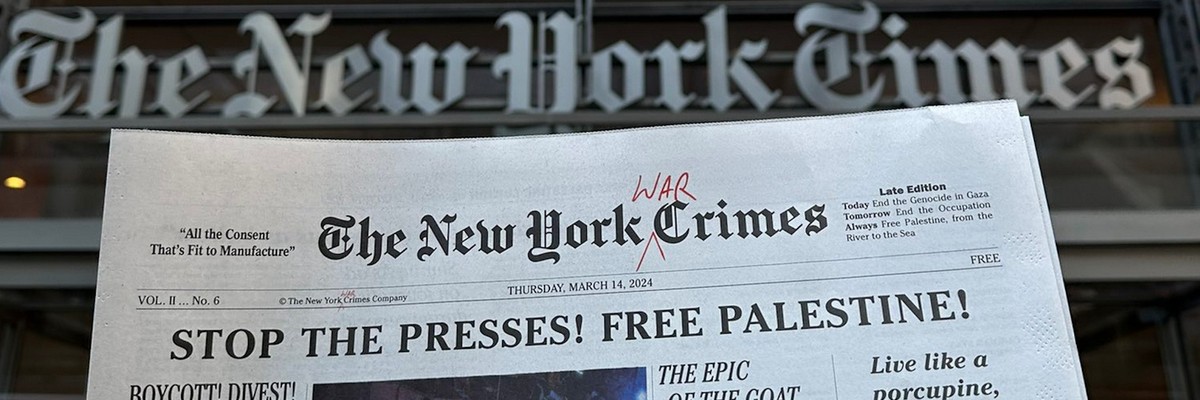
A reader holds up a copy of a satirical paper, “The New York War Crimes,” mocking The New York Times’ biased coverage of the Gaza genocide, on March 14, 2024 in New York City. (Photo: Nicki Kattoura/X)

Despite exceptional coverage at times, what was most profoundly important about war in Gaza—what it was like to be terrorized, massacred, maimed, and traumatized—remained almost entirely out of view.

A few days before the end of 2024, the independent magazine +972 reported that “Israeli army forces stormed the Kamal Adwan Hospital compound in Beit Lahiya, culminating a nearly week-long siege of the last functioning hospital in northern Gaza.” While fire spread through the hospital, its staff issued a statement saying that “surgical departments, laboratory, maintenance, and emergency units have been completely burned,” and patients were “at risk of dying at any moment.”

The magazine explained that “the assault on medical facilities in Beit Lahiya is the latest escalation in Israel’s brutal campaign of ethnic cleansing in northern Gaza, which over the last three months forcibly displaced the vast majority of Palestinians living in the area.” The journalism from +972—in sharp contrast to the dominant coverage of the Gaza war from U.S. media—has provided clarity about real-time events, putting them in overall context rather than episodic snippets.

+972 Magazine is the work of Palestinian and Israeli journalists who describe their core values as “a commitment to equity, justice, and freedom of information”—which necessarily means “accurate and fair journalism that spotlights the people and communities working to oppose occupation and apartheid.” But the operative values of mainstream U.S. news outlets have been very different.

What was sinister about proclaiming “Israel’s 9/11” was what happened after America’s 9/11.

Key aspects of how the U.S. establishment has narrated the “war on terror” for more than two decades were standard in American media and politics from the beginning of the Gaza war in October 2023. For instance:

  • Routine discourse avoided voices condemning the U.S. government for its role in the slaughter of civilians.
  • The U.S. ally usually eluded accountability for its high-tech atrocities committed from the air.
  • Civilian deaths in Gaza were habitually portrayed as unintended.
  • Claims that Israel was aiming to minimize civilian casualties were normally taken at face value.
  • Media coverage and political rhetoric stayed away from acknowledging that Israel’s actions might fit into such categories as “mass murder” or “terrorism.”
  • Overall, news media and U.S. government officials emitted a mindset that Israeli lives really mattered a lot more than Palestinian lives.

The Gaza war has received a vast amount of U.S. media attention, but how much it actually communicated about the human realities was a whole other matter. The belief or unconscious notion that news media were conveying war’s realities ended up obscuring those realities all the more. And journalism’s inherent limitations were compounded by media biases.

During the first five months of the war, the New York TimesWall Street Journal, and Washington Post applied the word “brutal” or its variants far more often to Palestinians (77%) than to Israelis (23%). The findings, in a study by Fairness and Accuracy In Reporting (FAIR), pointed to an imbalance that occurred “even though Israeli violence was responsible for more than 20 times as much loss of life.” News articles and opinion pieces were remarkably in the same groove; “the lopsided rate at which ‘brutal’ was used in op-eds to characterize Palestinians over Israelis was exactly the same as the supposedly straight news stories.”

Despite exceptional coverage at times, what was most profoundly important about war in Gaza—what it was like to be terrorized, massacred, maimed, and traumatized—remained almost entirely out of view. Gradually, surface accounts reaching the American public came to seem repetitious and normal. As death numbers kept rising and months went by, the Gaza war diminished as a news topic, while most talk shows seldom discussed it.

As with the slaughter via bombardment, the Israeli-U.S. alliance treated the increasing onset of starvation, dehydration, and fatal disease as a public-relations problem. Along the way, official pronouncements—and the policies they tried to justify—were deeply anchored in the unspoken premise that some lives really matter and some really don’t.

The propaganda approach was foreshadowed on October 8, 2023, with Israel in shock from the atrocities that Hamas had committed the previous day. “This is Israel’s 9/11,” the Israeli ambassador to the United Nations told reporters in New York, and he repeated: “This is Israel’s 9/11.” Meanwhile, in a PBS News Weekend interview, Israel’s ambassador to the United States declared: “This is, as someone said, our 9/11.”

What was sinister about proclaiming “Israel’s 9/11” was what happened after America’s 9/11. Wearing the cloak of victim, the United States proceeded to use the horrible tragedy that occurred inside its borders as an open-ended reason to kill in the name of retaliation, self-protection, and, of course, the “war on terror.”

As Israel’s war on Gaza persisted, the explanations often echoed the post-9/11 rationales for the “war on terror” from the U.S. government: authorizing future crimes against humanity as necessary in the light of certain prior events. Reverberation was in the air from late 2001, when the Pentagon’s leader Donald Rumsfeld asserted that “responsibility for every single casualty in this war, whether they’re innocent Afghans or innocent Americans, rests at the feet of the al Qaeda and the Taliban.” After five weeks of massacring Palestinian people, Israel’s Prime Minister Benjamin Netanyahu said that “any civilian loss is a tragedy”—and quickly added that “the blame should be placed squarely on Hamas.”

The licenses to kill were self-justifying. And they had no expiration date.

This piece was originally published by MediaNorth. It is adapted from the afterword in the paperback edition of Norman Solomon’s latest book, War Made Invisible: How America Hides the Human Toll of Its Military Machine (The New Press).

Original article by Norman Solomon republished from Common Dreams under Creative Commons (CC BY-NC-ND 3.0).

Continue ReadingHow US Media Hide Truths About the Gaza War

The World Stayed Silent as Israel Destroyed Gaza ‘for Generations to Come’

Spread the love

Original article by Ramzy Baroud republished from Common Dreams under Creative Commons (CC BY-NC-ND 3.0). 

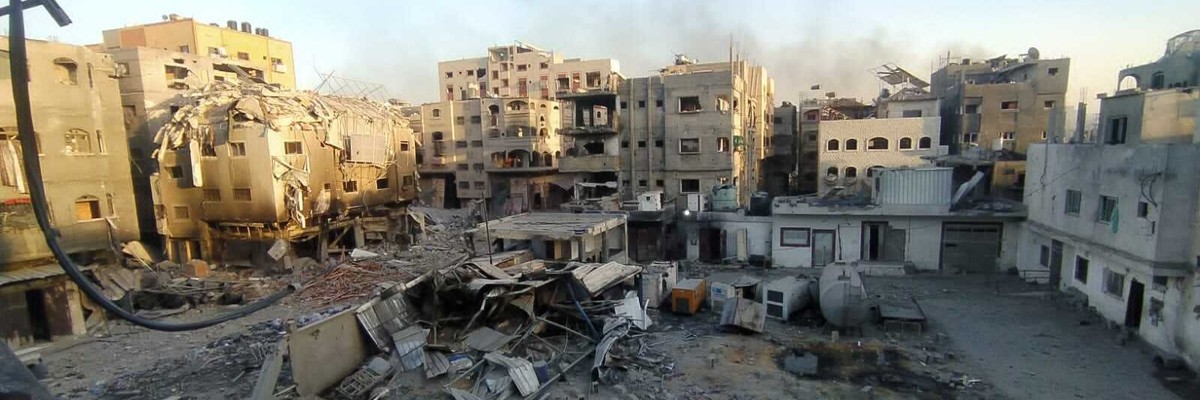
A view of destruction following the Israeli attack on the courtyard of Kamal Adwan Hospital and its surrounding buildings in Beit Lahia, Gaza on December 25, 2024. (Photo: Khalil Ramzi Alkahlut/Anadolu via Getty Images)

One wonders if the world had paid even the slightest attention to Gaza and the cries of people trapped behind walls, barbed wire, and electric fences, whether the current war and genocide could have been avoided.

The first official reference to Gaza becoming increasingly uninhabitable was made by the United Nations Conference on Trade and Development, or UNCTAD, in 2012, when the population of the Gaza Strip was estimated at 1.8 million inhabitants.

The intention of the reportThe Gaza Strip: The Economic Situation and the Prospects for Development, was not merely to prophesize, but to warn that if the world continued to stand idle in the face of the ongoing blockade on Gaza, a humanitarian catastrophe was imminent.

Yet, little was done, though the U.N. continued with its countdown, increasing the frequency and urgency of its warnings, especially following major wars.

Even after the devastating war on Gaza ends and the rebuilding of the strip concludes, the ecological and environmental harm that Israel has caused will remain for many years to come.

Another report in 2015 from UNCTAD stated that the Gaza crisis had intensified following the most destructive war to that date, the year before. The war had destroyed hundreds of factories, thousands of homes, and displaced tens of thousands of people.

By 2020, though, based on the criteria set by the U.N., Gaza should have become “uninhabitable.” Yet, little was done to remedy the crisis. The population grew rapidly, while resources, including Gaza’s land mass, shrank due to the ever-expanding Israeli “buffer zone.” The prospects for the “world’s largest open-air prison” became even dimmer.

Yet, the international community did little to heed the call of UNCTAD and other U.N. and international institutions. The humanitarian crisis—situated within a prolonged political crisis, a siege, repeated wars, and daily violence—worsened, reaching, on October 7, 2023, the point of implosion.

One wonders if the world had paid even the slightest attention to Gaza and the cries of people trapped behind walls, barbed wire, and electric fences, whether the current war and genocide could have been avoided.

It is all moot now. The worst-case scenario has actualized in a way that even the most pessimistic estimates by Palestinian, Arab, or international groups could not have foreseen.

Not only is Gaza now beyond “uninhabitable,” but, according to Greenpeace, it will be “uninhabitable for generations to come.” This does not hinge on the resilience of Palestinians in Gaza, whose legendary steadfastness is hardly disputed. However, there are essential survival needs that even the strongest people cannot replace with their mere desire to survive.

In just the first 120 days of war, “staggering” carbon emissions were estimated at 536,410 tons of carbon dioxide. Ninety percent of that deadly pollution was “attributed to Israel’s air bombardment and ground invasion,” according to Greenpeace, which concluded that the total sum of carbon emissions “is greater than the annual carbon footprint of many climate-vulnerable nations.”

report issued around the same time by the U.N. Environment Program (UNEP) painted an equally frightening picture of what was taking place in Gaza as a direct result of the war. “Water and sanitation have collapsed,” it declared last June. “Coastal areas, soil, and ecosystems have been severely impacted,” it continued.

But that was over seven months ago, when parts of Gaza were still standing. Now, almost all of Gaza has been destroyed. Garbage has been piling up for 15 months without a single facility to process it efficiently. Disease is widespread, and all hospitals have either been destroyed in the bombings, burned to the ground, or bulldozed. Many of the sick are dying in their tents without ever seeing a doctor.

Without any outside assistance, it was only natural for the disaster to worsen. Last December, Médecins Sans Frontières issued a report titled Gaza: Life in a Death Trap. The report, a devastating read, describes the state of medical infrastructure in Gaza, which can be summed up in a single word: non-existent.

Israel has attacked 512 healthcare facilities between October 2023 and September 2024, killing 500 healthcare workers. This means that a population is trying to survive during one of the harshest wars ever recorded, without any serious medical attention. This includes nearly half a million people suffering from various mental health disorders.

By December, Gaza’s Government Media Office reported that there are an estimated 23 million tons of debris resulting from the dropping of 75,000 tons of explosives—in addition to other forms of destruction. This has released 281,000 metric tons of carbon dioxide into the air.

Once the war is over, Gaza will be rebuilt. Though Palestinian sumud (steadfastness) is capable of restoring Gaza to its former self, however long it takes, a study conducted by Queen Mary University in the U.K. said that, for the destroyed structures to be rebuilt, an additional 60 million tons of CO2 will be released into an already severely impacted environment.

In essence, this means that even after the devastating war on Gaza ends and the rebuilding of the strip concludes, the ecological and environmental harm that Israel has caused will remain for many years to come.

It is baffling that the very Western countries, which speak tirelessly about environmental protection, preservation, and warning against carbon emissions, are the same entities that helped sustain the war on Gaza, either through arming Israel or remaining silent in the face of the ongoing atrocities.

The price of this hypocrisy is the enduring suffering of millions of people and the devastation of their environment. Isn’t it time for the world to wake up and collectively declare: enough is enough?

Original article by Ramzy Baroud republished from Common Dreams under Creative Commons (CC BY-NC-ND 3.0). 

Experiencing issues with this image not appearing. I suspect because it's so critical of Zionist Keir Starmer's support of and complicity in Israel's genocides.
Genocide denier and Current UK Prime Minister Keir Starmer is quoted that he supports Zionism without qualification. He also confirms that UK air force support has been essential in Israel’s mass-murdering genocide. Includes URLs https://www.declassifieduk.org/keir-starmers-100-spy-flights-over-gaza-in-support-of-israel/ and https://youtu.be/O74hZCKKdpA
Continue ReadingThe World Stayed Silent as Israel Destroyed Gaza ‘for Generations to Come’

Israeli Assault on Gaza, West Bank Continues in ‘Final Stage’ of Cease-Fire Talks

Spread the love

Original article by Jessica Corbett republished from Common Dreams under Creative Commons (CC BY-NC-ND 3.0).

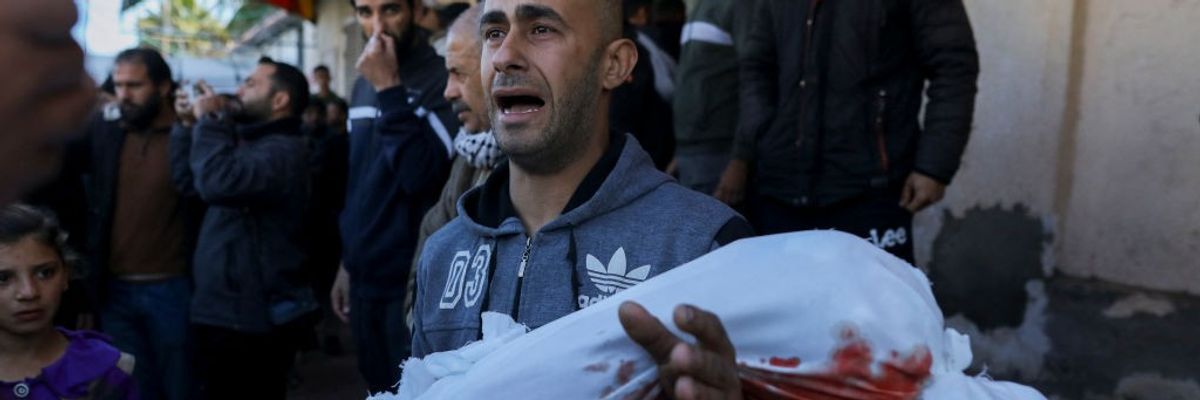
A father cries while carrying the body of his child wrapped in a blood-stained shroud west of Deir al-Balah, central Gaza Strip, on January 14, 2025. (Photo: Youssef Alzanoun/Middle East Images via AFP via Getty Images)

“As a cease-fire in Gaza is near, Israel is expanding its assault on the West Bank,” said one expert. “It was always a war on Palestinian existence.”

As negotiators in Qatar navigated the “final stage” of a cease-fire agreement to end the U.S.-backed Israeli assault on the Gaza Strip, Israel’s forces on Tuesday continued to kill Palestinians in the besieged coastal enclave and the illegally occupied West Bank.

Since the Hamas-led October 7, 2023 attack, the Israel Defense Forces (IDF) have killed at least 46,645 Palestinians in Gaza and wounded 110,012, with over 10,000 others missing, health officials said Tuesday. The true death toll could be much higher. A peer-reviewed analysis published last week in The Lancetfound that the official tally through last June was likely a 41% undercount.

The Palestinian National Authority’s news agency WAFA reported Tuesday that IDF shelling killed at least two civilians at the Nuseirat refugee camp and a correspondent in Gaza City “said that Israeli warplanes fired missiles at a house in the Sheikh Radwan neighborhood, north of Gaza City, and another house in the Manara neighborhood, south of Khan Younis City, killing several civilians and injuring others.”

According to multiple media outlets, Israeli forces also killed at least 13 people in an attack on a home in Deir al-Balah.

https://twitter.com/DropSiteNews/status/1879282625933930531?ref_src=twsrc%5Etfw%7Ctwcamp%5Etweetembed%7Ctwterm%5E1879282625933930531%7Ctwgr%5Efb190fd0cbacccf9c3169520bf576a90ec6772ee%7Ctwcon%5Es1_c10&ref_url=https%3A%2F%2Fwww.commondreams.org%2Fnews%2Fgaza-ceasefire-talks

Sorry, this content could not be embedded.
X

Israel faces a genocide case at the International Court of Justice over its assault on Gaza and in November the International Criminal Court issued arrest warrants for Israeli Prime Minister Benjamin Netanyahu and his former defense minister, Yoav Gallant, as well as Hamas leader Mohammed Diab Ibrahim Al-Masri.

In addition to waging war on Gaza over the past 15 months, Israel has stepped up its military activity in the West Bank—where a Tuesday strike on the Jenin refugee camp killed at least six Palestinians and wounded several others. The Times of Israel reported that “the IDF said it carried out the strike in a joint operation with the Shin Bet, without immediately providing further information.”

The Israeli newspaper also noted that “on Tuesday evening, as on many previous Tuesday nights, thousands gather for a unity rally of prayer and song held in Tel Aviv’s Hostages Square,” while hundreds of right-wing demonstrators blocked “an intersection in central Jerusalem, in protest of the ongoing hostage negotiations between Israel and Hamas.”

According to a draft obtained by The Associated Press, the first part of the three-stage deal would involve a halt to the fighting, both sides releasing captives, displaced Palestinians in Gaza returning home, and more humanitarian aid entering the strip.

Phase two would feature a declaration of “sustainable calm” and Hamas freeing more hostages in exchange for additional Palestinian prisoners and the full withdrawal of Israeli troops from Gaza, AP reported. The third part would include an exchange of bodies, a reconstruction plan for the strip—where civilian infrastructure is in ruins—and the reopening of border crossings.

https://twitter.com/AssalRad/status/1879253470630604879?ref_src=twsrc%5Etfw%7Ctwcamp%5Etweetembed%7Ctwterm%5E1879253470630604879%7Ctwgr%5Efb190fd0cbacccf9c3169520bf576a90ec6772ee%7Ctwcon%5Es1_c10&ref_url=https%3A%2F%2Fwww.commondreams.org%2Fnews%2Fgaza-ceasefire-talks

“The terms of the deal being negotiated are largely consistent with what was on the table last May when outgoing President Joe Biden first announced it. Biden allowed Netanyahu to steamroll him for months—rewarding Israel with billions of dollars in arms transfers and political support after rejecting that cease-fire deal,” Jeremy Scahill detailed at Drop Site News.

The latest cease-fire talks come as U.S. President-elect Donald Trump prepares for his inauguration next Monday. The Republican has been pushing for a resolution to Israel’s assault on Gaza—or at least an appearance of one—before he returns to office.

“The fact that Trump emerged as the decisive player in pushing a potential cease-fire forward is evidence that Biden never used the full powers available to a sitting U.S. president to seal the deal in the summer,” wrote Scahill. “While Trump has publicly repeated his threat that he will ‘unleash hell’ on Hamas if the Israeli hostages are not freed, his pressure has not been solely focused on Hamas; Trump and his aides have made clear to Netanyahu that the president-elect expects Israel to comply with his demands, too.”

Netanyahu on Tuesday told hostages’ families that “he is willing to agree to a prolonged cease-fire Gaza in exchange for their return,” according toHaaretz. Later Tuesday, The Times of Israel reported that the prime minister was meeting with “Israel’s hostage negotiation team and with members of Israel’s security establishment,” and expected negotiations to go through the night.

Even if a deal is reached regarding Gaza, some experts fear the bloodshed will continue there and in the West Bank

“There will possibly be an end to the Gaza war, but there will be now another war in the West Bank,” Sami Al-Arian, a Palestinian analyst and director of the Center for Islam and Global Affairs at Istanbul Zaim University, told Scahill. “It may not be on the same scale, but it would be as vicious from the settlers, from the Netanyahu government.”

Gazan writer and analyst Muhammad Shehada wrote for the U.S.-based Center for International Policy last week that a senior Arab official told him the U.S. president-elect asked the Qataris and Egyptians to finalize a deal before he takes office but the Israeli prime minister “is not budging while at the same time issuing false positive statements of a breakthrough and progress to buy time and pretend to seek a deal until Trump is in office, where Netanyahu can trade the Gaza war for something big in the West Bank.”

Sharing on social media a video of the Tuesday strike on Jenin, Middle East expert Assal Rad said that “as a cease-fire in Gaza is near, Israel is expanding its assault on the West Bank. The Gaza genocide is only the most recent atrocity Israel—with the help of the U.S.—has carried out against Palestinians. The same story for 77+ years. It was always a war on Palestinian existence.”

Original article by Jessica Corbett republished from Common Dreams under Creative Commons (CC BY-NC-ND 3.0).

Continue ReadingIsraeli Assault on Gaza, West Bank Continues in ‘Final Stage’ of Cease-Fire Talks

‘Far Too Little, Far Too Late,’ Say Critics as Biden Finally Removes Cuba From Terror List

Spread the love

Original article by Brett Wilkins republished from Common Dreams under Creative Commons (CC BY-NC-ND 3.0). 

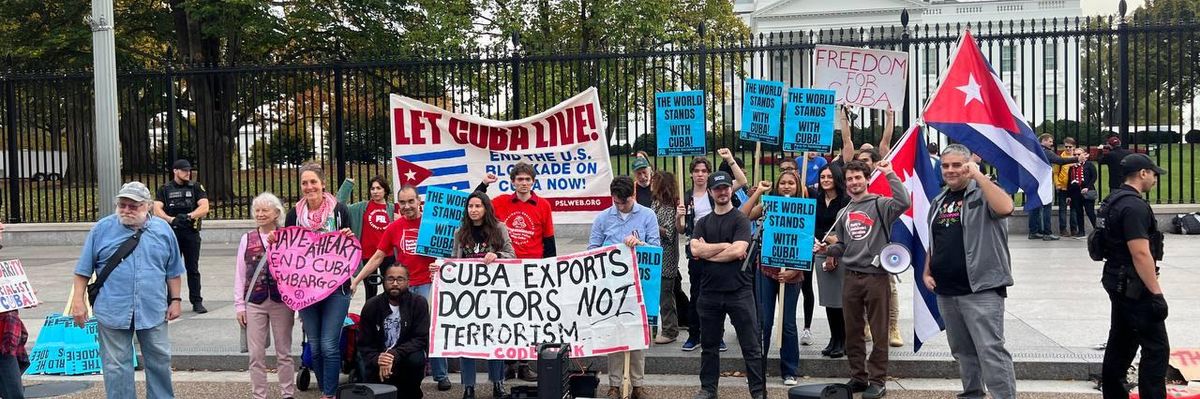
CodePink led a November 2, 2022 rally against the U.S. economic blockade of Cuba outside the White House in Washington, D.C. (Photo: CodePink)

“Seriously? You wait until six days before leaving office to do what you promised to do during your 2020 campaign?” said one observer.

In a move likely to be reversed by the incoming Trump administration, President Joe Biden on Tuesday notified Congress of his intent to remove Cuba from the U.S. State Sponsors of Terrorism list, a designation that critics have long condemned as politically motivated and meritless.

Noting that “the government of Cuba has not provided any support for international terrorism” and has “provided assurances” that it will not do so in the future, the White House said in a memo that the Biden administration is moving to rescind the first Trump administration’s January 2021 addition of Cuba to the State Sponsors of Terrorism (SSOT) list and take other measures to ease some sanctions on the long-suffering island of 11 million inhabitants.

Cuba’s SSOT designation was based mostly on the socialist nation’s harboring of leftist Colombian rebels and several U.S. fugitives from justice for alleged crimes committed decades ago, even though no other country has been placed on the SSOT list for such a reason and despite right-wing Cuban exile terrorists enjoying citizenship—and even heroic status—in the United States.

“Despite its limited nature, it is a decision in the right direction and in line with the sustained and firm demand of the government and people of Cuba, and with the broad, emphatic, and repeated call of many governments, especially Latin America and the Caribbean, of Cubans living abroad, political, religious and social organizations, and numerous political figures from the United States and other countries,” the Cuban Ministry of Foreign Affairs said in a statement.

“It is important to note that the economic blockade and much of the dozen coercive measures that have been put into effect since 2017 remain in force to strengthen it, with full extraterritorial effect and in violation of international law and human rights of all Cubans,” the ministry added.

https://twitter.com/cidelson/status/1879273086085939288?ref_src=twsrc%5Etfw%7Ctwcamp%5Etweetembed%7Ctwterm%5E1879273086085939288%7Ctwgr%5Ea895ab5425ec3540961455b263e9b98fa9fd162d%7Ctwcon%5Es1_c10&ref_url=https%3A%2F%2Fwww.commondreams.org%2Fnews%2Fcuba-ssot

Sorry, this content could not be embedded.

X

For 32 straight years, the United Nations General Assembly has overwhelmingly voted for resolutions condemning the U.S. blockade of Cuba. And for 32 years, the United States, usually along with a small handful of countries, has opposed the measures. Last year’s vote was 187-2, with Israel joining the U.S. in voting against the resolution.

Cuba followed Biden’s move by announcing it would “gradually” release 553 political prisoners following negotiations with the Catholic Church, The New York Timesreported.

Many progressives welcomed Biden’s shift. Congresswoman Nydia Velázquez (D-N.Y.) said in a statement that Cuba’s SSOT designation “has only worsened life for the Cuban people without advancing U.S. interests” and “has made it harder for Cubans to access humanitarian aid, banking services, and the ability to travel abroad.”

“It has also deepened food and medicine shortages and worsened the island’s energy crisis, especially after Hurricane Rafael,” she added. “These hardships have driven an unprecedented wave of migration, leading to the largest exodus in Cuba’s history.”

Rep. Ilhan Omar (D-Minn.) called Biden’s move “a long overdue action that will help normalize relations with our neighbor.”

“This is a step toward ending decades of failed policy that has only hurt Cuban families and strained diplomatic ties,” Omar added. “Removing this designation will help the people of Cuba and create new opportunities for trade and cooperation between our nations. I look forward to continuing the work to build bridges between our countries and supporting policies that benefit both the American and Cuban people.”

https://twitter.com/dsa_intl_comm/status/1879288137966641462?ref_src=twsrc%5Etfw%7Ctwcamp%5Etweetembed%7Ctwterm%5E1879288137966641462%7Ctwgr%5E5bb7e50bbcb151d4ef02ea69a12198cf5b1fc9ef%7Ctwcon%5Es1_c10&ref_url=https%3A%2F%2Fwww.commondreams.org%2Fnews%2Fcuba-ssot

Sorry, this content could not be embedded.

X

David Adler, the co-general coordinator at Progressive International, called the delisting “far too little, far too late.”

“POTUS removing Cuba’s SSOT designation in the final days of his presidency only means one thing: He knew—from day one—that the designation was simply an excuse to punish the Cuban people,” Adler added. “But he maintained it anyway. Sickening.”

The peace group CodePink released a statement welcoming Biden’s shift, but adding that “it is unacceptable that it took this administration four years to address these injustices.”

“President Biden made the inhumane decision every single day to not alleviate the suffering of millions of Cubans by keeping this designation in place,” the group added. “As we mark this overdue progress, we can only hope that the Trump administration does not reverse these crucial steps towards justice and diplomacy.”

Trump’s nominee for secretary of state, Sen. Marco Rubio (R-Fla.) is the son of Cuban immigrants and a fierce critic of Cuba’s socialist government. In 2021, Rubio introduced legislation aimed at blocking Cuba’s removal from the SSOT list. Trump has also tapped Mauricio Claver-Carone—a staunch supporter of sanctioning Cuba—as his special envoy for Latin America.

Alex Main, director of international policy at the Center for Economic and Policy Research, said Tuesday that “while this decision, which comes years after 80 members of Congress urged Biden to reverse Trump’s ‘total pressure’ approach should have been made long ago, it is better late than never.”

“Sixty years of failed policy should be more than enough, and hopefully the new administration will have the wisdom and the courage to pursue a new course, one that’s in the best interest of both the U.S. and the Cuban people,” Main added.

Cuba was first placed on the SSOT list by the Reagan administration in 1982 amid an ongoing, decadeslong campaign of U.S.-backed exile terrorismattempted subversionfailed assassination attemptseconomic warfare, and covert operations large and small in a futile effort to overthrow the revolutionary government of longtime leader Fidel Castro. Cuba says U.S.-backed terrorism has killed or wounded more than 5,000 Cubans and cost its economy billions of dollars.

In stark contrast, Cuba has not committed any terrorism against the United States.

Former President Barack Obama removed Cuba from the SSOT in 2015 during a promising but ultimately short-lived rapprochement between the two countries that abruptly ended when Trump took office for the first time in 2017.

“Cuba will continue to confront and denounce this policy of economic war, the interference programs, and the disinformation and discredit operations financed each year with tens of millions of dollars from the United States federal budget,” the Cuban Foreign Ministry said Tuesday. “It will also remain ready to develop a relationship of respect with that country, based on dialogue and noninterference in the internal affairs of both, despite differences.”

David Adler, the co-general coordinator at Progressive International, called the delisting “far too little, far too late.”

“POTUS removing Cuba’s SSOT designation in the final days of his presidency only means one thing: He knew—from day one—that the designation was simply an excuse to punish the Cuban people,” Adler added. “But he maintained it anyway. Sickening.”

The peace group CodePink released a statement welcoming Biden’s shift, but adding that “it is unacceptable that it took this administration four years to address these injustices.”

“President Biden made the inhumane decision every single day to not alleviate the suffering of millions of Cubans by keeping this designation in place,” the group added. “As we mark this overdue progress, we can only hope that the Trump administration does not reverse these crucial steps towards justice and diplomacy.”

Trump’s nominee for secretary of state, Sen. Marco Rubio (R-Fla.) is the son of Cuban immigrants and a fierce critic of Cuba’s socialist government. In 2021, Rubio introduced legislation aimed at blocking Cuba’s removal from the SSOT list. Trump has also tapped Mauricio Claver-Carone—a staunch supporter of sanctioning Cuba—as his special envoy for Latin America.

Alex Main, director of international policy at the Center for Economic and Policy Research, said Tuesday that “while this decision, which comes years after 80 members of Congress urged Biden to reverse Trump’s ‘total pressure’ approach should have been made long ago, it is better late than never.”

“Sixty years of failed policy should be more than enough, and hopefully the new administration will have the wisdom and the courage to pursue a new course, one that’s in the best interest of both the U.S. and the Cuban people,” Main added.

Cuba was first placed on the SSOT list by the Reagan administration in 1982 amid an ongoing, decadeslong campaign of U.S.-backed exile terrorismattempted subversionfailed assassination attemptseconomic warfare, and covert operations large and small in a futile effort to overthrow the revolutionary government of longtime leader Fidel Castro. Cuba says U.S.-backed terrorism has killed or wounded more than 5,000 Cubans and cost its economy billions of dollars.

In stark contrast, Cuba has not committed any terrorism against the United States.

Former President Barack Obama removed Cuba from the SSOT in 2015 during a promising but ultimately short-lived rapprochement between the two countries that abruptly ended when Trump took office for the first time in 2017.

“Cuba will continue to confront and denounce this policy of economic war, the interference programs, and the disinformation and discredit operations financed each year with tens of millions of dollars from the United States federal budget,” the Cuban Foreign Ministry said Tuesday. “It will also remain ready to develop a relationship of respect with that country, based on dialogue and noninterference in the internal affairs of both, despite differences.”

Original article by Brett Wilkins republished from Common Dreams under Creative Commons (CC BY-NC-ND 3.0). 

Continue Reading‘Far Too Little, Far Too Late,’ Say Critics as Biden Finally Removes Cuba From Terror List

Ministers warned to stop the rush to ‘political suicide’

Spread the love

https://morningstaronline.co.uk/article/ministers-warned-to-stop-the-rush-to-political-suicide

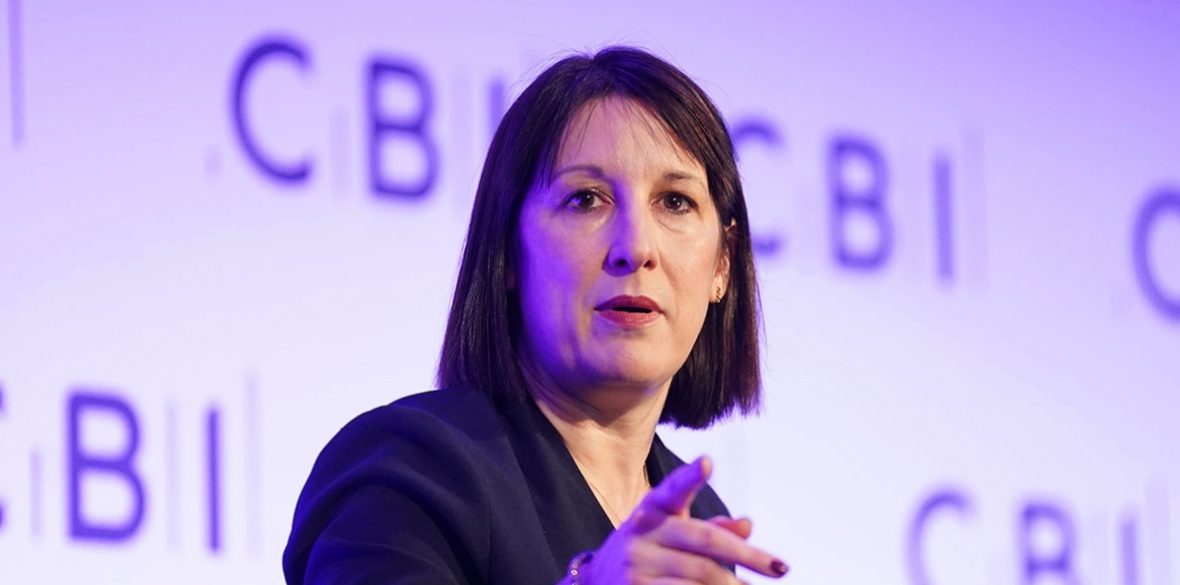
Chancellor of the Exchequer Rachel Reeves at the Confederation of British Industry (CBI) conference at the QEII Centre, London, November 25, 2024

Leading left MP and former shadow chancellor John McDonnell issued the warning to Rachel Reeves as the Chancellor returned from her China trip to confront the bond market crisis.

Mr McDonnell, presently suspended from the Labour whip for opposing the cruel two-child benefit cap, told BBC radio: “There is obviously a problem.

“There’s turbulence in the international markets, and we’ve just got to see those through.

“You don’t turn to cuts, certainly, because not only will that be politically suicidal, that would undermine the political support upon which Labour got elected.

“In addition to that, you would be taking demand out of the economy, and you would be looking at turning a crisis into a recession.

“So I think you just have to see through the turbulence in the markets.”

Mr McDonnell also reminded the government that voters matter more than markets.

https://morningstaronline.co.uk/article/ministers-warned-to-stop-the-rush-to-political-suicide

Continue ReadingMinisters warned to stop the rush to ‘political suicide’