Just Stop Oil protesters with a police officer outside Westminster Abbey in central London after they spray painted “1.5 is dead” on the grave of Charles Darwin, in the north aisle of the nave of the Abbey, January 13, 2025
JUST STOP OIL activists painted the grave of British naturalist Charles Darwin today to demand an end to reliance on fossil fuels by 2030.
Two activists entered Westminster Abbey and sprayed “1.5 Is Dead” on the grave after it was confirmed that 2024 was the first year on record with a global average temperature exceeding 1.5°C above pre-industrial levels.
During the action, the supporters said: “We have passed the 1.5° threshold that was supposed to keep us safe
“Darwin would be turning in his grave to know we are in the midst of the sixth mass extinction.
“The government’s plans will take us to over 3 degrees of warming.
“This will destroy everything we love. World leaders must stop burning oil, gas and coal by 2030.”
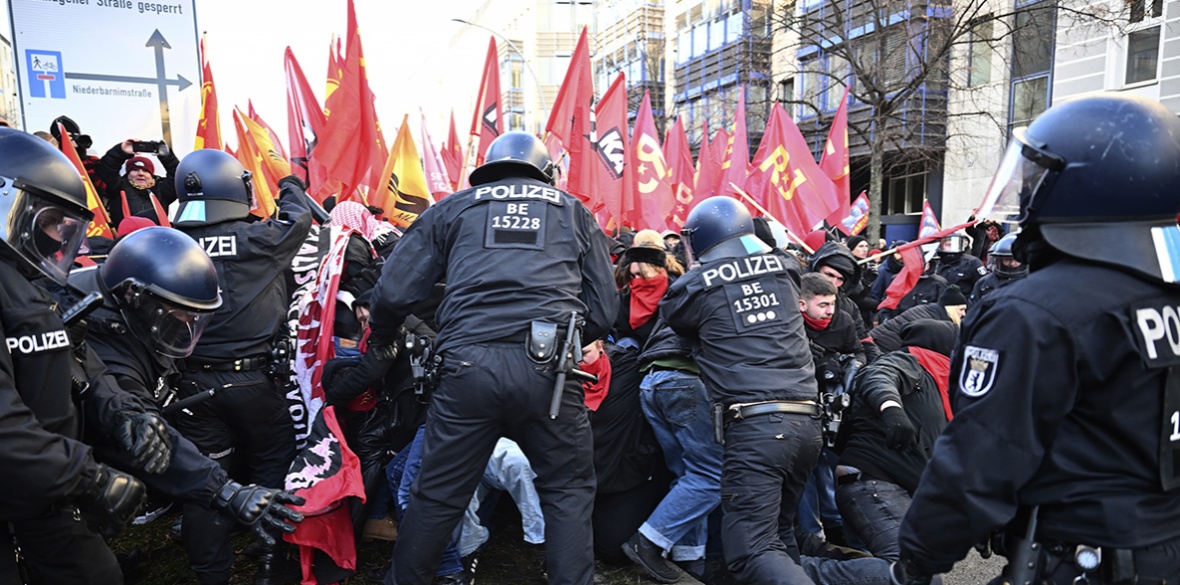
Police officers and demonstrators clash during the ‘Luxemburg-Liebknecht-Ehrung 2025’ demonstration in memory of Rosa Luxemburg and Karl Liebknecht, in Berlin, January 12, 2025
GERMAN police attacked the annual march to the graves of Rosa Luxemburg and Karl Liebknecht today, targeting marchers expressing solidarity with Palestine.
The second Sunday in January sees a traditional procession from Berlin’s Frankfurt Gate to the Friedrichsfelde cemetery, where a monument marks the graves of communist revolutionaries killed in the struggle, with thousands joining to place red carnations on their graves.
But a Palestine solidarity bloc came under immediate attack as the march moved off, with police charging marchers who chanted “From the river to the sea, Palestine will be free” and seizing individuals from the crowd to carry off.
Organisers halted the march and called for everyone to close gaps to prevent any bloc being separated and beaten up by police. But officers continued to snatch people from the crowd, saying placards or items of clothing were promoting “unconstitutional” messages, which ranged from expressions of solidarity with Palestine to one member of the German communist youth league being detained for wearing a red triangle, the badge assigned to political prisoners by the Nazis as the yellow star was for Jews.
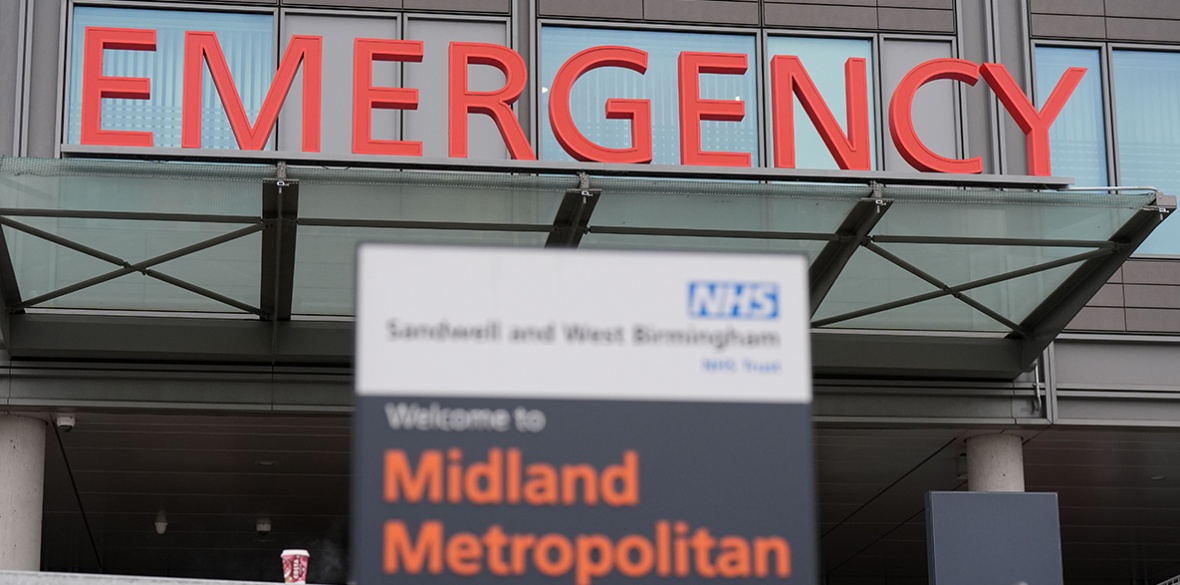
The emergency department at Midland Metropolitan University Hospital, Smethwick, January 8, 2025
Royal College of Emergency Medicine says advertisement is ‘normalising’ patients being treated in the corridors
A LONDON hospital has advertising for “corridor care” nurses because so many A&E patients are being cared for while waiting for beds or treatment.
The 12-hour shifts were advertised by Whittington hospital in north London.
The Royal College of Emergency Medicine (RCEM) said the advertisement indicated the “normalising” of patients being treated in the corridors of hospital A&E departments.
…
Retired paediatrician Dr John Puntis, co-chair of campaign group Keep Our NHS Public, said: “There can be no bleaker illustration of the current state of the NHS than ‘care’ delivered in corridors.
“Winter pressures on an already overstretched service were entirely predictable.
“Six months in power and Labour has done nothing pro-active to alleviate this situation.”
He accused the government of instead “throwing money at the private sector.”
October to April is normally considered to be the wet season in California, yet this January, the region is experiencing some of the most devastating fires it’s ever seen.
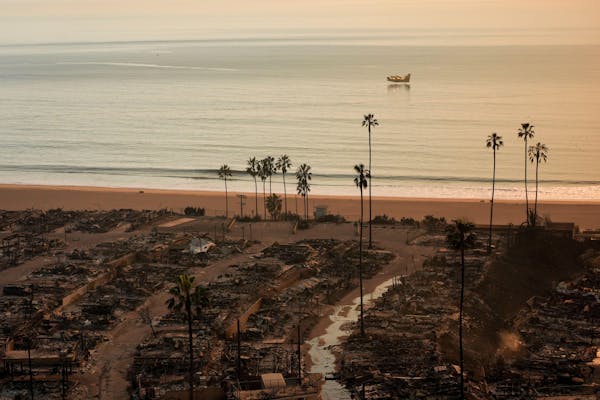
As of January 10, five major fires in and around Los Angeles have burned over 29,053 acres, leading to the evacuation of more than 180,000 people, the destruction of over 2,000 buildings (mainly homes), and an estimated damage cost of at least US$52 billion (£42.5 billion). Ten lives have been lost, and these numbers are expected to rise as the fires continue to burn.
The exact causes of each fire are still under investigation. However, several factors have contributed to their rapid spread and intensity.
The seasonal Santa Ana winds are particularly strong this year, bringing low humidity, dry air and high wind speeds. Southern California has received less than 10% of its average rainfall since October 2024, creating dry conditions that make the area highly vulnerable to fire.
Unusually wet winters in both 2022-23 and 2023-24 led to increased vegetation growth, providing more fuel for the fires. This cycle of wet and dry extremes, known as “hydroclimate whiplash”, is part of the increasingly intense climate cycles caused by climate change.
Hydroclimate whiplash can occur virtually anywhere. These cycles can cause extreme wildfires, such as those in California, where rapid vegetation growth is followed by drying. They can also exacerbate flooding when unusually heavy rains hit the dry-baked ground, then run off over the land rather than seeping in, leading to flash flooding.
In Los Angeles, some neighbourhoods have been almost entirely destroyed. Jae C. Hong / Alamy
The human impact of hydroclimate whiplash
Rapid transitions between extreme wet and dry conditions have significant and wide-ranging impacts on people, a focus of my academic research, affecting everything from public health to economic stability and social equity.
As we have seen in California, there is the immediate impact of loss of life, property and livelihoods. We have also seen this during whiplash-induced floods and landslides, such as those experienced across California in 2023 and east Africa in 2024, when years of drought were followed by weeks of rain.
Fires exacerbate respiratory and cardiovascular diseases through their polluting smoke. Flooding creates conditions for waterborne illnesses such as cholera, leptospirosis or norovirus to rip through populations. Extreme swings in temperature can also create more heat-related illnesses, as human bodies struggle to adapt quickly. It is estimated that the health-related impacts of climate change will cost US$1.1 trillion by 2050.
And these impacts are not evenly distributed. While this month’s wildfires are affecting some of the richest communities in the US, it is generally low-income communities and vulnerable populations that are disproportionately affected, with limited resources to prepare for or recover from extreme events. Across the world, poorer populations are experiencing a 24%-48% increase in drought-to-downpour events, exacerbating their vulnerability and widening the health equity gap.
All these events and concerns also lead to mental health issues such as anxiety, depression and post-traumatic stress disorder (PTSD), resulting from displacement and trauma. Such human impacts are harder to measure, and often under-reported.
Adaptation and resilience
As climate change intensifies hydroclimate whiplash events, the human impacts are expected to grow more severe. Addressing these challenges will require coordinated efforts across multiple sectors, with a focus on both mitigation and adaptation strategies to protect human health, economic stability and social equity.
Governments and local authorities will need to implement co-management approaches for both drought and flood risks, alongside developing more flexible water management systems and infrastructure. Investing in natural infrastructure to enhance biodiversity and ecosystems will reduce risks to humans, both by restricting the effects of climate change and lowering the risks of fire and flooding.
As individuals we can often feel powerless, but environmental campaigns and movements have been highly successful in changing government policies. In the UK, the 2008 Climate Change Act and the net zero by 2050 legislation were the direct result of citizen lobbying and action, and the same can be said for numerous renewable energy transition policies around the world.
In California, we have seen the devastating effect of hydroclimate whiplash – and this won’t be the last we see. By calling on our governments to produce adaptation and resilience strategies that recognise climate change as a long-term human and economic risk factor, we can be more prepared for these events.
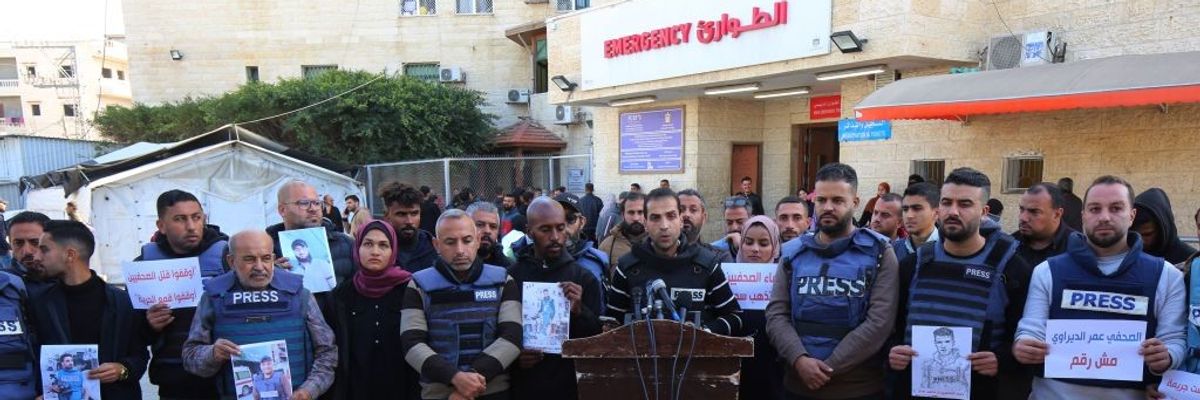
Palestinian journalists protest against the Israeli attacks on the media workers across the Gaza Strip outside al-Aqsa Martyrs Hospital in Deir al-Balah on January 8, 2025. (Photo: Rizek Abdeljawad/Xinhua via Getty Images)
“We have been let down by the international community, particularly the international media organizations,” said Abubaker Abed, sharing a message from Palestinian journalists.
Palestinian journalists gathered outside al-Aqsa Martyrs Hospital in Deir al-Balah this week to call attention to Israeli forces’ genocidal assault on the Gaza Strip, their slaughter of those reporting on the ground, and the global community’s failure to hold Israel accountable for the bloodshed.
On Thursday, the day after the event, Abubaker Abed, a Palestinian sports journalist now covering Israel’s war on Gaza, shared on social media a short video of his remarks in English, which he said were delivered on behalf of all the reporters in blue vests who surrounded him and the podium.
Since the Hamas-led October 7, 2023 attack on Israel, Palestinian reporters across Gaza have covered what Abed called “the most well-documented and first livestreamed genocide in history,” as Israel—armed by the United States—has launched airstrikes and ground raids, and stopped humanitarian aid and international media from entering the coastal enclave.
Abed said that “we’ve been reporting tirelessly, extensively, and thoroughly on this genocide. It’s indeed a genocide against us, which we’ve been documenting in makeshift tented camps and workplaces… You’ve seen us shedding tears over our loved ones, colleagues, friends, and family members. You’ve seen us killed in every possible way. We’ve been immolated, incinerated, dismembered, and disemboweled—and recently, we’ve been freezing to death.”
“What more ways should you be seeing us killed, then, so that you can move and act and stop the hell inflicted upon us? There are no words to describe what we’ve been going through, because you’ve seen our bodies, how they’ve become fragile, skinny, and fatigued, but we never stopped,” he continued, highlighting how Palestinian journalists have worked “to help the population that has seen every sort of torture and tasted every type of death,” while the world has refused to “stop Israel’s impunity against us.”
“Our message is very clear: We are journalists, and we are Palestinian journalists. We have been let down by the international community, particularly the international media organizations,” Abed declared. “We haven’t seen any sort of support—a single word of support. Even the press vests we’re wearing right now mark us as a target. They do not protect us at all, because we are Palestinians. Maybe if we were Ukrainians or of any other citizenship, with blond hair and blue eyes, the world would rage and rant for us. But because we are Palestinians, we have only one right, which is to die and be maimed.”
“We are just documenting a genocide against us,” he concluded. “After almost a year and a half, we want you to stand foot-by-foot with us, because we are like any other journalists, reporters, and media workers all across the globe—no matter the origin, the color, or the race. Journalism is not a crime. We are not a target.”
Some journalists around the world reposted Abed’s video and called out their colleagues for ignoring Israel’s decimation of Gaza or reporting on it in ways favorable to the far-right Israeli government and its supporters, including the United States.
“The past 15+ months have been one of the most shameful periods in the history of Western journalism,” said Jeremy Scahill, co-founder of Drop Site News, which has published Abed’s reporting from Gaza. “The refusal of so many journalists to speak out in defense of our Palestinian colleagues in Gaza as they and their families have been hunted down and killed is a bloody stain.”
The New Yorker editor Erin Overbey similarly said that “the staggering silence of Western journalists this past year as their Palestinian colleagues have been targeted, intimidated, and killed by Israeli forces during the genocide in Gaza will go down as one of the most shameful periods in media/journalism and human rights history.”
British writer Owen Jones said: “How to describe the refusal of Western journalists to speak out about the biggest slaughter of journalists in the history of human civilization? Damning. Racist. Nauseating. You will never be forgiven. History will damn those who stayed silent—every last fucking one.”
Hamza Yusuf, a London-based British Palestinian writer, said that “we will never forget that whilst Palestinian journalists in Gaza were being systematically slaughtered by Israel, their industry peers at best looked on with indifference and at worst used their positions and their coverage to whitewash Israel’s crimes. Blood on their hands.”
Journalists gather in front of the Al-Aqsa Martyrs Hospital in Deir el-Balah to condemn the ongoing atrocities of the Israeli occupation, which have claimed the lives of dozens of their colleagues since the start of the genocide. pic.twitter.com/iDsACXLTPV
As of Thursday, health officials in Gaza put the death toll from Israel’s 15-month assault at 46,006, with at least 109,378 other Palestinians wounded, the vast majority of the enclave’s population displaced, and civilian infrastructure in ruins. Israel faces global accusations of genocide, including in a case at the International Court of Justice.
Figures for press deaths have varied. The International Federation of Journalists—which works with its affiliate, the Palestinian Journalists’ Syndicate, to verify information—has documented the killings of 148 Palestinian media workers while the Committee to Protect Journalists has a list of 152 confirmed fatalities, at least 13 of which the group classifies as murders by Israeli forces.
At the end of last year, Al Jazeera published a long-form article titled “Know Their Names” and reported that “from October 7, 2023, to December 25, 2024, at least 217 journalists and media workers had been killed in Gaza. Five more were killed on December 26 when an Israeli airstrike targeted a news van near al-Awda Hospital.”
“Eighty percent of the journalists and media workers killed were between the ages of 20 and 40, a stark statistic that captures the young age of those who risk their lives to document the conflict,” according to Al Jazeera. “They were reporters and writers, photographers and video directors, analysts and editors, sound engineers and voiceover artists, and even founders of media outlets. Their stories remind us of the heavy price paid by those who strive to document humanity’s darkest moments.”