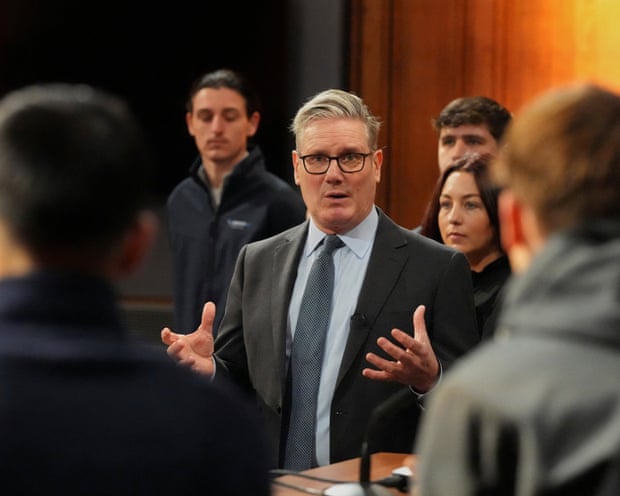
Keir Starmer and Labour have slumped in the polls. Photograph: Frank Augstein/Reuters
Keir Starmer accused of failing to adequately strategise while in opposition, leading to uncoordinated policymaking
Keir Starmer is failing to make major improvements to public services partly because he did not plan properly while in opposition, according to a report from the Institute for Government (IfG).
The prime minister went into government without a clear idea about how to achieve his targets, the IfG found, resulting in haphazard attempts to reform various sectors, from the health service to the courts.
The annual report provides a damaging overview of an occasionally chaotic first year in government for Labour, during which the party and Starmer have slumped in the polls.
Nick Davies, a programme director at the IfG and one of the authors of the report, said: “Starmer went into government with a set of missions, but no clear idea about how to achieve them or how those targets fit together in any meaningful way.
“He has not been properly engaged with this process. In opposition he should have been the one to say: ‘This is my view of what public sector reform looks like’, whether that’s on devolution, or the health service, or anything else.
“But there has been a void at the heart of government when it comes to public services.”
Keir Starmer says that the Labour Party under his leadership is intensely relaxed about assaulting those least able to defend themselves – the very poorest and most vulnerable.
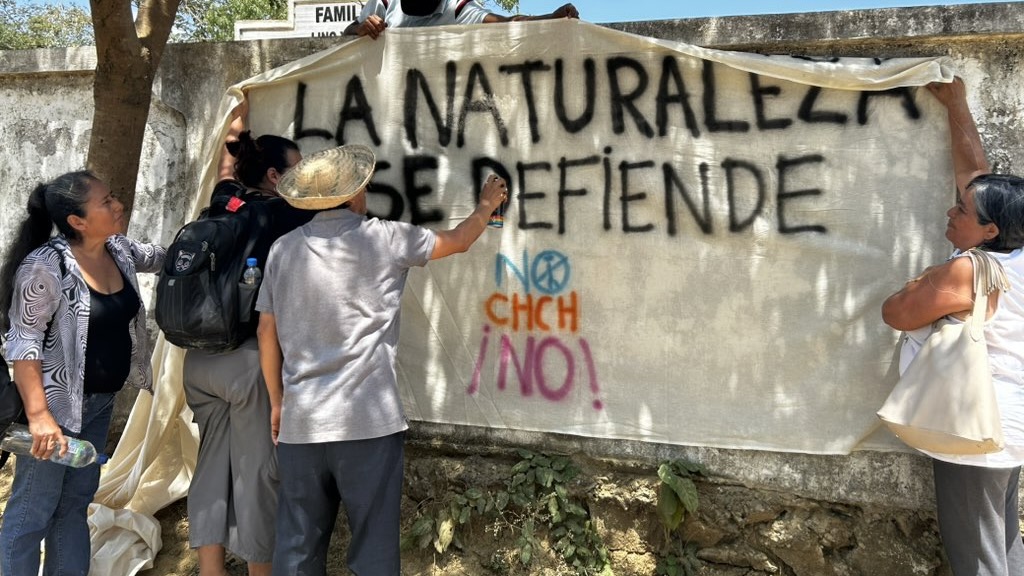
Community members in Santa Elena, Ecuador, painting a banner reading “Defend nature, VOTE NO”. The grassroots nature of the “NO” campaign appears to have given it greater success. Photo: NOchchNO / X
The government has suffered a harsh and resounding defeat to its political and economic plans. In this article, we present the results and offer some explanations for the outcome of November 16.
In a massive defeat for President Daniel Noboa’s neoliberal program, Ecuador overwhelmingly voted “No” on all four questions in the national referendum held on November 16. The result is a crushing blow for the government, who had hoped a victory would help pave the way for a structural transformation of the Ecuadorian state.
The election was organized at the request of right-wing President Noboa who called for a referendum in September of this year, hoping to achieve the economic elites’ long-awaited dream of converting Ecuador’s legal framework into a neoliberal one.
What were the referendum’s four questions?
The first question asked Ecuadorians whether foreign military bases should be allowed in Ecuador, something that is prohibited by the current constitution. Noboa appealed to the deep sense of insecurity felt by people in the country as a result of the historic crisis of violent crime, in which drug trafficking gangs are fighting over territory.
The government claimed that the installment of foreign military personnel would help reduce insecurity, although the opposition argued that it was an excuse to align the country with Washington’s geopolitical interests.
The next two questions were called “bait questions” by the opposition. They argued that the questions were less overtly ideological and employed a kind of electoral populism to exploit the widespread dissatisfaction with the political class, with the hope of garnering support for the more extreme parts of the referendum. The “bait questions” had to do with reducing the number of legislators and eliminating state funding for political parties.
The opposition, however, claimed that both measures would have benefited the ruling party, as they would have reduced the representation of small provinces and prevented political parties without wealthy contributors from running election campaigns.
Finally, the most important question had to do with the creation of a constituent assembly to draft a new neoliberal constitution, which is the great desire of the country’s economic elites.
Though the government was not particularly vocal about this, its silence about its intentions only provoked anxiety among voters, who saw this obscurity as a sign that the new constitution would reduce rights won in past decades.
The results
After the initial results were announced, several media outlets repeated the phrase “No one expected these numbers.” The latest polls had predicted that Noboa would win on all four questions, although it was known that the gap between the YES and NO votes had narrowed on the questions about military bases and the convening of a constituent assembly.
However, the president’s defeat was crushing. Not even on the so-called “bait questions” did Noboa manage to win over the majority of Ecuadorians, who clearly said “No” to the executive branch’s neoliberal project.
The government had prepared celebrations in Quito and Guayaquil, but the YES campaign headquarters were empty and the few Noboa supporters present were clearly shocked. Many expected the president to make statements to the press and his supporters, but Noboa did not appear.
He left only a brief message on X: “We consulted the Ecuadorian people, and they have spoken. We fulfilled our promise: to ask them directly. We respect the will of the Ecuadorian people. Our commitment remains unchanged; it is strengthened. We will continue to fight tirelessly for the country you deserve, with the tools we have.”
Thus, some analysts have claimed that Noboa is announcing his refusal to back down from his plan to neoliberalize the economy and the state, although he’s been forced to do so by other means. Currently, the ruling party has a majority in the National Assembly, but it will now be more difficult for it to carry out the reforms it proposes due to the votes of the independents who support it and who may hesitate to give their support to the government, as well as a Constitutional Court that has already put a stop to several of the president’s laws that undermine the legal structure of the state.
However, it is important to consider that if all the votes had been against the government, the results between one question and another would not have fluctuated so much. This is because there was a difference in voting, especially between questions 1 and 4, compared to questions 2 and 3. In this regard, some analysts have highlighted a flawed political communication strategy and the ruling party’s election campaign.
Questions loomed regarding, which foreign armed troops would come to the country to go where (there was much speculation that it would be in the Galapagos, one of the natural treasures most cherished by Ecuadorians). Also murky was the content of the constitution that the government wanted (Noboa literally said that the day after winning the referendum he would reveal the structure of the new constitution, not before).
However, attributing the government’s defeat solely to its communication failures is insufficient and dangerous, as it overshadows the enormous efforts of various political groups, social movements, and citizen collectives that campaigned for the NO vote.
Thus, the NO campaign had to be carried out in an almost artisanal manner. No political party (not even Correísmo) took the lead in the NO campaign, so funding was almost non-existent. The various videos on social media, discussions, interviews, etc., were produced by civil society, which did what it could with the little it had.
However, this accidental strategy proved to be fundamental, because, as it was “ordinary people” who ran the campaign, many undecided Ecuadorians felt that their “peers” were speaking directly to them, and not on behalf of a political party that would probably have been stigmatized by the ruling party.
Several government spokespeople began to suggest possible constitutional changes if the yes vote won, such as labor flexibility, the elimination of some rights of Indigenous peoples’ (such as Indigenous justice), the elimination of the rights of nature (something in which the country is a pioneer), and the elimination of free tuition for university students, among others. This, coupled with Noboa’s silence, allowed the opposition to organize a successful political campaign that appealed to an anti-neoliberal spirit that remains in the country.
Ecuador does not yield to neoliberalism: a historic struggle
Similarly, national workers’ strikes in the 1980s, Indigenous mobilizations in the 1990s, and in the last six years have stopped attempts to neoliberalize the country in the streets, a historical trend that continues to be confirmed today.
Faced with enormous popular rejection, the 1998 Constitution, with its clear neoliberal slant, was drafted in a military barracks, behind closed doors, with the almost exclusive participation of the Ecuadorian right.
That constitution, which opened the door to the dollarization of the country and the infamous bank holiday (in which thousands of Ecuadorians lost their savings to save the banks in crisis) was replaced by the 2008 Constitution, in which more than 150 social and political organizations went to the Assembly to demand that their claims be included.
Thus, this constitution, now clearly endorsed with full popular legitimacy, brought together a series of rights that had been demanded and won over decades by various groups of citizens. Perhaps this is why the government’s strategy of calling the current constitution “Correísta,” “Castro-Chavista,” etc., did not have the expected impact. People recognized that the country’s poor administration does not mean that the constitution is negative.
On the contrary, they saw in the ruling party’s plans something more dangerous than political antipathy toward Correísmo, which is why several people on the right and left who oppose the return of Correísmo voted NO in the 2025 referendum, which the government did not expect.
What will happen now?
For now, it remains to be seen how this sharp defeat will impact the country’s governability. Several right-wing intellectuals have called on the government to change its strategy, namely to start delivering clear results to Ecuadorians beyond advertising spots and smokescreens.
For now, changes are expected in the ministries and spokespersons of a government that, despite having been elected twice to govern, has lost in the referendums it has called and which have sought to introduce neoliberal changes.
This was the case in the 2024 referendum, also called by Noboa, in which he won on several questions to increase his power over security, but lost on the two economic questions, which sought to approve hourly work and subject Ecuador to international arbitration by international courts.
However, the defeat in 2025 is much deeper, as it implies a widespread rejection of a government that has lost much of the support of voters who trusted its administration but do not see results, which has increased mistrust. Today, the government has come to better understand sociologist Max Weber’s famous phrase: “Politics is a matter of faith and responsibility.”
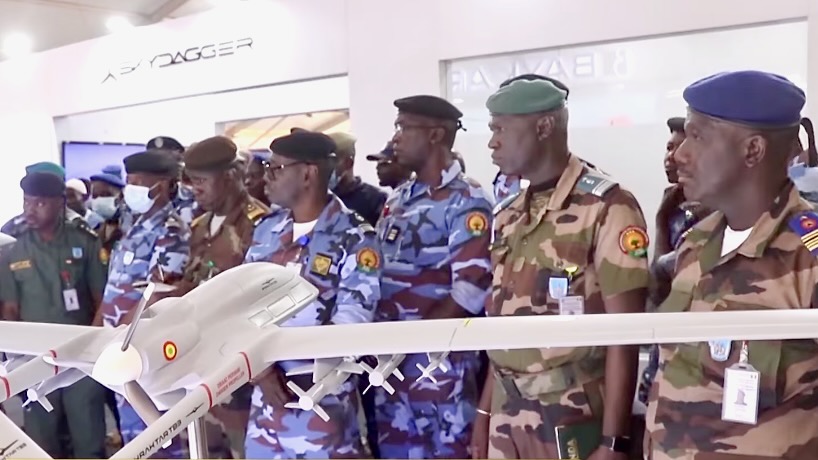
BAMEX 25 is Mali’s first international defense expo. Photo: screenshot
As panic-inducing travel advisories and doomsaying media reports prophesy the fall of Mali to an Al Qaeda affiliate attacking fuel convoys, the government has re-secured supply routes and hosted Mali’s first international defense expo in a supposedly besieged capital.
Amid a barrage of media reports prophesying the fall of Mali to an Al Qaeda affiliate disrupting its fuel supply by attacking tankers, delegates from ten African countries, Iran, and Turkey attended a defense expo in the capital Bamako from November 11 to 14.
Dismissing this portrayal as a scenario “concocted in the office of foreign intelligence services”, Foreign Minister Abdoulaye Diop insisted that “the fate of Mali, and the destiny of the people in the West African region will not be decided” by the media.
He made these remarks on November 12, addressing a press conference on the sidelines of BAMEX 25, Mali’s first international defense expo, aimed at building “an autonomous security architecture” for Africa in the face of “unprecedented security and geopolitical challenges”.
This expo, he said, is yet another indication of the Malian government’s priority to strengthen its defense and security to combat the threat of terror groups that were spawned across the Sahel by NATO’s destruction of Libya in 2011.
French-spawned terror groups
Mali was among the first and worst affected by these terror groups. Its former colonizer, France, which was a key participant in Libya’s destruction, then deployed its troops, ostensibly to protect Mali. Over the years, its military presence expanded across the Sahel. Alongside, the armed groups also grew in strength, increasing attacks and the area under their control.
This led to a growing perception that French troops in the region were not fighting the terror groups it helped create but guarding its own economic and political interests in maintaining its neocolonial grip over the troubled former colonies.
In 2021, then-prime minister Choguel Kokalla Maïga recalled in an interview the active role played by France in handing over Mali’s territory to terror groups.
“Upon arriving in” the northern town of Kidal in 2013, “France forbade the Malian army from entering. It created an enclave,” and handed it over to Al-Qaeda affiliate Ansar al Dine and Tuareg separatists brought together, he said. Later in 2017, Ansar al Dine coalesced with other terrorist groups to form the Jama’at Nusrat al-Islam wal-Muslimin (JNIM), which became one of the most dangerous groups in the Sahel.
“It’s an enclave controlled by France. They have armed groups trained by French officers. And we have evidence of this,” Maiga added in his 2021 interview. “Mali has no access to Kidal.”
However, the new government retook Kidal in November 2023, less than a year and a half after expelling the French troops.
“On the ground today, terrorist groups are no match for Mali’s defense and security forces,” Diop told reporters at the press conference. “There have been enormous efforts to equip Mali’s defense and security forces, which have achieved resounding successes” against the terror groups, he said, adding that this has “forced them to change their strategy and now attack softer targets.”
Attacks on fuel convoys
Early this September, the JNIM started attacks on drivers and their tankers carrying fuel from the Ivory Coast in the Sikasso region of southern Mali. “Due to disruptions in fuel supplies that are affecting the movement of school staff,” the Education Ministry suspended classes for two weeks on October 26.
“Do Not Travel to Mali for any reason due to crime, terrorism, kidnapping, unrest, and health,” the US State Department said in a travel advisory on October 25. Three days later, the department issued a second alert, insisting that its citizens in Mali “should” leave the country “using commercial aviation, as overland routes to neighboring countries may not be safe for travel due to terrorist attacks along national highways.”
Australia followed suit on October 29, warning, “If you’re in Mali, you should depart immediately using commercial means while the international airport in Bamako remains open and flights are available. If you decide to remain in Mali, be prepared to shelter in place for an extended period.” Italy and Germany also asked their citizens to leave the country.
Amid the panic-inducing travel advisories and doomsaying media reports, Mali’s president, Col. Assimi Goïta, inaugurated the country’s second Lithium mine on November 3, setting Mali en route to becoming Africa’s leading Lithium producer by 2026.
“There have been disruptions in the supply system,” but “the state organized itself, put in place a strategic plan to resume supplies, to ensure the security of convoys … And gradually, you see that hundreds of trucks are arriving every day to resume supplies to Bamako and other localities,” Diop added in his press conference. “As I speak, Mali is able to ensure the supply of hydrocarbons and petroleum products to its population.”
However, two days after the fuel convoys started arriving, France “advised” its citizens on October 7 to leave Mali “as soon as possible using the remaining available commercial flights” because the “security situation has been deteriorating.”
Mali’s first-ever National Electronic Payments Exhibition was organized in the capital that day by the Professional Association of Banks and Financial Institutions of Mali (APBEF-Mali) and the West African Economic and Monetary Union’s Interbank Electronic Payment Group (GIM-UEMOA).
Schools reopened on schedule on November 10. That day, President Goïta inaugurated the Presidential Emergency Hospital Project to upgrade six existing health centers in Bamako to district hospitals by the end of 2026, for which a health budget of USD 349.2 million has been allocated. The inauguration also marked the start of construction of nine new hospitals, including in Bougouni, Bandiagara, and Nioro, where attacks had been reported in the recent past.
Despite these indications of improving security, the UK government claimed on November 13 that “Terrorist group Jama’a Nusrat ul-Islam wa al-Muslimin (JNIM) has implemented blockades on key routes throughout Southern and Western Mali, including the capital city of Bamako,” where the international defense expo was underway.
“These blockades are targeting fuel trucks and are enforcing checkpoints for individuals attempting to pass through them. Attacks can occur at any time,” added its travel advisory.
A proxy war
“We must not think we are simply facing terrorist groups,” Diop maintains. “No, this is a proxy war, where certain powers, cowardly and unable to confront us directly, are using terrorist groups and asymmetric forces to fight us … These terrorist groups have drones. Where do they come from? Who manufactures them? Who provides them in areas where people cannot even eat?”
Le Monde had reported last year that Ukrainian authorities are training an armed group to use drones. Spokesperson of Ukraine’s military intelligence, Andriy Yusov, had said in an interview that it provided “information, and not only information,” to armed groups fighting the state in Mali.
Earlier in 2022, Diop had written a letter to the UN Security Council, saying Mali had evidence that France was flying missions in Malian airspace to collect intelligence and airdrop arms and ammunition to terror groups.
Mali’s southern neighbor, Burkina Faso, and eastern neighbor, Niger, have also since accused France of supporting terror groups to destabilize their countries after its troops were expelled following a similar sequence of anti-France protests and popular coups.
“Africa is now the epicenter of terrorism,” Nicolas Lerner, head of France’s General Directorate for External Security (DGSE), told France Inter radio on November 10. Calling it a threat to Europe, he insisted it “directly threatens our interests,” effectively trying to set up the case for another military intervention.
Curiously, he went on to add that while the “JNIM wants the fall of the junta and the installation of authorities who back the establishment of a caliphate,” the group itself “is not necessarily capable of controlling Mali, nor does it actually want to.”
Lerner is “saying … it is not even their intention to take Bamako … How [does he] know their intention? Is it you who gives them this intention? Is it you who commands them? Is it you who decides,” questioned Diop.
“This should help us understand how deep the collusion is today between hybrid forces. These are not terrorists – it is a proxy war. But I can assure you that Mali will endure.”
He reiterated that Mali, Burkina Faso, and Niger, which have formed the Alliance of Sahel States (AES), are fighting together, convinced that this proxy war is waged on them because they “chose to break the chain of dependency, to break the chain of subjugation to colonial domination.”
He added, “Our countries are being attacked first to break this dynamic and then to prevent other African countries from following this path. And we have understood the political message behind this.” The African Union (AU), however, has not.
“We are not reaching out to the so-called international community to come to our aid”
Amid the chorus by Western countries, the AU’s chairperson, Mahamoud Ali Youssouf, called for “a robust, coordinated, and coherent international response to counter terrorism and violent extremism in the Sahel.”
“No action can be … taken in Mali without Malians, without the consent of the Malian state, without the Malian state requesting it,” Diop retorted, affirming, “we are not reaching out to the so-called international community to come to our aid.”
“This call for international action is all the more worrying since Mali has emerged from this type of paradigm,” he added. Having expelled the French troops and asserted sovereignty, “the new paradigm [in the AES] is to trust ourselves and take charge … to ensure the security of our countries rests first and foremost on the shoulders of the people and leaders of our countries.”
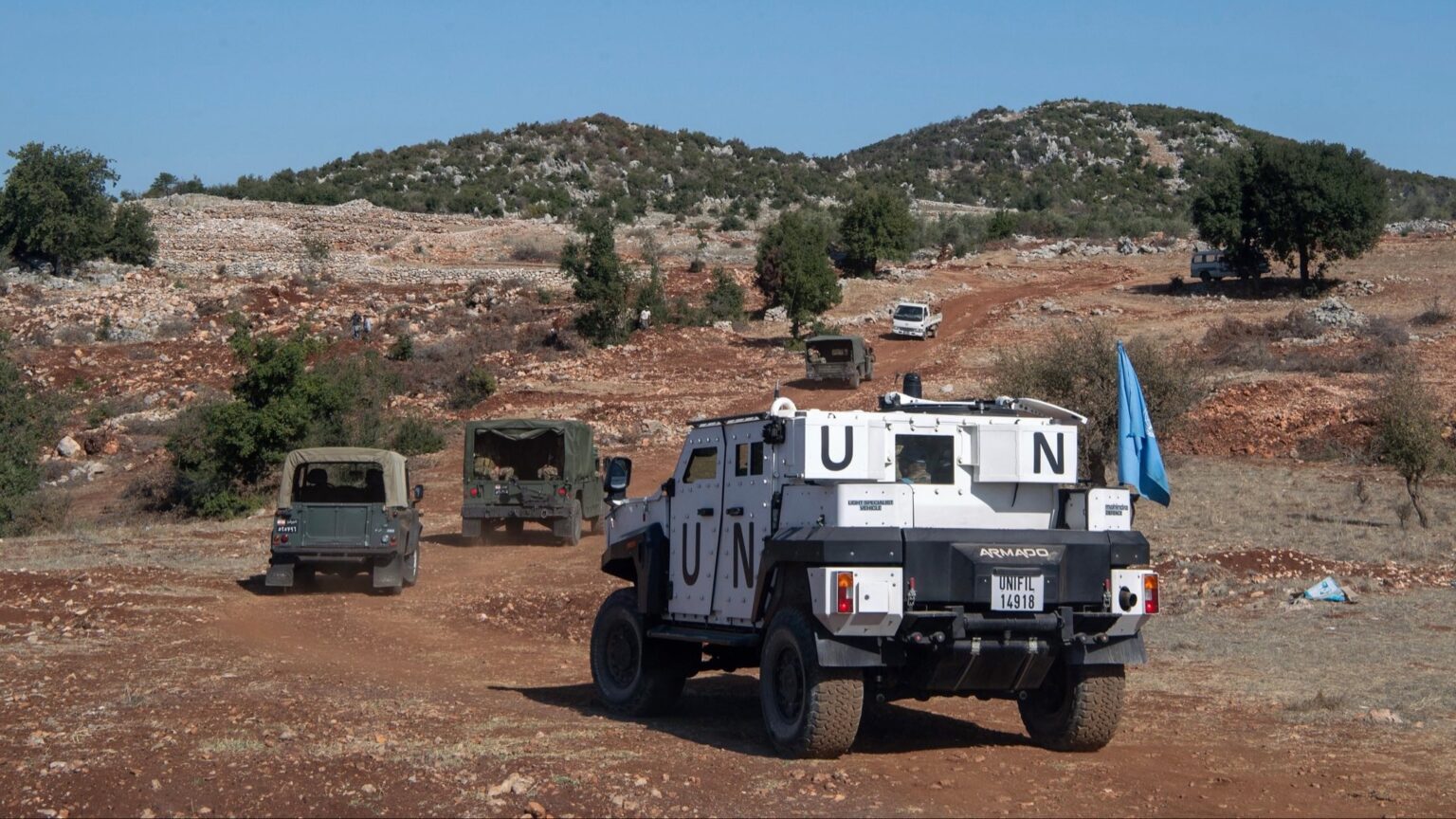
UN peacekeepers operating in Lebanon with the goal of “restoring state authority and ensuring lasting stability”. Photo: UNIFIL/X
Israel’s repeated violations of its neighbors’ sovereignty without being held accountable by the UN Security Council, confirm once again its guaranteed impunity.
The United Nations Interim Force in Lebanon (UNIFIL) said in a press release on Sunday, November 16, that some of its troops were targeted by Israeli artillery shelling earlier that day inside the Lebanese territories.
The peacekeeping mission clarified that its personnel escaped the offensive unharmed, after asking the Israeli Occupation Forces (IOF) to stop the assault through liaison channels.
The UNIFIL considered the incident, which marks the third Israeli attack on its troops in the last three months, a serious violation of the Security Council resolution 1701, which was adopted in 2006 to resolve the war between Israel and Hezbollah.
For its part, the IOF claimed that it misidentified the targeted peacekeepers due to poor visibility caused by weather conditions, after spotting two suspects in southern Lebanon, which entailed firing “warning shots” to disperse them.
However, the repeated assaults by the IOF against the mission for over a year exposes Israel’s systematic targeting of United Nations personnel, not only in Lebanon but also in other parts of the region, particularly Gaza.
Lebanon to file complaint against Israel for building a wall on the southern Lebanese border
Besides its daily airstrikes across Lebanon, and the recurrent attacks on UNIFIL troops, Israel has also committed another violation of Lebanon’s sovereignty by building a concrete wall that crosses the UN-demarcated Blue Line.
In response to the blatant violation, Lebanese President Joseph Aoun, issued directives to the concerned government officials to file an urgent complaint against Israel with the UN Security Council.
A UNIFIL report that refutes Israel’s denial of building the wall, and confirms that the wall has made 4,000 square meters of Lebanese land inaccessible to the residents in the affected area, will be enclosed in the complaint.
“Israeli presence and construction in Lebanese territory are violations of Security Council resolution 1701 and of Lebanon’s sovereignty and territorial integrity.” The UNIFIL asserted in the report.
It further reiterated its call on the IOF “to respect the Blue Line in its full length and withdraw from all areas north of it.”
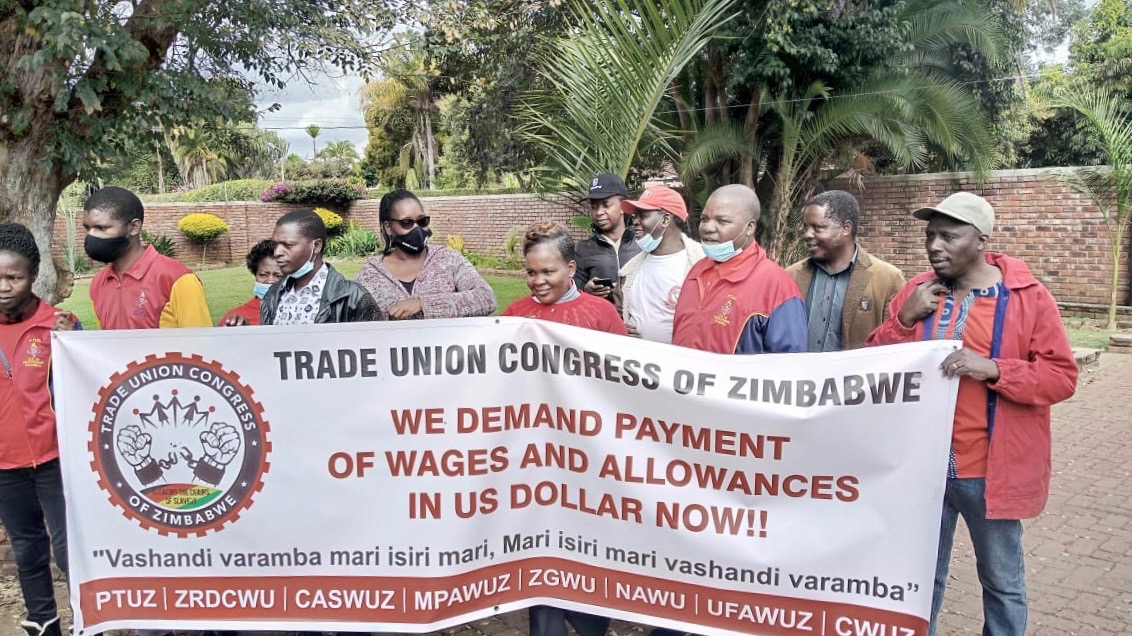
On Nov. 14, Nestlé Zimbabwe workers, led by UFAWUZ, staged a peaceful picket demanding living wages and an end to unfair labor practices. The action follows a protracted wage dispute in which Nestlé refused to increase wages.
Members of the United Food and Allied Workers Union of Zimbabwe (UFAWUZ) staged a picket at Nestlé Zimbabwe, demanding an end to unfair labor practices, restoration of decent wages, job security, and respect for workers’ rights.
According to UFAWUZ Secretary General Ady Mutero, the union was compelled to organize the picket after Nestlé, despite being chair of the Employers Association in the Food and Processing Industry, refused to grant any wage increase following a deadlock at the National Employment Council (NEC). Instead of championing fair wage discussions or proceeding to arbitration, Nestlé “obstructed both processes,” Mutero explained. This left workers without a wage agreement for the June–December period, effectively freezing them on poverty-level salaries. Under Section 74(6) of the Labour Act, workers are legally permitted to picket under such circumstances, leading to yesterday’s action.
Unfair labor practices inside the factory
Mutero calls out a series of unfair labor practices that workers have faced inside the factory. These include:
Refusal to award any wage increases, even after formal requests from both the Workers’ Committee and the union.
Violation of Nestlé’s own global Employer Relations Policy, which obligates all subsidiaries to align wages with each country’s Poverty Datum Line (PDL).
Use of labor brokers to hire workers on hourly rates below those agreed at the NEC, undermining sector standards.
Intentional wage suppression, even as senior management receives hefty salaries and corporate perks.
“These actions undermine both workers’ rights and Nestlé’s internationally accepted employment values,” Mutero noted, saying that the company’s local behavior sharply contradicts its global commitments to decent work.
Longstanding grievances, exhausted dialogue
The union’s grievances are not new, they have persisted throughout this year’s wage negotiation cycle, especially after the NEC wage talks collapsed earlier. Before calling for industrial action, UFAWUZ took several steps:
Participated in NEC wage negotiations for the sector.
Formally requested an internal wage adjustment, which the Labour Act allows even when NEC processes are stalled.
Urged Nestlé to respect its own global policy by ensuring wages align with the national PDL.
Pursued social dialogue, calling on Nestlé to lead by example as the sector’s most powerful employer.
“All these good-faith efforts were rejected,” Mutero said. “Industrial action became the last resort.”
Wages far below the poverty datum line
The wage crisis at Nestlé Zimbabwe is severe. The lowest-paid workers currently earn USD 250 per month, while the national PDL for a family of four stands at USD 650. This means Nestlé pays less than 40% of the living wage required, leaving workers USD 400 short every month.
Mutero highlighted the disparity: workers in the detergents sector, performing equivalent grades, earn USD 400, demonstrating that Nestlé is lagging far behind comparable industries despite commanding a strong global brand and significant local market share.
Inflation and the crisis of survival
Zimbabwe’s persistent inflation and soaring cost of living have eroded workers’ purchasing power to the point of survival crisis. At USD 250, workers cannot meet basic expenses, including food, transport, healthcare, or school fees. Families are forced into debt, informal side hustles, and other coping strategies that remain unsustainable.
“For employees of a multinational like Nestlé, the contradiction between corporate profits and workers’ daily struggles is stark and unjustifiable,” Mutero stressed.
A wider fight against exploitation
Mutero placed the workers’ struggle within a much broader African context. According to him, Nestlé’s actions reflect a pattern in which multinational corporations operating in Africa maximize profits while refusing to pay living wages.
“From Zimbabwe to the rest of the continent, neoliberal practices, outsourcing through labor brokers, wage suppression, and ignoring corporate social responsibility, have become entrenched,” he said. UFAWUZ therefore views the Nestlé picket as part of a wider continental resistance against exploitative corporate behavior.
By standing firm, the union hopes to push African governments, employers, and multinational corporations to uphold fair labor standards, respect workers’ rights, and ensure that economic growth benefits the very workers who create the wealth.