This work by Middle East Monitor is licensed under a Creative Commons Attribution-NonCommercial-ShareAlike 4.0 International License.
Pro-Palestinian demonstrators gather outside the United Nations headquarters, in front of the U.S. Mission to the UN, during an emergency picket titled “Hands off Gaza: Reject U.S.-Israeli Occupation,” in New York City, United States, on November 17, 2025. [Selçuk Acar – Anadolu Agency]
Hamas on Tuesday rejected the UN Security Council decision on the Gaza Strip, saying the adoption of the US-sponsored draft does not meet Palestinian demands or rights, and does not reflect the suffering the territory has experienced over the past two years.
The movement said in a statement that the decision does not reach the level of the political and humanitarian rights of the Palestinian people, especially in Gaza, which it said has suffered “a war of extermination and unprecedented crimes” whose effects continue despite the announcement of the end of the war under the plan of US President Donald Trump.
The statement added that the decision imposes an international guardianship mechanism on Gaza, which Palestinians reject, saying it “seeks to achieve goals that Israel failed to achieve through military operations”.
Hamas said the decision separates Gaza from the rest of the Palestinian territory and brings new conditions that undermine the Palestinian right to self-determination and the establishment of an independent state with Jerusalem as its capital.
The movement stressed that “resistance by all means is a legitimate right under international law”, adding that the issue of factions’ weapons is an internal national matter that can only be discussed within a political framework that ends the occupation.
Hamas also criticised any role for an international force inside Gaza that includes disarmament duties, saying this would “remove its neutrality”.
It explained that any potential force should limit its role to separating forces and monitoring a ceasefire along the borders, working under UN supervision and coordinating solely with Palestinian institutions, with no role for Israel.
This work by Middle East Monitor is licensed under a Creative Commons Attribution-NonCommercial-ShareAlike 4.0 International License.
Genocide denier and Current UK Prime Minister Keir Starmer is quoted that he supports Zionism without qualification. He also confirms that UK air force support has been essential in Israel’s mass-murdering genocide. Includes URLs https://www.declassifieduk.org/keir-starmers-100-spy-flights-over-gaza-in-support-of-israel/ and https://youtu.be/O74hZCKKdpAKeir Starmer objects to criticism of the IDF. He asks how could anyone object to them starving people to death, forced marches like the Nazis did, bombing Gaza’s hospitals and universities, mass-murdering journalists, healthworkers and starving people queuing for food, killing and raping prisoners and murdering children. He calls for people to stop obstructing his genocide for Israel.Orcas discuss Genocide-supporting and complicit Zionists. Donald Trump, Keith Starmer, David Lammy, Rachel Reeves, Angela Rayner and Wes Streeting are acknowledged as evil genocide-complicit and supporting cnuts.
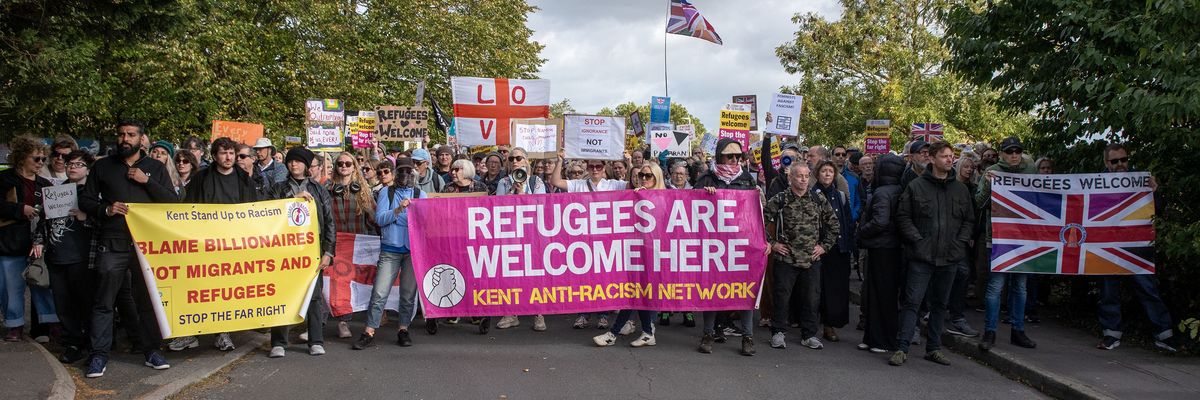
Protesters hold their banners, placards, and flags while they block the road during an anti-fascist counterprotest against a far-right anti-immigration protest on October 5, 2025, outside the Acacia Court in Faversham, UK. (Photo by Krisztian Elek/SOPA Images/LightRocket via Getty Images)
“Labour won’t redistribute wealth from billionaires,” said former party Leader Jeremy Corbyn. “But they will seize belongings from those fleeing war and persecution.”
A new asylum policy announced Monday by the UK Labour Party will allow authorities to confiscate the jewelry and other belongings of asylum-seekers in order to pay for their claims to be processed.
The policy, which some critics said was “reminiscent of the Nazi era,” was just one part of the Labour Party’s total overhaul of the nation’s asylum system, which it says must be made much more restrictive in order to fend off rising support for the far-right.
In a policy paper released Monday, the government announced that it would seek to make the status of many refugees temporary and gave the government new powers to deport refugees if it determines it to be safe. It also revoked policies requiring the government to provide housing and legal support to those fleeing persecution, while extending the amount of time they need to wait for permanent residency to 20 years, up from just five, for those who arrive illegally.
The UK government also said it will attempt to change the way judges interpret human rights law to more seamlessly carry out deportations, including stopping immigrants from using their rights to family life under the European Convention on Human Rights (ECHR) to avoid deportation.
In an article for the Guardian published Sunday, UK Home Secretary Shabana Mahmood called the reforms “the most significant and comprehensive changes to our asylum system in a generation.” She said they were necessary because the increase in migration to the UK had stirred up “dark forces” in the country that are “seeking to turn that anger into hate.”
Nigel Farage, the leader of the far-right Reform UK Party, is leading national polls on the back of a viciously anti-immigrant campaign that has included calls to abolish the UK’s main pathway for immigrants to become permanent residents, known as “leave to remain.”
Meanwhile, in September, over 100,000 people gathered in London for an anti-immigrant rally led by Tommy Robinson, a notorious far-right figure who founded the anti-Muslim English Defence League (EDL). The event saw at least 26 police officers injured by protesters.
Last summer, riots swept the UK after false claims—spread by Robinson, Farage, and other far-right figures—that the perpetrator of the fatal stabbing of two young girls and their caretaker had been a Muslim asylum-seeker. A hotel housing asylum-seekers was set on fire, mosques were vandalised and destroyed, and several immigrants and other racial minorities werebrutallybeaten.
Mahmood said that if changes are not made to the asylum system, “we risk losing popular consent for having an asylum system at all.”
But as critics were quick to point out, the far-right merely took Labour’s crackdown as a sign that it is winning the war for hearts and minds.
Robinson gloated to his followers that “the Overton window has been obliterated, well done patriots!” while Farage chortled that Mahmood “sounds like a Reform supporter.”
Many members of the Labour coalition expressed outrage at their ostensibly Liberal Party’s bending to the far-right.
“The government should be ashamed that its migration policies are being cheered on by Tommy Robinson and Reform,” said Nadia Whittome, the Labour MP for Nottingham East. “Instead of standing up to anti-migrant hate, this is laying the foundations for the far-right.”
In a speech in Parliament, she chided the home secretary’s policy overhaul, calling it “dystopian.”
“It’s shameful that a Labour government is ripping up the rights and protections of people who have endured unimaginable trauma,” she said. “Is this how we’d want to be treated if we were fleeing for our lives? Of course not.”
The UK has signed treaties, including the ECHR, obligating it to process the claims of those who claim asylum because they face persecution in their home countries based on race, religion, nationality, group membership, or political opinion. According to data from the Home Office, over 111,000 people claimed asylum in the year from June 2024-25, more than double the number who did in 2019.
The spike came as the number of people displaced worldwide reached an all-time high of over 123.2 million at the end of 2024, according to the Norwegian Refugee Council, with desperate people seeking safety from escalating conflicts in Sudan, Ukraine, Myanmar, the Democratic Republic of Congo, and across the Middle East.
In her op-ed, Mahmood lamented that “the burden borne by taxpayers has been unfair.” However, as progressive commentator Owen Jones pointed out, the UKtakes in far fewer asylum-seekers than its peers: “Last year, Germany took over twice as many asylum-seekers as the UK. France, Italy, and Spain took 1.5 times as many. Per capita, we take fewer than most EU countries. Poorer countries such as Greece take proportionately more than we do.”
The Labour government, led by Prime Minister Keir Starmer, already boasts that it has deported more than 50,000 people in the UK illegally since it came to power in 2024, but it has predictably done little to satiate the far-right, which has only continued to gain momentum in polls despite the crackdown.
Under the new rules, it is expected that the government will be able to fast-track many more deportations, particularly of families with children.
The jewelry rule, meanwhile, has become a potent symbol of how the Labour Party has shifted away from its promises of economic egalitarianism toward austerity and punishment of the most vulnerable.
“Labour won’t redistribute wealth from billionaires,” said former party leader Jeremy Corbyn, who is now an independent MP. “But they will seize belongings from those fleeing war and persecution.”
Keir Starmer refuses to be outcnuted by Nigel Farage’s chasing the racist bigot vote.The original Fascists Mussolini and HitlerClimate science denier Nigel Farage explains that it’s simple to blame asylum-seekers or Muslims for everything.
A projection urges leaders to “get serious” about drawing down fossil fuel emissions in Rio de Janeiro, Brazil ahead of the United Nations Climate Change Conference on November 5, 2025. (Photo by Fabio Teixeira/Anadolu via Getty Images)
“We need to make sure that any and all plans towards a fossil fuel-free future are built with community and frontline needs at the heart, and implemented in a way that does not leave vulnerable communities behind.”
Despite concerns over the presence of hundreds of corporate lobbyists peddling “false solutions” at the United NationsClimate Change Conference in Belém, Brazil, campaigners on Monday expressed optimism about the “remarkable speed” with which global support has grown at the summit for a Transition Away From Fossil Fuels Roadmap.
Brazilian President Luiz Inácio Lula da Silva opened the Leader’s Summit on November 6 with a call for the TAFF Roadmap, which would build on the 2023 conference’s (COP28) promise to “transition away from fossil fuels” in a “just, orderly, and equitable manner.”
He urged leaders to map out how their countries will “overcome dependence on fossil fuels,” reverse deforestation, and mobilize resources to achieve those goals, as the presidencies of this year’s conference (COP30) and last year’s released a Baku to Belém Roadmap with a plan to mobilize $1.3 trillion per year in climate finance for developing countries.
350.org found on Monday that within nine days, support for the TAFF Roadmap grew from one to 62 countries.
Suluafi Brianna Fruean, a 350.org Pacific Council elder, acknowledged that a call for “a transition away from fossil fuels is not a new concept for the Pacific, it’s a demand we’ve made at every COP and every room we’ve been in.”
Still, she said, “the growing support for a roadmap to this reality is a sign that the age of fossil fuels is over. We need to make sure that any and all plans towards a fossil fuel-free future are built with community and frontline needs at the heart, and implemented in a way that does not leave vulnerable communities behind.”
“The presidency calls on developing countries to lead, prioritize public, grant-based, concessional finance to protect the world’s most vulnerable, and break the vicious debt cycle. However, it misses the urgency to simplify direct access to finance for communities, especially Indigenous peoples.”
350.org analyzed public statements and written inputs from countries and country groups to the COP30 presidency, and released its analysis of the conference’s momentum as the Brazil presidency released its “consultation text.”
That document lays out options for a final agreement at COP30, including “the ingredients for a highly ambitious outcome,” said 350.org.
Options in the text include establishing a three-year program to implement Article 9.1 in the Paris Agreement, which requires wealthy countries to finance adaptation and a transition away from fossil fuels for the Global South; tripling adaptation finance; and implementing Article 3.5 of the UN Framework Convention on Climate Change, which requires parties to support an economic system that leads “to sustainable economic growth and development in all parties… thus enabling them better to address the problems of climate change.”
“Finance is the engine of climate action. The presidency calls on developing countries to lead, prioritize public, grant-based, concessional finance to protect the world’s most vulnerable, and break the vicious debt cycle,” said Fanny Petitbon, France team lead for 350.org. “However, it misses the urgency to simplify direct access to finance for communities, especially Indigenous peoples, who hold solutions on the ground yet face enormous barriers to securing the funds needed to scale them up.”
A second package of options is set to be released in the coming days and “will cover the more technical negotiating areas,” according to the World Wildlife Fund (WWF).
Andreas Sieber, associate director of policy and campaigns at 350.org, credited Lula with injecting “real momentum into a global roadmap to move away from fossil fuels.”
But Sieber noted that Brazil recently gave its state-owned oil and gas company, Petrobras, license to drill a well in the Amazon rainforest, and Brazil is still one of the top 10 producers of crude oil globally.
“Lula spoke powerfully about justice and cooperation in a divided world, highlighting the need to get rid of fossil fuels and accelerate the energy transition,” Sieber toldArgus Media after the Leaders’ Summit. “But he cannot be both a champion of climate justice and one of the world’s biggest oil expanders.”
350.org added that in a TAFF Roadmap, “finance, technology transfer, and capacity-building must be central pillars—not peripheral details—if the transition is to lift up communities rather than deepen inequality.”
WWF also applauded the “momentum” at COP30, and urged “decisive political leadership” in order to “get back on track to the 1.5°C Paris Agreement temperature limit.”
Manuel Pulgar-Vidal, WWF global climate and energy lead, and the president of COP20, said that “COP30 could make history by agreeing on roadmaps for both a transition away from fossil fuels and to combat deforestation. It must also respond to the emissions gap in national climate plans, and make advances on finance, including to help countries adapt to climate change.”
Donald Trump urges you to be a Climate Science denier like him. He says that he makes millions and millions for destroying the planet, Burn, Baby, Burn and Flood, Baby, Flood.Nigel Farage urges you to ignore facts and reality and be a climate science denier like him and his Deputy Richard Tice. He says that Reform UK has received £Millions and £Millions from the fossil fuel industry to promote climate denial and destroy the planet.Orcas comment on killer apes destroying the planet by continuing to burn fossil fuels.
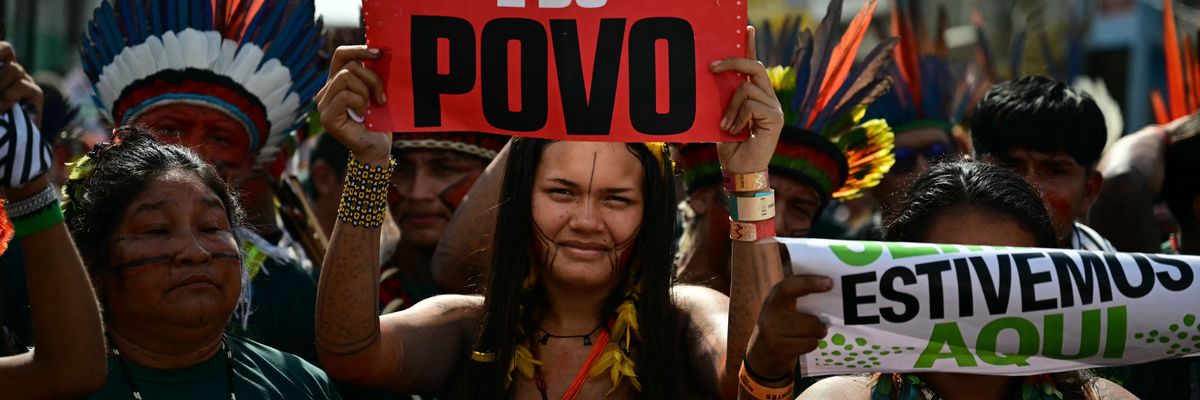
An Indigenous woman holds a sign reading, “The future belongs to the people” during the “Indigenous People Global March” at the United Nations Climate Change Conference in Belém, Brazil, on November 17, 2025. (Photo by Pablo Poriuncula/AFP via Getty Images)
“A roadmap for delivering on 1.5°C without a credible fossil fuel phaseout at its core is hollow,” said one campaigner.
Climate justice organizers on Tuesday expressed some cautious optimism that a draft text out of the United NationsClimate Change Conference in Belém, Brazil contained “building blocks” of a climate justice package that is needed to draw down planet-heating fossil fuel emissions and help the poorest and least-polluting countries confront the climate emergency—but advocates said that with just three days to go until the summit is over, the document still falls far short of delivering solutions.
The draft text, released by COP30 President André Corrêa do Lago, includes references to a “transition away from fossil fuels,” and calls for annual reviews of countries’ Nationally Determined Contributions (NDCs), the efforts they pledge to make to reduce their emissions.
But a day after campaigners expressed optimism about 62 countries and country groups endorsing Brazilian President Luiz Inácio Lula da Silva’s call for a Transition Away From Fossil Fuels (TAFF) Roadmap, 350.org condemned the draft text for mentioning the roadmap only in paragraph 44—and excluding a fossil fuel phaseout from that section of the proposal.
The TAFF Roadmap, according to the draft, would recognize that “finance, capacity-building, and technology transfer are critical enablers of climate action.”
The text also calls for “a high-level ministerial roundtable” where countries would discuss national circumstances, pathways to limiting planetary heating to 1.5°C over preindustrial temperatures, and approaches to supporting government in developing just transition roadmaps, “including to progressively overcome their dependency on fossil fuels and towards halting and reversing deforestation.”
But 350.org condemned that call as an “exceptionally weak,” sole reference to a fossil fuel transition, warning that “a mandated ministerial and a report… offer symbolism, not action.”
“For the decision to carry credibility, the presidency must embed a fossil fuel transition roadmap directly into the 1.5°C response, not relegate it to the margins,” said the group in its analysis of the document. “The roadmap must be placed in the section addressing the 1.5°C ambition gap, where it is currently absent.”
Andreas Sieber, associate director of policy and campaigns for 350.org, said that “the draft text may contain the right ingredients, but it’s been assembled in a way that leaves a bitter aftertaste.”
“For the decision to carry credibility, the presidency must embed a fossil fuel transition roadmap directly into the 1.5°C response, not relegate it to the margins. The roadmap must be placed in the section addressing the 1.5°C ambition gap, where it is currently absent.”
“A roadmap for delivering on 1.5°C without a credible fossil fuel phaseout at its core is hollow. The COP30 presidency must heed the many parties, including President Lula, calling for a clear transition pathway and put it where it belongs: at the center of the 1.5°C response, balanced with adequate finance,” said Sieber. “Without this, the overall effort will fall short.”
The group emphasized that a credible COP30 final text will include “a balanced package that delivers climate finance, strengthened adaptation measures, and a clear road map for phasing out fossil fuels.”
“Without all three pillars in place, a durable and effective agreement will not be possible,” said 350.org
The text mentions climate finance 26 times, the Guardian reported, and urges wealthy countries to clearly lay out their plans to provide financial assistance to the Global South—at a ministerial roundtable in one option included in the document, or through a “Belém Global De-Risking and Project Preparation and Development Facility,” which would “catalyze climate finance and implementation in developing country parties by translating Nationally Determined Contributions and national adaptation plans into project pipelines.”
But 350.org noted that pledges made to a global adaptation fund on Monday “once again fell short with only $133 million secured out of the $300 million target.”
Fanny Petitbon, France team lead for 350.org, warned that “adaptation has long been forgotten in climate finance,” and called on the presidency to ensure it has a central role in the final text.
“Crucially, the call to triple adaptation finance must stay,” said Petitbon. “There is no credible ambition without supporting communities already facing the devastating impacts of the climate emergency. The presidency has begun to respond to strong demands for developed countries to pay their climate debt, which is key for rebuilding trust in all negotiating rooms.”
“But the text still lacks a plan to fully deliver on the collective climate finance goal agreed upon in Baku [at COP29]—ignoring innovative sources of finance like taxing major polluters and the superrich,” Petitibon added, “and fails to guarantee direct access for the most vulnerable, including Indigenous peoples.”
At Oil Change International, global policy leader Romain Ioualalen said the options related to fossil fuels presented in the draft were “wildly unacceptable and a blatant dereliction of duty while the world burns.”
“We don’t need a COP decision to convene a workshop or ministerial roundtable on fossil fuels. What we need is a clear collective direction of travel on how countries intend to phase out fossil fuels based on equity, and how rich Global North countries will provide finance and support to the countries that need it,” said Ioualalen.
“Ministers must fix this mess,” he added, “and deliver the progress that we need to make the fair and funded transition away from fossil fuels they promised in Dubai [at COP28] a reality.”
Orcas discuss Donald Trump and the killer apes’ concept of democracy. Front Orca warns that Trump is crashing his country’s economy and that everything he does he does for the fantastically wealthy.Donald Trump urges you to be a Climate Science denier like him. He says that he makes millions and millions for destroying the planet, Burn, Baby, Burn and Flood, Baby, Flood.Nigel Farage urges you to ignore facts and reality and be a climate science denier like him and his Deputy Richard Tice. He says that Reform UK has received £Millions and £Millions from the fossil fuel industry to promote climate denial and destroy the planet.
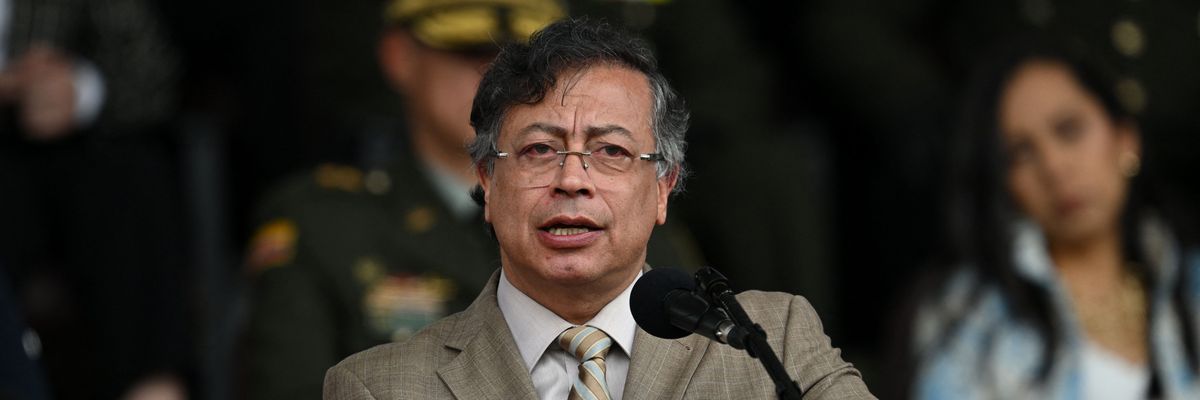
Colombia’s President Gustavo Petro delivers a speech during the commemoration of the 134th anniversary of the National Police and the promotion of officers at the General Santander Police Academy in Bogotá on November 13, 2025. (Photo by Raul Arboleda/AFP via Getty Images)
Rep. Gregory Meeks, who introduced a war powers resolution, said Trump’s actions combine the “worst excesses of the war on drugs and the war on terror.”
As Democrats in the US House of Representatives introduced their latest measure to stop President Donald Trump from continuing his attacks against alleged drug cartels without approval from Congress, the president said he wouldn’t “rule out” deploying US ground troops in Venezuela—and warned he could escalate attacks across Latin America, with possible strikes in Mexico and Colombia as well.
Shortly after the Department of Defense, called the Department of War by the Trump administration, announced its 21st illegal airstrike on what they’ve claimed, without evidence, to be “narco-terrorist” vessels mostly in the Caribbean—attacks that have killed at least 83 people—Trump told reporters in the Oval Office on Monday that he may soon begin similar operations against drug cartels in mainland Mexico.
“Would I launch strikes in Mexico to stop drugs? It’s OK with me. I’ve been speaking to Mexico. They know how I stand,” he said. “We’re losing hundreds of thousands of people to drugs. So now we’ve stopped the waterways, but we know every route.”
Earlier this month, following reports from US officials that the Trump administration had started “detailed planning” to send US troops to Mexico, the nation’s president, Claudia Sheinbaum, retorted that “it’s not going to happen.”
In his comments Monday, Trump threatened to carry out strikes in Colombia as well, saying: “Colombia has cocaine factories where they make cocaine. Would I knock out those factories? I would be proud to do it personally.”
Colombian President Gustavo Petro has been one of Latin America’s fiercest critics of Trump’s extrajudicial boat bombings, last week referring to the US president as a “barbarian.” Trump, meanwhile, has baselessly accused Petro of being “an illegal drug leader,” slapping him and his family with sanctions and cutting off aid to the country.
In response to Trump’s threats on Monday, Petro touted the number of cocaine factories that have been “destroyed” under his tenure. According to figures from the Colombian Ministry of Defense, around 18,000 of them have been taken out of commission since Petro took office in 2022, a 21% increase from Colombia’s previous president.
Immediately after Trump issued his threat against Colombia, he backpedaled, saying: “I didn’t say I’m doing it, I would be proud to do it.”
However, reporting from Drop Site News earlier this month has suggested that Sen. Lindsey Graham (R-SC) “was briefed by Secretary of War Pete Hegseth on the new list of hard targets inside Venezuela, Colombia, and Mexico in early October, and lobbied fellow senators on expanding the war to include drug-related sites in Colombia.”
The senator had alluded to the plans on CBS News’ “Face the Nation,” saying: “We’re not gonna sit on the sidelines and watch boats full of drugs come into our country. We’re gonna blow them up and kill the people who want to poison America. And we’re now gonna expand our operations, I think, to the land. So please be clear about what I’m saying today. President Donald Trump sees Venezuela and Colombia as direct threats to our country, because they house narco-terrorist organizations.”
On Tuesday, a group of Democrats in the US House of Representativesintroduced another measure that would stop Trump from continuing his attacks against alleged drug cartel members without approval from Congress.
The measure would require the removal of “United States Armed Forces from hostilities with any presidentially designated terrorist organization in the Western Hemisphere,” unless Congress authorizes the use of military force or issues a declaration of war. Previous measures to stall Trump’s extrajudicial attacks have been narrowly stymied, despite receiving some support from the Republican majority.
“There is no evidence that the people being killed are an imminent threat to the United States of America,” said Rep. Gregory Meeks (NY), the top Democrat on the House Foreign Affairs Committee, who introduced the resolution.
Meeks added that Trump’s campaign of assassinations in Latin America combines “the worst excesses of the war on drugs and the war on terror.”
Trump’s threats of military action come after Hegseth announced what he called “Operation Southern Spear” last week, which he said would be aimed at “remov[ing] narco-terrorists from our hemisphere.” In a description that evoked the 19th-century Monroe Doctrine, Hegseth wrote on social media that “the Western Hemisphere is America’s neighborhood—and we will protect it.”
In the Oval Office, Trump declared, without evidence, that with each strike his administration carries out against Venezuelan boats, “we save 25,000 American lives,” which experts say is obviously false since Venezuela plays a very minor role in global drug trafficking.
Several international legal experts have said Trump’s strikes constitute a war crime. Earlier this month, Oona A. Hathaway, a professor of international law at Yale Law School, said that members of the Trump administration “know what they are doing is wrong.”
“If they do it, they are violating international law and domestic law,” Hathaway said. “Dropping bombs on people when you do not know who they are is a breach of law.”
The Trump administration has argued that its actions are consistent with Article 51 of the UN’s founding charter, which requires the UN Security Council to be informed immediately of actions taken in self-defense against an armed attack.
The administration has not provided evidence that its attacks constitute a necessary form of self-defense. But last month, a panel of independent UN experts said that “even if such allegations were substantiated, the use of lethal force in international waters without proper legal basis violates the international law of the sea and amounts to extrajudicial executions.”
Donald Fuhrump says that Amerikkka doesn’t bother with crimes or charges anymore, not being 100% Amerikkkan and opposing his real estate intentions is enough.