Trump wants Greenland – but here’s what the people of Greenland want
Spread the love
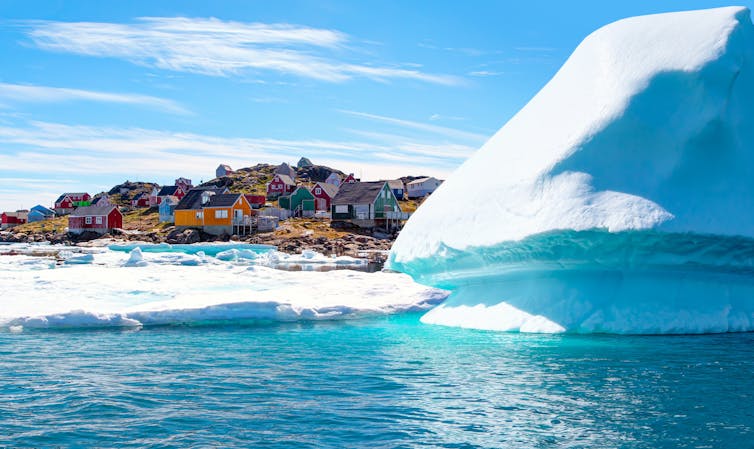
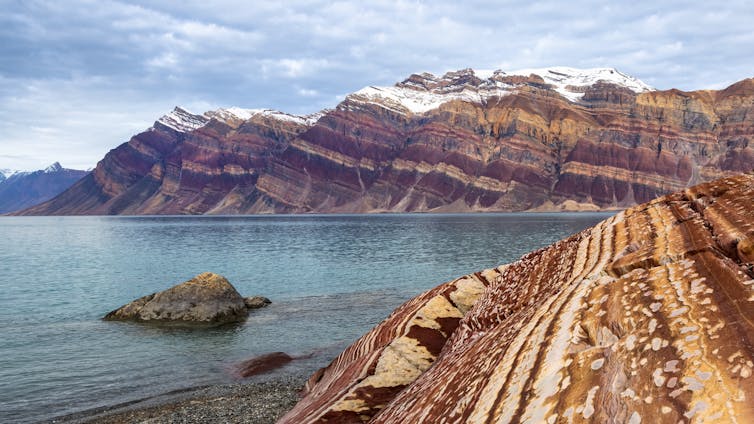
Kulusuk village in East Greenland. Shutterstock/Muratart

Gustav Agneman, Norwegian University of Science and Technology

In 2018, a colleague and I, together with a team of Greenlandic research assistants, conducted one of the most comprehensive surveys to date on public opinion in Greenland. We travelled to 13 randomly selected towns and settlements across the island nation, conducting in-person interviews with a representative sample of adult residents.

The survey explored a wide range of topics. We asked for views on climate change, economic matters – and the prospect of independence from Denmark. Until recently, this was the latest poll on what the people of Greenland thought about this issue.

Greenland, a former Danish colony, is currently an autonomous territory within the Kingdom of Denmark. This political arrangement grants Greenland extensive self-rule, including control over most domestic affairs, as well as its own prime minister and parliament. However, Denmark retains authority over foreign policy, defence and monetary policy.

While our survey results were covered in Greenlandic and Danish media upon their release, they received scant international attention. This changed abruptly on January 15, when newly re-elected US president Donald Trump reposted an old news article about our results. The headline stated that two-thirds of Greenlandic citizens support independence.
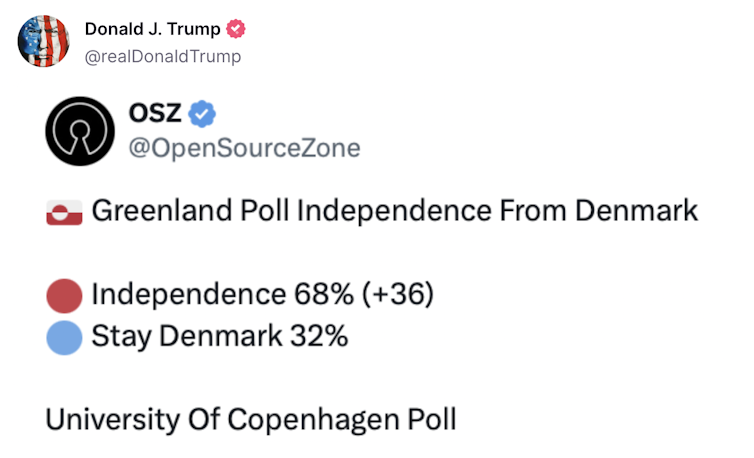
A Truth Social post in which Donald Trump posts a link to a 2018 survey saying Greenlanders want to be independent from Denmark.
Trump posting the 2018 poll in 2025. Truth Social

Trump did not add a comment in the post but the insinuation was clear given his recent statements about annexing Greenland from Denmark: Greenlandic residents want independence from Denmark, and therefore, they might be open to other political or economic arrangements with the US.

“I think we’re going to have it,” Trump recently said after a phone call with the Danish prime minister, Mette Frederiksen, who told him the land was “not for sale”. Trump has in the past spoken of somehow “purchasing” Greenland but has since moved on towards speaking in more assertive terms about taking control of the territory.

Back in 2018, when we conducted the survey, Trump had not yet revealed any plans to annex the island nation. It was a scenario we could hardly even have imagined and therefore did not ask our participants about. As such, regardless of how Trump framed them, the survey results in no way indicated that the population harboured a desire to join the US.

In fact, a recent survey conducted by Sermitsiaq (a Greenlandic newspaper) and Berlingske (a Danish newspaper) directly addressed this question and found that only 6% of respondents wanted Greenland to leave Denmark and instead become part of the US.

In the study I published based on the 2018 data collection, I reported that a majority of the Greenlandic population aspired to independence. Two-thirds of the participants thought that “Greenland should become an independent country at some point in the future”.

Opinions were more divergent regarding the timing of independence. When asked how they would vote in an independence referendum if it were held today, respondents who stated a preference were evenly split between “yes” and “no” to independence.

The Act on Greenland Self-Government, passed in 2009, grants the Greenlandic government the legal authority to unilaterally call a referendum on separating from the political union with Denmark. According to the law, “the decision regarding Greenland’s independence shall be taken by the people of Greenland”.

During the 15 years since its passage, the option to call a referendum has not been exercised. This is likely due to the potential economic consequences of leaving the union with Denmark.

Each year, Denmark sends a block grant that covers approximately half of Greenland’s budget. This supports a welfare system that is more extensive than what is available to most Americans. In addition, Denmark administers many costly including national defence.

This backdrop presents a dilemma for many Greenlanders who aspire to independence, as they weigh welfare concerns against political sovereignty. This was also evident from my study, which revealed that economic considerations influence independence preferences.

For many Greenlanders, the island nation’s rich natural resources present a potential bridge between economic self-sufficiency and full sovereignty. Foreign investments and the associated tax revenues from resource extraction are seen as key to reducing economic dependence on Denmark. Presumably, these natural resources, which include rare earths and other strategic minerals, also help explain Trump’s interest in Greenland.

As Greenland’s future is likely to remain at the centre of a geopolitical power struggle for some time, it is crucial to remember that only Greenlanders have the right to determine their own path. What scarce information is available on their views suggests that while many aspire to independence, it is not driven by a desire to join the US.

Gustav Agneman, Associate Professor, Department of Economics, Norwegian University of Science and Technology

This article is republished from The Conversation under a Creative Commons license. Read the original article.
Continue ReadingTrump wants Greenland – but here’s what the people of Greenland want

Greenland is rich in natural resources – a geologist explains why

Spread the love
Greenland’s concentration of natural resource wealth is tied to its hugely varied geological history over the past 4 billion years. Jane Rix/Shutterstock

Jonathan Paul, Royal Holloway, University of London

Greenland, the largest island on Earth, possesses some of the richest stores of natural resources anywhere in the world.

These include critical raw materials – resources such as lithium and rare earth elements (REEs) that are essential for green technologies, but whose production and sustainability are highly sensitive – plus other valuable minerals and metals, and a huge volume of hydrocarbons including oil and gas.

Three of Greenland’s REE-bearing deposits, deep under the ice, may be among the world’s largest by volume, holding great potential for the manufacture of batteries and electrical components essential to the global energy transition.

The scale of Greenland’s hydrocarbon potential and mineral wealth has stimulated extensive research by Denmark and the US into the commercial and environmental viability of new activities like mining. The US Geological Survey estimates that onshore northeast Greenland (including ice-covered areas) contains around 31 billion barrels of oil-equivalent in hydrocarbons – similar to the US’s entire volume of proven crude oil reserves.

But Greenland’s ice-free area, which is nearly double the size of the UK, forms less than a fifth of the island’s total surface area – raising the possibility that huge stores of unexplored natural resources are present beneath the ice.

Greenland’s concentration of natural resource wealth is tied to its hugely varied geological history over the past 4 billion years. Some of the oldest rocks on Earth can be found here, as well as truck-sized lumps of native (not meteorite-derived) iron. Diamond-bearing kimberlite “pipes” were discovered in the 1970s but have yet to be exploited, largely due to the logistical challenges of mining them.

Geologically speaking, it is highly unusual (and exciting for geologists like me) for one area to have experienced all three key ways that natural resources – from oil and gas to REEs and gems – are generated. These processes relate to episodes of mountain building, rifting (crustal relaxation and extension), and volcanic activity.

Greenland was shaped by many prolonged periods of mountain building. These compressive forces broke up its crust, allowing gold, gems such as rubies, and graphite to be deposited in the faults and fractures. Graphite is crucial for the production of lithium batteries but remains “underexplored”, according to the Geological Survey of Denmark and Greenland, relative to major producers such as China and South Korea.

But the greatest proportion of Greenland’s natural resources originates from its periods of rifting – including, most recently, the formation of the Atlantic Ocean from the beginning of the Jurassic Period just over 200 million years ago.

Map of Greenland's major geologic provinces with their rock types.
Greenland’s major geologic provinces with rock types and ages. Geophysical Research Letters, CC BY-NC-SA

Greenland’s onshore sedimentary basins such as the Jameson Land Basin appear to hold the greatest potential of oil and gas reserves, analogous to Norway’s hydrocarbon-rich continental shelf. However, prohibitively high costs have limited commercial exploration. There is also a growing body of research suggesting potentially extensive petroleum systems ringing the entirety of offshore Greenland.

Metals such as lead, copper, iron and zinc are also present in the onshore (mostly ice-free) sedimentary basins, and have been worked locally, on a small scale, since 1780.

Difficult-to-source rare earth elements

While not as intimately related to volcanic activity as nearby Iceland – which, uniquely, sits at the intersection of a mid-ocean ridge and a mantle plume – many of Greenland’s critical raw materials owe their existence to its volcanic history.

REEs such as niobium, tantalum and ytterbium have been discovered in igneous rock layers – similar to the discovery (and subsequent mining) of silver and zinc reserves in south-west England, which were deposited by warm hydrothermal waters circulating at the tip of large volcanic intrusions.

Critically among REEs, Greenland is also predicted to hold sufficient sub-ice reserves of dysprosium and neodymium to satisfy more than a quarter of predicted future global demand – a combined total of nearly 40 million tonnes.

These elements are increasingly seen as the most economically important yet difficult to source REEs because of their indispensable role in wind power, electric motors for clean road transport, and magnets in high-temperature settings like nuclear reactors.

The development of known deposits such as Kvanefield in southern Greenland – not to mention those not yet discovered in the island’s central rocky core – could easily affect the global REE market, owing to their relative global scarcity.

An unfortunate dilemma

The global energy transition came about due to increasing public recognition of the manifold threats of burning fossil fuels. But climate change has major implications for the availability of many of Greenland’s natural resources that are currently blanketed by kilometres of ice – and which are a key part of that energy transition.

An area the size of Albania has melted since 1995, and this trend is likely to accelerate unless global carbon emissions fall sharply in the near future.

Recent advances in survey techniques, such as the use of ground-penetrating radar, allow us to peer with increasing certainty beneath the ice. We are now able to obtain an accurate picture of bedrock topography below up to 2 km of ice cover, providing clues as to the potential mineral resources in Greenland’s subsurface.

However, progress is slow in prospecting under the ice – and sustainable extraction is likely to prove even harder.

Soon, an unfortunate dilemma may need to be addressed. Should Greenland’s increasingly available resource wealth be extracted with gusto, in order to sustain and enhance the energy transition? But doing so will add to the effects of climate change on Greenland and beyond, including despoiling much of its pristine landscape and contributing to rising sea levels that could swamp its coastal settlements.

Currently, all mining and resource extraction activities are heavily regulated by the government of Greenland through comprehensive legal frameworks dating from the 1970s. However, pressures to loosen these controls, and to grant new licences for exploration and exploitation, may increase amid the US’s strong interest in Greenland’s future.

Jonathan Paul, Associate Professor in Earth Science, Royal Holloway, University of London

This article is republished from The Conversation under a Creative Commons license. Read the original article.
Continue ReadingGreenland is rich in natural resources – a geologist explains why

Two people shot by US federal agents in Portland, police say

Spread the love

https://www.theguardian.com/us-news/2026/jan/08/portland-federal-agents-shooting

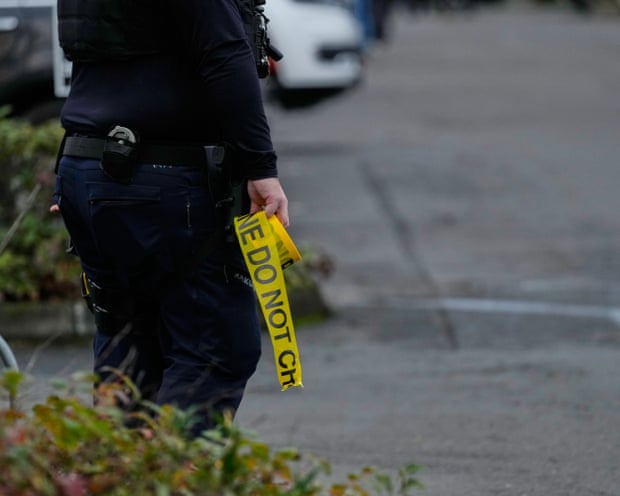
Officials at the scene following the shooting by federal agents of two people in Portland on Thursday. Photograph: Jenny Kane/AP

US federal agents shot two people in Portland, Oregon, on Thursday afternoon, Portland police said.

“Two people are in the hospital following a shooting involving federal agents,” the Portland Police Bureau (PPB) said in a statement, adding that their conditions were not known.

The PPB said its officers were not involved in the shooting.

“At 2.24pm, officers received information that a man who had been shot was calling and requesting help in the area of Northeast 146th Avenue and East Burnside,” police said. “Officers responded and found a male and female with apparent gunshot wounds. Officers applied a tourniquet and summoned emergency medical personnel. The patients were transported to the hospital. Their conditions are unknown.

“Officers have determined the two people were injured in the shooting involving federal agents.”

Maxine Dexter, a Democratic congresswoman who represents East Portland, said in a statement: “Just one day after the horrific murder in Minneapolis, I received reports that two people in my district were shot by federal immigration officials this afternoon in East Portland. Both individuals are alive, but we do not know the extent of their injuries.”

She added: “ICE has done nothing but inject terror, chaos, and cruelty into our communities. Trump’s immigration machine is using violence to control our communities – straight out of the authoritarian playbook. ICE must immediately end all active operations in Portland.”

https://www.theguardian.com/us-news/2026/jan/08/portland-federal-agents-shooting

dizzy: Details of this incident are still unclear. It appears strange to me that these individuals call emergency services themselves after being shot by federal agents i.e. did the federal agents abandon them after shooting them, did not realise or care that they had been shot?

Elon Musk urges you to be a Fascist like him, says that you can ignore facts and reality then.
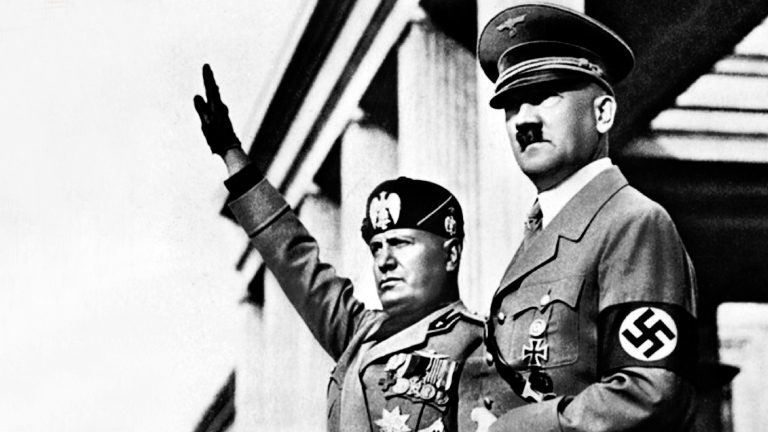
Image of the original Fascists Mussolini and Hitler.
The original Fascists Mussolini and Hitler
Orcas discuss how Trump was re-elected and him being an obviously insane, xenophobic Fascist.

Continue ReadingTwo people shot by US federal agents in Portland, police say

Watchdog Demands to Know If Trump Admin Colluded With Big Oil in Lead-Up to Venezuela Attack

Spread the love

Original article by Stephen Prager republished from Common Dreams under Creative Commons (CC BY-NC-ND 3.0).

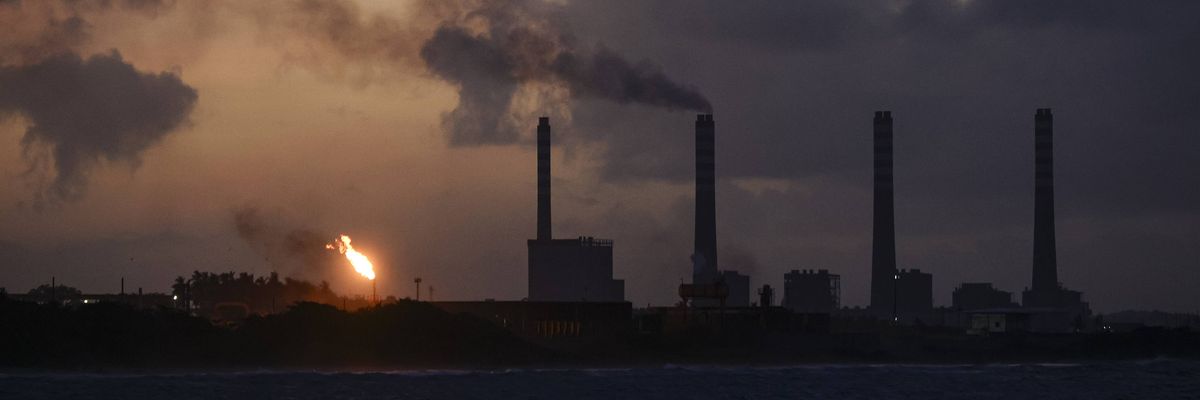
General view of ‘El Palito’ refinery building at dusk during a walk around the outskirts of ‘El Palito’ refinery on December 18, 2025, in Puerto Cabello, Venezuela. (Photo by Jesus Vargas/Getty Images)

“When government actions tied to foreign resources are preceded and followed by closed-door meetings with the world’s largest oil companies, transparency is not optional—it is essential.”

A legal watchdog group is demanding information about the extent to which the Trump administration planned its attack on Venezuela last weekend with American oil companies, which are expected to profit royally from the takeover of the South American nation’s oil reserves.

The group Democracy Forward filed a series of Freedom of Information Act (FOIA) requests on Monday seeking records and information about the role of US oil companies in the planning of the attack, which killed an estimated 75 people and led to the US military’s abduction of Venezuelan President Nicolas Maduro and his wife.

RECOMMENDED…

President Trump Returns To The  White House After Spending Holidays In Florida

‘What an Authoritarian Oligarchy Looks Like’: Trump Says Oil Execs Tipped Off About Venezuela Attack

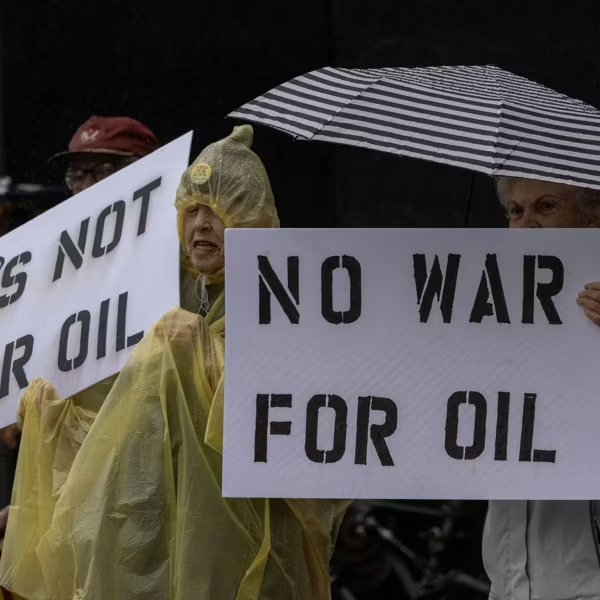
People participate in a "No War on Venezuela" protest

‘Get the Oil Flowing’: Trump’s Own Words Make His War Aims in Venezuela Clear

President Donald Trump did not inform Congress of the operation, which is required under the War Powers Act of 1973, but he told reporters on Sunday that he’d tipped off oil company executives both “before and after” the strike.

According to reporting by the Wall Street Journal, he informed executives roughly a month before the strike to “get ready” because big changes were coming to the country, which had long held state control over the largest oil reserves in the world.

Since toppling Maduro, in an operation that international law experts have widely described as illegal, Trump has said his goal is to “get the oil flowing” to American oil companies to start “taking a tremendous amount of wealth out of the ground.”

On Tuesday, Trump said Venezuela’s interim leaders—who he’s threatened with more attacks if they don’t do what he says—have agreed to hand over 30-50 million barrels of oil to be sold by the US, which will control how the profits are dispersed.

Trump and several members of his Cabinet, including Energy Secretary Chris Wright and Interior Secretary Doug Burgum, are expected to meet with oil executives on Friday at the White House to discuss “security guarantees” for their new spoils.

Democracy Forward has requested information about communications between senior officials at the US departments of Energy and the Interior and executives at top oil companies, including ChevronExxonMobil, and ConocoPhillips, prior to the attack. This includes emails, attachments, and calendar invitations exchanged since December 2025.

The group has said it will seek to determine whether these companies were given “privileged access or influence” over the administration’s policy toward Venezuela.

“The president couldn’t find time to brief members of Congress before kidnapping a foreign head of state, but appears to have prioritized discussions with Big Oil. When government actions tied to foreign resources are preceded and followed by closed-door meetings with the world’s largest oil companies, transparency is not optional—it is essential,” said Skye Perryman, the president and CEO of Democracy Forward. “The public deserves to know what interests are shaping decisions that have enormous consequences for global energy markets and democratic accountability.”

FOIA, which was passed in 1967, allows members of the public to request records from any federal agency. However, agencies have broad discretion to deny FOIA requests, including in cases involving national security or interagency communications.

Original article by Stephen Prager republished from Common Dreams under Creative Commons (CC BY-NC-ND 3.0).

Elon Musk urges you to be a Fascist like him, says that you can ignore facts and reality then.
Donald Fuhrump says that Amerikkka doesn't bother with crimes or charges anymore, not being 100% Amerikkkan and opposing his real estate intentions is enough.
Donald Fuhrump says that Amerikkka doesn’t bother with crimes or charges anymore, not being 100% Amerikkkan and opposing his real estate intentions is enough.
Orcas discuss how Trump was re-elected and him being an obviously insane, xenophobic Fascist.

Continue ReadingWatchdog Demands to Know If Trump Admin Colluded With Big Oil in Lead-Up to Venezuela Attack

‘Yankees Go Home!’ Colombians Demand at Mass Protests Against Trump Threats

Spread the love

Original article by Julia Conley republished from Common Dreams under Creative Commons (CC BY-NC-ND 3.0).

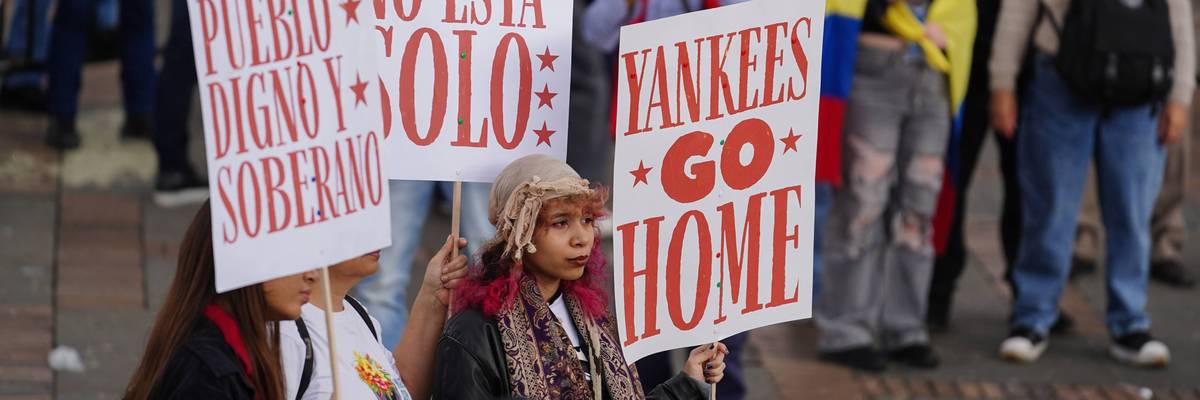
Demonstrators hold signs during an anti-Trump protest at Plaza de Bolivar on January 7, 2026 in Bogotá, Colombia. (Photo by Andres Rot/Getty Images)

Thousands of people across the country expressed support for their president, Gustavo Petro, who spoke to President Donald Trump ahead of the rallies and struck a diplomatic but defiant tone.

Colombian President Gustavo Petro struck a relatively diplomatic tone Wednesday at a rally in Bogotá, where he spoke about the Trump administration’s threats to launch military strikes against his country—but thousands of people who gathered in the Colombian capital and across the country were happy to say exactly what they thought of US President Donald Trump’s recent attack on neighboring Venezuela and his saber-rattling across Latin America.

“He’s a maniac,” 67-year-old José Silva told the Guardian at a march in the border city of Cúcuta. “The US Congress needs to do something to get him out of the presidency… He’s a thug.”

RECOMMENDED…

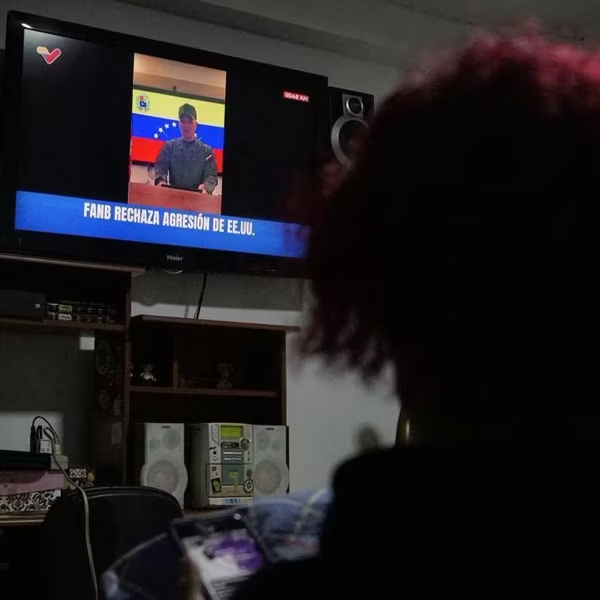
A woman watches a public television broadcast by Venezuelan Defense Minister Vladimir Padrino

‘This Is State Terrorism’: Global Outrage as Trump Launches Illegal Assault on Venezuela

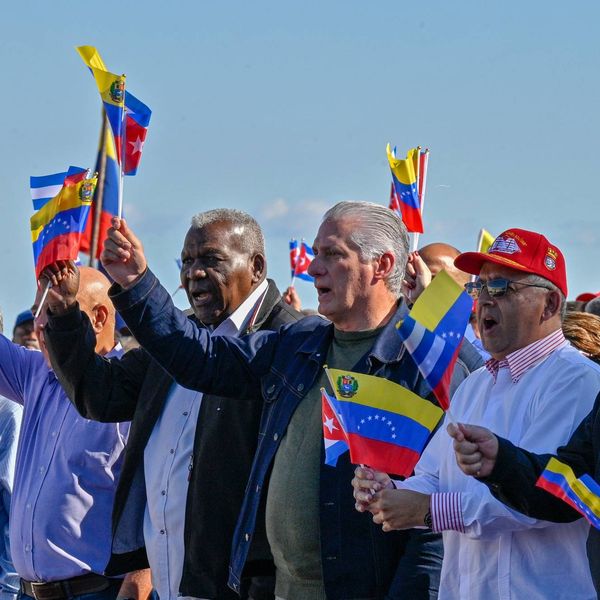
Cuban President Miguel Diaz-Canel flutters a Venezuelan national flag

After Venezuela Assault, Trump and Rubio Warn Cuba, Mexico, and Colombia Could Be Next

“Trump is the devil,” another marcher, Janet Chacón, told the outlet.

And demonstrators held English-language signs proclaiming, “Yankees Go Home!” as well as banners reading, “Fuera los yanquis!” or “Out with the Yanks!”

Colombians were rallying after Petro called for a mass mobilization days after Trump ordered a military attack in Venezuela, including a bombing and the abduction of President Nicolás Maduro and his wife, Cilia Flores. Maduro and Flores have pleaded not guilty to narco-terrorism charges in a court in New York City, while Trump and other White House officials have made clear in recent days that their objective in Venezuela is not to stop drug trafficking—a crime in which the country is not significantly involved—but to take control of its oil reserves.

Colombians marched together with Venezuelans in Cúcuta, with one man telling Reuters, “If they kidnap your president, they kidnap the entire homeland.”

Soon after invading Venezuela, Trump and other officials including Secretary of State Marco Rubio suggested they could soon attack other Latin Amercian countries and try to overthrow their leaders.

Officials in Cuba’s socialist government, said Rubio, are “in a lot of trouble,” while Trump said the US is “going to have to do something” about drug cartels operating in Mexico.

Regarding Colombia, Trump cited no evidence as he accused the left-wing Petro of “making cocaine and selling it to the United States” and said an invasion of the country “sounds good to me.” Petro has not been linked to the drug trade in Colombia.

Petro has vehemently condemned Trump’s escalation in Latin America in recent months and has accused the president of murder in the Caribbean, where the US has bombed dozens of boats and killed more than 100 people since September, accusing them of drug trafficking without releasing any evidence.

After the Venezuela attack and the threats toward other countries in the region, Petro warned that Trump had awakened a “jaguar,” referring to the opposition of the public in Colombia and across Latin American regarding US imperialism.

After calling on Colombians to take to the streets, Petro spoke to Trump on the phone at the US president’s request and accepted an invitation to the White House. Trump said it was “a great honor” to speak with the Colombian leader.

Petro told protesters in Bogotá that the speech he had planned to give had been “quite harsh.”

“For 34 years, peace has been my priority,” he said. “And I know that peace is found through dialogue. That is why I accept President Trump’s proposal to talk.”

“If there is no dialogue, there is war. The history of Colombia has taught us that,” the president added.

But he also made clear to thousands of supporters, many of whom carried placards with pictures of Petro, that “what happened in Venezuela was, in my opinion, illegal.”

“We cannot lower our guard,” he said. “Words need to be followed by deeds.”

In Cúcuta, a teacher named Marta Jiménez denounced a number of European leaders who have refused to clearly condemn Trump’s invasion of Venezuela’s neighbor, even as legal scholars have said it was a clear violation of the United Nations Charter.

“They are leaving him to fly, free as a bird over every single country, to do whatever he likes,” she said, expressing concern that Trump’s next target “might be Nicaragua, BrazilEcuador, Peru—any of them.”

Protests were also held this week in countries including Argentina and Brazil, with demonstrators expressing solidarity with the rest of Latin America in light of Trump’s threats and attacks.

“The message from the people of Latin America is: ‘Donald Trump, get your hands off Latin America,’” Brazilian Congressman Reimont Otoni said at a rally outside the US consulate in Rio de Janeiro. “Latin America isn’t the [United States’] backyard.”

Original article by Julia Conley republished from Common Dreams under Creative Commons (CC BY-NC-ND 3.0).

Elon Musk urges you to be a Fascist like him, says that you can ignore facts and reality then.
Donald Fuhrump says that Amerikkka doesn't bother with crimes or charges anymore, not being 100% Amerikkkan and opposing his real estate intentions is enough.
Donald Fuhrump says that Amerikkka doesn’t bother with crimes or charges anymore, not being 100% Amerikkkan and opposing his real estate intentions is enough.
Orcas discuss how Trump was re-elected and him being an obviously insane, xenophobic Fascist.

Continue Reading‘Yankees Go Home!’ Colombians Demand at Mass Protests Against Trump Threats