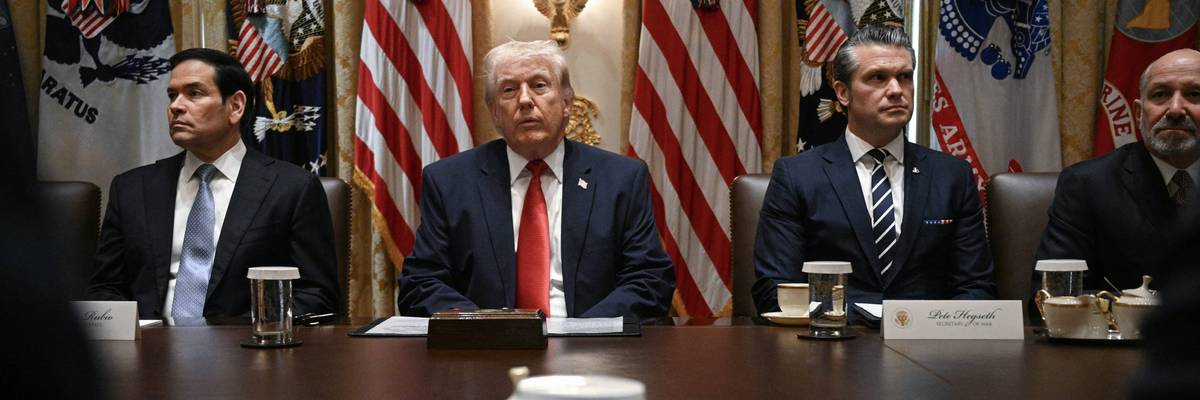
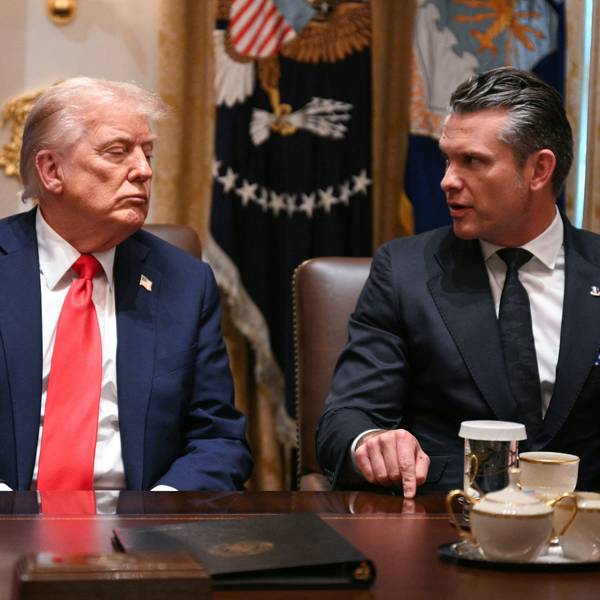
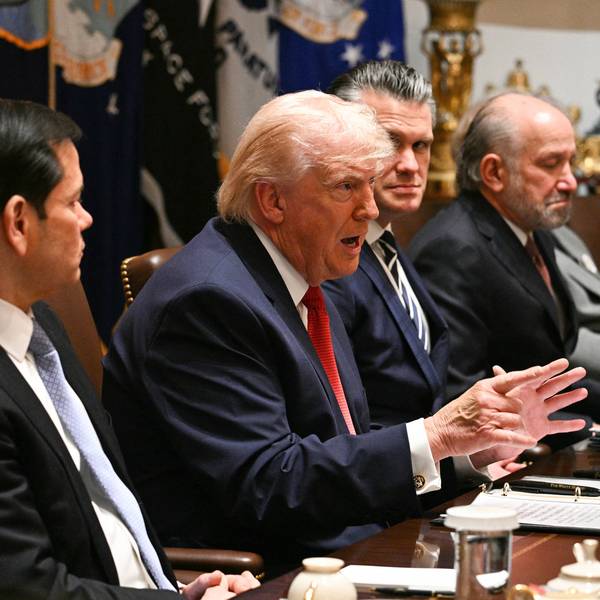
US President Donald Trump hosts a cabinet meeting in the Cabinet Room of the White House in Washington, DC, on March 26, 2026. (Photo by Jim Watson/AFP via Getty Images)
“The United States is inarguably in a weaker position than when it began this war of choice, with core US strategic objectives harmed.”
President Donald Trump’s illegal war of choice with Iran has dealt the United States an even bigger strategic defeat than the one it suffered in the Vietnam War, according to one expert.
In an essay published on Tuesday by Foreign Policy, Paul Musgrave, associate professor of government at Georgetown University in Qatar, made the case that the damage done to the United States’ reputation and credibility in the wake of the Iran war are significantly more severe than anything the country suffered in the wake of Vietnam.
Even though the Vietnam War went on for far longer and resulted in far more deaths than Trump’s Iran war, Musgrave argued, the US nonetheless exited it with little long-term damage to its global power.
“Compare that situation with the aftermath of Trump’s war,” Musgrave continued. “The United States is inarguably in a weaker position than when it began this war of choice, with core US strategic objectives harmed.”
Musgrave noted that while the US and Israel had initial success in decapitating Iran’s leadership at the beginning of the conflict, this only left the hardliners in the Islamic Revolutionary Guard Corps (IRGC) to run the country.
By failing to achieve the stated aim of regime change and by empowering even more radical elements within Iran, Musgrave added, Trump has severely damaged other nations’ willingness to trust the US for national security protection.
“Regional allies, many of whom reportedly argued against the venture, bore the brunt of the costs of the fighting,” the scholar wrote. “Most tellingly, Iran learned that its capacity to throttle the Strait of Hormuz could deliver economic leverage on a worldwide scale.”
Writing in The New York Times on Wednesday, national security journalist WJ Hennigan argued that the United States’ strategic defeat has laid bare the limits of US military power to bend weaker nations to its will.
In particular, he pointed out that the US, which spent $1 trillion on its military last year, could not take out even a majority of Iran’s missile stockpiles.
“Yes, the wonder weapons that American industry cranks out, like cruise missiles and air-defense interceptors, have proven impressive on the battlefield,” Hennigan wrote. “But the war has exposed the underlying weaknesses of depending on weaponry that’s extremely expensive and time-consuming to deliver. During an April 30 congressional hearing, Defense Secretary Pete Hegseth estimated it could take ‘months and years’ to replenish the stocks that had been used in the war.”
Matt Duss, executive vice president at the Center for International Policy, similarly said that Trump’s Iran war had resulted in a strategic defeat for the US. However, he also expressed hope that this defeat could mark a turning point in US foreign policy circles regarding the applications of American power throughout the world.
“There’s a longstanding US bipartisan consensus around wildly inflating the Iranian threat,” Duss wrote in a social media post. “Trump’s war, a strategic defeat, was an expression of that consensus. If… ending the war puts the US and Iran on path to a more normal relationship, that will be a positive thing.”
This work by Middle East Monitor is licensed under a Creative Commons Attribution-NonCommercial-ShareAlike 4.0 International License.
Israeli military vehicles and tanks are stationed near the Lebanese border in northern Israel on March 14, 2026. [Tsafrir Abayov – Anadolu Agency]
The Israeli army has urged the government to preserve its freedom to conduct operations throughout Lebanon, maintain a buffer zone and pursue the disarmament of Hezbollah, an Israeli newspaper reported Thursday.
According to the Israeli daily Yedioth Ahronoth, the army delivered what it described as an important message to Israel’s political leadership regarding future military activity in Lebanon.
The move came just hours after the US and Iranian presidents signed a memorandum of understanding to end the war on all fronts, including Lebanon.
The report claimed that the recent decline in Israeli strikes deep inside Lebanon is not the result of a policy change but rather the absence of clear instructions from political leaders.
“The army does not know what is permitted and what is prohibited,” it quoted military sources as saying.
The Israeli military’s position appeared to contrast with provisions of the US-Iran understanding, which Iranian officials say include commitments to end military operations in Lebanon and respect the country’s sovereignty and territorial integrity.
Keir Starmer objects to criticism of the IDF. He asks how could anyone object to them starving people to death, forced marches like the Nazis did, bombing Gaza’s hospitals and universities, mass-murdering journalists, healthworkers and starving people queuing for food, killing and raping prisoners and murdering children. He calls for people to stop obstructing his genocide for Israel.Orcas discuss rotting brain, front Orca says Sundown Syndrome is a dead givaway and he wishes someone would Lock Him Up
He described recent understandings between the US and Iran as an “encouraging development” and said there was a “glimmer of peace” in the Middle East that should not be wasted.
The foreign minister also said he would speak later with Iranian Foreign Minister Abbas Araghchi, and that Italy was ready to support efforts to turn the US-Iran understanding into lasting peace.
Tajani stressed the importance of restoring freedom of navigation in the Strait of Hormuz, saying it was vital for the Italian economy.
Washington and Tehran reached a temporary truce in April through Pakistani mediation before announcing a framework agreement Monday to end the war. The accord is expected to be formally signed Friday in Switzerland.
Keir Starmer objects to criticism of the IDF. He asks how could anyone object to them starving people to death, forced marches like the Nazis did, bombing Gaza’s hospitals and universities, mass-murdering journalists, healthworkers and starving people queuing for food, killing and raping prisoners and murdering children. He calls for people to stop obstructing his genocide for Israel.Orcas discuss rotting brain, front Orca says Sundown Syndrome is a dead givaway and he wishes someone would Lock Him Up
This work by Middle East Monitor is licensed under a Creative Commons Attribution-NonCommercial-ShareAlike 4.0 International License.
Israeli military forces carried out a strike on a vehicle in central Gaza City, resulting in multiple casualties. [Mohammed Asad/Middle East Monitor]Israeli military forces carried out a strike on a vehicle in central Gaza City, resulting in multiple casualties. [Mohammed Asad/Middle East Monitor]Israeli military forces carried out a strike on a vehicle in central Gaza City, resulting in multiple casualties. [Mohammed Asad/Middle East Monitor]
Keir Starmer objects to criticism of the IDF. He asks how could anyone object to them starving people to death, forced marches like the Nazis did, bombing Gaza’s hospitals and universities, mass-murdering journalists, healthworkers and starving people queuing for food, killing and raping prisoners and murdering children. He calls for people to stop obstructing his genocide for Israel.Orcas discuss rotting brain, front Orca says Sundown Syndrome is a dead givaway and he wishes someone would Lock Him Up
This work by Middle East Monitor is licensed under a Creative Commons Attribution-NonCommercial-ShareAlike 4.0 International License.
US President Donald Trump addresses a meeting with Gulf leaders of the six-nation Gulf Cooperation Council (GCC) in Riyadh on May 14, 2025. [Photo by BRENDAN SMIALOWSKI/AFP via Getty Images]
The suspension and redesign of Trump’s plan to reopen Hormuz showed that the Arab states of the Persian Gulf still need the United States, but they are no longer willing to pay, unconditionally, the price of a war they did not start.
When Donald Trump spoke of “Project Freedom” to reopen the Strait of Hormuz, the plan was supposed to be a display of restored American deterrence: an operation meant to prove that Washington could still open the world’s energy artery with its military fleet and its network of regional bases. Yet the rapid suspension of the project, after Saudi Arabia’s initial opposition to the use of its bases and airspace, carried a deeper meaning. This was not merely an operational disagreement.
“Project Freedom” showed that the Persian Gulf security order has entered a new phase: Arab states have not turned their backs on America, but they are no longer willing, without calculation, to serve as the launchpad for Washington’s war with Iran.
The significance of this shift became even clearer with the interim agreement between the United States and Iran. The framework, which is reportedly expected to lead to the reopening of Hormuz, ease pressure on the energy market, and begin a sixty-day period for nuclear negotiations, was not simply the product of military pressure. It was also the result of the constraints America faced on the regional battlefield. Washington could send more warships, but it could not be certain that all of its Arab partners would stand with it in every escalation scenario.
For decades, the relationship between Washington and the Arab governments of the Persian Gulf rested on a simple formula: oil, bases, and political alignment in exchange for security. Arab states provided access and alignment; in return, they expected protection. But the 2019 attacks on Aramco created the first serious crack in that mindset. Riyadh expected a decisive response, yet America’s reaction remained limited. From that moment, a hard question began to take shape: in a moment of danger, would America really enter a costly war to defend its allies?
The Hormuz crisis revived that question, but this time with greater urgency. The Arab states of the Persian Gulf know that any overt participation in an American military operation against Iran could turn them into direct targets of missile, drone, or maritime attacks. Their refineries, ports, and coastal cities are vulnerable, while the decision for war is made in Washington. From the perspective of Riyadh and Kuwait, the danger is not only Iran; the danger is being trapped in a war designed by others, while its geographic and economic costs fall on the Persian Gulf.
For this reason, the initial opposition to “Project Freedom” should not be read as a Saudi or Kuwaiti break with America. It was not an ideological “no”; it was a conditional and calculating “no.” Riyadh and Kuwait did not say they would no longer cooperate with the United States. They said they were not prepared to turn their territory into part of the theater of operations without clear guarantees about the consequences of war. Even later reports that Saudi Arabia and Kuwait had eased restrictions on U.S. military access did not erase the core issue. The significance of the episode was not that the restrictions were permanent; it was that such restrictions were imposed at all.
Some argue that because the restrictions were later reduced, no structural change has occurred. This argument sees part of the reality, but it misses the political meaning of hesitation. In regional politics, the pause itself matters.
If a plan that was supposed to display American authority became, from the very beginning, dependent on the consent of Riyadh and Kuwait, it means that American military power alone is no longer enough to produce political obedience. This is precisely the point at which strategic dependence remains, but automatic compliance begins to erode.
This shift cannot be separated from Saudi Arabia’s internal transformations either. Saudi Arabia today is not the Saudi Arabia of the early years of the Yemen war. Mohammed bin Salman needs stability in order to attract investment, expand tourism, and reduce dependence on oil. “Vision 2030” makes sense with the image of a safe country, not with the spectacle of a battlefield exchanging missiles and drones. Recent analyses of the consequences of a Hormuz war have also shown that the crisis made Saudi Arabia’s strategic vulnerability—and its need for safer energy routes—even more visible.
From this perspective, de-escalation with Iran is not a sign of weakness; it is part of a new rationality of survival. The Tehran-Riyadh agreement mediated by China, and the effort to preserve channels of communication with Tehran, can be understood within this same framework.
Arab countries know that Iran is not a neighbor that can be erased. They can compete with Tehran, but they cannot change geography. America can change its priorities; the Persian Gulf, however, must live with the consequences of every war in that same region.
Trump’s policy made this reality even more visible. On the one hand, he spoke in the language of threats, sanctions, and displays of power; on the other, he tried to avoid an all-out war, one that could endanger the energy market, the elections, and America’s focus on China. The result of this contradiction was the transfer of risk to allies. Arab states felt that Washington wanted to use their territory to pressure Iran, without offering a clear guarantee that it would bear the heavy costs of defending them. This is where security trust begins to erode from within.
Nor has the interim agreement between the United States and Iran ended this problem; rather, it has revealed it in a different form. If this agreement keeps Hormuz open on a durable basis, Arab governments will breathe a sigh of relief. Reports of oil tankers carrying Iranian crude once again passing through the route of America’s naval blockade are a sign of reduced tensions. But if the negotiations fail and Trump returns to the military option, the same question will return: should the Persian Gulf be the main arena for Iran’s retaliation?
“Project Freedom,” then, was not merely a plan to escort ships through Hormuz. It was a test of the Persian Gulf security order. And that test showed that America remains the region’s superior military power, but it can no longer count on the unconditional cooperation of its Arab partners. Arab allies still need Washington’s security umbrella, but they want distance between their own security and America’s costly adventures.
The Middle East today is not witnessing America’s complete withdrawal. It is witnessing the end of a political habit. The old habit was that whenever Washington decided to escalate pressure against Iran, the Arab states of the Persian Gulf would line up behind it without hesitation. Now they have become too cautious, and too vulnerable, to take such a decision lightly.
This is the main message of “Project Freedom”: America’s Arab allies still say “yes” to Washington, but that “yes” is no longer automatic, cheap, or unconditional.
Keir Starmer objects to criticism of the IDF. He asks how could anyone object to them starving people to death, forced marches like the Nazis did, bombing Gaza’s hospitals and universities, mass-murdering journalists, healthworkers and starving people queuing for food, killing and raping prisoners and murdering children. He calls for people to stop obstructing his genocide for Israel.Orcas discuss rotting brain, front Orca says Sundown Syndrome is a dead givaway and he wishes someone would Lock Him Up