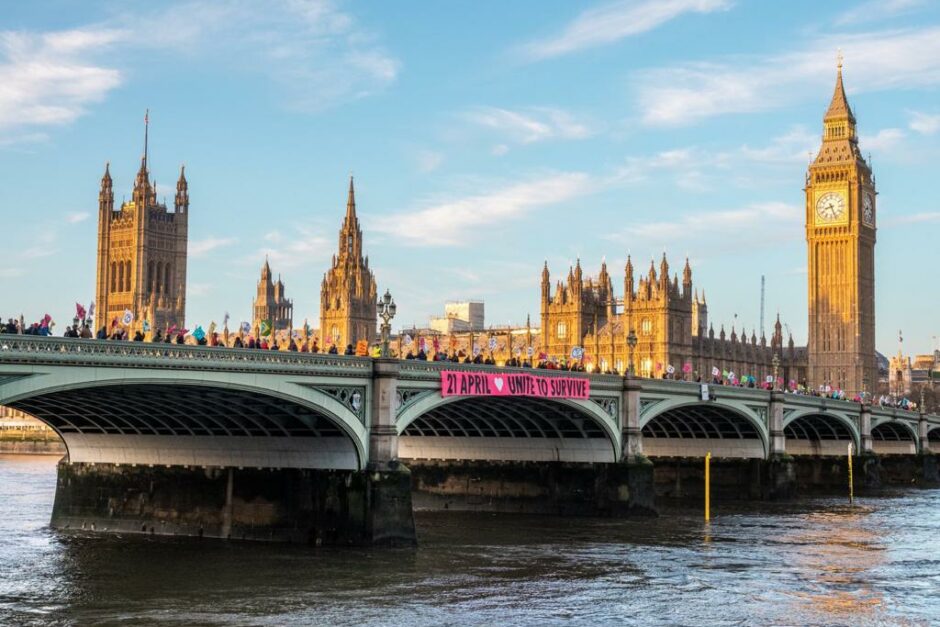
Extinction Rebellion UK dropped a large banner from Westminster Bridge in London that reads ‘APRIL 21: UNITE TO SURVIVE’. A group had marched with flags from Jubilee Gardens along Belvedere Road where they stood in single file off the road, forming a chain across the length of the bridge. When there, an important message was passed along a human chain from one side of the bridge to the other, symbolising connection across divides.
The action officially launches Extinction Rebellion’s ‘100 Days’ campaign – the biggest mobilisation campaign XR has ever undertaken. With it, a new Crowdfunder is set in motion with a £1million target by 21st April, 2023, when 100k are expected to stand together outside the Houses of Parliament.
Today marks the 100 day countdown to ‘The Big One’ on 21st April and is encouraging millions of conversations with friends, family, colleagues and strangers, as well as organisations across and beyond the environmental space, to bring 100k people to Westminster. With Extinction Rebellion’s official ‘ticker’ count revealed to show over 7,000 people ready to be there, this powerful targeted campaign aims to reach new audiences with an accessible, inclusive and easy-to-understand invitation to bring the remaining count into active resistance.
Anna Hyde of Extinction Rebellion UK, said: “The climate, ecological and biodiversity emergencies are not distant threats – they are happening right now, unevenly affecting many – ultimately affecting everyone, and life on Earth is at stake. Covered up by corrupt media, those in power continue to profit from the crises unravelling around us. The fossil fuel era must end, and restoration of the world must begin. This is where solidarity comes in.”
Following Extinction Rebellion’s New Year statement stating that we will “disrupt the abuse of power and imbalance” by targeting the true perpetrators, all signs at this chaotic time in history point toward cooperation between groups and movements taking our love and rage to the seat of power in Westminster. Horrified by the climate disasters unfolding around us, thousands in the UK are ready and waiting to do the work the government is unwilling to do.
Dr. Caroline Vincent of Scientists for XR, said: “Disruptive protest has done so much to change the conversation around the climate and ecological emergency over the last 4 years; more and more people are waking up to realities of the climate crisis, and more and more are saying they want immediate and decisive action.
“The reality is however, that as the general public becomes more concerned, the government in the UK backtracks on its already meagre climate promises, sanctioning a new coal mine in Cumbria at the end of 2022. So, the government isn’t listening and the only way that changes is by all of these newly concerned people recognising their own power and stepping into active resistance. At the same time, the Government is clamping down on the right to protest and criminalising those raising the alarm. In the current circumstances it’s clear that only larger numbers of people taking peaceful action together over prolonged periods will prove impossible to ignore.”
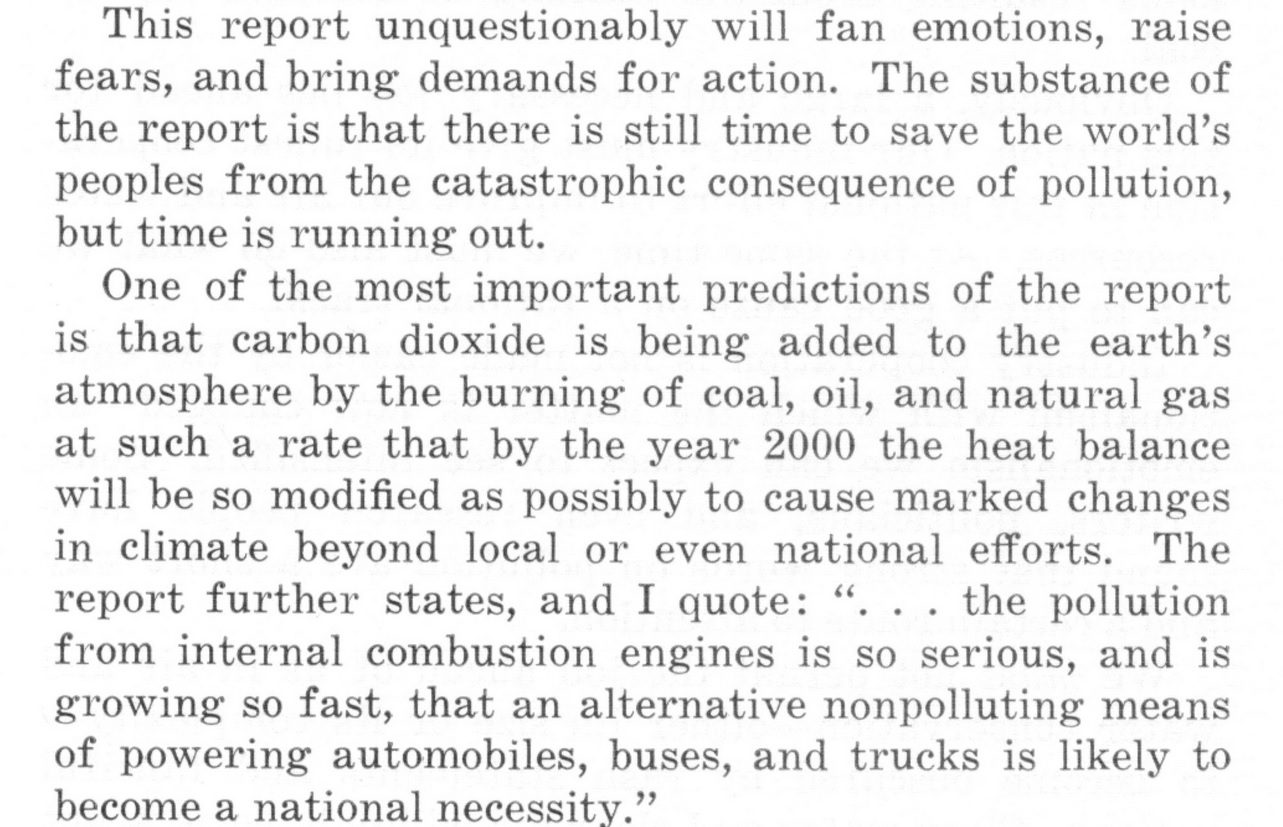
The warning is clear and dire — and the source unexpected. “This report unquestionably will fan emotions, raise fears, and bring demand for action,” the president of the American Petroleum Institute (API) told an oil industry conference, as he described research into climate change caused by fossil fuels.
“The substance of the report is that there is still time to save the world’s peoples from the catastrophic consequence of pollution, but time is running out.”
The speaker wasn’t Mike Sommers, who was named to helm API this past May. Nor was it Jack Gerard, who served as API’s president for roughly a decade starting in 2008.
The API president speaking those words was named Frank Ikard — and the year was 1965, over a half-century ago.
It was the same year that Dr. Martin Luther King Jr. led a civil rights march from Selma to Montgomery, Muhammad Ali felled Sonny Liston in the first round, and Malcom X was fatally shot in New York. The first American ground combat troops arrived in Vietnam and President Lyndon B. Johnson signed the law establishing Medicaid and Medicare.
It would be another four years before American astronaut Neil Armstrong first set foot on the moon — and another decade before the phrase “global warming” would appear for the first time in a peer-reviewed study.
“One of the most important predictions of the report is that carbon dioxide is being added to the Earth’s atmosphere by the burning of coal, oil, and natural gas at such a rate that by the year 2000 the heat balance will be so modified as possibly to cause marked changes in climate beyond local or even national efforts,” Ikard presciently added, according to excerpts from his speech published in Nature.
Exerpt of API President Frank Ikard’s 1965 speech on climate change and fossil fuels.
API Funded Early Research Linking CO2 and Fossil Fuels
That prediction was based in part on information that was known to the oil industry trade group for over a decade — including research that was directly funded by the API, according to Nature.
In 1954, a California Institute of Technology geochemist sent the API a research proposal in which they reported that fossil fuels had already caused carbon dioxide (CO2) levels to rise roughly five percent since 1854 — a finding that Nature notes has since proved to be accurate.
API accepted the proposal and funded that Caltech research, giving the program the name Project 53. Project 53 collected thousands of CO2 measurements — but the results were never published.
Meanwhile, other researchers were reaching similar conclusions. Nuclear physicist Edward Teller became known in 1951 as the “father of the hydrogen bomb” for designing a thermonuclear bomb that was even more powerful than the atomic bombs dropped in Hiroshima and Nagasaki. Teller warned the oil and gas industry in 1959 about global warming and sea level rise in a talk titled “Energy Patterns of the Future.”
“Carbon dioxide has a strange property,” Teller said in excerpts published earlier this year by The Guardian. “It transmits visible light but it absorbs the infrared radiation which is emitted from the earth. Its presence in the atmosphere causes a greenhouse effect.”
A researcher at Humble Oil Co. (now known as ExxonMobil) checked results from a study of carbon isotopes in tree rings against the unpublished Caltech results, and found that the two separate methods essentially agreed.
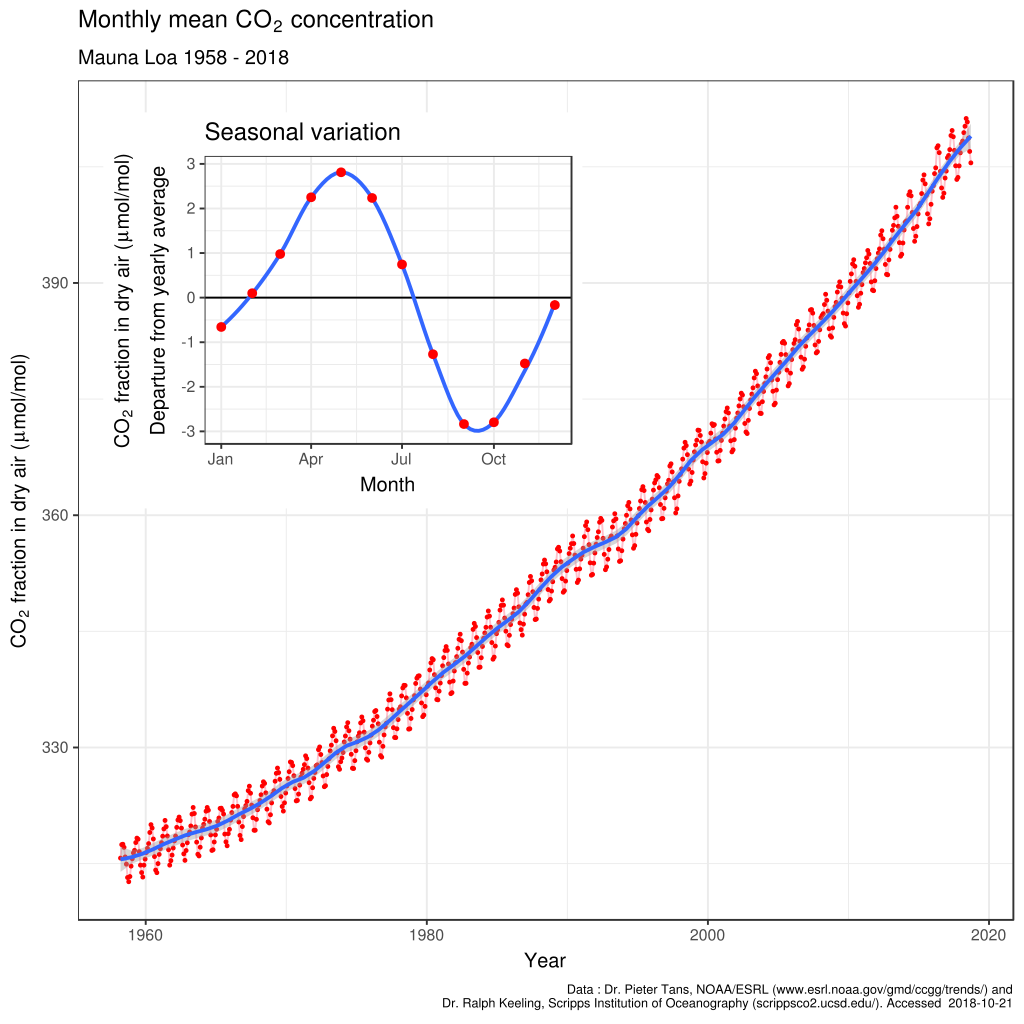
This figure shows the history of atmospheric carbon dioxide concentrations as directly measured at Mauna Loa, Hawaii since 1958. This curve is known as the Keeling curve, and is an essential piece of evidence of the man-made increases in greenhouse gases that are believed to be the cause of global warming. Credit: Delorme, data from Dr. Pieter Tans, NOAA, and Dr. Ralph Keeling, Scripps, CC BY–SA 4.0
And in 1960, Charles Keeling first published the measurements that became the famous “Keeling curve” — establishing one of the bedrock findings connecting climate change to fossil fuels. The CO2 measurements taken by Keeling back in the late 1950s showed levels of roughly 315 parts per million (ppm) at the Mauna Loa Observatory in Hawaii and rising.
Those CO2 levels have since climbed upwards to 410.13 (ppm) on the day that the Nature letter was published — CO2 levels that scientists knew both then and now would be dangerously high, as carbon levels in the Earth’s atmosphere have not been over 410 ppm in millions of years.
What the Oil Industry Knew, Then and Now
In his 1965 talk, the API’s Ikard described the role of oil and gasoline specifically in causing climate change. “The report further states, and I quote: ‘… the pollution from internal combustion engines is so serious, and is growing so fast,’” he told the API conference, “‘that an alternative nonpolluting means of powering automobiles, buses, and trucks is likely to become a national necessity.’”
Three decades later, the API urged a different approach to climate science. “It’s not known for sure whether (a) climate change actually is occurring, or (b) if it is, whether humans really have any influence on it,” the API wrote in a 1998 draft memo titled “Global Climate Science Communications Plan,” which was subsequently leaked.
As of publication time, an API spokesperson had not replied to questions sent by DeSmog.
It’s worth noting that since 1965, the science connecting climate change to fossil fuels has grown stronger and more robust. A scientific consensus around the hazards of climate change and the role that fossil fuels play in causing it has formed.
“Rigorous analysis of all data and lines of evidence shows that most of the observed global warming over the past 50 years or so cannot be explained by natural causes and instead requires a significant role for the influence of human activities,” the Royal Society explains.
Today, the API continues to call for further research on climate change — and expanding the use of fossil fuels in the meantime.
“It is clear that climate change is a serious issue that requires research for solutions and effective policies that allow us to meet our energy needs while protecting the environment: that’s why oil and gas companies are working to reduce their greenhouse gas emissions,” the API’s webpage on climate change states.
SEVEN HUNDRED SELF-DESCRIBED “climate rebels” breached the chain-link fence surrounding Amsterdam’s Schiphol Airport, the world’s third-busiest hub for international passenger traffic, on November 5. With bolt cutters they opened holes in the fence and poured in, some of them on bicycles, and raced across the tarmac. Others laid ladders against the 9-foot-high fence and topped it on foot.
…
“The superrich have got used to polluting as they please with a total disregard for people and planet, and private jets are the pinnacle of these luxury emissions that we simply cannot afford,” Jonathan Leggett, one of the activists, told us. “Our action brought them back to earth. We wanted to show the extremeness and injustice related to this manner of transport.”
…
In the Netherlands, 8 percent of the population takes 40 percent of flights. Worldwide, the difference is even more stark: One percent of the population is responsible for 50 percent of pollution due to aviation, making air travel a textbook example of how pollution by the rich leads to consequences and injustices for those who have not caused the climate crisis.
An interesting long article reviews and discusses climate activism 2022 and looks forward to 2023.
…
On New Year’s Day, Extinction Rebellion caused a stir by tweeting, “WE QUIT! Our New Year’s Resolution is to halt our tactics of public disruption. Instead, we call on everyone to help us disrupt our corrupt government.”
“Choose Your Future & join us”, they added, providing a date and a location: 21 April, Parliament. The aim — the idea of the velvet revolution — is to get 100,000 people to commit to turning at Parliament on April 21, and also to commit to not going home again at the end of the day.
Please give this date some serious thought and ask yourself, if you already find yourself making excuses not to turn up, why it’s not worth doing. The presence of 100,000 people could genuinely be a tipping point — a gathering too large for the government to suppress via the vile anti-protest legislation passed by the former home secretary Priti Patel, and which the current home secretary, Suella Braverman, wants to expand, which criminalises protest, and equates disruption to save the planet with terrorism.
In a recent report, a cross-party committee of MPs has asked for a “national mobilisation” that would improve home insulation and accelerate the transition towards net-zero.
The document has also called on ministers to set ambitious targets for rolling-out onshore wind and tidal energy, as well as recommending the government should set an end date for domestic oil and gas licensing.
“To reduce the UK’s demand on fossil fuels, we must stop consuming more than we need,” said Philip Dunne MP, the committee chairman. “We must fix our leaky housing stock, which is a major contributor to greenhouse gas emissions, and wastes our constituents’ hard-earned cash: we must make homes warmer and retain heat for longer.”