The same racketeering legislation used to bring down mob bosses, motorcycle gangs, football executives and international fraudsters is to be tested against oil and coal companies who are accused of conspiring to deceive the public over the climate crisis.
In an ambitious move, an attempt will be made to hold the fossil fuel industry accountable for “decades of deception” in a lawsuit being brought by communities in Puerto Rico that were devastated by Hurricane Maria in 2017.
“Puerto Rico is one of the most affected places by climate change in the world. It is so precariously positioned – they get hit on all fronts with hurricanes, storm surge, heat, coral bleaching – it’s the perfect place for this climate litigation,” said Melissa Sims, senior counsel for the plaintiffs’ law firm Milberg.
Two-thirds of Antarctica’s native species, including emperor penguins, are under threat of extinction or major population declines by 2100 under current trajectories of global heating, according to new research that outlines priorities for protecting the continent’s biodiversity.
The study, an international collaboration between scientists, conservationists and policymakers from 28 institutions in 12 countries, identified emperor penguins as the Antarctic species at greatest risk of extinction, followed by other seabirds and dry soil nematodes.
“Up to 80% of emperor penguin colonies are projected to be quasi-extinct by 2100 [population declines of more than 90%] with business-as-usual increases in greenhouse gas emissions,” it found.
Published in the journal Plos Biology, the research also found that implementing 10 key threat management strategies in parallel – which would cost an estimated US$23m annually – could benefit up to 84% of Antarctic organisms.
…
Emperor Penguins Huddle for Warmth | Nature on PBS
Climate change is one of the main drivers of species loss globally. We know more plants and animals will die as heatwaves, bushfires, droughts and other natural disasters worsen.
But to date, science has vastly underestimated the true toll climate change and habitat destruction will have on biodiversity. That’s because it has largely neglected to consider the extent of “co-extinctions”: when species go extinct because other species on which they depend die out.
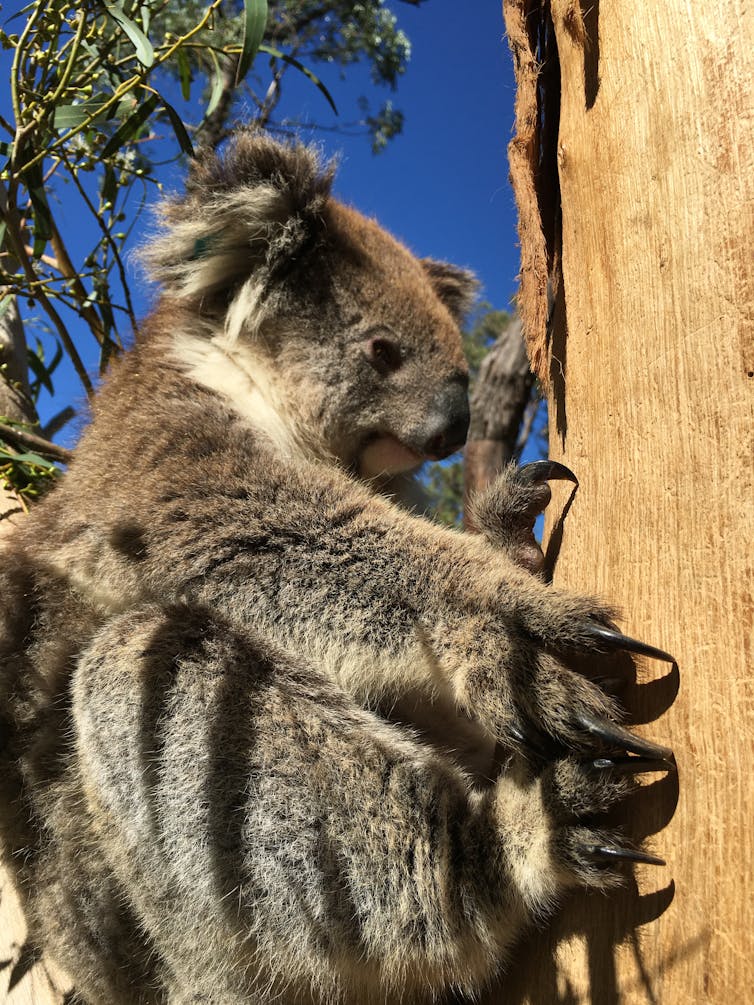
Our new research shows 10% of land animals could disappear from particular geographic areas by 2050, and almost 30% by 2100. This is more than double previous predictions. It means children born today who live to their 70s will witness literally thousands of animals disappear in their lifetime, from lizards and frogs to iconic mammals such as elephants and koalas.
But if we manage to dramatically reduce carbon emissions globally, we could save thousands of species from local extinction this century alone.
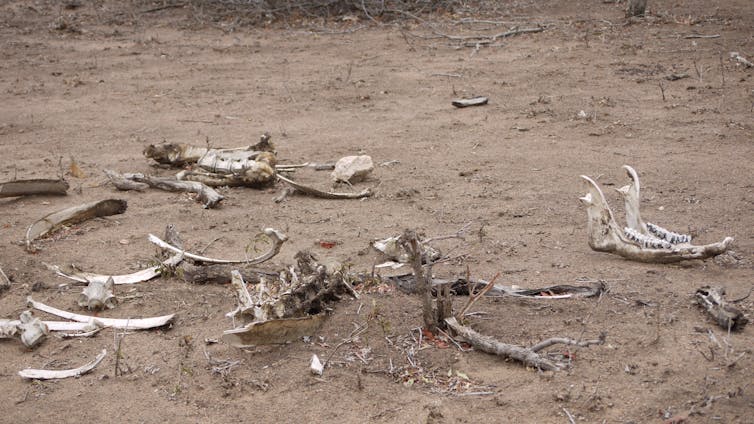
Ravages of drought will only worsen in coming decades. CJA Bradshaw
An extinction crisis unfolding
Every species depends on others in some way. So when a species dies out, the repercussions can ripple through an ecosystem.
For example, consider what happens when a species goes extinct due to a disturbance such as habitat loss. This is known as a “primary” extinction. It can then mean a predator loses its prey, a parasite loses its host or a flowering plant loses its pollinators.
A real-life example of a co-extinction that could occur soon is the potential loss of the critically endangered mountain pygmy possum (Burramys parvus) in Australia. Drought, habitat loss, and other pressures have caused the rapid decline of its primary prey, the bogong moth (Agrotis infusa).
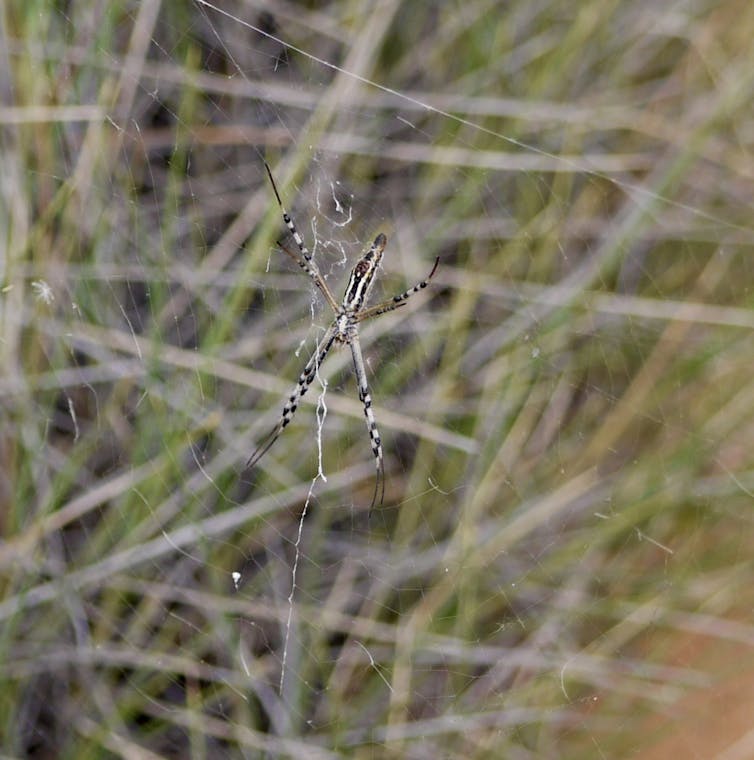
All species are connected in food webs. The spider shown here is an elongated St. Andrews cross spider Argiope protensa from Calperum Reserve, South Australia. CJA Bradshaw
Research suggests co-extinction was a main driver of past extinctions, including the five previous mass extinction events going back many hundreds of millions of years.
But until now, scientists have not been able to interconnect species at a global scale to estimate how many co-extinctions will occur under projected climate and land-use change. Our research aimed to close that information gap.
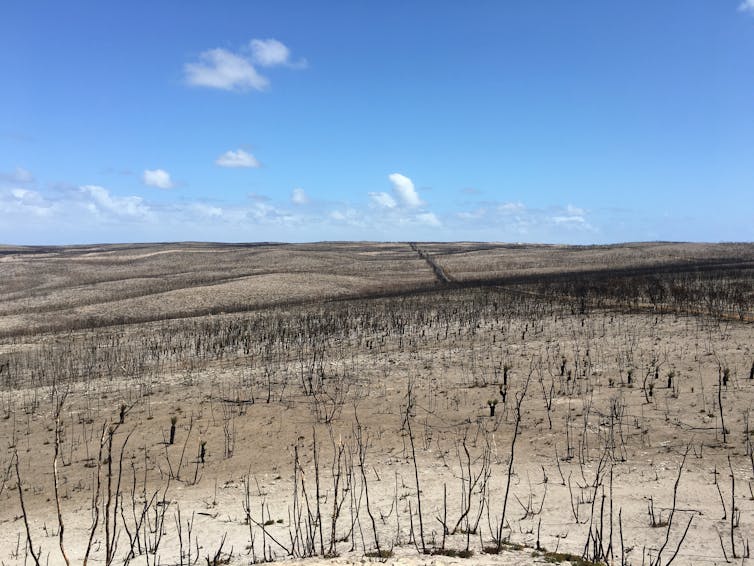
The unprecedented bushfires of 2019/2020 on Kangaroo Island killed thousands of individuals in many different wildlife populations. CJA Bradshaw
The fate of wildlife
Using one of Europe’s fastest supercomputers, we built a massive virtual Earth of interconnected food-web networks. We then applied scenarios of projected climate change and land-use degradation such as deforestation, to predict biodiversity loss across the planet.
Our virtual Earths included more than 15,000 food webs that we used to predict the interconnected fate of species to the end of the 21st Century.
Our models applied three scenarios of projected climate change based on future pathways of global carbon emissions. This includes the high-emissions, business-as-usual scenario that predicts a mean global temperature increase of 2.4℃ by 2050, and 4.4℃ by 2100.
If this scenario becomes reality, ecosystems on land worldwide will lose 10% of current animal diversity by 2050, on average. The figure rises to 27% by 2100.
Adding co-extinctions into the mix causes a 34% higher loss of biodiversity overall than just considering primary extinctions. This is why previous predictions have been too optimistic.
Worse still is the fate of the most vulnerable species in those networks. For species highest in food chains (omnivores and carnivores), the loss of biodiversity due to co-extinctions is a whopping 184% higher than that due to primary extinctions.
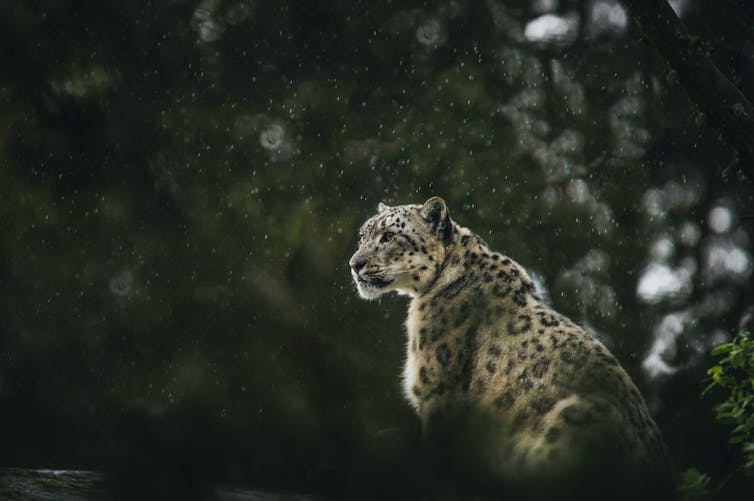
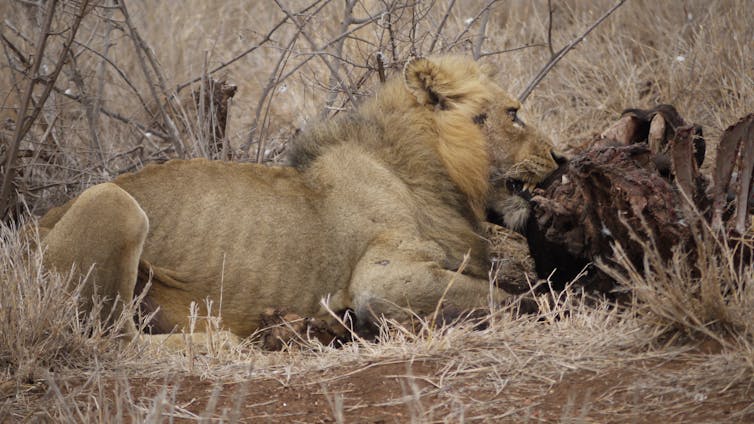
Without enough prey, predators like this African lion, will perish. CJA Bradshaw
We also predict that the greatest relative biodiversity losses will occur in areas with the highest number of species already – a case of the rich losing their riches the fastest.
These are mainly in areas recognised as “biodiversity hotspots” — 36 highly threatened areas of the Earth containing the most unique species, such as Southwest Australia and South Africa’s Cape Floristic region. This is because the erosion of species-rich food webs makes biological communities more susceptible to future shocks.
Tropical forest is the main ecosystem found in many biodiversity hotspots worldwide.
We also detected that these networks of interacting species themselves will change. We used a measure of “connectance”, which refers to the density of network connections. Higher connectance generally means the species in a food web have more links to others, thereby making the entire network more resilient.
Connectance, we learnt, will decline between 18% and 34% by the end of this century in the worst-case climate scenario.
This reduction in connectance was also driven by the loss of some key species occupying the most important positions in their local networks. These could be top predators such as wolves or lions keeping plant eaters in check, or an abundant insect eaten by many different insectivores.
When such highly connected species go extinct, it makes the network even less resilient to disturbance, thereby driving even more loss of species than would otherwise have occurred under a natural ecological regime. This phenomenon illustrates the unprecedented challenges biodiversity faces today.
It follows the recent COP27 climate change summit in Egypt, where the resulting agreement was inadequate to deal with the global climate crisis.
We hope our findings will, in future, help governments identify which policies will lead to fewer extinctions.
For example, if we manage to achieve a lower carbon-emissions pathway that limits global warming to less than 3℃ by the end of this century, we could limit biodiversity loss to “only” 13%. This would translate into saving thousands of species from disappearing.
Clearly, humanity has so far underestimated its true impacts on the diversity of life on Earth. Without major changes, we stand to lose much of what sustains our planet.
Just Stop Oil activists Louise and Rose both spoke to ITV News’ Here’s the Story as they await trial after being arrested following Just Stop Oil demonstrations.
They told us their views on the possibility of a prison sentence, their thoughts about the new public order bill and how their own actions could have an impact on their futures.
Next year is forecast to be one of the hottest on record with global average temperatures forecast to be about 1.2C above what they were before humans started to drive climate change, the UK Met Office predicts.
If correct, it would be the 10th year in a row to see global average temperatures reach at least 1C above what they were in pre-industrial times, measured as the period 1850-1900.
The current hottest year in records dating back to 1850 is 2016, a year that saw an ‘El Niño’ climate pattern in the Pacific which pushes up global temperatures on top of global warming trends.