Scientists analysed sea surface temperatures over the last 150 years, which have risen because of global heating. They found that extreme temperatures occurring just 2% of the time a century ago have occurred at least 50% of the time across the global ocean since 2014.
In some hotspots, extreme temperatures occur 90% of the time, severely affecting wildlife. More than 90% of the heat trapped by greenhouse gases is absorbed by the ocean, which plays a critical role in maintaining a stable climate.
“By using this measure of extremes, we’ve shown that climate change is not something that is uncertain and may happen in the distant future – it’s something that is a historical fact and has occurred already,” said Kyle Van Houtan, at the Monterey Bay Aquarium, US, and one of the research team. “Extreme climate change is here, it’s in the ocean, and the ocean underpins all life on Earth.”
…
The heat content of the top 2,000 metres of the ocean set a new record in 2021, the sixth in a row. Prof John Abraham at the University of St Thomas in Minnesota, one of the team behind the assessment, said ocean heat content was the most relevant to global climate, while surface temperatures were most relevant to weather patterns, as well as many ecosystems.
“Oceans are critical to understanding climate change. They cover about 70% of the planet’s surface and absorb more than 90% of global warming heat,” Abraham said. “The new study is helpful because the researchers look at the surface temperatures. It finds there has been a big increase in extreme heat at the ocean’s surface and that the extremes are increasing over time.”
17 projects with a combined 25gw potential have been approved in a £700 million sale.
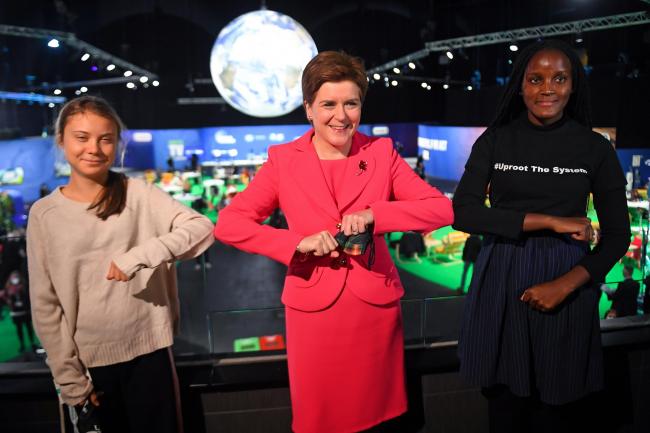
Greta Thunberg, Nicola Sturgeon and Vanessa Nakate at Cop26
The Scottish Government expects to secure at least £1 billion of investment in the Scottish supply chain for every gigawatt of power. Sturgeon says the workforce is “superbly placed with transferable skills to capitalise on the transition to new energy sources” and “people working right now in the oil and gas sector in the North East of Scotland can be confident of opportunities for their future”.
She went on: “While it is not yet possible to say with certainty what the scale of development will ultimately be, there is no doubt that the scale of this opportunity is transformational – both for our environment and the economy.”
Funds raised will be channelled to the Scottish Government and First Minister Nicola Sturgeon has said the “scale of opportunity here is truly historic”.
She said: “ScotWind puts Scotland at the forefront of the global development of offshore wind, represents a massive step forward in our transition to net zero, and will help deliver the supply chain investments and high quality jobs that will make the climate transition a fair one.”
The Scottish Government expects to secure at least £1 billion of investment in the Scottish supply chain for every gigawatt of power. Sturgeon says the workforce is “superbly placed with transferable skills to capitalise on the transition to new energy sources” and “people working right now in the oil and gas sector in the North East of Scotland can be confident of opportunities for their future”.
She went on: “While it is not yet possible to say with certainty what the scale of development will ultimately be, there is no doubt that the scale of this opportunity is transformational – both for our environment and the economy.”
It's getting desperate and urgent. Our climate is getting destroyed, countless species are becoming extinct while politicians cling to the system that is destroying our planet, reproducing and accelerating that senseless destruction.

We have a good idea who they are that are destroying the planet: It's the insane ultra-rich space tourism developers Jeff Bezos, Elon Musk, Richard Branson, it's the same and other insane ultra-rich cnuts with their climate-destroying superyachts, privately-owned islands, private jets and jetset lifestyles, it's the insane petrochemical and coal industries, it's the insane media magnates, it's insane politicians pursuing the destruction of the planet - Boris Johnson and Joe Biden included.

The planet, the people of this planet, it's plants and animals can't afford these absolutely climate-destroying cnuts. We need a clean break so that this world is managed sustainably to survive instead of being run for the benefit of a few super-rich cnuts, much less than 1% really.

May be altered, extended or elaborated

28/2/22 Artic tourism
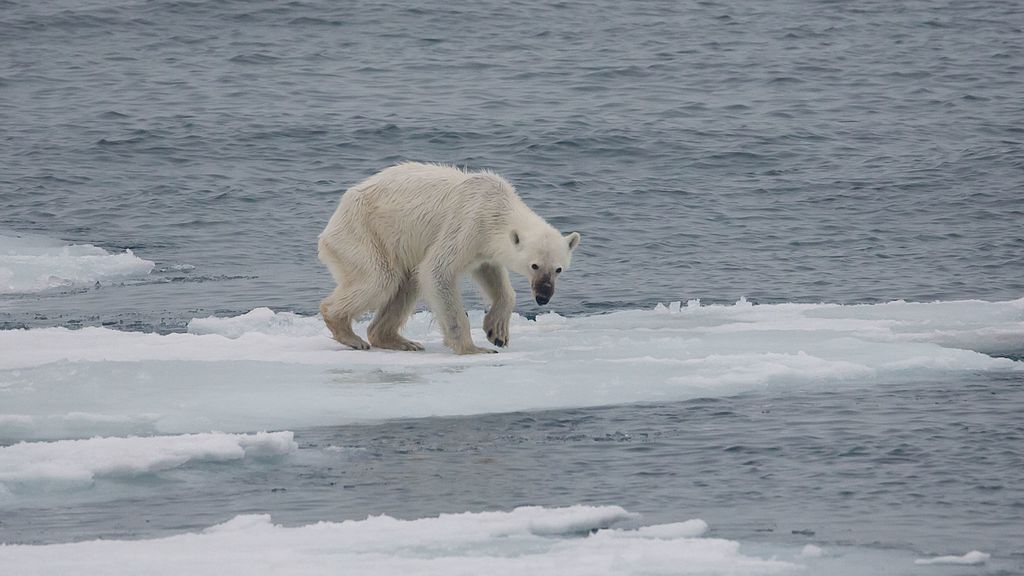
In summer, some polar bears do not make the transition from their winter residence on the Svalbard islands to the dense drift ice and pack ice of the high arctic where they would find a plethora of prey. This is due to global climate change which causes the ice around the islands to melt much earlier than previously. The bears need to adapt from their proper food to a diet of detritus, small animals, bird eggs and carcasses of marine animals. Very often they suffer starvation and are doomed to die. The number of these starving animals is sadly increasing.AWeith This file is licensed under the Creative CommonsAttribution-Share Alike 4.0 International license. https://en.wikipedia.org/wiki/File:Endangered_arctic_-_starving_polar_bear.jpg
Increasingly dire ecological damage and severe impacts of the climate crisis are pushing the natural world towards a mass extinction event unparalleled since the age of the dinosaurs, conservationists in Germany warned this week, with humanity possibly facing self-annihilation if behaviors do not change.
Releasing its annual “Winners and Losers” list on Wednesday, the World Wildlife Fund’s German branch said 40,000 of the 142,500 species listed on the Red List of Threatened Species by the International Union for Conservation of Nature (IUCN) are “threatened with extinction.”
“If the earth is sick, so will the people [be], because we depend on vital ecosystems and biodiversity for our own safe and healthy life.”
The Red List is now longer than it has ever been since the IUCN began cataloging threatened species in 1964.
More than 40% of amphibians, 27% of shark and ray species, a third of reef building corals, and more than a quarter of all mammals on the Red List are threatened with extinction.
At the current rate of species loss, “around one million species could go extinct within the next decade—which would be the largest mass extinction event since the end of the dinosaur age,” WWF Germany said in a statement.
With planet-heating atmospheric carbon dioxide emissions reaching a record high this year—contributing to drought, habitat loss, extreme weather, and health problems in humans as well as other species—the organization noted that humans should view the extinction crisis as one that could affect them directly.
“Species conservation is no longer just about defeating an environmental problem, but is rather about the question of whether or not humanity will eventually end up on the Red List in an endangered category—and thereby become a victim of its own lifestyle,” WWF Germany director Eberhard Brandes said.
“If the earth is sick, so will the people [be],” he added, “because we depend on vital ecosystems and biodiversity for our own safe and healthy life.”
The “losers” on the WWF’s list include the polar bear, which is already suffering from the erosion of its Arctic habitat as the northern region becomes warmer. The Arctic Ocean could be completely free of ice by 2035 at the current rate of loss, making it increasingly difficult for the bears to find food.
Sharks and rays also made the list, the result of overfishing, habitat loss, and the climate crisis. A third of all sharks and rays in the oceans were classified as threatened in 2021, the WWF said.
African forest elephants have been considered “critically endangered” for the first time this year, as their population in Central and West Africa has plummeted by 86% in the past three decades.
The inclusion of 40,000 species on the IUCN’s list of threatened species represents a major acceleration of biodiversity loss. In 2010, 17,300 species were considered to be under threat, according toThe Guardian.
The WWF’s list of “winners” this year includes bearded vultures, which have benefited from a resettlement program in the last 30 years that’s resulted in more than 300 of the birds now living in the Alpine region; the Iberian lynx, whose population has increased more than tenfold in the past 18 years; and Siamese crocodiles in Cambodia. Eight young crocodiles were found by researchers this year, marking the first time in more than a decade that the species has reproduced in nature.
“The winners of the list show that there are still opportunities for species protection,” said Brandes. “If we implement effective nature conservation measures, we can protect plants, animals and, ultimately, the climate.”