The Earth could be doomed to breach the symbolic 1.5C warming limit in as little as three years at current levels of carbon dioxide emissions.
That’s the stark warning from more than 60 of the world’s leading climate scientists in the most up-to-date assessment of the state of global warming.
Nearly 200 countries agreed to try to limit global temperature rises to 1.5C above levels of the late 1800s in a landmark agreement in 2015, with the aim of avoiding some of the worst impacts of climate change.
But countries have continued to burn record amounts of coal, oil and gas and chop down carbon-rich forests – leaving that international goal in peril.
“Things are all moving in the wrong direction,” said lead author Prof Piers Forster, director of the Priestley Centre for Climate Futures at the University of Leeds.
“We’re seeing some unprecedented changes and we’re also seeing the heating of the Earth and sea-level rise accelerating as well.”
These changes “have been predicted for some time and we can directly place them back to the very high level of emissions”, he added.
Neo-Fascist Climate Science Denier Donald Trump says Burn, Baby, Burn.Elon Musk urges you to be a Fascist like him, says that you can ignore facts and reality then.
‘We scientists, philosophers, writers, artists and citizens of the world have a responsibility to denounce and resist the resurgence of fascism in all its forms.’ Photograph: Karl B DeBlaker/AP
As in 1925, when Mussolini was in power, we must openly defy the brutal imposition of the fascist ideology
On 1 May 1925, with Benito Mussolini already in power, a group of Italian intellectuals publicly denounced his fascist regime in an open letter. The signatories – scientists, philosophers, writers and artists – took a stand in support of the essential tenets of a free society: the rule of law, personal liberty and independent thinking, culture, art and science. Their open defiance against the brutal imposition of the fascist ideology – at great personal risk – proved that opposition was not only possible, but necessary. Today, 100 years later, the threat of fascism is back – and so we must summon that courage and defy it again.
Fascism emerged in Italy a century ago, marking the advent of modern dictatorship. Within a few years, it spread across Europe and the world, taking different names but maintaining similar forms. Wherever it seized power, it undermined the separation of powers in the service of autocracy, silenced opposition through violence, took control of the press, halted the advancement of women’s rights and crushed workers’ struggles for economic justice. Inevitably, it permeated and distorted all institutions devoted to scientific, academic and cultural activities. Its cult of death exalted imperial aggression and genocidal racism, triggering the second world war, the Holocaust, the death of tens of millions of people and crimes against humanity.
At the same time, the resistance to fascism and the many other fascist ideologies became a fertile ground for imagining alternative ways of organising societies and international relations. The world that emerged from the second world war – with the charter of the United Nations, the Universal Declaration of Human Rights, the theoretical foundations of the EU and the legal arguments against colonialism – remained marked by deep inequalities. Yet, it represented a decisive attempt to establish an international legal order: an aspiration toward global democracy and peace, grounded in the protection of universal human rights, including not only civil and political, but also economic, social and cultural rights.
Fascism never vanished, but for a time it was held at bay. However, in the past two decades, we have witnessed a renewed wave of far-right movements, often bearing unmistakably fascist traits: attacks on democratic norms and institutions, a reinvigorated nationalism laced with racist rhetoric, authoritarian impulses and systematic assaults on the rights of those who do not fit a manufactured traditional authority, rooted in religious, sexual and gender normativity. These movements have re-emerged across the globe, including in long-standing democracies, where widespread dissatisfaction with political failure to address mounting inequalities and social exclusion has once again been exploited by new authoritarian figures. True to the old fascist script, under the guise of an unlimited popular mandate, these figures undermine national and international rule of law, targeting the independence of the judiciary, the press, institutions of culture, higher education and science, even attempting to destroy essential data and scientific information. They fabricate “alternative facts” and invent “enemies within”; they weaponise security concerns to entrench their authority and that of the ultra-wealthy 1%, offering privileges in exchange for loyalty.
This process is now accelerating, as dissent is increasingly suppressed through arbitrary detentions, threats of violence, deportations and an unrelenting campaign of disinformation and propaganda, operated with the support of traditional and social media barons – some merely complacent, others openly techno-fascist enthusiasts.
Democracies are not flawless: they are vulnerable to misinformation and they are not yet sufficiently inclusive. However, democracies by their nature provide fertile ground for intellectual and cultural progress and therefore always have the potential to improve. In democratic societies, human rights and freedoms can expand, the arts flourish, scientific discoveries thrive and knowledge grow. They grant the freedom to challenge ideas and question power structures, propose new theories even when culturally uncomfortable, which is essential to human advancement. Democratic institutions offer the best framework for addressing social injustices, and the best hope to fulfil the post-war promises of the rights to work, education, health, social security, participation in cultural and scientific life, and the collective right of peoples to development, self-determination and peace. Without this, humanity faces stagnation, growing inequality, injustice and catastrophe, not least from the existential threat caused by the climate emergency that the new fascist wave negates.
In our hyper-connected world, democracy cannot exist in isolation. As national democracies require strong institutions, international cooperation relies on the effective implementation of democratic principles and multilateralism to regulate relations among nations, and on multistakeholder processes to engage a healthy society. The rule of law must extend beyond borders, ensuring that international treaties, human rights conventions and peace agreements are respected. While existing global governance and international institutions require improvement, their erosion in favor of a world governed by raw power, transactional logic and military might is a regression to an era of colonialism, suffering and destruction.
As in 1925, we scientists, philosophers, writers, artists and citizens of the world have a responsibility to denounce and resist the resurgence of fascism in all its forms. We call on all those who value democracy to act:
Defend democratic, cultural and educational institutions. Call out abuses of democratic principles and human rights. Refuse pre-emptive compliance.
Join collective actions, locally and internationally. Boycott and strike when possible. Make resistance impossible to ignore and costly to repress.
Uphold facts and evidence. Foster critical thinking and engage with your communities on these grounds.
This is an ongoing struggle. Let our voices, our work and our principles be a bulwark against authoritarianism. Let this message be a renewed declaration of defiance.
Nobel laureates: Eric Maskin, Roger B Myerson, Alvin E Roth, Lars Peter Hansen, Oliver Hart, Daron Acemoglu, Wolfgang Ketterle, John C Mather, Brian P Schmidt, Michel Mayor, Takaaki Kajita, Giorgio Parisi, Pierre Agostini, Joachim Frank, Richard J Roberts, Leland Hartwell, Paul Nurse, Jack W Szostak, Edvard I Moser, May-Britt Moser, Harvey James Alter, Victor Ambros, Gary Ruvkun, Barry James Marshall, Craig Mello, Charles Rice
Leading scholars on fascism and democracy: Ruth Ben-Ghiat, Timothy Snyder, Jason Stanley, Claudia Koonz, Mia Fuller, Giovanni De Luna and Andrea Mammone
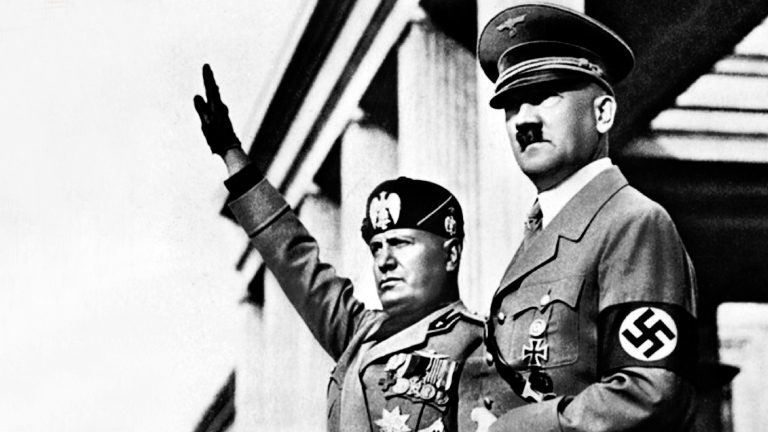
The original Fascists Mussolini and HitlerElon Musk urges you to be a Fascist like him, says that you can ignore facts and reality then.UK Labour Party government ministers Keir Starmer, Angela Rayner and Rachel Reeves explain that they are partners complicit in Israel’s Gaza genocide. The UK has provided Israel with arms, military and air force support. They explain that they don’t do gas chambers but do do forced marches, starvation, destroy hospitals, mass-murders of journalists and healthcare workers.Image of Mussolini & Co hanging out. What happens to Fascists.
This isn’t just an attack on the environment. It’s an attack on every state.
The White House is once again defying the will of the people.
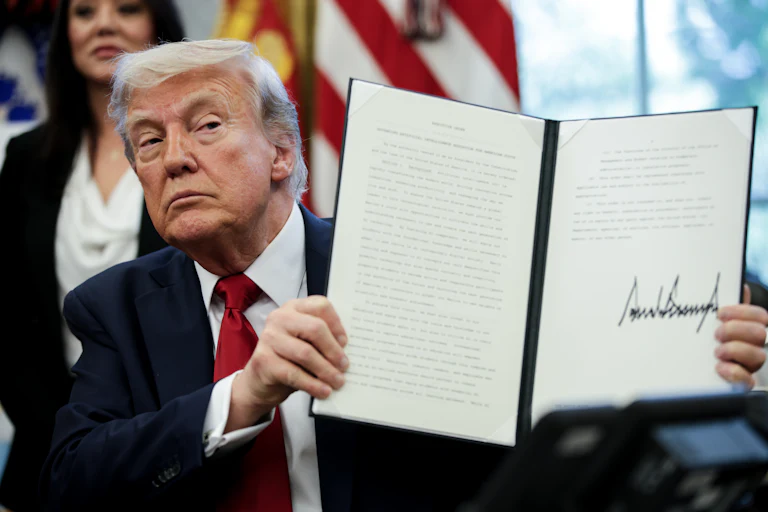
Donald Trump moved to overturn California’s electric vehicle mandate Thursday, marking the second instance this week in which the president has stretched his authority to advance his political agenda in the state.
California mandated a phaseout of gas vehicles and diesel trucks by 2035, citing benefits to public health and the environment. Eleven other states and Washington, D.C., followed suit. The plan required at least 35 percent of 2026 model vehicles sold within state bounds to be emissions-free, with that percentage growing to 68 percent by 2030 and 100 percent by 2035.
The Golden State passed the laws under the authority of the 1967 Clean Air Act, on the basis that the state needed more power to handle its highly polluted air and car-dependent cities. But each state requires a waiver from the Environmental Protection Agency before the rules can actually take effect.
Trump’s signature on the congressional resolution revokes three of those waivers, issued during the Biden administration, effectively erasing the mandate.
Elon Musk urges you to be a Fascist like him, says that you can ignore facts and reality then.Neo-Fascist Climate Science Denier Donald Trump says Burn, Baby, Burn.
Kemi Badenoch is due to address the Scottish Tory conference in Edinburgh (Image: PA)
KEMI Badenoch’s call for an end to the windfall tax for fossil fuel firms and a ban on new oil and gas licences has been branded “out of touch”.
The Conservative leader is set to address her first Scottish branch office conference in Edinburgh on Friday and will speak about the oil and gas industry.
Scottish Tory leader Russell Findlay is set to address the party conference for the first time since taking over the role from Douglas Ross.
The energy profits levy, also known as the windfall tax, was brought in by the previous Tory government, and extended by Labour when they took power.
Badenoch is expected to tout the oil and gas sector during her conference speech, accusing the UK Government of “killing” it, claiming “renewing our party and our country means standing up for our oil and gas industry”.
UK Conservative Party leader Kemi ‘not a genocide’ Badenoch explains her reality that the Earth is flat, the Moon is made of cheese and that she was born from
Unicorn horn dust
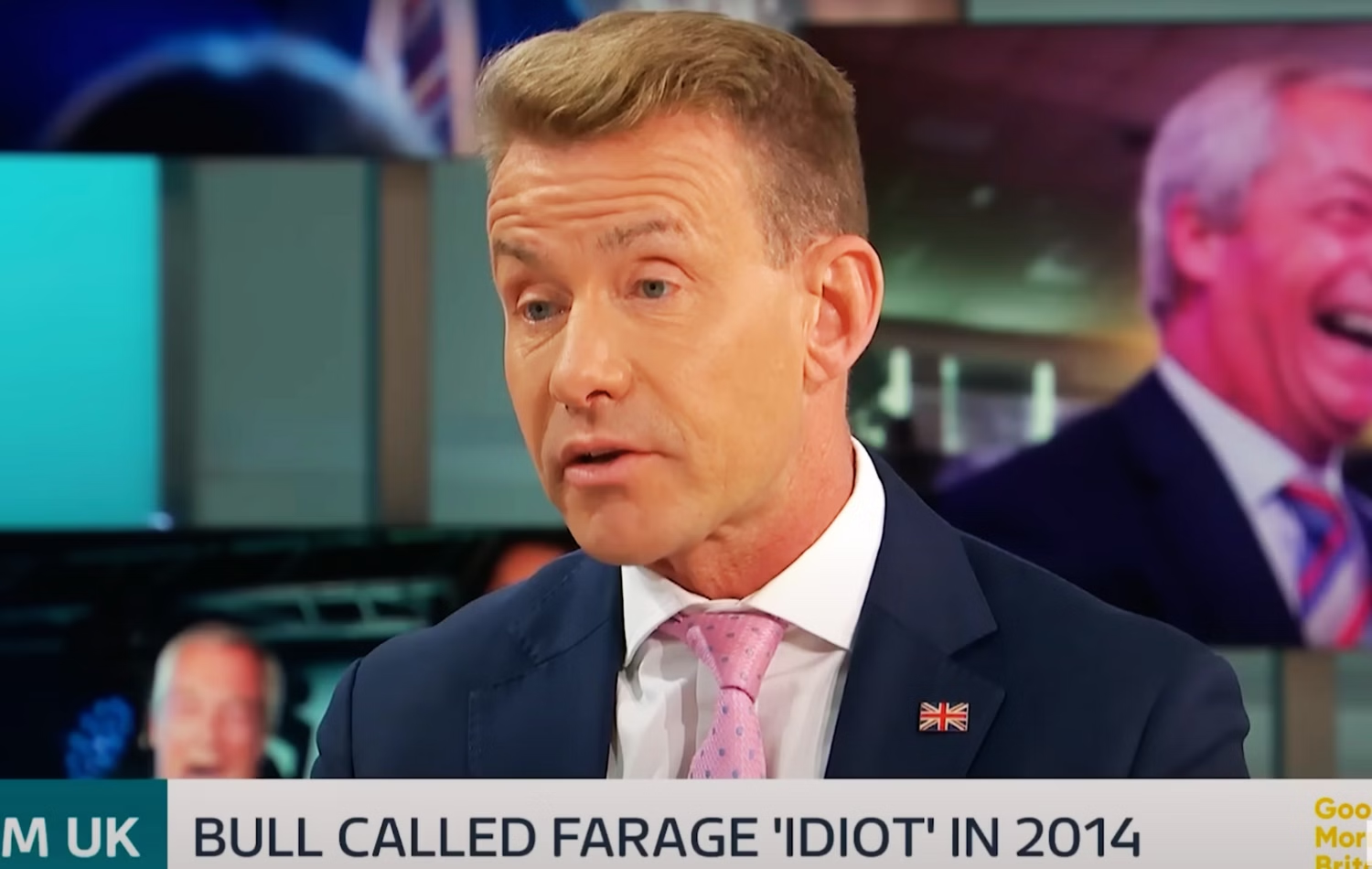
Reform UK chair David Bull[…]. Credit: Good Morning Britain / YouTube
Farage’s latest chairman is a TV presenter who has attacked climate “madness” and called for the ban on fracking to be lifted.
Reform UK’s new chairman has repeatedly attacked climate targets as “madness” and “a killer”, supported fracking, and falsely dismissed the role of carbon emissions on heatwaves.
David Bull, a TalkTV presenter and former doctor, was appointed as the chair of Nigel Farage’s right-wing populist party this week following the resignation of its previous chair Zia Yusuf.
Yusuf, a luxury lifestyle entrepreneur, said that working to achieve a Reform government was no longer a good use of his time, before returning two days later in a new role.
Bull is now loyal Farage supporter, despite having called the Reform leader a “dangerous, prejudiced idiot” in 2014. He was a member of the European Parliament in 2019 for the Brexit Party, the predecessor to Reform UK, and served as Reform’s deputy leader from March 2021 to July 2024.
In a series of social media posts, Bull has repeatedly attacked the UK’s target to cut carbon emissions to net zero by 2050, which climate scientists have said is needed to limit global warming to 1.5C.
On the eve of the 2024 general election, Bull posted on Elon Musk’s website X.com: “Net Zero is a killer. It’s killing British jobs, communities and the economy. Only Reform UK will scrap Net Zero.”
In reality, according to risk management experts the Institute and Faculty of Actuaries (IFoA), 50 percent could be wiped off the global economy between 2070 and 2090 if runaway temperature increases are not halted, while there could be more than 4 billion deaths.
In January of this year, he shared a Telegraph story about a lull in wind power and claimed that it made “a complete mockery” of Labour’s net zero chief Ed Miliband and his “religious obsession” with renewable energy.
As revealed by DeSmog, Reform’s constitution gives sweeping powers to its chairman, who cannot be formally sacked by the party leader.
Reform wants to scrap the UK’s net zero target entirely, stop subsidies for renewable energy, impose a “windfall tax” on wind and solar companies, approve new oil and gas extraction, and open new coal mines. The party’s leaders have also repeatedly made false statements about climate change.
As DeSmog has reported, Reform received £2.3 million between the 2019 and 2024 general elections from climate deniers, fossil fuel investors, and polluting interests. It is also openly seeking donations from oil executives.
David Bull’s Climate Stance
In May 2023, Bull hosted a TalkTV segment called “the madness of net zero”. He began by saying: “I think all of us feel that the climate is changing and that we want to go to net zero”. This is out of step with Reform’s position, and the title of his segment.
But he went on to claim, of the UK’s record heatwave the previous summer, “we don’t know whether that is a result of man-made emissions”.
In the same segment, Bull suggested net zero was “subjecting people in this country to become poorer”. In reality, according to the Confederation of British Industry (CBI), the UK’s net zero economy grew by 10 percent in 2024, employing almost a million people in full-time jobs with an average wage of £43,000 – £5,600 higher than the national average.
In October 2021, Bull endorsed a campaign by climate denial pressure group CAR26 for a Brexit-style referendum on net zero, and shared a poll commissioned by the group, adding: “We absolutely MUST have a referendum on the Government’s net zero policy. Retweet if you agree.”
CAR26 director Lois Perry now runs the UK-EU branch of the Heartland Institute, a notorious U.S. climate denial think tank. The UK-EU branch was launched in December by Reform’s leader Farage.
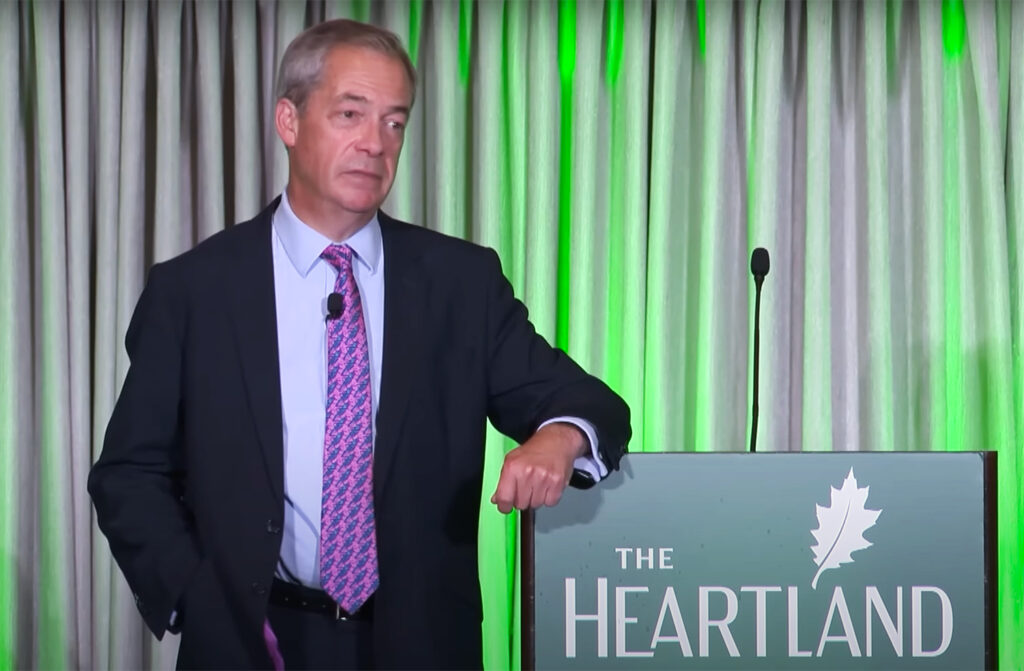
Reform UK leader Nigel Farage speaking at the Heartland Institute’s 40th anniversary fundraiser in September 2024. Credit: Heartland Institute / YouTube
In November 2021, while the UK hosted the flagship UN COP26 climate summit, Bull attacked what he called “the hypocrisy of COP26”. He told TalkTV: “It is obscene. The hypocrisy that they [world leaders] fly in on private jets. People are sick and tired of being told what to do.”
In April 2022, Bull posted on X.com predicting that “Net Zero will be the new Brexit. It will be the most defining issue at the next general election”. Despite Reform’s best efforts, the pro-net zero Labour Party won a historically large majority.
Bull has also supported overturning the UK’s ban on fracking for shale gas.
In October 2022, when prime minister Rishi Sunak reversed the decision by his predecessor Liz Truss to lift the ban, Bull posted: “MASSIVE MISTAKE. We need cheap energy NOW. Fracking has allowed the US to have 100-200 years of cheap energy.”
Aside from the pollution caused by burning shale gas, fracking is environmentally controversial due to its triggering of earth tremors, and the vast amount of water that it uses. The House of Commons Environmental Audit Committee – a body of MPs that advises the government on climate matters – concluded in 2019 that fracking was incompatible with the UK’s climate goals.
TalkTV was launched in 2022 by Rupert Murdoch’s News UK as a rival to GB News, but in 2024 it switched to an online streaming service.
As DeSmog has reported, TalkTV presenters have frequently attacked climate action. In the COP26 segment, Bull was interviewed by fellow TalkTV host Mike Graham, who has declared on social media that “climate change is a load of old bollocks”.
Bull has resigned as a TalkTV presenter, following his appointment as Reform’s chair.
Nigel Farage reminds you that he’s the man that brought you Brexit and asks what could possibly go wrong.Nigel Farage explains the politics of Reform UK: Racism, Fake anti-establishmentism, Deregulation, Corporatism, Climate Change Denial, Mysogyny and Transphobia.