Activists drape a “No Space For Bezos” banner from Venice’s iconic Rialto Bridge on June 13, 2025 to protest a party celebrating the wedding of multicentibillionaire Amazon.com founder Jeff Bezos and journalist Lauren Sánchez. (Photo: Stefano Mazzola/Getty Images)
“We’re just citizens who started organizing and we managed to move one of the most powerful people in the world,” said one protest organizer.
Amazon.com founder Jeff Bezos and Lauren Sánchez on Tuesday relocated their upcoming lavish Venice wedding celebration, a move cheered as an “enormous victory” by protesters whose recent demonstrations in the northeastern Italian city have highlighted the socioeconomic and climate damage caused by billionaires.
Bezos—who is currently the world’s fourth-richest person, according to lists published by Bloomberg and Forbes—is set to marry Sánchez, a journalist, later this week, and the couple is planning to celebrate the occasion with a three-day extravaganza costing an estimated $46-56 million, according to Reuters.
Around 90 private jets are scheduled to land in area airports and local yacht harbors are fully booked, underscoring the climate and environmental impact on a city struggling to survive on one of myriad frontlines of the planetary emergency.
“We are very proud of this! We are nobodies, we have no money, nothing!”
The nuptial celebration has been relocated from the Scuola Grande della Misericordia to the Arsenale di Venezia, a historic fortified palace about 3 kilometers (1.8 miles) away from the original location. Officials cited concerns for the security of guests including several members of U.S. President Donald Trump’s family.
Members of groups including No Space for Bezos, Greenpeace Italy, and Everyone Hates Elon—which targets Elon Musk, the world’s richest person—have staged a series of demonstrations, including one on Monday at which protesters laid out a massive banner with Bezos’ face and the message “If You Can Rent Venice for Your Wedding You Can Pay More Tax” in Piazza San Marco.
Responding to the celebration’s relocation, Tommaso Cacciari of No Space for Bezos told the BBC Wednesday: “We are very proud of this! We are nobodies, we have no money, nothing!”
“We’re just citizens who started organizing and we managed to move one of the most powerful people in the world,” Cacciari added.
Wedding-related festivities are set to kick off Thursday evening, and city officials have blocked off parts of central Venice. While some residents have welcomed the money and fanfare the event will bring to a city with a long and storied history of oligarchs and opulence, others bristle at what they see as the transformation of their home into a playground for the superrich.
“There’s only one thing that rules now: money, money, money, so we are the losers,” Venice resident Nadia Rigo told Reuters. “We who were born here have to either move to the mainland or we have to ask them for permission to board a ferry. They’ve become the masters.”
In the United States, critics contrasted the stratospheric cost of Bezos’ celebration with the multicentibillionaire’s history of personal and corporate tax dodging—and the hyper-capitalist system that enables it.
“Jeff Bezos is worth $230 billion and is reportedly spending $20 million on a three-day wedding in Venice while sailing around on his $500 million yacht,” former U.S. Labor Secretary Robert Reich said Wednesday on the social media site X. “If he can afford to do that, he can afford a wealth tax and to pay Amazon workers a living wage. Hello?”
This is oligarchy. This is obscene.While 60% live paycheck to paycheck & kids go hungry, Jeff Bezos, worth $230 billion, goes to Venice on his $500 million yacht for a $20 million wedding & spends $5 million on a ring while his real tax rate is just 1.1%.End this oligarchy.
While No Space for Bezos organizers are celebrating their victory and have canceled plans to fill Venice’s canals with inflatable crocodiles in a bid to block celebrity guests from accessing the Scuola Grande della Misericordia, they said they still plan on protesting the festivities by holding a “No Bezos, No War” rally and march.
“It will be a strong, decisive protest, but peaceful,” Federica Toninello of the Social Housing Assembly network toldEuronews Wednesday. “We want it to be like a party, with music, to make clear what we want our Venice to look like.”
A private jet making its final approach into Edinburgh airport
Private flights at the Scottish government-owned Glasgow Prestwick Airport increased by more than a third last year, according to figures from Oxfam Scotland.
The charity says there were more than 12,000 private flights in and out of Scottish airports in 2024, with the busiest being Edinburgh, Glasgow Prestwick and Inverness.
Oxfam says that if an Air Departure Tax had been in place, and applied at the highest possible rate, that would have generated an extra £29m in tax revenue.
The Scottish government says it is reviewing rates and bands and is open to introducing a higher tax on private jets.
The rise reflects a global trend in private jets being used increasingly by the super-rich, with climate scientists warning that they can be up to 30 times more damaging for the planet than scheduled flights.
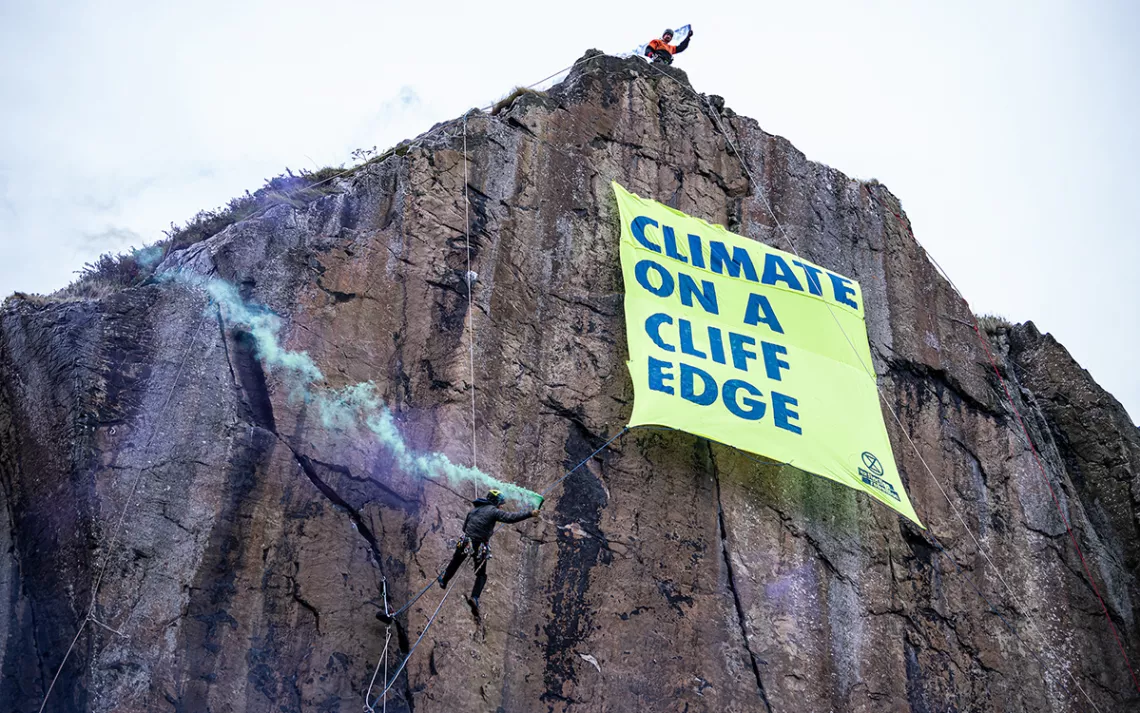
Experienced climbers scale a rock face near the historic Dumbarton castle in Glasgow, releasing a banner that reads “Climate on a Cliff Edge.” One activist, dressed as a globe, symbolically looms near the edge, while another plays the bagpipes on the shores below. | Photo courtesy of Extinction Rebellion and Mark Richards
While campaigners take to the streets, fossil fuel interests lobby governments directly, and often without scrutiny, a new report has found | Vuk Valcic/SOPA Images/LightRocket via Getty Images)
Oil and gas firms were able to water down or change Conservative policies without scrutiny, new report finds
The British government weakened key climate policies after fossil fuel giants lobbied ministers and used legal loopholes to avoid public scrutiny, a new report has found.
Climate-focused think tank InfluenceMap has uncovered that industry influence appears to have led to the delay and dilution of UK policies on the roll-out of heat pumps, the development of ‘sustainable’ aviation fuel and the granting of new oil and gas licenses.
In each case, it found that lobbyists representing fossil fuel actors that stood to lose billions from progressive climate regulations were able to influence the Conservative government’s policy without scrutiny.
While InfluenceMap’s report looks at policies relating to the UK’s net-zero ambitions, its findings on the way the UK’s lax laws allow lobbying to be conducted in secret can be applied across sectors. The think tank is calling for reforms to address this and close the “major transparency gap”.
The secrecy around lobbying, which has been at the heart of many government scandals in recent years, is a major driver of the disillusionment in British politics.
InfluenceMap’s findings illustrate “how inadequate and opaque lobbying rules undermine effective policymaking”, said Alastair McCapra, the CEO of the UK lobbying industry body.
He added: “Business engagement should help to build sounder policy with better outcomes for the public, but unaccountable lobbying breeds public mistrust. This important report removes the guesswork needed to piece together what kind of lobbying is taking place.”
Weak lobbying laws
openDemocracy has previously reported extensively on the ways that the UK’s weak lobbying laws allow corporate influence to secretly shape policy.
Our investigations have now been backed up by InfluenceMap, which has found a huge gap exists between the lobbying that takes place and that which is disclosed. This means the British public often has no way of knowing who is swaying policy.
Comparing transparency rules in the UK, the European Parliament, the US, Canada and France, InfluenceMap found that the UK has by far the worst system.
Of the five, only the UK exempts lobbyists who work in-house for a company, rather than for an agency or consultancy, from registering with a statutory lobbying watchdog. Less than 15% of lobbyists working in the UK need to register because of this rule.
The firms on the register must publish a list of clients on whose behalf they have lobbied each quarter. But they do not have to publish any details about the lobbying, including whether it involved written correspondence or a meeting and what legislation or policy was discussed.
Registered lobbyists also only need to declare clients for whom they lobbied government ministers and senior officials. There is no requirement to name clients when they approached other MPs and peers, including those on select committees, or influential government advisers.
The Committee for Standards in Public Life, an independent public body that advises the prime minister on lobbying and other aspects of public office, has consistently recommended the government publish a single, searchable database of all meetings with lobbyists.
Its recommendations would expand the scope of the current register considerably, requiring lobbyists to disclose the specific policies or legislation they discussed at meetings with government ministers and special advisers.
InfluenceMap has also called on the government to take up this recommendation and address the fundamental flaws in the lobbying act by including in-house lobbyists and publishing all responses to government policy consultants as standard.
Susan Hawley, executive director of Spotlight on Corruption, said the report “starkly demonstrates how major transparency gaps in the UK’s lobbying regime are undermining the development of good climate policy.”
“We fully support their recommendations to make lobbying much more transparent and bring the UK in line with international best practice. These reforms would support more participatory and open decision-making to help rebuild public trust and ensure better decision-making, widening the evidence base for policy making and reducing risks of policy capture by vested interests,” she said.
Oil and gas licensing
In 2022, the UK government quietly dropped two criteria from its ‘Climate Compatibility Checkpoint’ after lobbying from the fossil fuel industry. The checkpoint is used to assess whether proposed oil and gas licenses align with the UK’s climate change goals.
Oil giants BP and Shell and their industry association, Offshore Energies UK (OEUK), responded to a consultation on the checkpoint by objecting to the inclusion of two key metrics for measuring the impact of fossil fuels, according to InfluenceMap’s analysis of consultation responses obtained via Freedom of Information requests.
The measures they opposed would have required the government to consider ‘Scope 3 emissions’ and the ‘global production gap’ when issuing new oil and gas licences.
Scope 3 emissions are produced during end-use and contribute the largest share of all emissions from oil and gas production, while the production gap tracks the discrepancy between planned fossil fuel production and what’s needed to limit global warming to 1.5°C or 2°C.
The government dropped both criteria from the final checkpoint, which instead focuses solely on operational emissions, which represent only a fraction of total emissions from oil and gas projects.
This outcome, InfluenceMap’s report notes, strongly aligns with the positions advocated for by BP, Shell, and OEUK, suggesting their lobbying efforts were successful.
The following year, the government approved 100 new North Sea oil and gas licences, which had a potential emissions footprint equivalent to Denmark’s annual output.
InfluenceMap’s report also highlights the issues around government consultations on proposed policies, pointing out that, as in this case, lobbyists typically use these to suggest amendments in favour of their clients, but their responses are not published as standard.
Similarly, unlike in the other four Parliaments InfluenceMap looked at, corporations in the UK are not required to declare their engagement on policies, how much they spend on lobbying, or which legislation or decisions they are targeting.
It highlights that this can lead to a situation in which companies make voluntary corporate disclosures that fail to capture the true extent of this advocacy. In this case, InfluenceMap found BP published a summary of its response to the checkpoint that omitted key lines of its opposition, which were only revealed later through Freedom of Information requests.
Rachel Davies, advocacy director at Transparency International UK, said: “This report highlights, yet again, the glaring gaps in our lobbying transparency regime and the potential risks of favouring a small group of vested interests at the public’s expense.
“The UK needs to catch up to other comparable democracies and act swiftly to introduce a comprehensive lobbying register with meaningful disclosures.”
Domestic hydrogen
It is broadly agreed that, in the UK, hydrogen is not a viable solution for decarbonising domestic heating and is an especially bad alternative to heat pumps. Much of our hydrogen comes from burning gas or coal and it cannot be transported through our existing pipelines without massive and costly infrastructure changes.
This reality has been set out by different independent bodies advising the UK government.
In 2021, the Climate Change Committee warned that hydrogen had “not yet been proven at scale and should not be a cause to delay other options” such as the roll-out of heat pumps or low-carbon heat networks. Two years later, the National Infrastructure Commission said the government “should not support the roll-out of hydrogen heating” because there is “no public policy case” for its use.
As InfluenceMap’s report notes, this has not prevented the gas industry from waging a successful lobbying campaign in a bid to shore up its market position – with a clear impact on government policy.
The think tank found the industry pursued its cause in a number of ways, including setting up Hello Hydrogen, a campaign fronted by TV star Rachel Riley, to make the case for using hydrogen in homes to the public in 2022. While the campaign did not declare its funders, its director was also a director of Cadent Gas, the UK’s largest gas distribution network.
Cadent is one of the funders of the All-Party Parliamentary Group (APPG) on Hydrogen, which has publicly called for hydrogen to play a part in domestic heating. The APPG’s other funders include Equinor, Shell and the Energy and Utilities Alliance, a lobbying body run by Mike Foster, the former Labour MP for Worcester (home to Worcester Bosch, a major manufacturer of gas boilers).
Other fossil fuel firms and industry lobbying bodies have also consistently pushed for the use of hydrogen in domestic heating in letters to parliamentary select committees and responses to government consultations.
Ahead of last year’s general election, Centrica (formerly British Gas) wrote to the Public Accounts Committee, which examines the value for money of government projects, to call for further public investment in hydrogen for home heating. The firm had written to the Energy Security and Net Zero Committee in support of the technology less than 12 months earlier.
This industry lobbying has led to indecision and disruption on government plans. A February 2023 report by the House of Lords Committee blamed mixed messages on the effectiveness of hydrogen from the government and industry for the poor uptake of a publicly subsidised scheme for heat pumps, which would reduce greenhouse gas emissions and create many jobs.
The lords’ report concluded: “Hydrogen is not a serious option for home heating for the short to medium-term and misleading messages, including from the government, are negatively affecting take-up of established low-carbon home heating technologies like heat pumps.”
The UK’s heat pump roll-outs have lagged behind those of its neighbours. Just 55,000 heat pumps were installed in the UK in 2019, compared to 600,000 in France, according to a study cited in the InfluenceMap report.
In the UK, this reportedly created around 2,000 jobs and reduced emissions of CO₂ by 0.08 million tonnes (MT); in France 30,000 jobs were created and 0.84 MT of CO₂ emissions avoided.
‘Sustainable’ aviation fuel
InfluenceMap also uncovered how industry significantly influenced the government’s so-called ‘Jet Zero’ strategy for cutting emissions in the UK’s aviation industry, which is heavily reliant on fossil fuels.
Biofuels, largely made up of used cooking oils, are often suggested as an option for producing Sustainable Aviation Fuel (SAF), although they are generally accepted to be worse in terms of scalability than other, more advanced fuels, and much worse than just reducing the number of flights.
The government initially proposed limiting the use of used cooking oil for SAF to alleviate competition on the resource – which is increasingly in demand for other uses, such as producing biodiesel for cars – and to encourage investment in new technologies for the aviation industry.
The proposals included two options; either banning the use of used cooking oil for SAF altogether, or rapidly phasing down its use so that it would make up just 8.5% of total sustainable aviation fuel by 2040.
But the government’s final SAF policy was more closely aligned with industry preferences than scientific warnings, InfluenceMap found. It allows used cooking oil to make up 100% of SAF uptake in 2025 and 2026, 71% in 2030, and 35% in 2040.
InfluenceMap’s analysis reveals the weakened SAF mandate came after pressure from Shell, BP, the International Airlines Group (which owns several airlines), Airlines UK (the trade body for UK-registered airlines) and Virgin Atlantic airline.
It also found that business interests were overrepresented in parliamentary meetings on SAF while the policy was being shaped.
This can be seen in the make-up of Parliament’s Jet Zero Council, “a partnership between industry academia and government”, which was run by Heathrow’s chief operating officer, while the International Airlines Group chaired the Sustainable Aviation Fuel Delivery Group.
The council comprised 24 members from industry, three from academia and one from civil society. Ministers were also directly involved with the council, with then-prime minister Boris Johnson attending the group’s first meeting along with four ministers.
Transparency failures again played a key role. Not a single ministerial meeting on SAF referenced the weakening of the cooking oil cap in official records, and industry responses to consultations were only obtained through Freedom of Information.
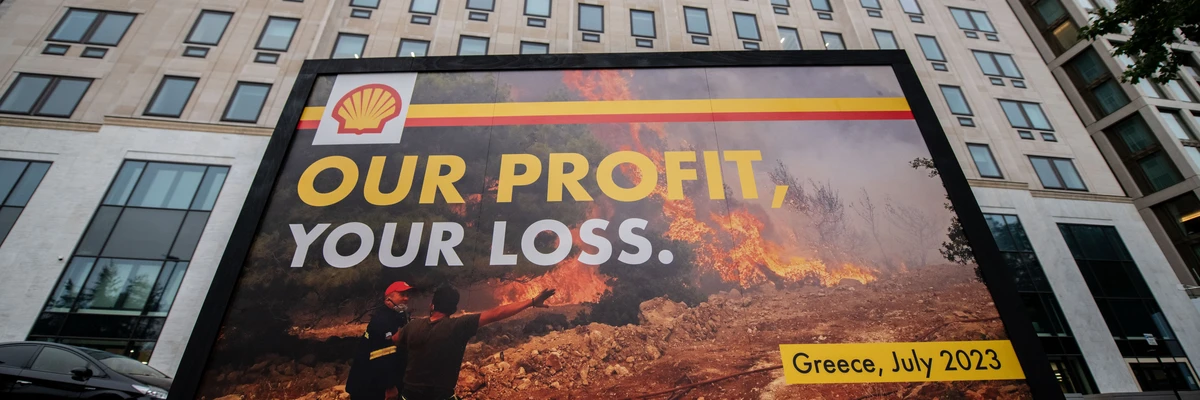
Greenpeace activists display a billboard during a protest outside Shell headquarters on July 27, 2023 in London. (Photo: Handout/Chris J. Ratcliffe for Greenpeace via Getty Images)Experienced climbers scale a rock face near the historic Dumbarton castle in Glasgow, releasing a banner that reads “Climate on a Cliff Edge.” One activist, dressed as a globe, symbolically looms near the edge, while another plays the bagpipes on the shores below. | Photo courtesy of Extinction Rebellion and Mark Richards
Human-caused greenhouse gas (GHG) emissions in 2024 continued to drive global warming to record levels.
This is the stark picture that emerges in the third edition of the “Indicators of Global Climate Change” (IGCC) report, published in Earth System Science Data.
In doing so, the IGCC fills the gap between the IPCC’s sixth assessment (AR6) in 2021 and the seventh assessment, expected in 2028.
Following IPCC methods, this year’s assessment brings together a team of over 60 international scientists, including former IPCC authors and curators of vital global datasets.
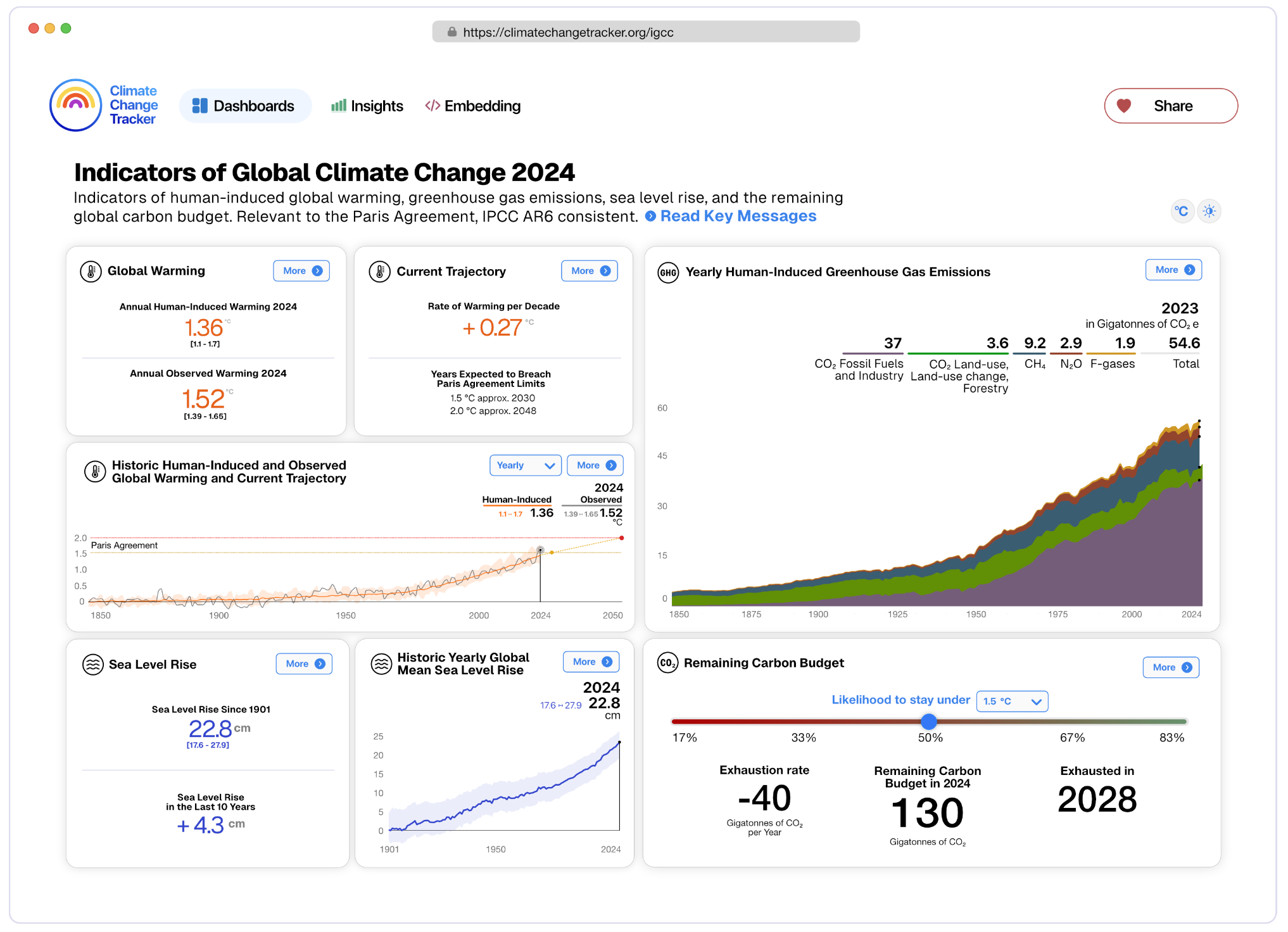
As in previous years, it is accompanied by a user-friendly data dashboard focusing on the main policy-relevant climate indicators, including GHG emissions, human-caused warming, the rate of temperature change and the remaining global carbon budget.
Below, we explain this year’s findings, highlighting the role that humans are playing in some of the fundamental changes the global climate has seen in recent years.
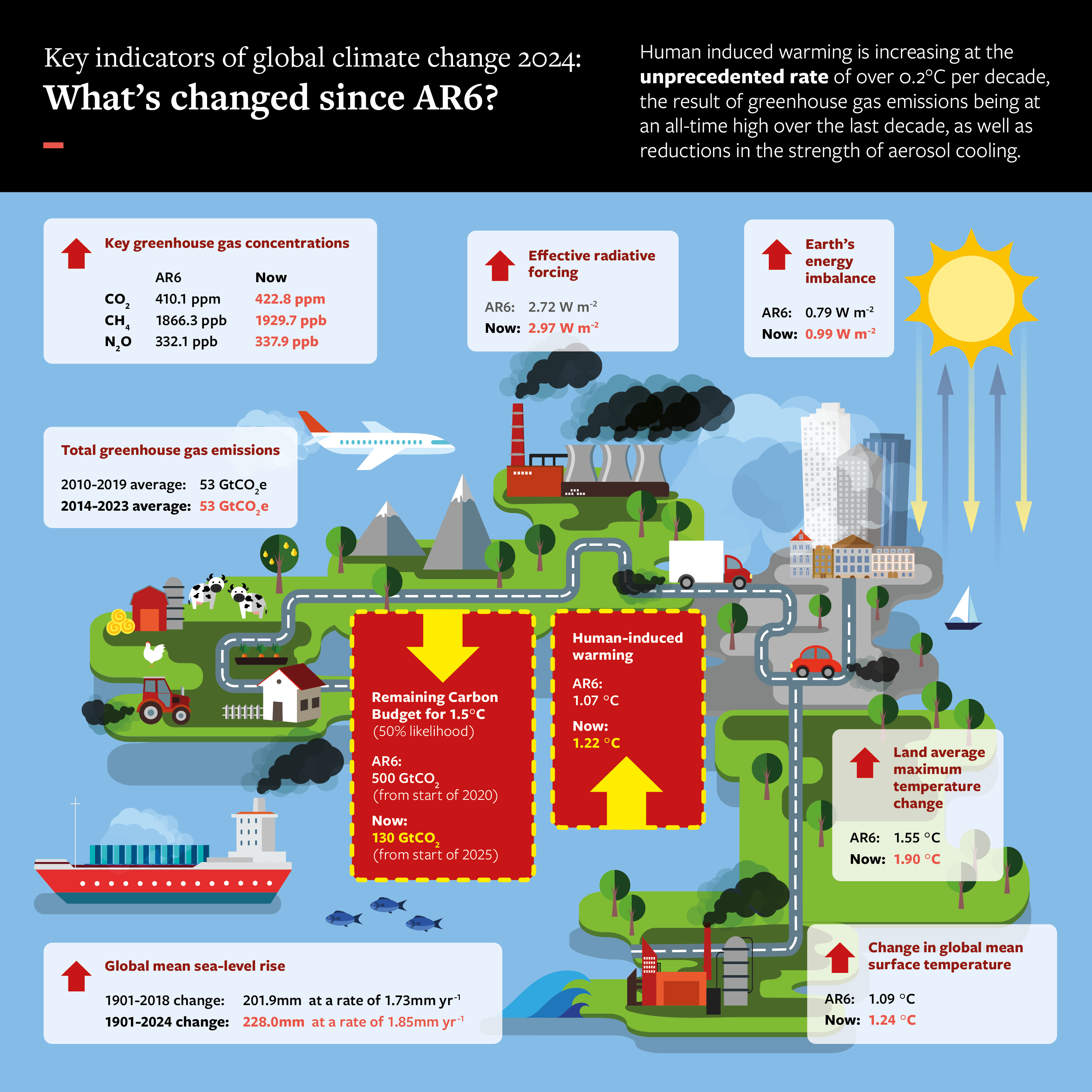
Headline results from an analysis of key climate indicators in 2024, compared to the IPCC AR6 climate science report. Source: Forster et al. (2025)
(For previous IGCC reports, see Carbon Brief’s detailed coverage in 2023 and 2024.)
Our best estimate is a rise of 1.52C (with a range of 1.39-1.65C), of which human activity contributed around 1.36C. The rest is the result of natural variability in the climate system, which also plays a role in shaping global temperatures from one year to the next.
Our estimate of 1.52C differs slightly from the 1.55C given by the World Meteorological Organisation (WMO) state of the global climate 2024 report, published earlier this year. This is because they make slightly different selections on which of the available global land and ocean temperature datasets to include. (The warming estimate has varied by similar amounts in past years and future work will aim to harmonise the approaches.)
The height of 2024’s temperatures, while unprecedented in at least the last 2,000 years, is not surprising. Given the high level of human-induced warming, we might currently expect to see annual temperatures above 1.5C on average one year in six.
However, with 2024 following an El Niño year, waters in the North Atlantic were warmer than average. These conditions raise this likelihood to an expectation that 1.5C is surpassed every other year.
From now on, we should regard 2024’s observed temperatures as unexceptional. Temperature records will continue to be broken as human-caused temperature rise also increases.
Longer-term temperature change
Despite observed global temperatures likely rising by more than 1.5C in 2024, this does not equate to a breach of the Paris Agreement’s temperature goal, which refers to long-term temperature change caused by human activity.
IGCC also looks at how temperatures are changing over the most recent decade, in line with IPCC assessments.
Over 2015-24, global average temperatures were 1.24C higher than pre-industrial levels. Of this, 1.22C was caused by human activity. So, essentially, all the global warming seen over the past decade was caused by humans.
Observed global average temperatures over 2015-24 were also 0.31C warmer than the previous decade (2005-14). This is unsurprising given the high rates of human-caused warming over the same period, reaching a best estimate of 0.27C per decade.
This rate of warming is large and unprecedented. Over land, where people live, temperatures are rising even faster than the global average, leading to record extreme temperatures.
But every fraction of a degree matters, increasing climate impacts and loss and damage that is already affecting billions of people.
Driven by emissions
Undoubtedly, these changes are being caused by GHG emissions remaining at an all-time high.
Over the last decade, human activities have released, on average, the equivalent of around 53bn tonnes of CO2 into the atmosphere each year. (The figure of 53bn tonnes expresses the total warming effect of CO2 and other greenhouse gases, such as methane and nitrous oxide, using CO2 as a reference point.)
Emissions have shown no sign of the peak by 2025 and rapid decline to net-zero required to limit global warming to 1.5C with no or limited “overshoot”.
Most of these emissions were from fossil fuels and industry. There are signs that energy use and emissions are rising due to air conditioning use during summer heatwaves. Last year also saw high levels of emissions from tropical deforestation due to forest fires, partly related to dry conditions caused by El Niño.
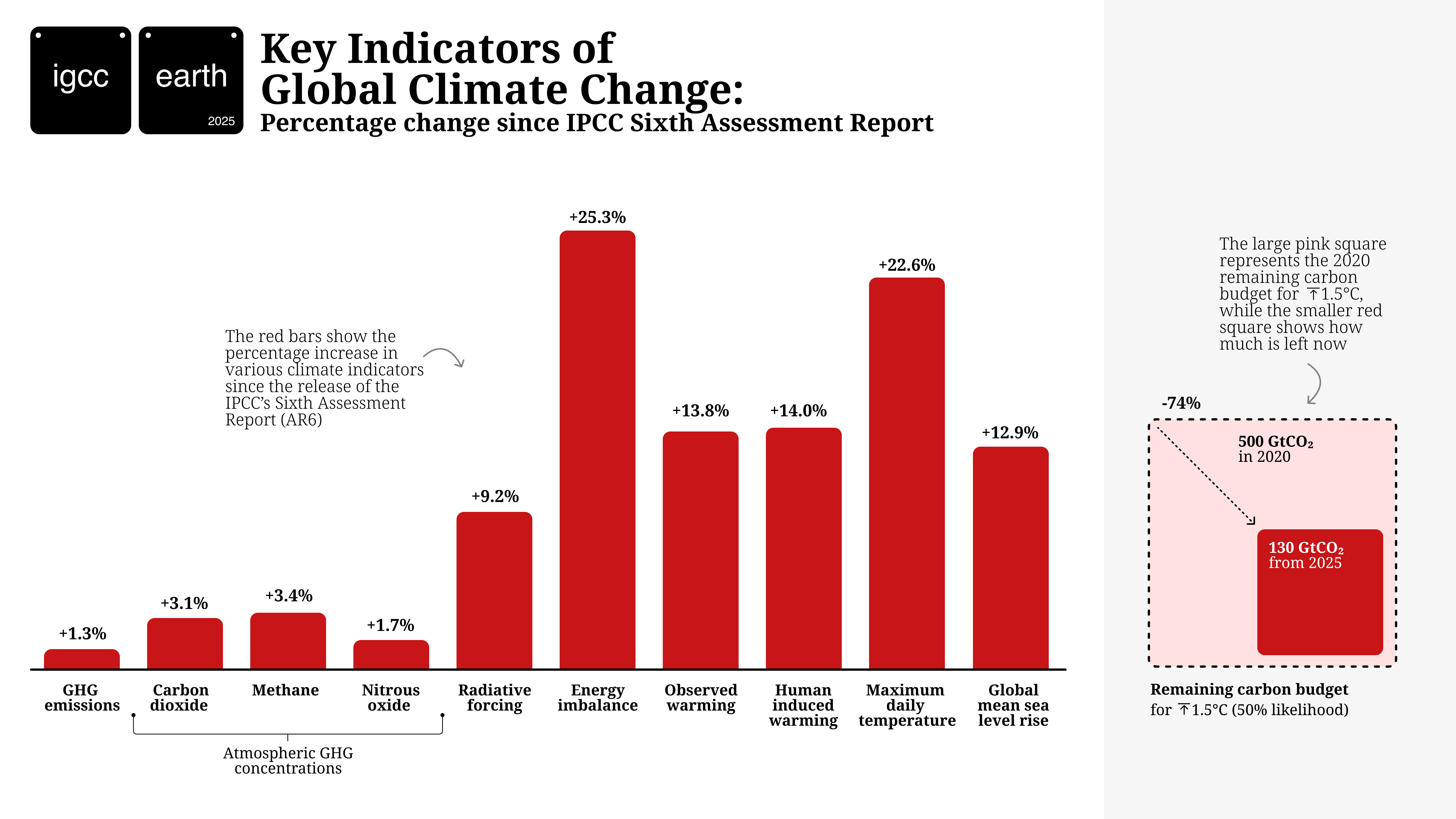
The amount of CO2 in the atmosphere, alongside the other major GHGs of methane (CH4) and nitrous oxide (N2O), is continuing to build up to record levels. Their concentrations have increased by 3.1, 3.4 and 1.7%, respectively, since the 2019 values reported in the last IPCC assessment.
At the same time, aerosol emissions, which have a cooling effect, are continuing to fall as a result of important efforts to tackle air pollution. This is currently adding to the rate of GHG warming.
Notably, cutting CH4 emissions, which are also short-lived in the atmosphere, could offset this rise. But, again, there is no real sign of a fall – despite major initiatives such as the Global Methane Pledge.
The effect of all human drivers of climate change on the Earth’s energy balance is measured as “radiative forcing”. Our estimate of this radiative forcing in 2024 is 2.97 Watts per square metre (W/m2), 9% above the value recorded in 2019 that was quoted in the last IPCC assessment.
This is shown in the figure below, which illustrates the percentage change in an array of climate indicators since the data update given in the last IPCC climate science report.
Percentage changes in key climate indicators in 2024, compared to the IPCC AR6 climate science report. The remaining carbon budget given on the right is the only indicator to show a reduction and is the change since IPCC AR6, presented as a shrinking box. Source: Forster et al. (2025)
Continued emissions and rising temperatures are meanwhile rapidly eating into the remaining carbon budget, the total amount of CO2 that can be emitted if global warming is to be kept below 1.5C.
Our central estimate of the remaining carbon budget from the start of 2025 is 130bn tonnes of CO2.
This has fallen by almost three-quarters since the start of 2020. It would be exhausted in a little more than three years of global emissions, at current levels.
However, given the uncertainties involved in calculating the remaining carbon budget, the actual value could lie between 30 and 320bn tonnes, meaning that it could also be exhausted sooner – or later than expected.
Beyond global temperatures
Our assessment also shows how surplus heat is accumulating in the Earth’s system at an accelerating rate, becoming increasingly out of balance and driving changes around the world.
The data and their changes are displayed on a dedicated Climate Change Tracker platform, shown below.
Snapshot of Climate Change Tracker
The radiative forcing of 2.97 W/m2 adds heat to the climate system. As the world warms in response, much of this excess heat radiates to space, until a new balance is restored. The residual level of heating is termed the Earth’s “energy imbalance” and is an indication of how far out of balance the climate system is and the warming still to come.
This residual rate of heat entering the Earth system has now approximately doubled from levels seen in the 1970s and 1980s, to around 1W/m2on average during the period 2012-24.
Although the ocean is storing an estimated 91% of this excess heat, mitigating some of the warming we would otherwise see at the Earth’s surface, it brings other impacts, including sea level rise and marine heatwaves.
Global average sea level rise, from both the melting of ice sheets and thermal expansion due to deep ocean warming, is included in the IGCC assessment for the first time.
We find that it has increased by around 26mm over the last six years (2019-24), more than double the long-term rate. This is the indicator that shows the clearest evidence of an acceleration.
Overall, our indicators provide multiple lines of evidence all pointing in the same direction to provide a clear and consistent – but unsurprising and worsening – picture of the climate system.
It is also now inevitable that global temperatures will reach 1.5C of long-term warming in the next few years unless society takes drastic, transformative action – both in cutting GHG emissions and stopping deforestation.
Every year of delay brings reaching 1.5C – or even higher temperatures – closer.
This year, countries are unveiling new “nationally determined contributions” (NDCs), the national climate commitments aimed at collectively reducing GHG emissions and tackling climate change in line with the Paris Agreement.
While the plans put forward so far represent a step in the right direction, they still fall far short of what is needed to significantly reduce, let alone stop, the rate of warming.
At the same time, evidence-based decision-making relies on international expertise, collaboration and global datasets.
Our annual update relies on data from NASA and the National Oceanic and Atmospheric Administration (NOAA) and input from many of their highly respected scientists. It is this type of collaboration that allows scientists to generate well-calibrated global datasets that can be used to produce trusted data on changes in the Earth system.
It would not be possible to maintain the consistent long-term datasets employed in our study if their work is interrupted.
At a time when the planet is changing at the fastest rate since records began, we are at risk of failing to track key indicators – such as greenhouse gas concentrations or deep ocean temperatures – and losing core expertise that is vital for understanding the data.
Forster, P. M. et al. (2025) Indicators of Global Climate Change 2024: Annual update of key indicators of the state of the climate system and human influence, Earth System Science Data, doi:10.5194/essd-17-2641-2025
Neo-Fascist Climate Science Denier Donald Trump says Burn, Baby, Burn.Experienced climbers scale a rock face near the historic Dumbarton castle in Glasgow, releasing a banner that reads “Climate on a Cliff Edge.” One activist, dressed as a globe, symbolically looms near the edge, while another plays the bagpipes on the shores below. | Photo courtesy of Extinction Rebellion and Mark RichardsElon Musk urges you to be a Fascist like him, says that you can ignore facts and reality then.
EU policymakers have dealt several critical blows to the European Green Deal since the end of 2023. Photograph: Jaap Arriens/NurPhoto/REX/Shutterstock
Observers shocked at scale and speed of deregulation drive they say is watering down European Green Deal and laws
The European Union’s rollback of environment policy is gaining momentum, campaigners have warned, in a deregulation drive that has shocked observers with its scale and speed.
EU policymakers have dealt several critical blows to their much-vaunted European Green Deal since the end of 2023, when opinion polls suggested a significant rightward shift before the 2024 parliamentary elections. Environment groups say the pace has picked up under the competition-focused agenda of the new European Commission.
The most striking examples are the “omnibus” packages that water down sustainable finance rules, some of which have been put on hold even before they came into force, and which member states proposed diluting further on Monday. The European Commission has promised more simplification measures to “radically lighten the regulatory load” on people and businesses.