RISHI SUNAK will come under pressure on Friday to explain why he ignored expert warnings during the pandemic, after the Covid inquiry heard politics drove government’s public messaging about the virus.
TUC assistant general secretary Kate Bell is giving evidence to the hearing this morning and has said the Prime Minister has “serious questions to answer” after the Treasury “massively undermined” Britain’s public health effort.
“It pushed up infection rates, put a huge strain on our public services and ballooned the cost of Test and Trace,” she said.
“The Prime Minister must come clean about why these decisions were taken, especially when senior government advisers were warning that people couldn’t afford to stay home when sick.
“And he must explain why he saw fit to spend more on Eat Out to Help Out than on helping people to self-isolate.
“The failure to provide proper financial support was an act of self-sabotage that left millions brutally exposed to the pandemic.”
This week the inquiry heard that Mr Sunak blocked chief medical officer Chris Whitty’s calls in May of 2020 for “an accessible offer of financial support” to help reduce the risk of “no adherence” to Covid rules.
…
The TUC will urge Mr Sunak on Friday to answer why he didn’t provide better statutory sick pay (SSP) than just £94 a week, which left the average worker facing a £418 drop in earnings if they had to self-isolate.
The government had been warned at the start of the pandemic that two million workers had no sick pay protection at all, it added, noting that 23 per cent of the country’s workforce had to rely on SSP if they needed to self-isolate during the pandemic, rising to three in 10 for the lowest paid.
Meanwhile freedom of information requests showed the then-chancellor spent more than £800 million on Eat Out to Help Out than the £385m on funding the self-isolation scheme.
One of the many occasions UK Prime Minister Rishi Sunak uses a private jet.
Political leaders owe their citizens the truth about the costs and the challenges of the energy transition on a warming planet. Last week, UK Prime Minister Rishi Sunak failed – and California Governor Gavin Newsom passed – that test.
…
If Sunak had mustered the courage to tell Brits the truth, rather than throwing up flack about excessive costs and burdens, he could have taken a cue from Newsom and said this instead: “The cost-of-living crisis is a fossil fuel crisis. Inflation persists. It’s not complicated. It’s not complicated. It’s the burning of oil. It’s the burning of gas. It’s the burning of coal – and we need to call that out.”
“The rise in energy prices started last winter, when many countries experienced low gas stocks, leading to a rise in gas prices. Russia’s invasion of Ukraine and volatile market conditions led to further price hikes,” wrote van Halm. European gas prices peaked in August 2022 at more than €300 per megawatt-hour (/MWh), she noted, when before the Covid-19 pandemic and Russia’s invasion of Ukraine, European gas prices were regularly around €10–20/MWh.
Image of InBedWithBigOil by Not Here To Be Liked + Hex Prints from Just Stop Oil’s You May Find Yourself… art auction. Featuring Rishi Sunak, Fossil Fuels and Rupert Murdoch.
The recently-approved Rosebank oil field in the North Sea has been touted as a way to boost the UK economy and its energy security. But even with its windfall tax on energy company profits, the project is a good example of how the UK could miss out on billions in taxes over the life of an oilfield.
Energy companies Equinor and Ithaca expect to invest £8.1 billion in Rosebank from development, during its operation and when they decommission the field once they’ve finished extracting its oil. Of this, 78% will be invested in UK-based businesses, and the project will support 1,600 jobs at the height of construction and around 450 UK-based jobs over its entire lifetime.
The UK charges a headline 75% rate of tax on all UK energy production and so, at first glance, a major project like Rosebank would be expected to generate billions in tax payments for the UK Treasury over the years. But, according to my research, it could instead create billions in tax savings for the companies involved.
Of the 75% tax that energy companies are currently charged, profits from oil and gas extraction in the UK are charged a corporate tax of 30%, supplemented by an extra 10% charge. The other 35% in taxes comes from the UK’s windfall tax.
Such levies are typically used to redistribute profits when a company benefits from external circumstances. For example, energy companies have recently seen profits soar as prices rose due to concerns about satisfying global oil and gas demand during Russia’s invasion of Ukraine.
The UK rolled out an additional 25% windfall tax in 2022 for oil and gas companies in response to this profit spike. On January 1 2023, the government increased it to 35% until at least the spring of 2028. The UK government raised £2.6 billion from the windfall tax alone last year.
When the windfall tax is added to the 30% rate and the 10% extra, that makes for a whopping 75% tax on energy companies. This seems like a lot, but the reliefs and other tax breaks open to companies often help a lot of these charges disappear. When a business invests its profits, it can benefit from first-year capital allowances, subtract costs related to daily operations and gain additional investment allowances that can be saved up to reduce taxes on future profits.
Crunching the numbers
If an oil company makes £10 million, for example, current tax rules would claim £7.5 million from this. But if the company reinvests the earnings in oil and gas extraction, it wouldn’t just zero out its tax, it could also set aside an extra £1.6 million against future gains – or £3.4 million if it invests in decarbonisation.
Project this on to Equinor and Ithaca’s multibillion-pound Rosebank investment and it could generate up to £8.4 billion in tax savings for the companies involved, based on my analysis of levies on energy producers,
A spokesperson for Equinor told The Conversation: “These are numbers we don’t recognise.” Adding that estimates by energy consultancy Wood Mackenzie found Rosebank would bring £26.8 billion to the UK through tax payments and investments, he continued: “Over the years, oil and gas taxation in the UK has changed many times. It is impossible to estimate with any certainty exactly how large tax revenue and value creation this project will generate for the UK.” Ithaca did not respond to a request for comment.
Many players in the UK’s oil and gas sector can take advantage of a range of capital and investment allowances, deductions and taxation reliefs. In fact, before the windfall tax, companies often got back more from the UK government than they paid in taxes.
The windfall tax will expire in 2028 or if energy prices fall below a certain level for six months. And so while it has forced some companies pay tax on some recent bumper profits, it won’t always be around to make even that happen.
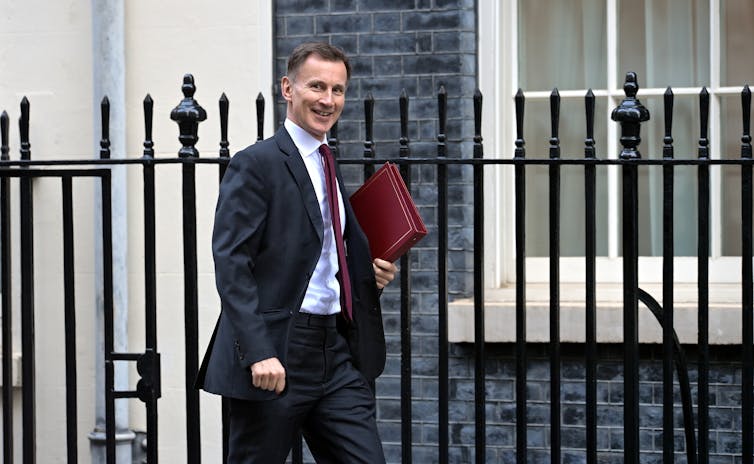
UK chancellor Jeremy Hunt increased and extended a UK windfall tax on oil and gas companies last year. Sean Aidan Calderbank/Shutterstock
Shortsighted or strategy?
Compared to nations like Norway that offer more long-standing corporate tax regimes, the UK’s history is riddled with policies that have been swayed by short-term political urgencies. This sidelines long-term vision and provides a very weak signal to companies considering investment in the UK.
A revolving door of UK prime ministers in recent times hasn’t helped and has also seen investors lose some confidence in the country’s economy. A slew of lucrative tax reliefs might seem like the perfect way to counterbalance recent policy oscillations.
Central to the UK’s energy strategy is an intent to ramp up extraction, ostensibly to enhance national energy security. But will this happen with Rosebank?
When asked about this, the Equinor spokesperson said: “Rosebank will strengthen our contributions to UK energy security. The field is estimated to start producing in 2026/2027 and produce for more than 20 years. The gas will go into the UK pipeline system. The oil will be offloaded offshore. It is a light, sweet crude oil that can be used in refineries in the UK. If the UK needs the oil, when the field starts producing, the UK will get it.”
The UK continues to feed the oil and gas industry with reliefs, while renewable energy projects (but not gas-generation) face the electricity generator levy – a 45% charge on power generated above a £75 per megawatt hour (MWh) threshold. As much of the rest of the world moves towards more sustainable energy solutions, the UK should realign its tax priorities with the broader, greener global vision.
Energy Monitor talks to leading climate change economist Dimitri Zenghelis about an open letter from 100 economists lamenting UK Prime Minister Rishi Sunak’s recent net-zero U-turns.
One of the many occasions UK Prime Minister Rishi Sunak uses a private jet.
…
So, what’s behind Sunak’s net-zero moves then?
It’s got nothing to do with cost; it’s pure politics. It’s dog-whistle stuff. He thinks he can turn this issue into an identity politics story. Hence, the “seven bins”. He’s talking about these cosmopolitan elite liberals with their fetishistic recycling (hence the seven bins) and how they’re wanting to take away our cars – from hard-working people who don’t have access to transport. It’s another “us against them” story.
It is true that if you live next to public transport in central London, you can afford to legislate against dirty vehicles, but if you live in a suburb with a terrible bus line, and you can’t afford the latest electric vehicle, yes, it is potentially quite punitive. So, this has to be done in a very careful and fair way. But just removing legislation that doesn’t impose costs sends a signal to the electorate that you’re taking a position, but to businesses that you absolutely haven’t a clue what you’re doing. Because on the one hand, you’re saying you’re committed to net zero by 2050; and on the other hand, you’re providing absolutely zero policy certainty because even when you do apply policies, you then rescind them. It’s economic short-termism.
Sunak’s playing politics with people’s livelihoods, and he’s selling it as if he’s actually trying to help people’s livelihoods instead of actually grappling with the issues of net-zero disruption and figure how we make it easier for people to adjust, how we support people in making their house as energy efficient as possible and transition to heat pumps, how we support people with bad public transport who at the moment can’t afford electric vehicles. But he’s thinking of what happened with ULEZ [Ultra Low Emission Zone] in the Uxbridge vote and what those culture wars can do to turn around his chances in the upcoming election. And if the economy suffers, well that won’t be his problem, because he probably won’t be in government by then. It’s just so cynical.
It’s hard for him to argue this is what economists are saying when both the OBR [Office for Budget Responsibility] and the Treasury have provided numbers that show the cost of delaying this transition is more expensive than the cost of pursuing it, as has the independent Climate Change Committee (CCC).
Liberty is taking the home secretary to court for ‘unlawfully’ passing legislation Parliament had already rejected
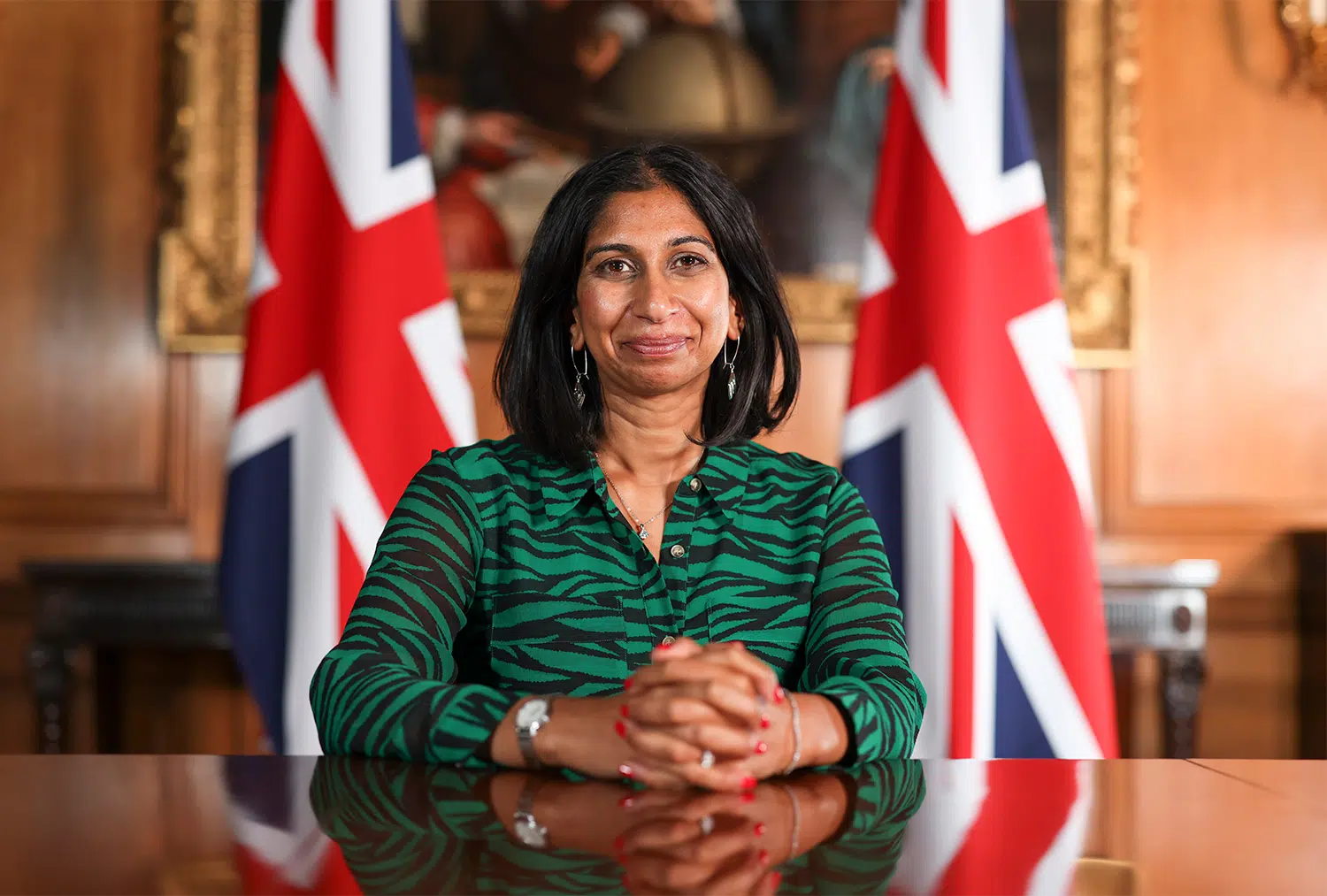
Image of Home Secretary Suella ‘Sue-Ellen’ Braverman
A human rights campaign group is taking Suella Braverman to court for “unlawfully” forcing draconian anti-protest legislation through Parliament, openDemocracy can reveal.
In June, Braverman used secondary legislation – which is subject to less parliamentary scrutiny – to allow police to restrict or shut down any protest that they believe could cause “more than minor disruption to the life of the community”.
A cross-party parliamentary committee said this is the first time secondary legislation has been used to make changes to the law that have already been rejected by Parliament. Akiko Hart, interim director of Liberty, which launched initial legal action in June, described the move as “the latest power grab from this government”.
The government previously tried to insert the new powers into the Public Order Act 2023 in January, but was blocked by the Lords. Liberty’s lawyer, Katy Watts, accused Braverman of “sneak[ing] in new legislation via the back door, despite not having the power to do so”.
Hart said: “We all want to live in a society where our government respects the rules – but the home secretary has deliberately done the opposite. The home secretary’s actions have enabled the government to circumvent the will of Parliament.”
She continued: “This is just the latest power grab from this government, which has shown it is determined to erode the ways people can hold it to account, whether that’s in Parliament or on the streets. The home secretary’s actions give the police almost unlimited powers to stop any protest the government doesn’t agree with – and the way she has done it is unlawful.”
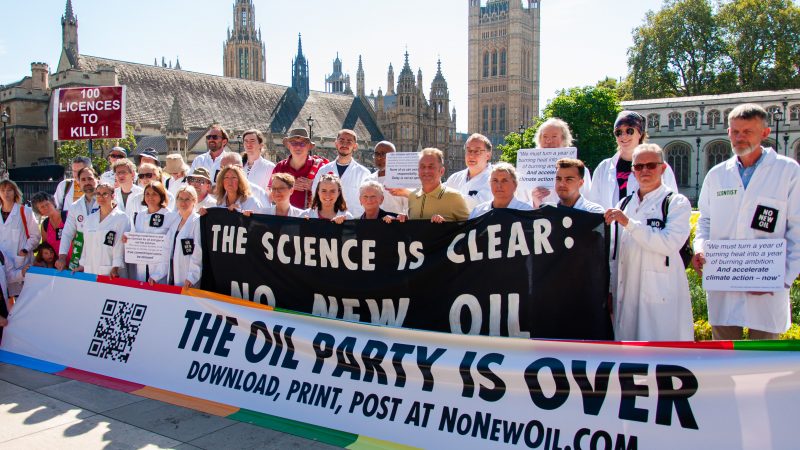
The home secretary has long called for more police powers to tackle peaceful methods of protests by climate activists, such as road blocking, ‘locking on’, and slow marching, which she said “bring misery and chaos to the law-abiding majority”.
One supporter of Insulate Britain previously told openDemocracy that protest is “our only legitimate means to achieve the changes needed within the time frame we have”.
Another of the group’s supporters said that the criminalisation of protest – in particular, of environmental protest – “is an example of attempting to shoot the messenger” and that elected politicians “obviously don’t really care about protecting people’s democratic rights”.
Watts, Liberty’s lawyer leading the case, said Braverman’s circumventing of the Lords’ rejection is “a flagrant breach of the separation of powers that exist in our constitution”.
She added: “The wording of the government’s new law is so vague that anything deemed by police to cause ‘more than a minor’ disturbance could have restrictions imposed upon it. This same rule was democratically rejected earlier this year, yet the home secretary has gone ahead and introduced it through other means regardless.
“It’s really important the government respects the law and that the home secretary’s decision is reversed immediately.”
Liberty has also claimed the new legislation was not consulted on fairly. It has accused the government of only consulting parties it knew would support the amendments, such as the police.